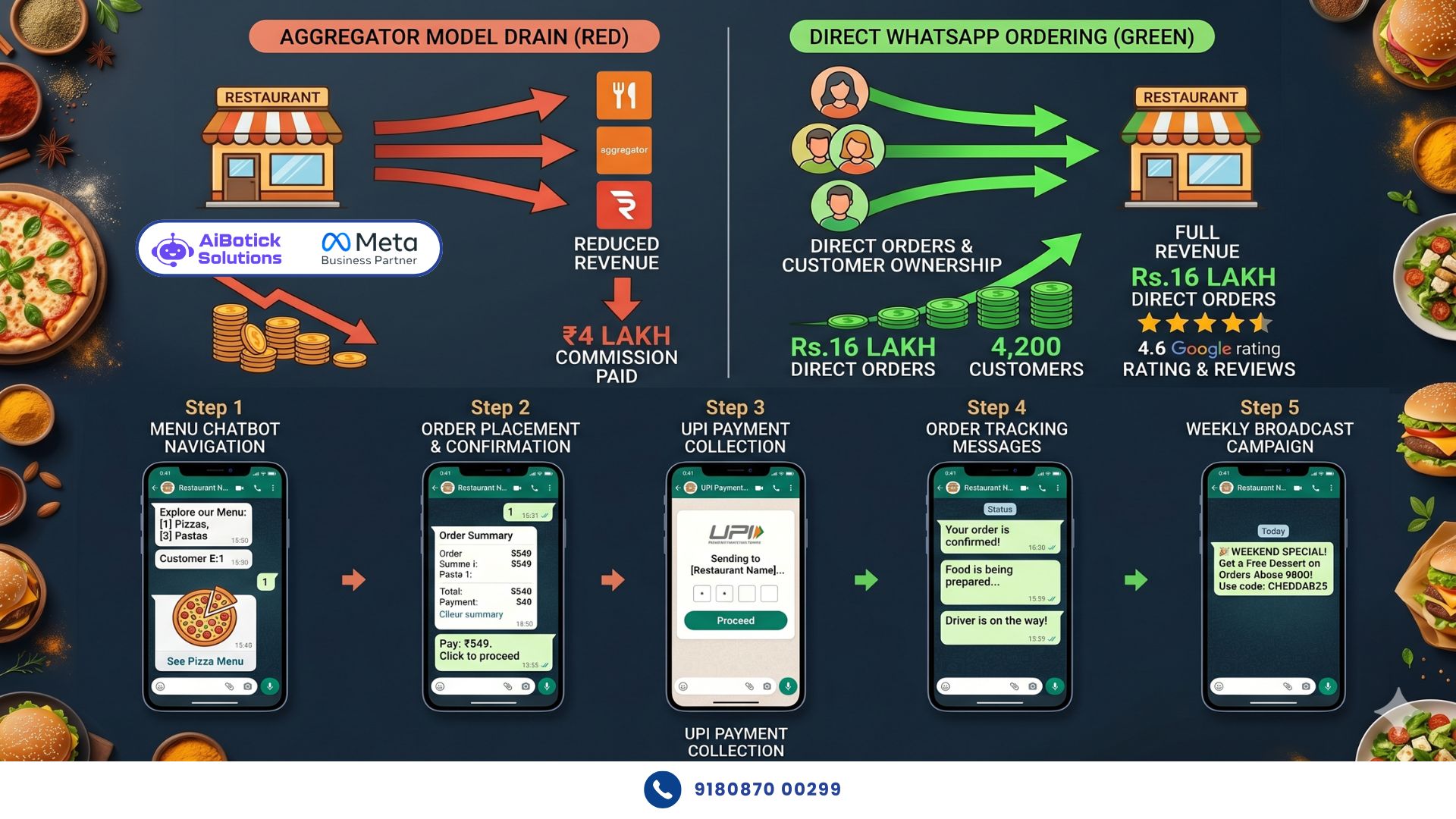
A restaurant in Bandra lost Rs.4.2L in a single weekend. Not because the food was bad. Not because they were understaffed. Because their online ordering system crashed on Friday evening and customers couldn’t reach them fast enough to place orders directly.
The ones who could reach them? They WhatsApped. 67 orders came through WhatsApp that weekend. The restaurant fulfilled every single one.
That’s when the owner realised — WhatsApp for restaurants wasn’t a backup plan. It was the actual plan. Here’s what 18 months of implementing this across Indian F&B businesses taught me.
Why Indian Restaurants Are Losing Money on Every Channel Except WhatsApp
Dekho, let me lay out the brutal math of food delivery for Indian restaurant owners right now.
Zomato and Swiggy take 18-30% commission. On a Rs.500 order, you’re paying Rs.90-150 to a platform. For a restaurant doing Rs.15L monthly delivery revenue, that’s Rs.2.7-4.5L going to aggregators. Every. Single. Month.
And here’s what’s worse — you don’t own the customer relationship. The platform does. Customer reorders on Zomato. You get the order but not the customer’s number. You can’t retarget. You can’t build loyalty. You’re just a commodity on their platform.
WhatsApp for restaurants changes this equation completely. Direct orders. Zero commission. Full customer ownership.
I’ve seen this shift happen with a biryani chain in Hyderabad. They were doing Rs.22L monthly revenue — Rs.14L through aggregators (paying Rs.3.8L in commission), Rs.8L through their own channels. After 6 months of WhatsApp for restaurants implementation, their direct orders hit Rs.16L and aggregator dependency dropped to Rs.6L. Monthly commission savings: Rs.2.9L. That’s Rs.34.8L annually they stopped giving to Zomato and Swiggy.
Why Traditional Restaurant Marketing Doesn’t Work Anymore
Most restaurant owners think marketing means running Instagram ads and maintaining a Google listing.
Both are important. Neither builds repeat customers at scale.
Here’s the hard truth: a customer who orders from you on Zomato and had a great experience has an 8% chance of ordering from you again directly within 30 days. Why? Because next time they open Zomato, they see 40 other restaurants. You’re one of 40. You have no way to reach them.
A customer who orders from you on WhatsApp and had a great experience? You have their number. You can send them your weekend special on Friday at 7 PM. You can send them a birthday discount. You can tell them about your new menu item. That customer has a 34% chance of ordering again within 30 days.
That’s a 4x difference in repeat order probability. From one channel shift.
What People Get Wrong About WhatsApp for Restaurants
Most restaurant owners think WhatsApp for restaurants means sharing their personal number on Instagram and telling people “order on WhatsApp.”
That’s not a system. That’s chaos.
Nope, that’s not it. Here’s what actually happens when you share a personal WhatsApp number:
- You get 50 messages simultaneously during dinner rush
- Half are asking the menu
- 20% are asking price
- Someone’s complaining about yesterday’s order
- You can’t process orders fast enough
- You miss orders
- Customers get frustrated
- You give up
The reason WhatsApp for restaurants fails for most people who try it is because they don’t build a system. They just open a channel.
Here’s what a proper WhatsApp for restaurants system looks like:
Customer messages your WhatsApp business number.
Automated response within 5 seconds: “Welcome to [Restaurant Name]! 🍽️ Choose an option: 1️⃣ View Menu 2️⃣ Place an Order 3️⃣ Track My Order 4️⃣ Speak to Someone Reply with 1, 2, 3, or 4.”
Customer replies “2.” They get the menu with categories. They pick. They confirm. Order goes directly to your kitchen display or POS system. Payment collected via UPI link in chat. Order confirmed automatically.
No human needed until the food is being packed. That’s the system.
Real Case Study: Hyderabad Biryani Chain — Rs.8L to Rs.16L Direct Orders in 6 Months
The Situation:
- Cloud kitchen chain in Hyderabad, 3 outlets
- Monthly revenue: Rs.22L (Rs.14L aggregator, Rs.8L direct)
- Monthly commission to Zomato/Swiggy: Rs.3.8L
- WhatsApp ordering: zero system, occasional personal number usage
- Customer repeat rate: 18% (aggregator customers), 31% (direct customers)
- Database of customer numbers: 0 (didn’t own customer data)
The Problem: Complete dependency on aggregators. No direct relationship with customers. No ability to retarget or build loyalty. Margin destruction from 25%+ commission. Couldn’t even contact their own best customers.
What They Implemented:
- WhatsApp ordering chatbot — full menu, category navigation, customisation options, order confirmation
- UPI payment collection in chat — no payment gateway friction
- Order tracking updates — automated WhatsApp: order received → being prepared → out for delivery → delivered
- Customer database building — every WhatsApp order builds their owned database
- Weekly broadcast campaigns — weekend specials, new items, offers sent to existing customers
- Loyalty program on WhatsApp — every 5th order gets 20% discount, tracked automatically
- Feedback collection — automated WhatsApp message 30 minutes after delivery asking for rating
- Re-engagement campaigns — customers who haven’t ordered in 21 days get a “We miss you” offer
The Results (6 months):
| Metric | Before | After | Change |
|---|---|---|---|
| Direct order revenue/month | Rs.8L | Rs.16L | +100% |
| Aggregator commission paid | Rs.3.8L | Rs.1.4L | -63% |
| Customer repeat rate (direct) | 31% | 58% | +87% |
| Customer database owned | 0 | 4,200 | — |
| Average order value | Rs.340 | Rs.420 | +24% |
| Monthly WhatsApp broadcast revenue | Rs.0 | Rs.2.8L | — |
| Net monthly profit improvement | Rs.0 | Rs.5.2L | — |
| Google rating | 3.8 | 4.6 | +21% |
That broadcast revenue number. Rs.2.8L per month from simply messaging their existing customer base about weekend specials and new items. Zero ad spend. Zero commission. Pure direct revenue from a database they now own.
How WhatsApp for Restaurants Works Across Different F&B Formats
Cloud Kitchens
No dine-in. No walk-in. 100% dependent on delivery. Aggregator commission is an existential threat to margins.
WhatsApp for restaurants is especially critical for cloud kitchens. Build your own ordering channel. Every order through WhatsApp saves 25% commission. At Rs.10L monthly WhatsApp orders, that’s Rs.2.5L in monthly savings — Rs.30L annually. That’s your kitchen upgrade fund, right there.
Actually wait — better example: a cloud kitchen in Pune doing multi-cuisine (not a single brand, 4 virtual brands on one kitchen) implemented WhatsApp for restaurants with a brand selector at the start:
“Which kitchen would you like to order from? 🥗 GreenLeaf (Healthy) 🍕 PizzaBox (Italian) 🍛 DumKitchen (Indian) 🌮 TacoTown (Mexican) Reply with your choice.”
Four brands. One WhatsApp number. One system. 60% of orders moved to direct within 4 months.
QSR and Fast Food Chains
Speed is everything. Customer wants to order, pay, and pick up without waiting.
WhatsApp for restaurants pre-ordering for QSR: customer WhatsApps order 15 minutes before arrival. Order is ready when they walk in. No queue. Better experience. Higher repeat rate.
One QSR chain in Chennai implemented WhatsApp pre-ordering across 6 outlets. Average wait time dropped from 12 minutes to 3 minutes for WhatsApp orders. Repeat order rate from WhatsApp customers: 67%. From walk-in customers: 22%.
Fine Dining and Specialty Restaurants
Table reservations. Special occasion bookings. Wine pairing requests. Chef’s table. These are high-touch interactions that email handles badly and phone calls handle inconsistently.
WhatsApp for restaurants in fine dining: reservation request comes on WhatsApp — table preference, occasion, dietary restrictions, special arrangements. Confirmation sent on WhatsApp. Day-before reminder sent automatically. Special instructions shared with kitchen via internal WhatsApp. Post-dinner feedback request sent 2 hours after bill payment.
One fine dining restaurant in Mumbai went from 34% table utilisation to 67% after implementing WhatsApp reservation management. Cancellations dropped 58% because WhatsApp reminders actually get read — unlike email reminders.
Tiffin and Subscription Meal Services
This is where WhatsApp for restaurants shines brightest. Recurring customers. Daily orders. Subscription management.
Managing 200 tiffin subscriptions on personal WhatsApp is a nightmare. Managing it on WhatsApp Business API is smooth:
- Monthly subscription confirmation sent automatically on 1st of month
- Daily menu message sent at 8 AM (what’s for lunch today)
- Customer can reply “skip today” — system marks it, no delivery, no charge
- Monthly invoice sent automatically with UPI link
- Pause and resume subscription handled by chatbot
One tiffin service in Ahmedabad managing 340 subscriptions reduced their admin time from 4 hours daily to 20 minutes daily using this system. They added 80 new subscribers in 2 months because the service became so smooth that existing customers started referring friends.
Step-by-Step: Setting Up WhatsApp for Restaurants
Step 1: Get WhatsApp Business API (Not Just WhatsApp Business App)
The free WhatsApp Business App has limitations — no automation, no broadcasts to large lists, no chatbot flows. You need the API for everything described in this article.
Don’t use personal WhatsApp for ordering. Ever.
Step 2: Build Your Menu as a WhatsApp Flow
Structure your menu logically:
- Category selection (starters, mains, desserts, drinks)
- Item selection with description and price
- Customisation (spice level, add-ons, special instructions)
- Quantity confirmation
- Order summary with total
- Payment via UPI link or WhatsApp Pay
- Order confirmation with estimated time
Test this flow yourself 10 times before going live. Find every friction point. Fix it.
Step 3: Set Up Order Tracking Messages
Every order triggers 4 automated messages:
- Order received: “Your order #[X] is confirmed! Preparation starts now. Est. time: 25 mins.”
- Being prepared: “Your [item] is being freshly prepared 👨🍳. Almost ready!”
- Out for delivery: “Your order is on the way! 🛵 Delivery partner: [name], [number]. Est. arrival: 15 mins.”
- Delivered: “Enjoy your meal! 😄 How was your experience? Reply 1-5.”
These 4 messages eliminate 90% of “where’s my order?” calls. And if you want to see how order tracking communication on WhatsApp reduces customer service load in detail, our WhatsApp order tracking guide shows the exact setup that drops WISMO queries by 78% — directly applicable to restaurant delivery operations.
Step 4: Build Your Customer Database
Every WhatsApp order = one contact added to your database. Automatically.
Within 6 months of consistent WhatsApp for restaurants operation, you’ll have 2,000-5,000 opted-in customers depending on your volume. This database is your most valuable marketing asset.
Never bought from a paid list. Never scraped numbers. Only customers who chose to interact with you. Highest quality database you’ll ever build.
Step 5: Create Your Broadcast Calendar
Plan 4 broadcasts per month:
- Week 1: New item launch or weekend special
- Week 2: Mid-week offer (“Order Tuesday-Thursday, get 15% off”)
- Week 3: Customer loyalty reward (“You’ve ordered 5 times — here’s your free dessert”)
- Week 4: Monthly bestseller announcement or seasonal special
Each broadcast to your full database. At Rs.0.8631 per marketing conversation (Meta rate), sending to 3,000 customers costs Rs.2,589. If even 8% convert at Rs.400 average order value — that’s Rs.9,600 in revenue from Rs.2,589 spend. 3.7x ROAS. Every single broadcast.
Step 6: Set Up Re-engagement Flows
Customer hasn’t ordered in 21 days? Automated WhatsApp:
“Hi [Name], it’s been a while! 😅 We’ve been cooking up something special. This week’s bestseller: [Item] — Rs.[Price] Here’s a 20% discount just for you: WELCOME20 Order here 👇 [ordering link or reply to order]”
Win-back rate on these re-engagement messages: 18-24%. Compare that to email win-back rates of 2-3%.
Step 7: Automate Feedback and Reviews
30 minutes after delivery confirmation, send:
“How was your [item] from [Restaurant]? Rate us: ⭐ 1 – Very bad ⭐⭐ 2 – Bad ⭐⭐⭐ 3 – Okay ⭐⭐⭐⭐ 4 – Good ⭐⭐⭐⭐⭐ 5 – Amazing! Reply with your number.”
Rating 4-5: automatically ask them to share on Google/Zomato with a link. Rating 1-3: alert the manager immediately for personal outreach and resolution.
The Hyderabad biryani chain went from 3.8 to 4.6 Google rating in 6 months using this exact flow. And if you want to see how this review collection strategy applies more broadly across customer feedback automation, our WhatsApp customer feedback guide — originally written for healthcare but with mechanics that translate directly to restaurant review management — shows the full system in detail.
The Anti-Aggregator Strategy: Building Direct Revenue
Honestly? I think restaurant owners who are 80%+ dependent on Zomato and Swiggy are running the riskiest business model in Indian F&B right now.
Platform commission rates have gone from 15% to 25-30% in the last 5 years. They’ll go higher. Platform algorithms decide your visibility. Platform promotions cost you additional margin. One policy change and your revenue drops overnight.
WhatsApp for restaurants is your independence strategy. Not “get off aggregators tomorrow” — that’s not realistic. But every percentage point of revenue you shift to direct WhatsApp channels is a percentage point of margin you keep. And a percentage point of customer relationship you own.
Target: 50% direct orders within 12 months of serious WhatsApp for restaurants implementation. That’s achievable. The Hyderabad chain hit it. The Pune cloud kitchen hit it. I’ve seen it happen consistently.
What This Saves a Restaurant (Real Numbers)
For a restaurant doing Rs.20L monthly delivery revenue, 70% through aggregators:
Current state:
- Aggregator revenue: Rs.14L
- Commission paid (25%): Rs.3.5L
- Direct revenue: Rs.6L
- Monthly profit available from delivery: [reduced by Rs.3.5L]
After 6 months of WhatsApp for restaurants:
- Aggregator revenue: Rs.8L (reduced dependency)
- Commission paid: Rs.2L
- Direct WhatsApp revenue: Rs.12L
- Broadcast campaign revenue: Rs.1.5L additional
- Monthly commission savings: Rs.1.5L
- Additional broadcast revenue: Rs.1.5L
Monthly improvement: Rs.3L Annual improvement: Rs.36L
For an investment of Rs.15,000-25,000 per month on WhatsApp Business API platform. That’s 12-20x ROI on the platform cost alone.
Common Mistakes Restaurants Make With WhatsApp
Mistake 1: Using personal WhatsApp for orders
Unmanageable at scale. No automation. No tracking. No broadcast capability. Switch to Business API immediately.
Mistake 2: No ordering system — just sharing menu PDFs
Sending a PDF menu and saying “tell me what you want” creates manual work for both sides. Build a proper ordering flow.
Mistake 3: No payment collection in chat
If customer has to order on WhatsApp but pay somewhere else, you’ve created friction. Integrate UPI payment directly in the WhatsApp conversation. One-tap payment = more completions.
Mistake 4: Not building the database
Every WhatsApp order customer should be tagged, categorised, and added to broadcast lists. If you’re not doing this, you’re building a tap that runs water but doesn’t fill a tank.
Mistake 5: Irregular broadcasts
One broadcast, no response, owner concludes “WhatsApp marketing doesn’t work.” The first broadcast always underperforms because the database is new and the audience isn’t conditioned. Consistency over 90 days is where the results come.
Mistake 6: No feedback automation
Manual feedback collection catches maybe 5% of customers. Automated WhatsApp feedback catches 35-45%. And catching negative feedback early — before it becomes a 1-star Zomato review — is worth thousands of rupees in reputation value.
Why 2026 Is the Year to Go Direct on WhatsApp
Real talk — the aggregator model isn’t going to get cheaper. Meta’s WhatsApp isn’t going to get more expensive than Zomato’s commission. The math only moves in one direction.
WhatsApp for restaurants gives you what aggregators will never give: your customer’s direct contact, their order history, their preferences, and the ability to reach them whenever you want without paying a third party.
The restaurants that build direct WhatsApp ordering systems in 2026 will be the ones with the highest margins, the most loyal customers, and the most resilient businesses when aggregator conditions change.
Jo seedha baaat hai yaar — aggregator pe rehna zaroori hai, par unpe depend rehna nahi. WhatsApp for restaurants is your escape route. Use it. 💯
Want to set up WhatsApp ordering and marketing for your restaurant?
— Mohit Shah | 15+ years in IT industry | 4+ years in WhatsApp automation | Worked with various MNC brands | Now helping businesses figure out what actually works
Q1: Can WhatsApp for restaurants completely replace Zomato and Swiggy for food delivery?
A1: Not immediately — and that’s not the goal. Aggregators provide discovery for new customers. WhatsApp for restaurants converts those discovered customers into direct repeat buyers. The strategy is: use aggregators for acquisition, use WhatsApp for retention and repeat orders. A 50% direct / 50% aggregator split within 12 months is realistic and dramatically improves margins. Every Rs.1 shifted from aggregator to direct saves you 25 paise in commission — permanently.
Q2: How do restaurants handle peak hour order volume on WhatsApp without getting overwhelmed?
A2: This is exactly why WhatsApp Business API (not personal WhatsApp) is essential. The API handles unlimited simultaneous conversations with automated responses. During peak hours, the ordering chatbot processes 50 orders simultaneously without any human involvement — order collection, confirmation, and payment are all automated. Human staff only get involved for special requests or complaints. The Hyderabad chain handled 67 simultaneous WhatsApp orders during their aggregator outage weekend with zero staff managing WhatsApp directly.
Q3: How long does it take to build a meaningful WhatsApp customer database for a restaurant?
A3: A restaurant doing 200 orders per month will build a database of 1,500-2,000 unique WhatsApp customers within 6 months (accounting for repeat orders from the same customers). At 500 monthly orders, you’re at 3,500-4,500 customers in the same period. The speed depends on how aggressively you promote WhatsApp ordering over aggregator ordering — discounts for direct orders, “WhatsApp-only” specials, and QR codes on packaging all accelerate database building significantly.