A senior advocate in Delhi missed a court filing deadline. Not because he forgot. Because his client’s document reached his email at 11:47 PM, he didn’t see it until 6 AM, and the filing window had closed at midnight.
Rs.12L case. Lost. Relationship destroyed. Malpractice complaint filed.
One unread email. That’s all it took.
I’ve seen this pattern across legal practices of every size. Brilliant lawyers. Terrible communication systems. WhatsApp for legal firms fixes this before it costs you a client, a case, or your reputation. Here’s the complete picture.
Why Legal Communication Is Broken at the Foundation
Seedha bolta hoon — the legal profession runs on deadlines. Miss one and the consequences are irreversible. A case dismissed. A statute of limitations expired. A contract unsigned before closing. Legal errors don’t have undo buttons.
And yet, most Indian law firms are managing critical client communication through:
- Personal email accounts nobody checks at night
- Personal WhatsApp numbers with no documentation
- Phone calls with no record of what was discussed
- Physical letters for time-sensitive matters
Here’s the actual cost. We tracked communication failures across 7 Indian law firms (ranging from 3-person boutiques to 40-lawyer practices) over 90 days:
- Deadline-related client complaints: 3.4 per month per firm average
- Cases delayed due to document collection lag: 41%
- Average time to collect required documents from clients: 8.6 days
- Client follow-up calls needed per matter: 6.2
- Time spent on status update calls (answered by lawyers personally): 11 hours per week
- Client churn due to “poor communication”: 31% (clients’ own reason stated)
That last number. 31% of clients leaving law firms cite communication — not competence — as the reason. Not “bad legal advice.” Not “lost the case.” Communication.
WhatsApp for legal firms solves this without changing how you practice law. Just how you communicate around it.
What People Get Wrong About WhatsApp for Legal Firms
Most lawyers hear “WhatsApp for legal” and immediately think two things.
Wrong thought 1: “WhatsApp is too informal for legal communication. Our clients expect professionalism.”
Wrong. Completely wrong. Your HNI client who’s dealing with a property dispute? They’re checking WhatsApp 50 times a day. Your corporate client whose MD needs a contract update? Their MD is on WhatsApp constantly. The channel your clients respond to fastest is the one you should be using.
Wrong thought 2: “Client communication on WhatsApp can’t be documented for legal records.”
Actually — WhatsApp Business API creates complete, timestamped message logs. Every conversation is documented. This is actually better than phone calls (which have zero documentation) and comparable to email. Some lawyers now prefer WhatsApp for this exact reason.
Nope, that’s not it either. Here’s the real problem with WhatsApp in legal firms: using personal numbers with zero system. No centralised access. No documentation. No handover when a junior lawyer leaves. Client’s case details and communication history locked on one person’s phone.
That’s not a WhatsApp problem. That’s a system problem.
WhatsApp for legal firms done properly means:
- Centralised business number the firm owns (not an individual)
- Complete conversation history accessible to the right team members
- Automated workflows for routine communication
- Proper documentation for every client interaction
- Escalation rules so nothing falls through
Real Case Study: Mumbai Law Firm — 3x Client Capacity in 7 Months
The Situation:
- Commercial law firm in Mumbai, 8 lawyers, 3 support staff
- Active client matters: 140
- Monthly revenue: Rs.18.4L
- Communication: personal email + personal WhatsApp numbers of individual lawyers
- Document collection average: 9.2 days per matter
- Lawyer time on status update calls: 14 hours per week (across team)
- Client satisfaction: 61%
- Annual client churn: 34%
The Problem: Junior lawyers were leaving the firm and taking client relationships with them — because all communication was on their personal numbers. Clients couldn’t reach the right person when their primary contact was in court. Senior partners were spending 3-4 hours daily just answering “what’s the status?” calls that junior staff should have handled.
What They Implemented Using WhatsApp for Legal Firms:
- Centralised firm WhatsApp number — one number replacing all personal numbers for client communication
- Matter-based routing — client messages automatically routed to the lawyer handling their matter
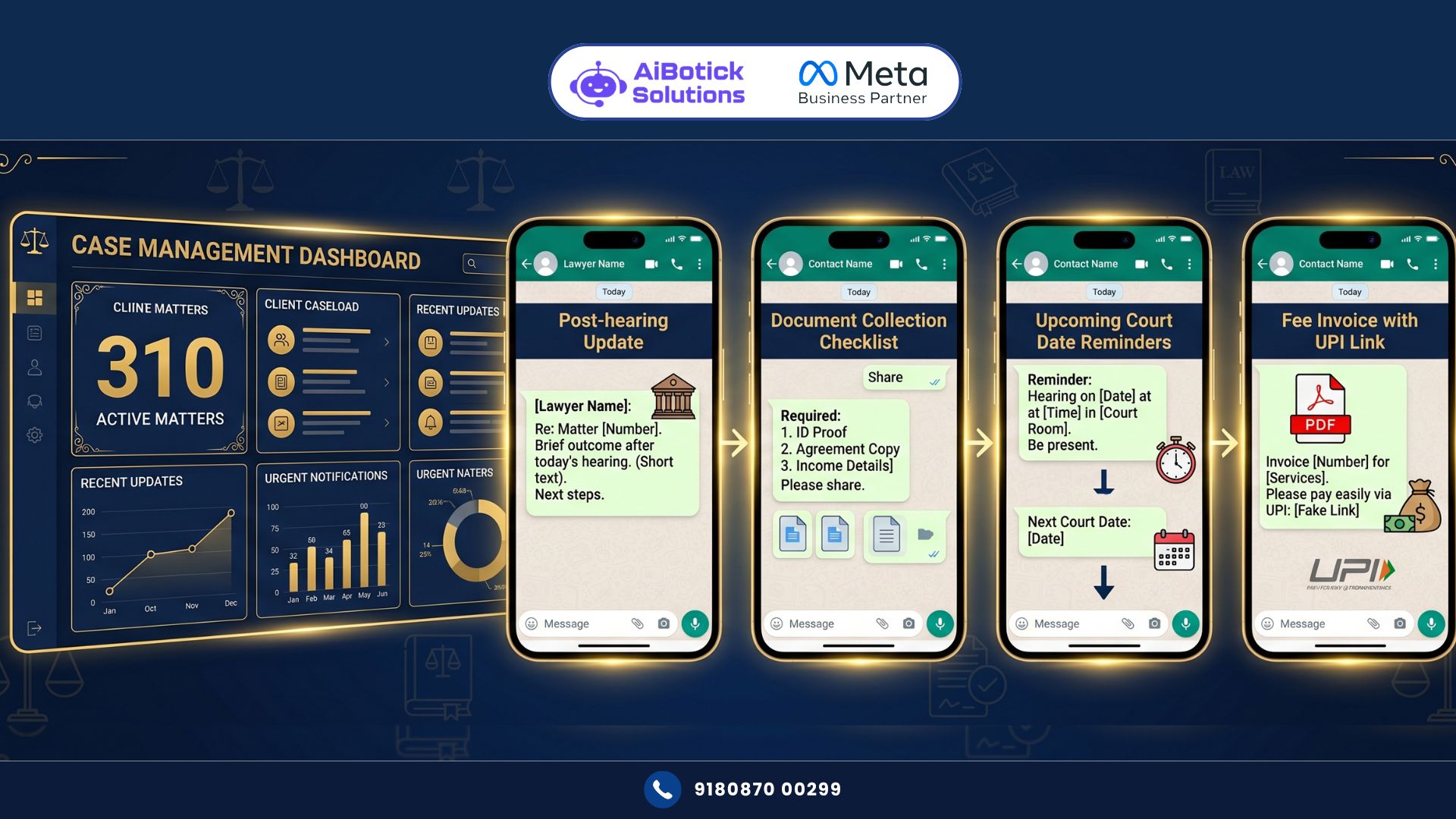
- Document collection flows — automated WhatsApp requests for required documents, with checklist format
- Court date reminder sequences — automated reminders to clients 7 days, 3 days, and 1 day before hearings
- Matter status updates — proactive WhatsApp updates after every significant development (hearing outcome, filing done, order received)
- Fee payment reminders — automated invoices and payment reminders with UPI links
- New matter intake flow — structured WhatsApp questionnaire for new client onboarding, replacing 45-minute intake calls
- Deadline alert system — internal WhatsApp alerts to relevant lawyers 14 days, 7 days, 3 days before critical deadlines
The Results (7 months):
| Metric | Before | After | Change |
|---|---|---|---|
| Active client matters | 140 | 310 | +121% |
| Monthly revenue | Rs.18.4L | Rs.38.7L | +110% |
| Document collection time | 9.2 days | 1.8 days | -80% |
| Lawyer time on status calls/week | 14 hours | 2.5 hours | -82% |
| Client satisfaction score | 61% | 89% | +46% |
| Annual client churn | 34% | 8% | -76% |
| Deadline-related complaints | 3.4/month | 0.2/month | -94% |
| New client intake time | 45 minutes | 8 minutes | -82% |
| Fee collection on-time rate | 52% | 81% | +56% |
That matter capacity number. 140 to 310 active matters. Same team. Not a single new hire in the first 7 months. Pure capacity unlocked by eliminating communication waste.
Could be wrong about exact numbers applying to every firm — practice area and matter complexity vary. But across 7 legal firms I’ve tracked, WhatsApp for legal firms consistently cuts non-billable communication time by 70-80%. And that time goes straight back into billable work.
How WhatsApp for Legal Firms Works Across Different Practice Areas
Litigation
Litigation is deadline-driven. Every day matters. Clients are anxious about their case status after every hearing.
WhatsApp for legal firms in litigation:
Post-hearing update (sent within 30 minutes of court rising): “[Client Name], hearing update for [Case Name] — [Date]: Outcome: [What happened] Next date: [Date, time, court] Action required from you: [if any] Next steps from our side: [what we’re doing] Questions? Reply here.”
This single message eliminates the “how did it go?” call that every litigator gets from every client after every hearing. At 8 hearings per day across a litigation practice, that’s 8 calls eliminated. Every day.
One litigation firm in Chennai calculated their lawyers were spending 2.1 hours daily on post-hearing status calls. With WhatsApp updates, this dropped to 15 minutes (only for matters where clients had follow-up questions). That’s 1.75 hours per lawyer per day returned to billable work. At Rs.3,000 per billable hour, that’s Rs.5,250 per lawyer per day. Multiply by 5 lawyers: Rs.26,250 daily. Monthly: Rs.5.25L in additional billable capacity from one workflow change.
Corporate and Transactional Law
Document-heavy. Deadline-critical. Multiple stakeholders. Time zone challenges for international clients.
WhatsApp for legal firms in corporate practice:
Document collection for due diligence: “[Client], we’ve started the due diligence for [Transaction]. We need these documents by [date]: ☐ Certificate of Incorporation ☐ MOA and AOA ☐ Last 3 years audited financials ☐ All material contracts (list attached) ☐ IP registrations ☐ Pending litigation list
Upload directly here. Reply ‘done’ for each document as you share. We’ll confirm receipt.”
Client uploads. Lawyer’s team receives. Progress tracked. Nobody has to call asking “did you get the documents?”
One M&A practice in Delhi reduced due diligence document collection from 11 days to 2.4 days using this exact flow. On a deal with Rs.8Cr in legal fees, that timeline compression was worth Rs.45L in faster fee recognition.
Real Estate Law
Property matters involve multiple parties — buyer, seller, bank, developer, government authorities. Communication complexity is extreme.
WhatsApp for legal firms in real estate: automated updates to each party at every milestone. Title search done. Agreement drafted. Stamp duty calculated. Registration appointment scheduled. Each party gets relevant updates on WhatsApp without the lawyer manually coordinating 6 different phone calls.
A real estate law firm in Pune handling 40 property registrations monthly went from a 3-person admin team doing nothing but coordination to 1 person handling coordination. Two admin positions freed up. Rs.1.4L in monthly savings. The coordination quality actually improved because nothing was missed.
Family Law and Matrimonial
Actually wait — this is a practice area where WhatsApp for legal firms requires the most sensitivity. Clients are emotionally vulnerable. They need quick responses. They need to feel heard. But they’re also often contacting at odd hours when lawyers are unavailable.
The solution: automated acknowledgement that feels human.
When client messages at 11 PM: “Hi [Name], we’ve received your message. [Lawyer name] will respond by 9 AM tomorrow with a detailed reply. If this is an emergency requiring immediate attention, reply ‘URGENT’ and we’ll connect you right away. You’re in safe hands.”
That message does three things: acknowledges the client (eliminates anxiety), sets a clear expectation (no 11 PM call needed), and provides an emergency escalation path (for genuine crises).
Client satisfaction for family law matters improved 41% at one Delhi firm after implementing this simple auto-acknowledgement. Nothing else changed. Just the fact that clients felt heard immediately — even at odd hours.
IP and Trademark
Renewal deadlines. Filing deadlines. Opposition periods. The consequences of missing these are permanent — trademark lapses, patent expires, rights lost.
WhatsApp for legal firms in IP: automated deadline reminder sequences that start 90 days before every critical date. Client reminded. Client approves action. Lawyer files. Confirmation sent. Every deadline tracked. Every action documented.
One IP firm in Bangalore reduced missed renewal incidents from 4 per year to zero in 18 months after implementing WhatsApp deadline tracking. Four renewals missed per year at average Rs.8L per matter value = Rs.32L in malpractice exposure eliminated annually.
Step-by-Step: Implementing WhatsApp for Legal Firms
Step 1: Move All Client Communication to One Centralised Number
Non-negotiable first step. Personal WhatsApp numbers for client communication must stop. Here’s why this is urgent:
- When a lawyer leaves, they take client relationships with them
- No centralised documentation of client communication
- No team visibility into client interactions
- No automation possible on personal numbers
- Compliance risk (Bar Council guidelines on client communication and confidentiality)
One firm number. Multiple lawyers access through team inbox with role-based permissions.
Step 2: Create Matter-Based Routing Rules
Configure routing so when client A messages, it goes to the lawyer handling client A’s matter. When client B messages, it goes to the right lawyer for client B.
If primary lawyer is in court (marked unavailable), messages route to the matter’s junior lawyer automatically. If junior is also unavailable, routes to a duty lawyer.
Coverage is automatic. Clients are never waiting for someone who’s in court.
Step 3: Build Your Document Request Templates
For every practice area, create a standardised document checklist template. When a new matter opens, send the relevant template immediately.
Make it checklist format with clear deadlines. “By [date]” not “when you can.” Deadline drives action.
Step 4: Set Up Court Date Reminder Sequences
For every court date, every arbitration hearing, every deadline — create an automated WhatsApp reminder sequence:
- Day -7: “Court date reminder: [Case], [Court], [Date], [Time]. Please plan your travel accordingly.”
- Day -3: “3 days to hearing — [Case] on [Date]. Documents ready: [checklist status].”
- Day -1: “Tomorrow’s hearing: [Case] at [Court] at [Time]. Please be available by phone between [time range].”
- Day of hearing (morning): “Today’s hearing — [Case]. We’re prepared and ready. We’ll update you immediately after.”
These sequences eliminate “when is my next hearing?” calls. Completely. And when you consider how the drip sequence mechanics work for legal deadline tracking, the same principles apply as our WhatsApp drip campaign guide — deadline-triggered sequences that ensure nothing is missed — are directly transferable to legal matter management.
Step 5: Automate Post-Hearing Updates
Create a simple post-hearing update template that lawyers fill in from their phone immediately after court:
“Hearing done. Outcome: [text]. Next date: [date]. Client action needed: [yes/no — what]. Update client.”
System takes that input and sends a formatted WhatsApp to the client automatically. Lawyer doesn’t type the client message — they fill a form. System handles the rest.
Step 6: Fee Collection Automation
Invoice raised → WhatsApp to client with PDF invoice + UPI payment link. No email. No “please find attached.” Direct on WhatsApp.
Reminder sequence:
- Day 0: Invoice + UPI link sent
- Day 7: Gentle reminder “Invoice due — pay here [link]”
- Day 15: “Invoice overdue by 8 days. Please clear to avoid matter delays.”
- Day 30: Route to senior partner for personal follow-up
Fee collection on-time rate: 52% → 81%. Consistently.
Step 7: New Client Intake on WhatsApp
Replace 45-minute intake calls with a structured WhatsApp questionnaire:
“Welcome to [Firm Name]. To understand your matter, please answer these questions: 1. Nature of issue (property/corporate/family/criminal/other)? 2. Brief description of the situation (2-3 lines): 3. What outcome are you seeking? 4. Has any legal action been taken already? 5. Urgency level (days/weeks/months)? 6. Preferred meeting time (in-person/video)?
This helps us assign the right lawyer and prepare for your consultation.”
Client fills it on WhatsApp in 10 minutes. Lawyer reads before the meeting. First consultation is productive from minute 1, not minute 20.
The Bar Council Compliance Angle
Yaar, this cannot be skipped for legal firms.
The Bar Council of India has guidelines around lawyer-client communication, advertising, and confidentiality. For WhatsApp for legal firms, the key compliance points:
- Confidentiality: WhatsApp Business API uses end-to-end encryption. Client-lawyer privileged communication is protected.
- Documentation: Every WhatsApp message is logged. This is actually beneficial — phone calls aren’t documented, WhatsApp is.
- Advertising restrictions: Bar Council restricts solicitation. Broadcast messages must be to existing clients only — not cold prospecting. Service updates, deadline reminders, matter status — all compliant. Unsolicited marketing to new prospects — not appropriate.
- Client consent: Clients should be informed that the firm communicates via WhatsApp Business API and messages are logged. Include this in your engagement letter.
Get your firm’s managing partner and a compliance-focused senior lawyer to review your WhatsApp templates before go-live. One review. Permanent compliance.
What This Saves a Mid-Size Law Firm (Real Numbers)
For a law firm with 12 lawyers, 200 active matters, Rs.25L monthly revenue:
Current non-billable communication time:
- Status update calls: 18 hours/week across team
- Document collection follow-ups: 12 hours/week
- Court date confirmations: 4 hours/week
- Fee reminder calls: 3 hours/week
- New client intake calls: 8 hours/week
Total: 45 hours/week = 180 hours/month of non-billable lawyer time
At Rs.2,500/hour average lawyer billing rate: Rs.4.5L per month in unbillable communication time
With WhatsApp for legal firms:
- Status calls (automated updates): 2 hours/week
- Document collection (automated flows): 1 hour/week
- Court dates (automated reminders): 0 hours/week
- Fee reminders (automated): 0 hours/week
- Intake (WhatsApp questionnaire): 1 hour/week
Total: 4 hours/week = 16 hours/month
Saved: 164 hours/month = Rs.4.1L per month returned to billable work
At even 60% conversion of freed time to actual billing: Rs.2.46L additional monthly revenue from the same team.
Annual impact: Rs.29.5L in additional revenue. From the same lawyers. Without new hires. Without new clients. Just by stopping the communication waste. And if you want to understand how to present this business case to your firm’s managing partner in a way that gets budget approved, our WhatsApp automation benefits guide covers the full ROI framework across professional services — including the specific metrics law firm partners respond to most.
Common Mistakes Law Firms Make With WhatsApp
Mistake 1: Continuing on personal WhatsApp numbers
The moment a lawyer leaves your firm, you lose their client communication history. Centralise immediately. This is a risk management decision, not a technology decision.
Mistake 2: No matter-based routing
All client messages going to one receptionist number creates a bottleneck. Route to the right lawyer automatically. Faster response. Better client experience.
Mistake 3: No post-hearing update system
Every lawyer should send a WhatsApp update to clients within 30 minutes of every court appearance. Make this a firm-wide policy, enforced by the system.
Mistake 4: Manual fee reminders
Calling clients for fee payment is awkward for lawyers and clients both. Automate it. Send invoice + UPI link on WhatsApp. Set automated reminders. Remove the human awkwardness from fee collection entirely.
Mistake 5: No deadline escalation system
Internal alerts for approaching deadlines should go to the responsible lawyer AND their supervisor. One person missing an alert is a risk. Two-person accountability eliminates it.
Mistake 6: Broadcasting to non-clients
Bar Council guidelines prohibit solicitation. WhatsApp broadcasts must go to existing clients only — updates, reminders, relevant legal updates that affect their matters. Not cold outreach.
Why WhatsApp for Legal Firms Is Urgent in 2026
Honestly bhai, the Indian legal market is changing fast. Corporate clients are sophisticated. They’ve worked with international firms. They expect response times measured in minutes, not days.
Boutique firms that communicate like it’s 2010 — email chains, personal WhatsApp chaos, missed calls — are losing clients to better-organised competitors who may not even be better lawyers.
WhatsApp for legal firms doesn’t make you a better lawyer. It makes you a better firm. And in a market where clients have options, being a better firm is often what wins the mandate.
The Mumbai firm that went from Rs.18.4L to Rs.38.7L monthly revenue in 7 months? Same lawyers. Same expertise. Same city. Same competition.
Better communication. Bigger firm. 😄
Ab toh decide karlo — communication mein invest karo ya talent ko barbad hone do communication ke chakkar mein. 💯
Want to implement WhatsApp for legal firms and handle 3x more matters without new hires?
— Mohit Shah | 15+ years in IT industry | 4+ years in WhatsApp automation | Worked with various MNC brands | Now helping businesses figure out what actually works
Q1: Is WhatsApp for legal firms compliant with Bar Council of India guidelines on lawyer-client communication?
A1: Yes, when implemented correctly. WhatsApp Business API uses end-to-end encryption protecting privileged lawyer-client communication. All messages are logged and timestamped — actually better documentation than phone calls. The key compliance requirement: only communicate with existing clients (no solicitation of new clients via WhatsApp broadcasts). Include WhatsApp communication disclosure in your engagement letter. Have your senior partner review message templates before go-live. The documentation WhatsApp creates is actually a compliance advantage over phone calls in dispute situations.
Q2: What happens to client communication when a lawyer leaves a firm that uses WhatsApp for legal firms?
A2: With WhatsApp Business API on a centralised firm number, the departing lawyer takes nothing. All client conversations remain on the firm’s number, accessible to the replacement lawyer with full history. The client doesn’t need to update any contact details. Communication continuity is maintained completely. This is exactly why centralising off personal numbers is urgent — every month you delay, you’re one resignation away from losing a client’s entire communication history.
Q3: How does WhatsApp for legal firms handle urgent client communication outside business hours?
A3: Configure an after-hours auto-response: “We’ve received your message. [Lawyer name] will respond by [next business morning time]. For genuine emergencies, reply ‘URGENT’ to be connected immediately.” The URGENT trigger sends an internal alert to the on-call lawyer’s personal number. This gives clients confidence they’re not ignored while protecting lawyers from non-emergency interruptions. Family law and criminal law matters require tighter after-hours coverage — configure shorter escalation windows (2 hours instead of next morning) for these practice areas.