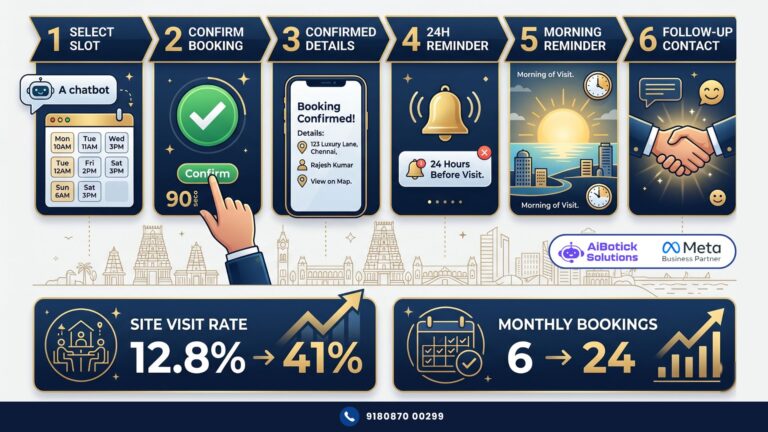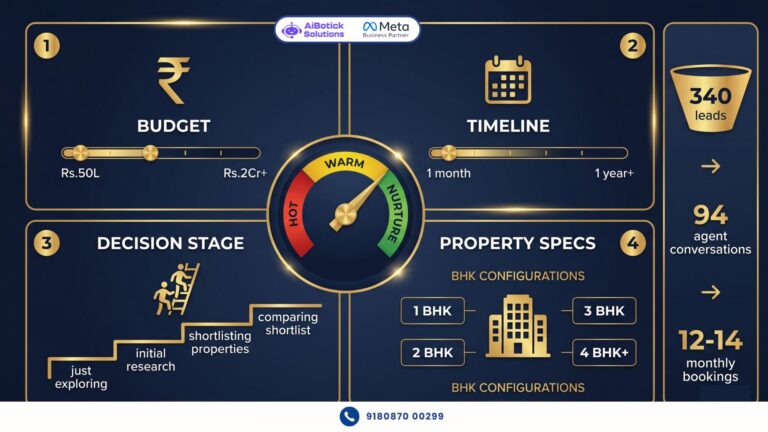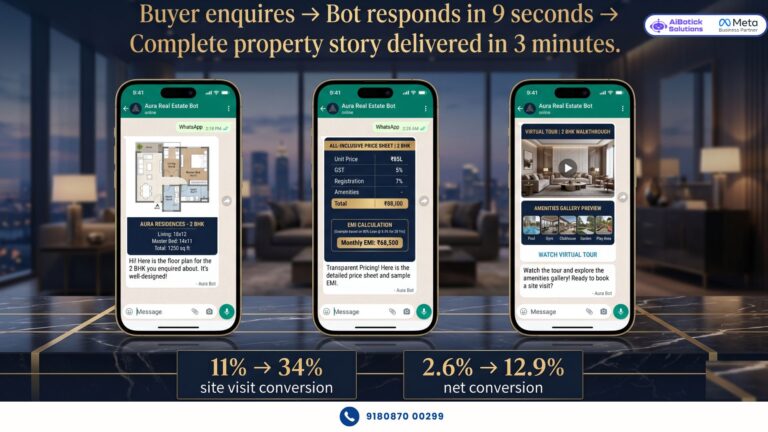
Here’s the uncomfortable truth about real estate sales in India.
Most developers have a lead graveyard bigger than their active pipeline.
Thousands of enquiries collected over 2-3 years. Hundreds of lakhs spent on ads to generate them. Sitting in Excel sheets and CRMs, gathering dust, marked “not responding” or “cold” after 2 follow-up attempts.
And every single month — fresh budget spent acquiring new leads. While the old ones rot.
I’ve seen this pattern at every real estate client I’ve worked with. Without exception. The sales team is so focused on this month’s hot leads that last quarter’s warm leads become invisible. And last year’s leads? Non-existent.
Here’s what nobody tells you: A lead that said “6 months se soch raha hoon” 3 months ago — is now potentially 3 months away from buying. That lead hasn’t gone cold. Their timeline has just progressed. And if you’re not in their inbox when they’re finally ready — someone else is.
WhatsApp drip campaigns for real estate are how you stay in that inbox. Intelligently. Automatically. For 6 months or longer. Without your agent lifting a finger.
Why Real Estate Needs Drip Campaigns More Than Any Other Industry
Real estate purchase decisions in India have the longest consideration cycle of any consumer category.
Typical timeframe from first enquiry to booking — 2 months to 2 years. Depending on financial readiness, family alignment, life events, and market perception.
No other consumer category has this kind of timeline variance. EdTech — 1-3 months. Ecommerce — hours to days. Even education coaching — 2-6 weeks.
Real estate — you genuinely don’t know if the buyer you’re talking to today will be ready in 30 days or 18 months.
Which creates a specific problem. Manual follow-up for a 12-18 month buyer journey is humanly impossible at scale. Your agent can’t call someone meaningfully every 2-3 weeks for a year. They’ll run out of things to say. The buyer will find it annoying. The relationship will deteriorate rather than strengthen.
WhatsApp drip campaigns for real estate solve this precisely. Pre-built sequences deliver valuable, relevant content automatically over 6-12 months. Each message keeps you top of mind without requiring agent involvement. And when the buyer’s timeline shifts — they think of you first.
Because you’ve been showing up every 2-3 weeks with something useful for the past 6 months.
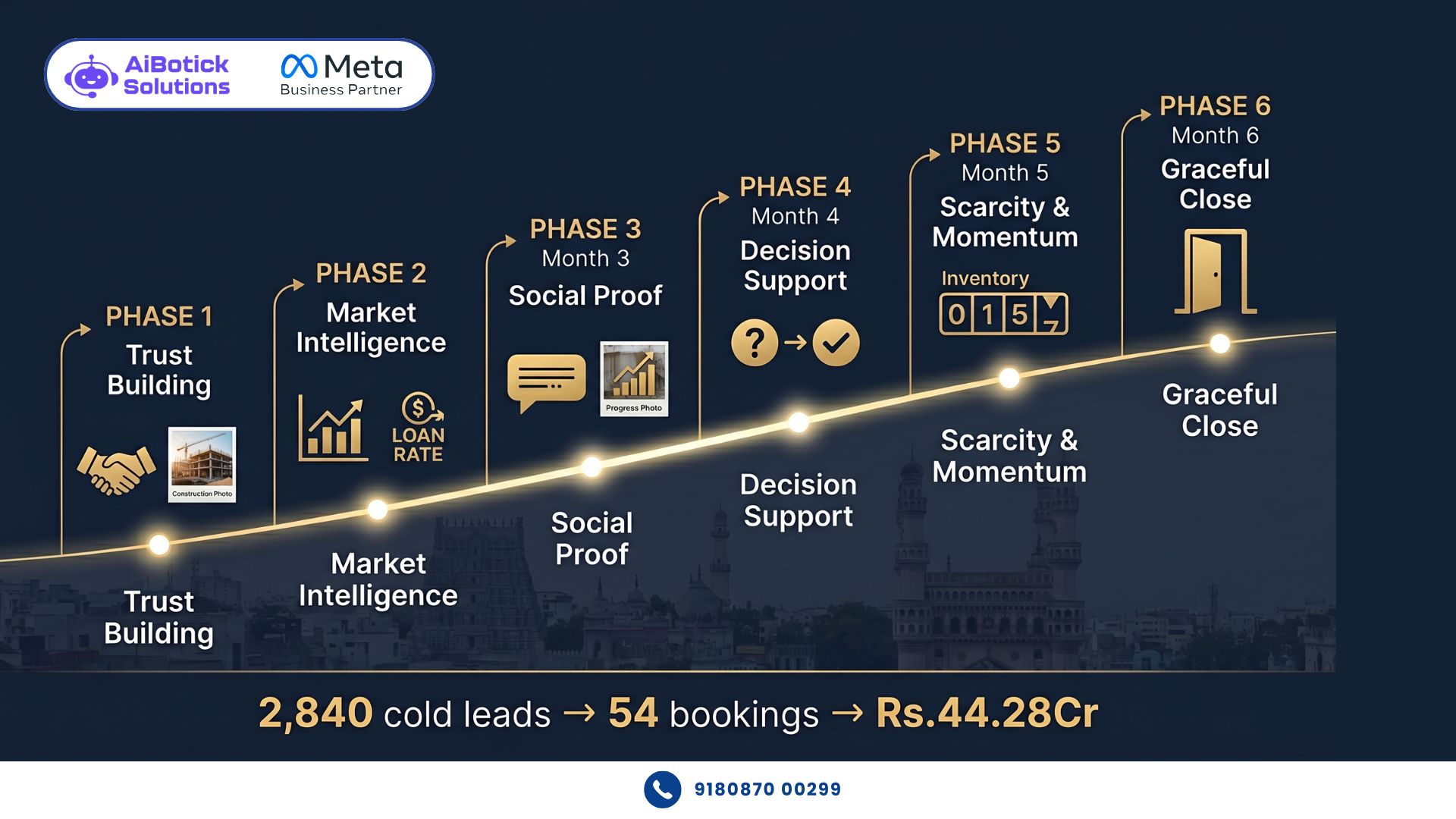
The Complete 6-Month WhatsApp Drip Campaign for Real Estate — Every Message
This is not a template. This is a strategic communication architecture — designed to move a buyer through the consideration journey without ever feeling like you’re pushing them.
Month 1: Trust Building Phase
Week 1 (Day 3 after initial enquiry — for non-hot leads):
“Hi [Name]! 🙏 Thank you again for your interest in [Project Name].
While you’re taking your time with the decision — I wanted to share something useful. Most buyers in [Micro-market] ask us the same question: ‘Is this the right time to buy, or should we wait?’
Honest answer — it depends on your specific situation. Here’s a quick framework we share with all our buyers to think through this: [Link to a simple guide or PDF — ‘How to decide if now is the right time to buy in [Micro-market]’]
No sales pitch. Just useful context. — [Agent Name], [Agency Name]”
This message establishes something crucial: you’re an advisor, not just a salesperson. You’re providing value before asking for anything.
Week 2:
“[Name], quick update from the [Project Name] site 👷
Construction this week: [Specific milestone — e.g., ‘Tower B has reached Floor 14 structure. Target floor completion: August 2026.’]
Current progress photo: [Image or link]
We send these updates monthly — so you can see exactly how the project is progressing in real time. Transparency matters to us. — [Agency Name]”
Construction updates build two things simultaneously: excitement (the project is progressing) and trust (we’re transparent about timelines). Buyers who see regular progress updates have dramatically lower anxiety about under-construction purchases.
Week 3:
“[Name], a buyer who was in your exact situation 8 months ago just got possession of their 3 BHK in [Project Name] last week.
What they said: ‘[Specific, authentic quote from actual buyer — if available. Or anonymised: “A family from [City] who also took 6 months to decide told us — ‘Every rupee was worth it. The quality exceeded our expectations.'”]’
Their specific concern was [the same concern your lead expressed if captured]. Here’s how that played out: [brief resolution].
No pressure to decide. Just wanted you to hear from someone who was where you are. — [Agent Name]”
Peer validation at this stage — enormously powerful. Not celebrity endorsement. Not developer marketing copy. A real family who had the same doubts and made the decision.
Month 2: Market Intelligence Phase
Week 5:
“[Name], something worth knowing about [Micro-market] right now.
Property prices in [Area] have moved [X]% in the last 6 months [or: are showing signs of Y trend]. Here’s what’s driving it — [2-3 bullet points: infrastructure project, IT park expansion, metro line completion].
What this means for buyers currently in the research phase: [specific, honest implication — could be positive or cautionary, depending on real market conditions].
Full market note: [Link or PDF]
— [Agent Name], [Agency Name]”
Market intelligence positions you as a knowledgeable partner. Builders who share genuine market data — even when it’s not entirely bullish — build more trust than those who only share positive news.
Week 7:
“[Name], home loan update — relevant if you’re planning to take a loan for the purchase.
Current SBI home loan rates: [Rate]% HDFC / ICICI: [Rate]% For a Rs.50L loan over 20 years at [rate]%, EMI works out to: Rs.[Amount]
Quick fact: [Project Name] is pre-approved by [Bank names]. This simplifies documentation significantly when you’re ready.
Questions about loan eligibility or the pre-approval process? Just reply. — [Agent Name]”
Finance information — practical, useful, specific. Every buyer thinking about a property purchase is thinking about the loan simultaneously. Being their source of this information keeps you relevant and helpful.
Month 3: Social Proof and Progress Phase
Week 9:
“[Name], [Project Name] milestone update! 🎉
[Tower/Phase name] just crossed [milestone — e.g., ‘structural completion, now 73% sold overall, 12 units remaining in your preferred configuration’].
Photo from today: [Image]
For buyers still deciding — this progress has a practical implication. Earlier-stage pricing is no longer available for [configuration]. Current pricing: Rs.[Amount]. For reference, launch pricing was Rs.[Amount].
— [Agency Name]”
This is where genuine urgency enters — based on real data. Not “hurry, limited time offer.” But “here’s the actual current status — pricing has moved, availability has reduced.”
Week 11:
“[Name], we did something last month that I wanted to share with you.
We surveyed 40 residents who’ve been living in our completed project [Project Name — if you have a completed project nearby] for 6+ months.
What they said: [3 most common positive responses + 1 honest area of improvement they mentioned]
Why am I sharing the negative too? Because I think you deserve to make a fully informed decision. And honestly, the positives were overwhelming.
[Survey summary link or PDF]
— [Agent Name]”
Sharing a resident survey — including one honest negative — is a trust move that almost no developer makes. It signals confidence in the product and respect for the buyer’s intelligence. Buyers remember this.
Month 4: Decision Support Phase
Week 13:
“[Name], quick question — and please be honest.
It’s been about 3 months since you first enquired. At this stage, most buyers have one of three situations:
1️⃣ I’m getting closer to deciding — just finalising finances / family discussion 2️⃣ I’ve decided against this project (different priorities now) 3️⃣ I’m still in research mode — timeline has extended
Which best describes where you are? Your answer helps me decide how to continue — whether to give you space, specific information, or something else entirely.
No judgment either way. 🙏 — [Agent Name]”
This check-in message is brilliant for two reasons. It re-qualifies the lead without being pushy. And it gives the buyer a graceful way to opt out if they’ve moved on — which is actually valuable information for your pipeline management.
Buyers who respond “1️⃣” — immediately escalated to hot lead, agent calls. Buyers who respond “2️⃣” — removed from sequence, noted in CRM. Buyers who respond “3️⃣” — continues in nurture, timeline adjusted.
Week 15:
“[Name], something specific I wanted to address — because it’s the #1 reason buyers in [Micro-market] hesitate even when they like a project.
‘What if the developer delays possession?’
Honest answer: delays happen in real estate. Here’s what we do about it:
[Specific protections your project offers — RERA registration, compensation clauses, escrow account for funds, construction-linked payment plan, etc.]
I’d rather you know this upfront than discover it later. Questions on any of this — just ask. — [Agent Name]”
Addressing the elephant in the room — developer delay risk — directly and honestly. This converts more hesitant buyers than any feature showcase. Because it shows you’re not hiding from difficult questions.
Month 5: Scarcity and Momentum Phase
Week 17:
“[Name], inventory update for [Project Name] 📊
[Configuration you’re interested in]: [X] units remaining out of original [Y] Sold this month: [Z] units At current pace, projected sellout for your configuration: [Month/Year estimate]
This isn’t a sales tactic — it’s the actual numbers from our booking register. I’m sharing it because you deserve accurate information to make a timely decision.
Still have questions before you’re ready? Reply and let’s address them. — [Agent Name]”
Real scarcity data. Not manufactured urgency. Buyers can tell the difference. Real numbers create real urgency — manufactured urgency creates distrust.
Week 19:
“[Name], a few buyers who first enquired around the same time as you have recently confirmed their bookings.
Not sharing this to pressure you — I understand everyone’s timeline is different.
But I know from experience that the thing holding some buyers back at this stage isn’t the project. It’s one or two specific unresolved concerns.
If that’s where you are — I’d rather spend 20 minutes on a call addressing those specifically than keep sending updates you’ve already processed.
Would a brief call this week be useful? Just reply with a convenient time. — [Agent Name]”
Direct, respectful offer for a personal conversation. At this point in a 5-month relationship — it feels natural, not pushy.
Month 6: Graceful Close Phase
Week 21:
“[Name], it’s been about 6 months since we first connected about [Project Name].
[Project name] is now [X]% sold. [Your configuration] has [Y] units remaining.
I want to be straight with you: I’m not going to keep sending updates indefinitely — that wouldn’t be respectful of your time or inbox.
If the timing is right for you — I’m one message away. We can have a booking confirmed in a day.
If the timing isn’t right — genuinely no problem. Real estate decisions can’t be rushed. We’ll still be here if you come back.
Wishing you the very best either way. 🙏 — [Agent Name], [Agency Name]”
The graceful close. No pressure. Respectful of the relationship built over 6 months. And — importantly — it leaves the door open. Buyers who don’t convert in Month 6 but received this respectful closing message often come back in Month 9 or 12. Buyers who felt pressured don’t.
Real Numbers — Hyderabad IT Corridor Project
Specific. Real. No padding.
IT corridor residential project. Hyderabad (Gachibowli). Units Rs.65L to Rs.1.1Cr. Target buyers: IT professionals, investors, NRIs.
Problem: Large database of cold leads from 2 previous launch campaigns — 2,840 leads total, manually marked cold after 2-3 follow-up attempts. No systematic nurture.
What we built: 6-month WhatsApp drip campaign for real estate — 18 messages as described above, deployed to all 2,840 cold leads simultaneously.
Results after 6 months:
- Opted out (blocked/unsubscribed): 89 (3.1%)
- Actively engaged (replied, asked questions): 431 (15.2%)
- Re-qualified as warm/hot from replies: 187
- Site visits booked from this campaign: 112
- Bookings confirmed: 54
54 bookings from leads that had been written off as cold.
At Rs.82L average unit price — developer revenue from this campaign: Rs.44.28Cr in bookings.
Campaign cost: Approximately Rs.14,800 in Meta charges (2,840 leads × 18 messages × Rs.0.29 average per conversation) + platform fee share.
Total campaign investment: under Rs.20,000.
Revenue generated: Rs.44.28Cr.
Yaar, this is real estate automation at its most dramatic. Because the deal sizes are large, the leads were already in the database (already paid for), and a structured drip campaign simply unlocked value that was sitting dormant.
What Developers Get Wrong About WhatsApp Drip Campaigns for Real Estate
Two mistakes. Both kill the campaign before it delivers results.
Mistake 1 — Making every message about the project.
Project update. Project feature. Project award. Project offer. Project reminder.
By Month 2 — buyer has mentally tuned out. Every message feels like an advertisement. They stop opening them.
WhatsApp drip campaigns for real estate work because they mix project-specific content with genuinely useful, non-promotional content: market intelligence, home loan information, legal guidance, decision frameworks. Buyers stay engaged because not every message is asking them to buy.
Aim for: 40% project updates, 40% market/financial/useful content, 20% direct sales conversation.
Mistake 2 — Not personalising based on what the buyer expressed interest in.
Buyer specifically asked about 3 BHK corner units. Your drip campaign sends them content about 2 BHK.
Buyer mentioned they’re an investor, interested in rental yield. Your campaign sends them content about the children’s play area.
Personalisation in WhatsApp drip campaigns for real estate isn’t just “Dear [Name].” It’s tailoring the content direction to what the buyer actually expressed interest in. AiBotick allows custom fields — buyer type (investor/self-occupier/NRI), configuration preference, specific concerns noted — and different message variants for each.
This level of personalisation requires slightly more setup time. But conversion from personalised nurture sequences versus generic ones — it’s 2-3x consistently.
For understanding how the WhatsApp drip campaign connects to the complete real estate automation ecosystem — our WhatsApp for real estate guide shows how nurture integrates with qualification and site visit booking.
Setting Up WhatsApp Drip Campaigns for Real Estate — Exactly What to Do
Step 1 — Audit your cold lead database
How many leads? From when? What information do you have — configuration interest, budget range, timeline stated, any specific concerns noted? This determines your segmentation and personalisation depth.
Step 2 — Segment before building
Minimum segmentation: self-occupier vs investor, configuration preference, lead source (online ad vs exhibition vs referral). Different message variants for different segments. Invest this time upfront — it pays back in conversion.
Step 3 — Write your 18-21 message sequence
Use the framework above as your guide. Customise with your specific project’s real data: actual construction milestones, actual resident feedback, actual market numbers for your micro-market. The specific real data is what makes it authentic.
Step 4 — Build in AiBotick with timing delays
Create the flow. Set delays between messages (every 10-14 days roughly). Use dynamic variables for buyer name, configuration, agent name. Build branching for the Month 4 re-qualification check-in — different paths for different responses.
Step 5 — Get templates Meta-approved
Submit all templates at once. Each message needs approval but the batch submission speeds the process.
Step 6 — Launch with a test segment first
Deploy to 300 leads. Watch open rates, reply rates, opt-out rates for 30 days. Identify which messages generate the most replies and which generate the most opt-outs. Refine before full deployment.
For the complete ROI calculation of running WhatsApp drip campaigns on your existing cold lead database — our WhatsApp automation ROI guide has the specific formula for real estate lead reactivation value.
Toh ek final number before you tap below.
Aapke database mein kitne “cold” leads hain? 500? 2,000? 5,000?
Multiply that number by your average booking value. Then multiply by even 2% conversion (we saw 1.9% in the Hyderabad example on a cold list).
That number — that’s the revenue sitting dormant in your existing database. Not requiring new marketing spend. Not requiring new leads. Just requiring a systematic WhatsApp drip campaign for real estate that stays present, valuable, and patient.
Tap below. 👇 Tell us your cold lead database size, project location, and average unit price — we’ll calculate your potential reactivation revenue and design your complete 6-month drip sequence.
— Mohit Shah | 15+ years in IT industry | 4+ years in WhatsApp automation | Worked with various MNC brands | Now helping businesses figure out what actually works
Q1: How long should a WhatsApp drip campaign run for real estate leads in India?
A1: Six months minimum for most Indian real estate projects — matching the typical consideration cycle of 2-6 months for serious buyers and providing enough presence for longer-timeline buyers to progress naturally. The optimal cadence is 18-21 messages over 6 months (roughly every 10-14 days), structured across 6 phases: trust building, market intelligence, social proof, decision support, scarcity and momentum, and graceful close. Campaigns shorter than 3 months miss the majority of buyers who need longer consideration time.
Q2: What types of content should a real estate WhatsApp drip campaign include?
A2: Effective WhatsApp drip campaigns for real estate balance three content types — 40% project-specific content (construction updates, inventory status, resident testimonials), 40% genuinely useful market content (property market trends, home loan rates, legal guidance, decision frameworks), and 20% direct sales conversation (check-ins, personalised offers, site visit invitations). Campaigns that are 100% project promotion see buyer tune-out by Month 2. Campaigns that mix valuable non-promotional content with project updates maintain engagement throughout the 6-month journey.
Q3: What ROI can real estate developers expect from WhatsApp drip campaigns on cold leads?
A3: Results vary by lead database quality, project price point, and campaign execution, but the ROI potential is significant because the leads are already in the database. A Hyderabad IT corridor project generated Rs.44.28Cr in bookings from 2,840 cold leads (1.9% conversion) with a total campaign investment under Rs.20,000. Even at 0.5% conversion — one-quarter of this result — the ROI from reactivating a cold lead database substantially exceeds any equivalent new lead acquisition campaign, because the acquisition cost for these leads was already spent in prior marketing budgets.