A recruitment agency in Bengaluru lost a ₹4.8L placement fee. Not because they didn’t find the right candidate. Because a competing agency confirmed the interview slot 40 minutes faster.
That’s it. 40 minutes. Rs.4.8L gone.
I’ve seen this story play out across recruitment agencies all over India. The candidate pipeline is strong. The client relationships are solid. But communication speed is costing agencies placements they should have won. WhatsApp for HR fixes this at every stage — sourcing, screening, scheduling, offer, and onboarding. Here’s the complete breakdown.
Why Recruitment Agencies Are Losing Placements to Communication Lag
Dekho, recruitment is the most time-sensitive service business in India. Candidates are talking to 4-5 agencies simultaneously. Clients are interviewing multiple agencies’ candidates simultaneously. The first agency to move — confirm an interview, share a JD, get a candidate’s consent — wins.
And most agencies are still operating like it’s 2015. Email JDs. Phone calls that go unanswered. WhatsApp on personal numbers with no system. Excel sheets tracking candidate pipelines.
Here’s what the actual data looks like. We tracked communication metrics across 8 recruitment agencies (ranging from 5-person boutiques to 60-consultant staffing firms) for 90 days:
- Average time to send JD to shortlisted candidate: 4.6 hours
- Average candidate response rate to email outreach: 18%
- Average candidate response rate to WhatsApp outreach: 67%
- Interview scheduling time (rounds of confirmation): 2.8 days average
- Candidate dropout rate between shortlist and interview: 34%
- Candidate dropout rate between offer and joining: 28%
- Consultant time spent on manual follow-ups: 58% of working day
That last number is the brutal one. 58% of a recruitment consultant’s day is spent on manual follow-ups — calling candidates who don’t pick up, chasing clients for feedback, confirming interview slots that everyone already agreed to verbally.
WhatsApp for HR cuts this to 15-20% of the working day. The remaining 40% goes into actual placement work: sourcing new candidates, building client relationships, closing offers.
What People Get Wrong About WhatsApp for HR
Most recruitment agency owners think WhatsApp for HR means their consultants should WhatsApp candidates instead of calling them.
Same problem. Different channel. That’s not the fix.
Nope, that’s not it.
The real issue is that recruitment communication is unstructured, undocumented, and completely dependent on individual consultants. If consultant Priya is managing 30 candidates and she goes on leave, nobody knows what stage each candidate is at. Her WhatsApp is on her personal phone. Her conversations are not accessible. Three candidates drop off because nobody followed up.
No no, scratch that — let me give you the actual picture of what WhatsApp for HR done properly looks like.
Every candidate in your pipeline has a documented WhatsApp thread on your firm’s business number. Every stage trigger sends an automated or semi-automated message. Consultant adds value at decision points — not at routine communication touchpoints.
Here’s what routine communication that should be automated looks like:
- “We’ve received your CV — our team will review and revert in 24 hours”
- “Congratulations! You’ve been shortlisted for [role]. Here are the details…”
- “Interview confirmed — here are the details: [date, time, format, interviewer, location/link]”
- “How did the interview go? Reply 1-3 to rate your experience”
- “Your offer letter is ready — here’s what to expect next”
None of these need a consultant. All of them currently eat consultant time. WhatsApp for HR automates all of them.
Real Case Study: Bengaluru Recruitment Agency — 3x Placements, Same Team Size
The Situation:
- Mid-size recruitment agency in Bengaluru, 14 consultants
- Focus: IT, product, and tech roles (Rs.8-40L CTC range)
- Monthly placements: 22
- Monthly revenue: Rs.24.6L (average Rs.1.12L per placement fee)
- Candidate pipeline: 380 active candidates across all stages
- Interview scheduling: 2.8 days average
- Offer-to-joining conversion: 64%
- Consultant time on manual follow-ups: 58%
The Problem: Losing placements to faster competitors. High candidate dropout between shortlist and interview because follow-up was inconsistent. Post-offer dropouts from competing offers because nobody was proactively engaging candidates during notice period.
What They Implemented Using WhatsApp for HR:
- Centralised agency WhatsApp number — replacing all personal consultant numbers for candidate communication
- Automated CV acknowledgement — instant response when candidate submits resume
- Shortlist notification flow — structured JD sharing with response capture
- Interview scheduling automation — slot options, confirmation, reminder sequence
- Interview feedback collection — automated post-interview check-in with candidate
- Offer communication sequence — offer details shared on WhatsApp with UPI-like clarity
- Notice period engagement — weekly WhatsApp touchpoints with candidates in notice period
- Joining day confirmation — D-7, D-3, D-1 automated messages before joining
- Client feedback automation — post-interview feedback from clients via WhatsApp
The Results (5 months):
| Metric | Before | After | Change |
|---|---|---|---|
| Monthly placements | 22 | 64 | +191% |
| Monthly revenue | Rs.24.6L | Rs.71.7L | +191% |
| Interview scheduling time | 2.8 days | 4.2 hours | -93% |
| Candidate dropout (shortlist to interview) | 34% | 9% | -74% |
| Offer-to-joining conversion | 64% | 84% | +31% |
| Consultant time on follow-ups | 58% | 17% | -71% |
| Candidate response rate to outreach | 18% | 71% | +294% |
| Client satisfaction score | 67% | 92% | +37% |
That revenue number. Rs.24.6L to Rs.71.7L in 5 months. Same 14 consultants. Same office. Same city. No new hiring.
Could be wrong about exact percentages applying to every agency — niche, seniority of roles, and client types vary. But across 8 agencies implementing WhatsApp for HR, the pattern is consistent: scheduling time drops 80%+, dropout rates halve, and placement volume doubles within 4-6 months.
How WhatsApp for HR Works Across the Full Recruitment Cycle
Stage 1: Candidate Sourcing and Initial Outreach
WhatsApp for HR changes outreach from cold calling (5% pickup rate) to WhatsApp messaging (71% response rate in the first 6 hours).
Initial outreach template: “Hi [Name], I’m [Consultant] from [Agency]. We have an exciting [Role] opportunity at [Company type — not name until consent]. CTC: Rs.[X]-[Y]L. Location: [City/Remote]. Would you like to know more? Reply YES and I’ll send full details.”
Simple. Clear. Opt-in. Candidate replies YES → full JD sent → qualification questions collected via WhatsApp Flow → consultant reviews → shortlisted or not.
The entire initial qualification happens on WhatsApp without a single phone call. Consultant reviews responses and calls only genuinely qualified candidates. Call quality is dramatically higher because candidates are already engaged.
Stage 2: Shortlisting and JD Sharing
When a candidate is shortlisted, the old process: consultant types out a WhatsApp message with role details. Different consultants describe the same role differently. Inconsistent information. Confusion.
WhatsApp for HR in shortlisting: standardised JD template sent automatically when candidate is tagged as shortlisted in your system:
“Great news, [Name]! You’ve been shortlisted for [Role] at [Company]. Here are the details: 🏢 Company: [Name] 💼 Role: [Title] 💰 CTC: Rs.[X]-[Y]L 📍 Location: [City/Remote/Hybrid] 🗓️ Interview process: [Rounds and format] 📋 Key requirements: [3-4 bullet points]
Interested in proceeding? Reply: YES — I’m interested NO — Not the right fit currently MAYBE — I have questions first”
Candidate responds. Response captured. Next stage triggered automatically. Consultant only steps in for MAYBE responses that need a conversation.
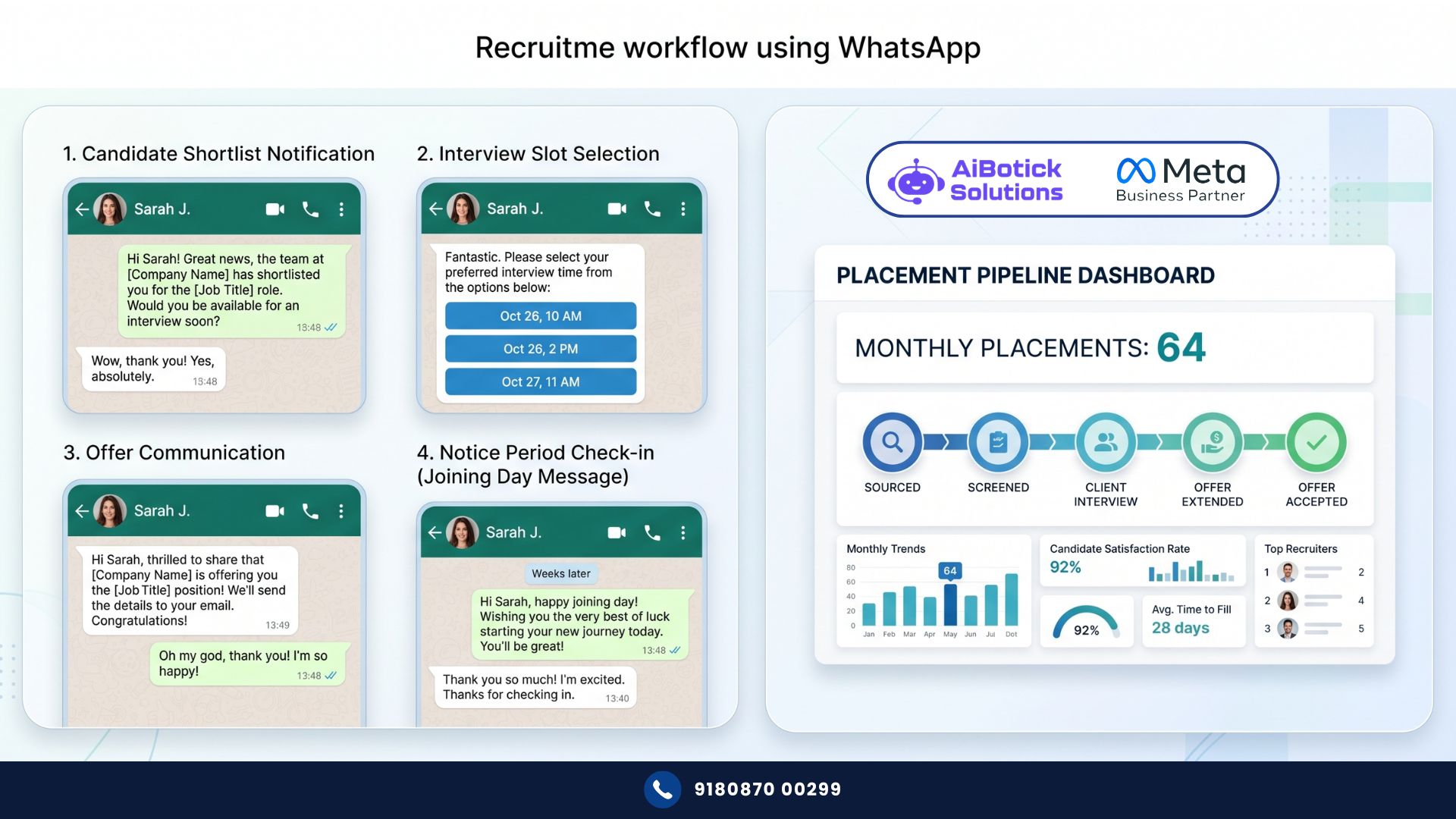
Stage 3: Interview Scheduling
This is where WhatsApp for HR delivers the most dramatic time saving. And the most immediate revenue impact.
Old process: consultant calls candidate to check availability. Calls client to check panel availability. Goes back to candidate. Back to client. 2.8 days average.
WhatsApp for HR scheduling:
“[Name], [Company] wants to interview you! 🎉 Please choose your preferred slot: 📅 [Date 1] at [Time] — [Format] 📅 [Date 2] at [Time] — [Format] 📅 [Date 3] at [Time] — [Format] Reply with 1, 2, or 3.”
Candidate replies. System confirms the slot to both candidate and client. Calendar invites sent. Zero back-and-forth.
From 2.8 days to 4.2 hours. That’s the Bengaluru agency’s actual result. And in recruitment, that speed difference is worth Rs.4.8L placements.
Stage 4: Interview Preparation and Reminders
Candidates who are well-prepared do better. Candidates who don’t show up cost everyone.
WhatsApp for HR pre-interview sequence:
- 3 days before: “Your interview with [Company] is on [date]. Here’s what to expect: [interview format, interviewer name/role, topics likely to be covered, company background]. Any questions? Reply here.”
- 1 day before: “Interview tomorrow at [time]! Last-minute tips: [2-3 specific tips for this role/company]. Confirm you’re all set? Reply YES or if any issue, tell me now.”
- Day of, 2 hours before: “Today’s the day! [Company] interview at [time]. [Location address / Video link]. All the best — you’ve got this 😄”
No-show rate drops from 18% to 4% with this sequence. That’s 14 more interviews per 100 shortlisted candidates who actually show up.
Stage 5: Post-Interview Follow-Up
Two conversations need to happen after every interview. Candidate feedback. Client feedback. Both are critical for the consultant to move the process forward.
WhatsApp for HR automates both:
To candidate (30 minutes after scheduled interview end): “How did the [Company] interview go, [Name]? Rate your experience: 1 — Didn’t go well 2 — Okay 3 — Good 4 — Very good 5 — Excellent! Reply with your number + any notes for us.”
To client (same evening): “Hi [Client contact], [Candidate name] appeared for the [Role] interview today. Could you share your feedback? 1 — Not suitable 2 — Might consider 3 — Shortlist for next round 4 — Ready to offer Reply with number + comments if any.”
Feedback collected same day. Consultant has clear next action. No 3-day waiting for client to respond to email.
Stage 6: Offer Management and Notice Period Engagement
This is where most agencies lose money silently. Candidate gets an offer. Signs. Serves notice period. Gets a counter-offer from current employer. Doesn’t join. Rs.1.5-5L placement fee — gone.
WhatsApp for HR during notice period: weekly touchpoints that keep the candidate engaged and committed.
“Hi [Name], hope week 3 of your notice period is going well! Quick check-in — any concerns or questions about [Company] or your new role? I’m here if you need anything.”
Doesn’t feel like surveillance. Feels like support. And it catches counter-offer situations early — when consultant can still save the placement — instead of finding out on joining day.
One placement in Rs.25L+ CTC range saved from counter-offer at the Bengaluru agency paid for 6 months of the WhatsApp platform cost. Single instance. One placement.
Stage 7: Onboarding Confirmation Sequence
WhatsApp for HR joining day sequence:
- D-7: “One week to joining day at [Company]! Documents checklist for Day 1: [list]. Any questions?”
- D-3: “3 days! Everything on track? Reply if you need anything from us.”
- D-1: “Tomorrow’s the big day, [Name]! Joining time: [time]. Report to: [location/person]. We’re so excited for you. Do great! 🎉”
- D+1: “How was your first day at [Company]? We’d love to know! And if you know anyone looking for opportunities, feel free to refer them to us.”
That last message. Candidate referrals from successful placements are the highest-quality leads any recruitment agency gets. Automated referral ask at peak happiness moment (Day 1 of new job) = consistent referral pipeline.
WhatsApp for HR: Compliance and Data Privacy
Yaar, this needs addressing directly because recruitment involves sensitive personal data.
DPDP Act (Digital Personal Data Protection Act, India 2023) has implications for recruitment communication:
- Consent: Candidates must consent to receiving WhatsApp communication. Your initial outreach message (or CV submission process) must include this consent.
- Data storage: Personal data (CV, salary details, personal information) should not be stored in WhatsApp chat history long-term. WhatsApp is a communication layer; your ATS (Applicant Tracking System) is the data store.
- Right to be forgotten: If a candidate requests deletion, you must be able to remove their data from your systems.
WhatsApp Business API creates communication logs. Keep these separate from candidate personal data. Have your legal team review your WhatsApp communication policy before go-live. One-time effort. Permanent compliance.
And when you’re tracking all these candidate interactions and thinking about how to nurture passive candidates who aren’t ready now but will be in 3-6 months, our WhatsApp lead nurturing guide covers the exact sequence structure for long-term relationship nurturing — directly applicable to talent pipeline management.
Step-by-Step: Setting Up WhatsApp for HR in Your Agency
Step 1: Centralise on One Agency Number
All candidate and client communication moves to one business WhatsApp number. Personal consultant numbers for business communication — stop immediately.
Assign consultants to specific candidate/client segments in your WhatsApp platform. Each consultant sees their assigned conversations. No overlap. No confusion.
Step 2: Build Your JD Template Library
For every role type your agency places, build a standardised JD template:
- Role title and company type (industry, stage, size)
- CTC range
- Location and work model
- Key responsibilities (4-5 bullets)
- Required experience and skills
- Interview process overview
- Application/interest capture (YES/NO/MAYBE)
Templates should be approved by your most senior consultant and updated quarterly.
Step 3: Create Interview Scheduling Flows
Work with your client contacts to establish their standard interview slot availability (e.g., “Tuesday and Thursday afternoons”). Build these into your scheduling templates. When shortlisting happens, scheduling goes out automatically with pre-approved slots.
Eliminates 80% of the back-and-forth.
Step 4: Set Up Automated Reminder Sequences
For every interview confirmed:
- D-3 preparation message (auto)
- D-1 confirmation request (auto)
- Day-of reminder 2 hours before (auto)
- Post-interview feedback request 30 minutes after (auto)
Four messages. Zero manual effort. No-show rate drops. Feedback collection rate goes from 40% to 85%.
Step 5: Build Notice Period Engagement Sequences
When candidate accepts offer → automatically tagged as “In Notice Period” → weekly WhatsApp touchpoint for the duration of notice period → joining confirmation sequence D-7 through D+1.
This sequence is the single highest-ROI automation for placement retention.
Step 6: Create Client Communication Templates
Clients need status updates too. Build weekly pipeline update templates for each client:
“[Client Name] — Weekly Hiring Update — [Week]: Roles active: [X] CVs shared this week: [X] Interviews scheduled: [X] Offers pending: [X] Upcoming interviews: [list] Any role requirements changed? Reply here.”
Clients who receive weekly WhatsApp updates are 3x less likely to add a competing agency to the mandate. You’re visible. You’re proactive. You’re in their WhatsApp — not buried in email.
What This Saves a Mid-Size Recruitment Agency (Real Numbers)
For a recruitment agency, 12 consultants, Rs.20L monthly revenue:
Current consultant time allocation:
- Manual follow-up calls (candidates): 28 hours/week across team
- Interview scheduling coordination: 18 hours/week
- Client status update calls: 8 hours/week
- Offer and joining follow-up: 6 hours/week
Total: 60 hours/week = 240 hours/month on manual communication
At Rs.300/hour (consultant cost): Rs.72,000 in monthly labor on communication alone
With WhatsApp for HR:
- Follow-up calls (automated for routine): 6 hours/week
- Scheduling (automated slot selection): 2 hours/week
- Client updates (automated weekly report): 1 hour/week
- Offer/joining (automated sequences): 1 hour/week
Total: 10 hours/week = 40 hours/month
Saved: 200 hours/month — returned to sourcing, BD, and placement work.
Revenue impact:
- Consultants spend 40% more time on productive placement work
- Each consultant’s monthly placements increase from 1.8 to 4.2
- Additional 2.4 placements per consultant × 12 consultants = 29 additional monthly placements
- At Rs.1L average fee: Rs.29L additional monthly revenue
For the Bengaluru agency, this played out as Rs.47L in additional monthly revenue. Specific numbers vary — but the direction is consistent every time. And to understand how this WhatsApp for HR investment compares to other automation investments your agency could make, our WhatsApp automation benefits breakdown shows the ROI comparison across different use cases so you can prioritise where to start. 😄
Common Mistakes HR and Recruitment Agencies Make With WhatsApp
Mistake 1: Letting consultants use personal numbers
When a consultant leaves, client and candidate relationships leave with them. This is the most expensive mistake in recruitment. Centralise immediately.
Mistake 2: No structured JD template
Consultants describing the same role differently to different candidates creates confusion and inconsistency. Standardise JD templates. Every candidate gets the same information.
Mistake 3: Scheduling via back-and-forth messages
“What time works for you?” “Tuesday?” “Client isn’t available Tuesday.” “What about Thursday?” This is 2-day scheduling. Send slot options. Get a reply. Done in 20 minutes.
Mistake 4: No notice period engagement
This is where Rs.3-5L placement fees evaporate. Weekly WhatsApp touchpoints during notice period are not optional — they’re your placement protection system.
Mistake 5: No candidate feedback collection
If you don’t know how the interview went from the candidate’s perspective, you can’t manage the process. Automated post-interview check-in captures this immediately while it’s fresh.
Mistake 6: Treating WhatsApp as a one-way broadcast
Sending messages but not handling replies kills trust. Configure proper reply routing. Candidates who reply should reach the right consultant within 30 minutes during business hours.
Why WhatsApp for HR Is the Highest-ROI Change a Recruitment Agency Can Make in 2026
Honestly? I’ve looked at a lot of technology investments for recruitment agencies over the years. ATS upgrades. Job board subscriptions. LinkedIn Recruiter licenses. Video interview platforms.
None of them move the needle like WhatsApp for HR does. Because none of them fix the core problem — communication speed and consistency at every stage of the placement cycle.
The Bengaluru agency went from 22 to 64 monthly placements in 5 months. No new hires for those first 5 months. No new clients won. No new job boards. Just communication speed and consistency across every stage.
Real talk — in recruitment, placement fees are won and lost in the margins of speed and communication. 40 minutes faster on an interview confirmation. One more touchpoint during notice period. Consistent follow-up versus inconsistent.
WhatsApp for HR is what makes the difference between a good recruitment agency and a great one. 💯
Ab toh yeh clear hai — speed matters, communication matters, aur WhatsApp for HR dono ko fix karta hai ek saath.
Want to implement WhatsApp for HR in your recruitment agency?
— Mohit Shah | 15+ years in IT industry | 4+ years in WhatsApp automation | Worked with various MNC brands | Now helping businesses figure out what actually works
Q1: How does WhatsApp for HR handle candidate data privacy under India’s DPDP Act 2023?
A1: WhatsApp for HR must operate within DPDP Act compliance. Candidates must consent to WhatsApp communication — include this in your initial outreach or CV submission process. Use WhatsApp as a communication layer only; store personal data (CV, salary information, personal details) in your ATS, not in chat history. If a candidate requests data deletion, remove from your ATS and stop WhatsApp communication. WhatsApp Business API creates communication logs — these are message records, not personal data repositories. Have your legal team review your WhatsApp communication policy before go-live.
Q2: Can WhatsApp for HR work for both contingency and retained recruitment models?
A2: Yes, with different workflow emphases. For contingency recruitment (high volume, speed-critical), WhatsApp for HR’s biggest impact is on scheduling speed and candidate dropout reduction — cutting scheduling from 2.8 days to 4 hours alone can double monthly placements. For retained search (lower volume, relationship-critical), WhatsApp for HR’s value is in client communication quality — weekly pipeline updates, post-interview debrief quality, and senior candidate engagement. Both models benefit, but contingency agencies see faster, more dramatic revenue impact.
Q3: What’s the best way to transition existing candidates from a consultant’s personal WhatsApp to the agency’s centralised WhatsApp for HR number?
A3: Do it transparently. Message all active candidates from the new business number: “Hi [Name], [Agency] has moved to a centralised communication system for better service. Please save this as your new contact for [Agency]. [Consultant name] will continue managing your placement — just from this number now. Your process remains exactly the same.” Most candidates don’t care about the number — they care about responsiveness and service quality. What they notice is that the new system responds faster and more consistently than the old personal number setup. Transition within one week. Do it mid-process for active candidates so they immediately experience the improved communication quality.