Most businesses discover WhatsApp broadcasting the wrong way. They find a bulk sender tool, upload 10,000 numbers, blast a promotional message, and wake up the next morning to find their number banned.
Permanently.
I’ve watched this happen to 3 businesses in a single month — a D2C skincare brand in Mumbai, a real estate developer in Pune, and an education company in Delhi. Combined loss: Rs.18L in marketing spend, plus the harder-to-calculate damage of losing a verified business number they’d built credibility on for 2+ years.
WhatsApp broadcasting done right is one of the most powerful marketing channels available to Indian businesses right now. Done wrong, it ends your business on the channel entirely. This article is about doing it right. Every time.
What WhatsApp Broadcasting Actually Is (And What It Isn’t)
WhatsApp broadcasting is the ability to send one message to multiple contacts simultaneously — where each contact receives the message as an individual, private conversation. Not a group. Not a forward. A one-to-one message that appears to come directly from you, privately, to them.
This is fundamentally different from:
- WhatsApp groups: Everyone sees everyone else. Chaos for 50+ people. Not broadcasting.
- Message forwarding: Forwarded tag appears. Feels spammy. Not broadcasting.
- Bulk WhatsApp senders: Unofficial tools. Gets you banned. Absolutely not broadcasting.
Real WhatsApp broadcasting uses the official WhatsApp Business API. Meta-verified. Compliant. Scalable. Permanent.
Here’s what it looks like from a customer’s perspective: they receive what appears to be a direct WhatsApp message from your business. No “forwarded” tag. No group notification. Just a clean, direct message in their private chat with your business. They can reply. You can respond. It’s a real conversation.
That’s why WhatsApp broadcasting works. And that’s why open rates are 95% — because it doesn’t feel like a broadcast. It feels personal.
Why 95% of Businesses Get WhatsApp Broadcasting Wrong
Seedha bolta hoon — most businesses approach WhatsApp broadcasting like they approach email marketing. Blast everyone. As often as possible. With as many offers as possible.
This is the fastest way to get banned and lose your audience simultaneously.
WhatsApp’s algorithm is smart. It tracks:
- How many recipients block your number after receiving your message
- How many mark your message as spam
- How many report your business
- Your message quality score (updated weekly)
If 2% of your broadcast recipients block or report you, your quality score drops to “Medium.” If it continues, it drops to “Low.” At Low quality, your broadcasting limits reduce dramatically. If it continues further, your number gets banned.
The businesses that get permanent results from WhatsApp broadcasting treat it completely differently. They’re not broadcasters. They’re communicators who happen to use broadcasting as their delivery mechanism.
What People Get Wrong About WhatsApp Broadcasting
Most marketers think WhatsApp broadcasting is a mass marketing tool — like email blasts or SMS campaigns. Send to everyone. Maximum reach. Maximum frequency.
Nope. Wrong mental model entirely.
Actually wait — better example: imagine you have 10,000 customer phone numbers. You could cold call all of them with a sales pitch. Or you could personally call your 500 best customers with genuinely useful information they’d appreciate. Which one gets results? Which one gets complaints?
WhatsApp broadcasting is the second scenario, scaled. It works when:
- You’re sending to people who genuinely opted in to hear from you
- Your message has clear value for the recipient (not just for you)
- You’re sending at appropriate frequency (not daily)
- You’re segmenting (not sending the same message to everyone)
It fails when:
- You’re broadcasting to purchased lists or scraped numbers
- Your message is pure promotion with no value
- You’re sending to the same audience daily
- Everyone gets the same message regardless of their relationship with you
Let me be direct: WhatsApp broadcasting without proper segmentation is not marketing. It’s spam with extra steps.
Real Case Study: Mumbai D2C Brand — Rs.11.4L From One Broadcast Campaign
I mentioned this in our WhatsApp broadcasting for ecommerce guide — but this case deserves a detailed breakdown here because it perfectly illustrates what right looks like.
The Setup:
- Women’s fashion D2C brand in Mumbai
- Monthly GMV: Rs.28L
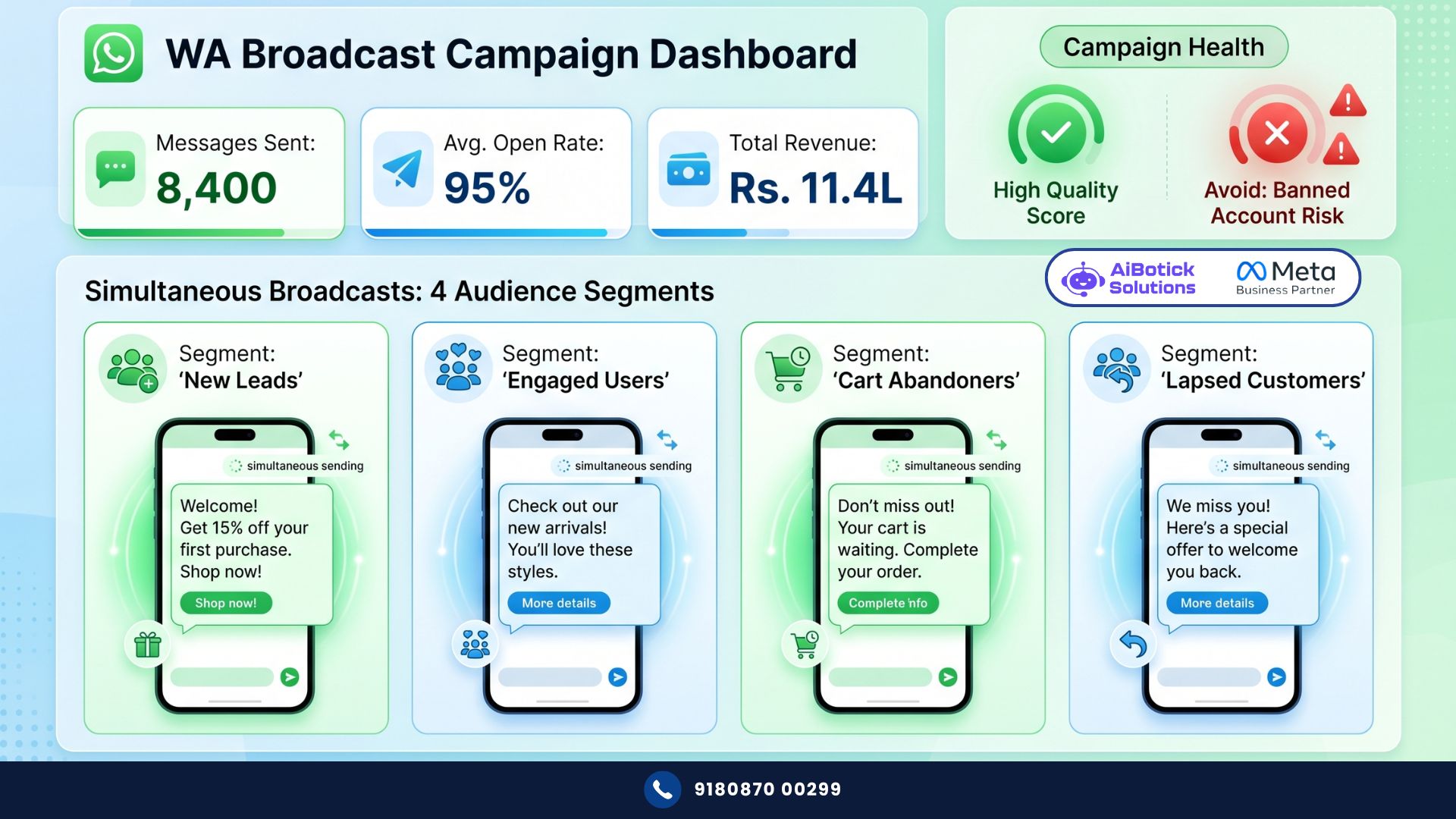
- WhatsApp opted-in customer database: 8,400 contacts
- Had never done a WhatsApp broadcast campaign
The Campaign: End of season sale announcement. But here’s what they did differently — they didn’t send one message to 8,400 people. They segmented into 4 groups:
Segment 1 (2,100 contacts) — High-value customers (3+ purchases, spent Rs.5,000+): “[Name], as one of our most valued customers, you get early access to our end-of-season sale — 24 hours before anyone else. Up to 60% off. Shop now: [link]
Your exclusive access ends tomorrow at 11:59 PM.”
Segment 2 (1,800 contacts) — Mid-value customers (2 purchases): “[Name], our end-of-season sale is live! Up to 50% off on styles you’ve been watching. Here’s what’s trending right now: [link]
Sale ends in 72 hours.”
Segment 3 (2,600 contacts) — Single purchase customers: “Hi [Name], remember that [category they bought] you loved? Our sale has more of the same — and everything’s at its lowest price of the year. Up to 40% off: [link]”
Segment 4 (1,900 contacts) — Subscribers who never purchased: “[Name], you’ve been browsing for a while — now might be the right time. Our biggest sale of the year is live. First order gets an additional 10% with code FIRST10. Shop: [link]”
The Results:
| Segment | Messages Sent | Response Rate | Revenue |
|---|---|---|---|
| High-value | 2,100 | 34% | Rs.4.8L |
| Mid-value | 1,800 | 22% | Rs.2.9L |
| Single purchase | 2,600 | 18% | Rs.2.4L |
| Never purchased | 1,900 | 7% | Rs.1.3L |
| Total | 8,400 | 20% | Rs.11.4L |
Rs.11.4L in revenue from one day’s broadcast. At Rs.0.8631 per marketing conversation (Meta rate): total cost Rs.7,250.
ROAS: 1,572x.
And critically — block rate across all segments: 0.3%. Well below the 2% danger threshold. Because the messages were relevant, personal, and valuable to each segment.
The 5 Types of WhatsApp Broadcasts (And When to Use Each)
Type 1: Promotional Broadcasts
Sales, offers, new launches, limited-time deals. This is what most people think of when they think WhatsApp broadcasting.
Use sparingly. Maximum 2-4 per month. Always segment. Always include clear value.
Best for: Ecommerce, D2C, retail, restaurants, travel companies.
Type 2: Informational Broadcasts
Updates, news, policy changes, useful content. No selling. Pure value.
“[Name], a quick update — our delivery timelines in Mumbai are back to 24 hours after the recent disruption. Orders placed today will arrive tomorrow. [Link to track existing orders]”
This type of broadcast has the highest open rates (often 97%+) and the lowest block rates (under 0.1%). Send these confidently.
Best for: All businesses. Especially ecommerce, healthcare, finance, and education.
Type 3: Re-engagement Broadcasts
Dormant customers. People who haven’t engaged in 30-60 days. Win-back campaigns.
These need to be softer. Not “BUY NOW” — more like “We miss you. Here’s something we think you’d love.”
For a coaching institute, this might be: “[Name], it’s been 2 months since you attended [Course]. We’ve added [new content/modules] that we think you’ll find useful. Want to take a look? Reply ‘yes’.”
Response rates: 12-18%. Block rates: 0.4-0.8%. Worth it for the 12-18% you win back.
Type 4: Utility Broadcasts
Order confirmations, appointment reminders, payment receipts, shipment updates. Triggered by specific events, sent automatically.
These have the absolute highest engagement rates because they’re expected and wanted. Open rate: 98%+. Block rate: near 0.
And importantly — utility broadcasts are charged at Rs.0.115 per conversation (vs Rs.0.8631 for marketing). 7.5x cheaper. Use utility templates for transactional messages and you save dramatically on messaging costs.
Type 5: Relationship Broadcasts
Birthday messages. Anniversary of first purchase. Milestone celebrations. “You’ve ordered from us 10 times — here’s a gift.”
These drive the highest brand loyalty and referral behaviour. Not the highest immediate revenue, but the highest lifetime value. Build these into your monthly broadcast calendar.
Step-by-Step: Setting Up WhatsApp Broadcasting the Right Way
Step 1: Get WhatsApp Business API (Non-Negotiable)
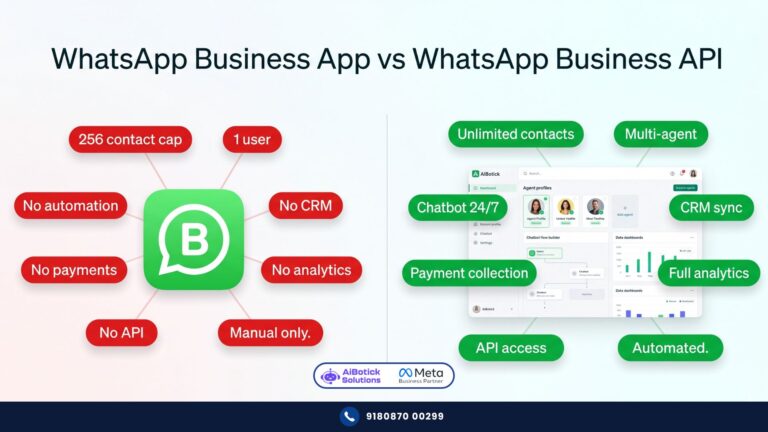
You cannot do legitimate, scalable WhatsApp broadcasting without the official WhatsApp Business API. Not the free WhatsApp Business app. Not a third-party bulk sender.
The API is the only way to:
- Send to large lists without getting banned
- Get message delivery and read receipts
- Segment audiences
- Create approved templates
- Track campaign performance
Step 2: Build Your Opted-In Contact List
This is the foundation. Every contact in your WhatsApp broadcasting list must have explicitly opted in to receive messages from you on WhatsApp.
How to build an opted-in list:
- Website pop-up: “Get exclusive offers on WhatsApp — [Enter number]”
- Checkout flow: “Stay updated on your order via WhatsApp — [checkbox]”
- QR code in-store/packaging: “Join our WhatsApp community for offers”
- Previous WhatsApp conversations: customers who’ve chatted with you already
- Click-to-WhatsApp ads: customers who click and initiate conversation
Never import random phone number lists. Never buy lists. Never scrape numbers. The short-term reach isn’t worth the permanent ban risk.
Step 3: Create Meta-Approved Message Templates
All WhatsApp broadcasting messages must use pre-approved templates. This isn’t optional. It’s how the API works.
Template approval tips:
- Be clear and specific in your template — Meta rejects vague templates
- Include personalisation (at minimum, recipient’s name)
- Don’t make it purely promotional in first submission — add value element
- Marketing templates typically approve in 24-48 hours
- Utility templates typically approve within 4 hours
Build a library of 10-15 templates before your first campaign. You’ll need them.
Step 4: Segment Your Audience Before Every Broadcast
Never send the same message to your entire list. Minimum segmentation:
- New customers (0-30 days): Onboarding, education, relationship building
- Active customers (30-90 days, 2+ purchases): Loyalty, upsell, new arrivals
- Dormant customers (90+ days, no purchase): Re-engagement with soft offer
- High-value customers: VIP access, early access, special treatment
More segmentation = higher relevance = higher response = lower block rate = safer broadcasting.
Step 5: Set Frequency Rules
Maximum frequency guidelines:
- Promotional broadcasts: 2-4 per month maximum
- Informational broadcasts: up to 8 per month (if genuinely useful)
- Utility messages: unlimited (triggered by events, always expected)
- Re-engagement: 1 per month maximum for dormant segments
More than 4 promotional broadcasts per month and your block rate climbs. Higher block rate = lower quality score = reduced limits. Respect the frequency ceiling.
Step 6: Monitor Quality Score Weekly
WhatsApp Business Manager shows your phone number quality score:
- Green (High): You’re good. Continue.
- Yellow (Medium): Warning. Reduce broadcast frequency. Review your templates. Check who you’re sending to.
- Red (Low): Pause all broadcasts immediately. Review. Fix. Then slowly resume.
Check this every week without exception. Act on Yellow before it becomes Red.
Step 7: Track Campaign Performance
After every WhatsApp broadcasting campaign, track:
- Messages sent
- Messages delivered (should be 98%+)
- Messages read (should be 85%+)
- Response rate (replies received)
- Block rate (should be under 1%)
- Conversion rate (link clicks, purchases, bookings)
- Revenue or leads generated
This data tells you what’s working and what needs adjustment. No data = no improvement.
WhatsApp Broadcasting vs Email Marketing: The Numbers Don’t Lie
Honestly? I think email marketing is completely overhyped for businesses that have WhatsApp-accessible customers. Let me show you why.
| Metric | Email Marketing | WhatsApp Broadcasting |
|---|---|---|
| Open rate | 18-22% | 92-95% |
| Click-through rate | 2-3% | 15-25% |
| Response rate | 0.5-1% | 8-15% |
| Delivery rate | 85-90% | 97-99% |
| Time to open | 6-12 hours | Under 3 minutes |
| Unsubscribe rate | 0.5-1% | 0.2-0.5% |
For an Indian audience? The gap is even wider. Indian consumers check WhatsApp 50+ times per day. They check email 2-3 times. Where do you think your message lands with more impact?
And if you want a deeper comparison of exactly how WhatsApp stacks up against email across different metrics and business types, our WhatsApp vs email deep dive breaks this down specifically for Indian business contexts — including the cases where email still makes sense alongside WhatsApp.
Common WhatsApp Broadcasting Mistakes That Get Businesses Banned
Mistake 1: Using unofficial bulk WhatsApp senders
This is the number one ban trigger. Unofficial senders don’t use the official API. Meta detects this. Number banned. Often permanently. There is no appeal process that regularly works.
Mistake 2: Sending to contacts who didn’t opt in
Purchased lists, scraped numbers, old contacts who never agreed to WhatsApp communication — these people don’t recognise your number. Block rate goes immediately to 5-10%+. Quality score tanks. Ban follows.
Mistake 3: Promotional messages daily
Even opted-in customers don’t want daily promotional messages on WhatsApp. This channel is personal. Respect it. 2-4 promotional broadcasts per month maximum.
Mistake 4: No personalisation
“Dear Customer” messages get blocked. “[Name], we thought you’d love this based on your last purchase” messages get responses. Personalisation isn’t optional — it’s what separates broadcasting from spamming.
Mistake 5: Same message to everyone
A customer who spent Rs.25,000 with you and a customer who browsed once shouldn’t get the same message. Segment. Every. Time.
Mistake 6: Ignoring quality score warnings
When your quality score drops to Yellow, most businesses ignore it and keep broadcasting. By the time it’s Red, it’s too late. Yellow is your warning. Act on it immediately.
Mistake 7: No reply handling
Broadcasting and then ignoring replies is a trust killer. Configure your system so every reply reaches the right person. Customers who get no reply after a WhatsApp broadcasting message block you faster than customers who never received the message.
The Legal and Compliance Side of WhatsApp Broadcasting in India
TRAI and Meta both have rules here. The combined compliance checklist:
Meta requirements:
- Official WhatsApp Business API only
- Pre-approved message templates for outbound messages
- Only message opted-in contacts
- Honor opt-out requests immediately (reply “STOP” or similar)
- Maintain phone number quality score above Red
India (TRAI/DPDP Act) requirements:
- Explicit consent before messaging for promotional content
- Clear opt-out mechanism in every promotional message
- Respect DND registrations for new contacts
- Data protection compliance under DPDP Act 2023
Simple addition to every promotional WhatsApp broadcasting message: “Reply STOP to unsubscribe.” One line. Full compliance. Zero friction for customers who want out.
What WhatsApp Broadcasting Costs in India (Real Numbers)
Meta conversation charges for broadcasting:
- Marketing conversations: Rs.0.8631 per conversation (per 24-hour window)
- Utility conversations: Rs.0.115 per conversation
- Service conversations (inbound-initiated): Free
Cost to broadcast to 10,000 contacts: 10,000 × Rs.0.8631 = Rs.8,631
If your campaign converts at even 5% at Rs.500 average order value: Revenue: 500 orders × Rs.500 = Rs.2,50,000
Cost: Rs.8,631 + platform fee (Rs.3,000-5,000 approximate for the broadcast)
Net return: Rs.2,36,000 on Rs.13,631 spend = 17x ROAS
For higher-value products or higher conversion rates, the math gets dramatically better. The Mumbai D2C brand’s 1,572x ROAS was exceptional — but 15-50x ROAS is consistently achievable with proper WhatsApp broadcasting execution.
Why WhatsApp Broadcasting Is the Best Marketing Channel in India Right Now
Real talk — no other marketing channel gives you 95% open rates, 15-25% click-through rates, and personal direct-to-consumer communication at Rs.0.86 per message.
Facebook ads: Rs.30-100 per click, 2-3% conversion. Google ads: Rs.20-80 per click, 3-5% conversion. Email: 20% open rate, 2% click-through. SMS: 35% open rate, 0.5% click-through. Feels transactional. No two-way communication.
WhatsApp broadcasting through the official API: 95% open rate, 15-25% click-through, full two-way conversation capability, personalised at scale.
The channel is genuinely exceptional. The businesses winning in India right now — across ecommerce, education, real estate, finance, and every other sector — are the ones who’ve figured out WhatsApp broadcasting done right.
The ones still using email as their primary customer communication channel? They’re leaving Rs.50-100L in annual revenue on the table. Every year. 💯
Ab toh ek simple choice hai — email ki tarah sochna band karo aur WhatsApp broadcasting ko seriously lena shuru karo. 😄
Want to set up WhatsApp broadcasting for your business without the risk of getting banned?
— Mohit Shah | 15+ years in IT industry | 4+ years in WhatsApp automation | Worked with various MNC brands | Now helping businesses figure out what actually works
Q1: What’s the difference between WhatsApp broadcasting using the Business API versus the free WhatsApp Business app?
A1: The free WhatsApp Business app limits broadcasting to 256 contacts per list, requires contacts to have your number saved, doesn’t support automation, and can’t scale beyond a few hundred messages. WhatsApp Business API (what AiBotick provides) supports broadcasting to unlimited contacts (in compliance with Meta’s quality guidelines), doesn’t require contacts to save your number first, supports full automation and scheduling, allows pre-approved templates, tracks delivery and read receipts, and enables two-way conversation management for teams. For any serious business doing more than 500 messages per month, the API is the only option that scales safely.
Q2: How do you get contacts to opt in to WhatsApp broadcasting without making it feel forced?
A2: The most effective opt-in methods are value-exchange based — give something useful in return for the opt-in. “Get your order updates on WhatsApp” (ecommerce checkout), “Receive exclusive early access to sales on WhatsApp” (retail), “Get your appointment reminders on WhatsApp” (healthcare, services), “Receive your course materials on WhatsApp” (education). The key is making the opt-in feel like a benefit, not a subscription. Never pre-tick WhatsApp opt-in boxes — explicit, voluntary consent is the only kind that produces engaged audiences with low block rates.
Q3: How often can you send WhatsApp broadcasting messages before customers start blocking you?
A3: Block rates stay low (under 0.5%) when promotional broadcasts are limited to 2-4 per month and messages are genuinely relevant to the recipient. Informational and utility broadcasts can go higher — up to 8 per month — if the content is valuable (shipping updates, relevant news, appointment reminders). Daily promotional messages reliably push block rates above 2%, which triggers Meta’s quality score reduction and eventually limits or bans your number. The rule of thumb: every broadcast should pass the “would I be glad to receive this?” test. If the answer is no for more than 5% of your audience, don’t send it.