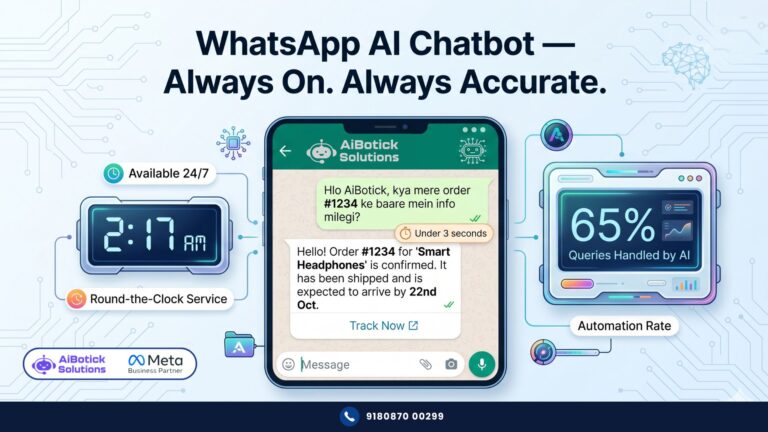
A customer messages your WhatsApp at 1am asking about your product. ChatGPT replies — accurately, conversationally, in their language — within 3 seconds. No human involved. No delay. No “we’ll get back to you in the morning.”
This is real. It’s happening right now. And the Indian businesses using ChatGPT on WhatsApp are running circles around teams still doing everything manually.
Let me show you exactly how this works — and more importantly, how to set it up for your business without a technical degree.
What “ChatGPT on WhatsApp” Actually Means
First — let’s be precise. Because this phrase gets thrown around loosely and I’ve seen businesses build wrong expectations because of it.
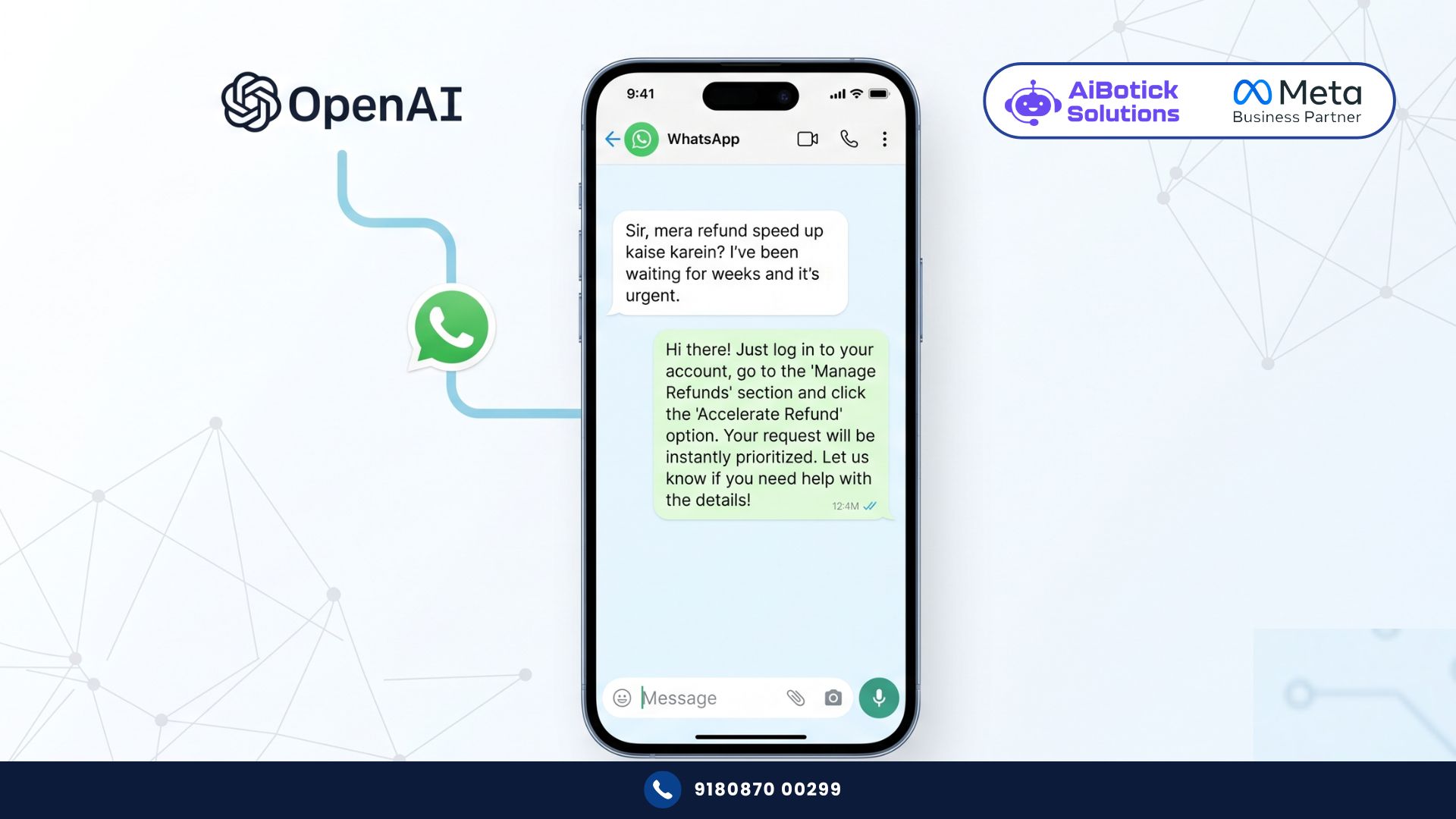
ChatGPT on WhatsApp doesn’t mean you give customers your ChatGPT login. It means you connect OpenAI’s GPT models — the same AI engine that powers ChatGPT — to your WhatsApp Business number via the API. So when a customer messages you on WhatsApp, the response is generated by GPT, trained on your specific business information, and sent back through WhatsApp automatically.
The customer never leaves WhatsApp. They never see “ChatGPT.” They just get a fast, intelligent, contextually accurate response from your business number.
That’s ChatGPT on WhatsApp. Practical. Businesslike. Genuinely useful.
And this is exactly what AiBotick enables — OpenAI integration built into the platform, connected to your WhatsApp Business API number, trained on your business knowledge base. No coding. No API keys to manage yourself. No complex technical setup.
Why ChatGPT on WhatsApp Is Different From a Regular Chatbot
I keep making this point because it keeps mattering.
A regular rule-based chatbot responds to keywords. Customer types “price” → bot replies with pricing info. Customer types “what will it cost me for my team of 8 people with two locations?” → bot says “I didn’t understand that, please choose from the options below.”
ChatGPT on WhatsApp understands the second message just fine. It reads the full context, understands the intent, and responds: “For a team of 8 with two locations, here’s what we’d typically recommend…” — pulling from your business information and actually answering the question.
That’s the difference. And in customer communication, that difference is enormous.
I’ll give you a personal example. Few years ago, I was evaluating chatbot solutions for a mid-size insurance distribution company. They had a keyword bot set up — took 3 months and Rs.4 lakhs of custom development to build. It handled maybe 35% of their queries. Everything else fell through to humans.
Then GPT-based solutions became accessible. Same company. Same use case. Knowledge base uploaded in 2 days. GPT connected through the WhatsApp API. Handling rate jumped to 68% in the first month. Queries the old bot would never have handled — nuanced product comparisons, eligibility questions in Hinglish, follow-up questions mid-conversation — all handled automatically.
Rs.4 lakhs of custom development vs 2 days of setup. Ab toh technology ne sab badal diya.
How ChatGPT on WhatsApp Works — Step by Step
No jargon. Just the actual flow.
Step 1 — Customer sends a WhatsApp message to your business number
Could be a query, a question, a complaint, a purchase request. Anything.
Step 2 — Message reaches AiBotick via WhatsApp Business API
AiBotick receives the message in real time.
Step 3 — AiBotick passes the message to OpenAI’s GPT
Along with: your business knowledge base, the conversation history so far, and any specific instructions you’ve set (tone, language, what to do if certain topics come up, when to escalate).
Step 4 — GPT processes and generates a response
This takes under 2 seconds typically. GPT reads the full context — not just the latest message, but everything discussed in that conversation — and generates a response that’s accurate, contextual, and on-brand.
Step 5 — Response is sent back to the customer on WhatsApp
Looks like a normal WhatsApp message from your business. No indication it’s AI-generated unless you choose to disclose it.
Step 6 — Conversation continues or escalates
If the customer’s query is resolved — done. If GPT detects a situation that needs human judgment (complex complaint, negotiation, emotional context) — it routes to your shared team inbox with the full conversation history already there. Your agent picks up without asking the customer to repeat anything.
The whole loop runs continuously, 24/7, across every conversation simultaneously. You could have 300 active WhatsApp conversations at 3pm on a Monday and the system handles all of them without breaking a sweat.
What ChatGPT on WhatsApp Can Handle for Your Business
Let’s get specific. Because “handles queries automatically” is vague. Here’s what GPT on WhatsApp actually does well:
Product and Service Information
Any question about what you offer, how it works, what’s included, what’s not. As long as it’s in your knowledge base — GPT answers it accurately, in detail, conversationally.
“What’s the difference between your Growth and Scale plan?” → Full, accurate comparison. “Does your WooCommerce integration support variable products?” → Yes or no, with explanation. “Mujhe ek coaching institute ke liye WhatsApp automation chahiye — kya aap help kar sakte ho?” → Full response in Hinglish, covering relevant features.
Lead Qualification
GPT can ask qualifying questions naturally, gather information, and route high-intent leads to the right team member — all within the WhatsApp conversation.
No rigid form. No “please select option 1, 2, or 3.” Just a natural back-and-forth that feels like talking to a knowledgeable sales exec.
FAQ Handling
Your top 20-30 frequently asked questions — pricing, policies, timelines, processes, returns, eligibility — handled automatically, accurately, instantly. No human needed.
Appointment and Booking Queries
“Can I book a demo for Thursday 3pm?” → GPT checks your availability rules and either confirms or offers alternatives. Combined with WhatsApp Flows — the actual booking happens inside WhatsApp without any redirect.
Follow-Up Conversations
Customer asked about a product 3 days ago and now comes back with a follow-up. GPT on WhatsApp remembers the conversation context (within session limits) and responds accordingly. No “sorry, who are you again?”
Multilingual Communication
Hindi, Hinglish, Tamil, Bengali — GPT handles multilingual queries better than any rule-based system ever could. Indian businesses with diverse customer bases find this particularly valuable.
Real Example — A D2C Skincare Brand Using ChatGPT on WhatsApp
Mumbai-based skincare brand. Rs.2.5Cr annual revenue. Heavy Instagram presence, most customer communication happening on WhatsApp after social media discovery.
Before ChatGPT on WhatsApp:
- 2 customer support executives handling WhatsApp manually
- Average response time: 35 minutes during business hours, 0 responses overnight
- 60% of queries were repetitive: ingredients, skin type suitability, shipping timelines, return policy
- Team burning out on repetitive questions, quality of complex query handling suffering
They implemented ChatGPT on WhatsApp through AiBotick. Knowledge base: full product catalog, ingredient lists, skin type recommendations, shipping policy, return policy, FAQ document.
After 60 days:
- 71% of queries handled fully automatically by GPT
- Average response time: 4 seconds (down from 35 minutes)
- Overnight queries — all handled. Zero missed conversations.
- Team now handles only: complex skin consultations, complaints, influencer partnerships, B2B retailer queries
- Revenue impact: 18% increase in WhatsApp-originated conversions — because responses were instant and customers didn’t drop off waiting
Actually wait — the overnight number is the one that stays with me. They had been losing an estimated 20-25 purchase decisions per week to “we’ll reply tomorrow morning” silence. Those customers had already moved on by morning. ChatGPT on WhatsApp captured that window. That alone justified the entire investment. 😄
Setting Up ChatGPT on WhatsApp — What You Need
Seedha bolta hoon — here’s the actual checklist:
What you need:
- WhatsApp Business API access (through AiBotick — Meta verified)
- Your business knowledge base compiled and documented
- OpenAI API integration (built into AiBotick — no separate setup needed)
- Clear escalation rules defined
- Someone to monitor and improve the system in the first 2-4 weeks
What you don’t need:
- A developer or technical team
- Separate OpenAI account management
- Custom coding or API key management
- Months of setup time
On AiBotick, the OpenAI integration is native. You upload your knowledge base, set your instructions, define escalation rules, test conversations, go live. Most businesses are running ChatGPT on WhatsApp within a week of starting setup.
What People Get Wrong About ChatGPT on WhatsApp
Wrong belief #1: “ChatGPT will hallucinate and give customers wrong information.”
This is a real concern — and it’s why knowledge base configuration matters. When GPT is given clear, accurate business information and instructed to only answer from that knowledge base, hallucination risk drops dramatically. You also set a fallback: if GPT isn’t confident in an answer, it escalates to a human rather than guessing.
The risk isn’t zero. But it’s manageable — and far lower than the risk of a human agent giving inconsistent or incorrect information from memory.
Wrong belief #2: “Our customers will feel cheated if they find out it’s AI.”
Customers care about speed, accuracy, and helpfulness. A response that’s instant, accurate, and solves their problem — they’re happy. The frustration comes when AI is used to delay, deflect, or give useless canned responses.
Be transparent if your customers ask. Most won’t. And those who do — if the AI has been genuinely helpful — will usually say “fair enough, it was still useful.”
Wrong belief #3: “This is too advanced for our business stage.”
Nope. I’ve seen businesses at Rs.40L turnover successfully running ChatGPT on WhatsApp. The technology access point is lower than it’s ever been. The ROI is faster than most other technology investments. Stage doesn’t matter as much as use case clarity.
Wrong belief #4: “We need to hire someone technical to manage this.”
On AiBotick — you don’t. Knowledge base updates are done through a simple interface. Escalation rules are set via dropdown configurations. Monthly analytics are dashboard-readable. Your marketing manager can manage this. They don’t need a developer.
ChatGPT on WhatsApp vs Human Agents — Not a Competition
Look, here’s the thing — I want to be clear about something I’ve said to clients directly.
ChatGPT on WhatsApp is not a replacement for human connection. It’s a replacement for the parts of human work that shouldn’t require humans.
Answering “what’s your return policy?” for the 200th time this month shouldn’t require your best sales exec. ChatGPT handles that. Your best sales exec then spends that time on conversations that actually need human empathy, judgment, creativity, and relationship-building.
The businesses getting this right aren’t using AI to eliminate their teams. They’re using AI to make their teams dramatically more effective — handling more volume with the same people, at higher quality, with less burnout.
Could be wrong — but I’ve seen this pattern consistently enough to say it with confidence. AI + good humans beats AI alone or humans alone every time.
For the full picture of what the AI layer looks like across a complete WhatsApp automation setup — and how it connects with chatbot flows, team inbox, and broadcast — read our breakdown on how a WhatsApp AI chatbot works and what makes one genuinely effective. That article covers the technical layer in more detail than I have here.
The Businesses That Will Win With ChatGPT on WhatsApp
Not every business gets the same ROI. The ones that win are those where:
- Customer queries are high volume and partially repetitive
- Speed of response directly affects conversion (lead-heavy businesses especially)
- After-hours queries are currently being lost
- Team is spending significant time on low-value repetitive communication
- Customer base communicates in varied languages and styles
If that’s your business — ChatGPT on WhatsApp isn’t optional anymore. It’s infrastructure.
And if you’re wondering where to start — start with your most common 20 customer queries. Write them down with the ideal answers. That’s your knowledge base foundation. Everything else builds from there.
For context on the broader WhatsApp automation ecosystem this fits into — and the measurable business ROI you should expect — our article on calculating WhatsApp automation ROI for growing Indian businesses gives you the framework to build the business case internally. 💯
Your customers are messaging you right now. Some of them will wait. Most of them won’t.
If you want to see ChatGPT on WhatsApp working for your specific business — Chat with us on WhatsApp and we’ll show you a live demo using your actual use case.
— Mohit Shah | 15+ years in IT industry | 4+ years in WhatsApp automation | Worked with various MNC brands | Now helping businesses figure out what actually works
Q1: Can I connect ChatGPT to my WhatsApp Business number?
A1: Yes — through the WhatsApp Business API and a platform like AiBotick that has OpenAI integration built in. You cannot connect ChatGPT directly to the regular WhatsApp Business App. The connection requires WhatsApp Business API access, which is available through Meta-verified providers. Once connected, OpenAI’s GPT models respond to customer messages on your behalf — trained on your specific business knowledge base — without any coding or technical management required from your team.
Q2: Will ChatGPT give wrong information to my customers on WhatsApp?
A2: The risk is manageable when the system is configured correctly. GPT is instructed to answer only from your uploaded knowledge base — not from general internet knowledge. When GPT is not confident in an answer, it escalates to a human agent rather than guessing. In practice, businesses with well-structured knowledge bases see very low error rates — typically lower than the inconsistency rate from human agents answering from memory. The key is maintaining an accurate, up-to-date knowledge base and reviewing AI conversations in the first few weeks to catch any gaps.
Q3: How long does it take to set up ChatGPT on WhatsApp for a business?
A3: Most businesses are live within 5-7 working days. The setup has three phases: WhatsApp Business API connection and verification (2-3 days), knowledge base preparation and upload (1-2 days), and testing and refinement before going live (1-2 days). On AiBotick, the OpenAI integration is built into the platform — there’s no separate API management or coding required. Your onboarding team guides you through each step. The knowledge base preparation — compiling your product info, FAQs, policies, and pricing — is typically the most time-consuming part, and the quality of that input directly determines how well the AI performs.