WhatsApp automation ROI — teen words jo har business owner ko seriously lene chahiye.
Let me ask you something uncomfortable.
If I asked you right now — “what’s the ROI of your WhatsApp automation investment?” — could you answer that?
Most business owners can’t. They know it’s “working.” They feel it’s useful. But actual numbers? Blank stare.
And I get it. ROI calculation sounds like something the finance department handles. Not the founder. Not the marketing head.
But here’s the thing — if you can’t calculate the ROI, you can’t justify the investment. You can’t scale it confidently. You can’t convince your management team. And you definitely can’t identify where it’s underperforming.
I’ve been in this industry 15 years. The businesses that scaled WhatsApp automation aggressively — they all had one thing in common. They knew their numbers. Precisely.
So today — let’s fix that. Real math. Real examples. No fluff.
WhatsApp Automation ROI — What Does It Actually Mean?
ROI = Return on Investment.
Simple formula:
ROI = (Money Gained − Money Spent) ÷ Money Spent × 100
So if you spend Rs.45,000/year on WhatsApp automation and it generates Rs.3,00,000 in additional revenue — your ROI is 567%.
But here’s where most people get it wrong — they only count direct revenue. They forget the cost savings. And in WhatsApp automation, the cost savings are often bigger than the revenue gains.
Let me show you both sides of this properly.
Side 1 — What You’re Spending
Two costs. Always two. Never forget this.
Cost 1 — Platform fee (AiBotick) This is your annual or monthly subscription. Depending on your plan:
- Starter: Rs.15,000/year
- Growth: Rs.25,000/year
- Scale: Rs.45,000/year
- Enterprise: Rs.60,000/year
Cost 2 — Meta conversation charges Paid directly to Meta. Separate from your platform fee.
- Marketing conversations: ~Rs.0.88 per conversation
- Utility messages (order updates, reminders): ~Rs.0.13
- Service conversations (customer replies): ~Rs.0.13
For a business sending 5,000 marketing messages and 10,000 utility messages per month:
- Marketing: 5,000 × Rs.0.88 = Rs.4,400/month
- Utility: 10,000 × Rs.0.13 = Rs.1,300/month
- Total Meta charges: ~Rs.5,700/month = Rs.68,400/year
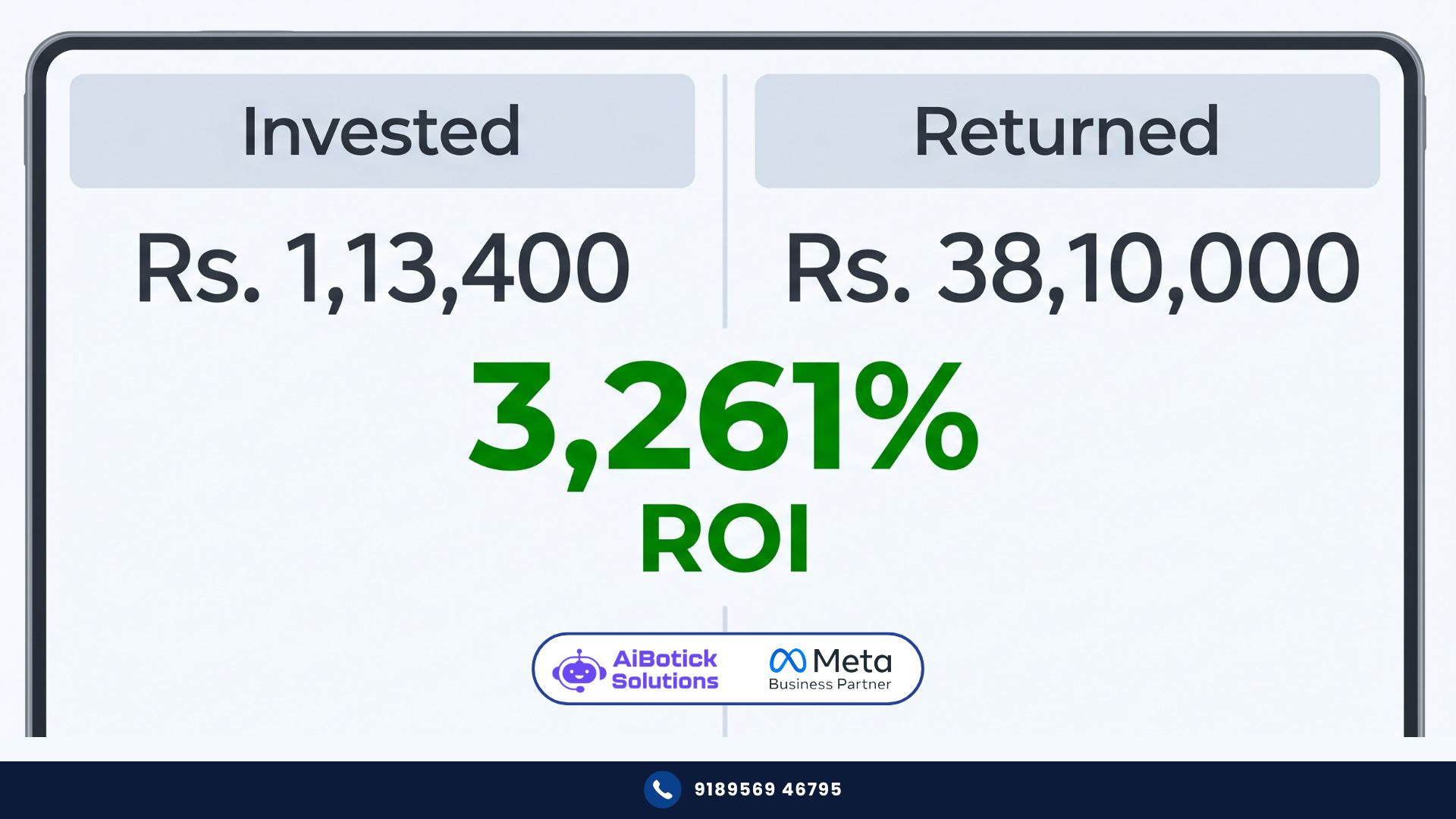
Total annual investment: Rs.45,000 (platform) + Rs.68,400 (Meta) = Rs.1,13,400/year
Write this number down. This is your denominator in the ROI formula.
Not sure which plan is right for your business size? Here’s our complete WhatsApp automation guide.
Side 2 — What You’re Gaining
This is where it gets interesting. Four buckets. Calculate each one separately.
Bucket 1 — Leads Recovered (The Biggest One)
How many leads are you currently missing because:
- Nobody responded after business hours
- Response time was too slow (over 30 minutes)
- Follow-up never happened
Be honest. For most businesses getting 100 enquiries/month — at least 20-30 are going cold for these reasons.
Let’s say 25 leads/month going cold. WhatsApp automation recovers even 30% of them = 7-8 additional conversions/month.
If your average order or deal value is Rs.5,000 — that’s Rs.35,000-40,000 additional revenue per month. Rs.4,20,000-4,80,000 per year.
From leads you were already generating. Just recovering what was slipping through.
Bucket 2 — Abandoned Cart Recovery (Ecommerce)
Industry average — WhatsApp abandoned cart recovery rate: 8-15%.
Say your store does Rs.10L GMV per month. Cart abandonment rate is typically 70% — so Rs.7L in potential revenue is abandoned monthly.
WhatsApp recovers 10% of that = Rs.70,000/month additional revenue.
That’s Rs.8,40,000/year. From one automation. One flow. Set up once.
Bucket 3 — Staff Cost Savings
This one is underrated massively.
Before automation — how many people were handling WhatsApp manually? Let’s say 2 support executives at Rs.20,000/month each = Rs.40,000/month = Rs.4,80,000/year.
After automation — bot handles 70-80% of queries. You need 1 person instead of 2. Saving = Rs.20,000/month = Rs.2,40,000/year.
And that one remaining person? Now handling higher-value tasks instead of answering “what are your timings?” forty times a day.
See the 10 signs your business is already losing money without automation. Read this.
Bucket 4 — Broadcast Campaign Revenue
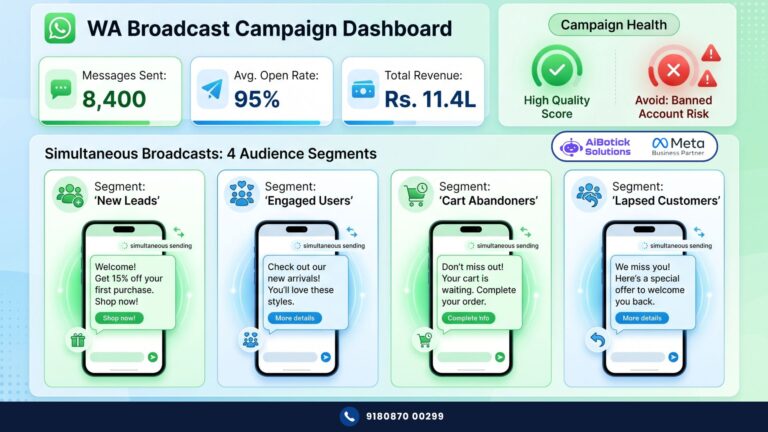
You have 5,000 opted-in contacts. You run one WhatsApp broadcast campaign per month promoting an offer.
95% open rate = 4,750 people see it. Conservative 2% conversion = 95 sales. Average order value Rs.2,000 = Rs.1,90,000 additional revenue per campaign.
12 campaigns/year = Rs.22,80,000 in campaign-driven revenue.
Compare that to email — same list, same offer, 20% open rate = 1,000 people see it, maybe 20 conversions. Rs.40,000 per campaign.
WhatsApp campaigns generate 5-6x more revenue from the same list. Every time.
Putting It All Together — Real ROI Calculation
Let’s use a mid-size ecommerce business as our example.
Annual Investment:
- Platform (Scale plan): Rs.45,000
- Meta charges: Rs.68,400
- Total spent: Rs.1,13,400
Annual Returns:
- Recovered leads: Rs.4,50,000
- Abandoned cart recovery: Rs.8,40,000
- Staff cost savings: Rs.2,40,000
- Broadcast campaign revenue: Rs.22,80,000
- Total gained: Rs.38,10,000
ROI Calculation: (Rs.38,10,000 − Rs.1,13,400) ÷ Rs.1,13,400 × 100 = 3,261% ROI
For every Rs.1 spent — Rs.33 back.
Now — your numbers will be different. Maybe your deal value is higher. Maybe your list is smaller. Maybe you’re not ecommerce. But the framework is the same. Plug in your actual numbers.
“Mohit, These Numbers Seem Too Good. Am I Missing Something?”
Fair pushback. Let me be straight with you.
These numbers assume:
- Your bot is set up properly — not a badly designed flow that frustrates customers
- Your opted-in contact list is warm — people who actually want to hear from you
- Your team is using the platform actively — not just ignoring the inbox
- Your offers and campaigns are relevant — not spam
A poorly implemented WhatsApp automation? You’ll recover maybe 20% of what I’ve shown above.
A well-implemented one with proper onboarding, training, and ongoing optimisation? These numbers are conservative actually. I’ve seen businesses exceed them.
This is exactly why implementation quality matters as much as the platform itself. Software alone doesn’t generate ROI. Software + right setup + trained team does.
The Non-Financial ROI — Don’t Ignore This
Numbers are important. But some returns don’t show up in a spreadsheet immediately.
Speed of response: Average WhatsApp bot response — 8 seconds. Average human response — 2-4 hours. The customer experience difference is massive. Customers who get instant responses trust you more, complain less, and refer more.
Data and visibility: Before automation — you had zero data on WhatsApp conversations. Now — every message logged, every campaign tracked, every agent measured. You can make decisions based on actual data instead of gut feel.
Team morale: Your support team stops spending 6 hours answering the same 5 questions repeatedly. They handle interesting, complex problems. Retention improves. Quality of work improves.
Brand perception: A business with a professional, instant-responding WhatsApp feels like a serious operation. Even if you’re a 10-person team — you feel like a 100-person operation to your customers.
These don’t have a rupee value attached immediately. But they compound over time into something very real.
How to Track Your WhatsApp Automation ROI — Month by Month
Don’t calculate this once and forget it. Track it monthly.
Here’s what to measure:
- Leads responded to within 5 minutes — before vs after automation
- Demo bookings per month — before vs after
- Abandoned cart recovery rate — before vs after (ecommerce)
- Support tickets resolved by bot — percentage of total
- Broadcast campaign conversion rate — per campaign
- Monthly Meta charges — keep this visible, don’t let it creep up silently
- Staff hours saved — estimate per week
Build a simple Google Sheet. Update it monthly. After 3 months — you’ll have enough data to calculate your actual ROI — not estimated. Actual.
And once you have actual ROI data — you’ll never question the investment again. Because the numbers will speak for themselves.
One Last Thing
The biggest mistake I see businesses make with WhatsApp automation ROI?
They calculate it too early. At week 2. When the bot is still being refined. When the team is still learning. When the contact list is still small.
And they say — “yaar, it’s not working.”
Give it 90 days minimum before judging ROI. The first month is setup and learning. Second month is optimisation. Third month is when it starts performing at full capacity.
Businesses that abandon at week 3 — they’ll never know what month 3 would have looked like.
Don’t be that business.
If you want us to walk through this ROI calculation for your specific business — your industry, your numbers, your current setup — just tap below. 👇
We’ll do it together. Realistic numbers. No overselling.
— Mohit Shah | 15+ years Learning & Growting | Now helping businesses figure out what actually works
Q1: How do I calculate WhatsApp automation ROI for my business?
A1: Add up all your returns — leads recovered, cart recovery revenue, staff savings, campaign revenue. Subtract your total investment (platform fee + Meta charges). Divide by investment and multiply by 100. Most businesses see 500-3000%+ ROI within the first year when properly implemented.
Q2: How long does it take to see ROI from WhatsApp automation?
A2: Give it 90 days minimum. Month 1 is setup and learning. Month 2 is optimisation. Month 3 is full performance. Businesses that judge ROI at week 2-3 almost always give up too early and miss the real returns.
Q3: What are the main costs of WhatsApp automation in India?
A3: Two costs — platform fee (Rs.15,000-60,000/year depending on plan) and Meta conversation charges (paid directly to Meta — roughly Rs.0.11-0.86 (as on apr-2026) per conversation depending on type). Both must be included in your ROI calculation.