Main aapko ek scene describe karta hoon.
March 2025. A mid-size developer in Pune launches a new residential project in Baner. 180 units. Aggressive pricing. Strong location. Good product.
Their marketing team runs the standard playbook — newspaper ads, hoardings, Facebook ads, 99acres listing, Housing.com premium placement. Total campaign spend: Rs.28L.
Leads pour in. 1,240 leads over 6 weeks. Sales team of 6 people works overtime.
Final result at project end: 67 bookings. 5.4% conversion. Project sold out in 14 months.
Now — same market. Six months later. A competitor developer launches a similar project 2 kilometres away. Similar pricing. Similar configuration. Similar product quality.
They use the exact same marketing channels. Similar campaign spend: Rs.31L.
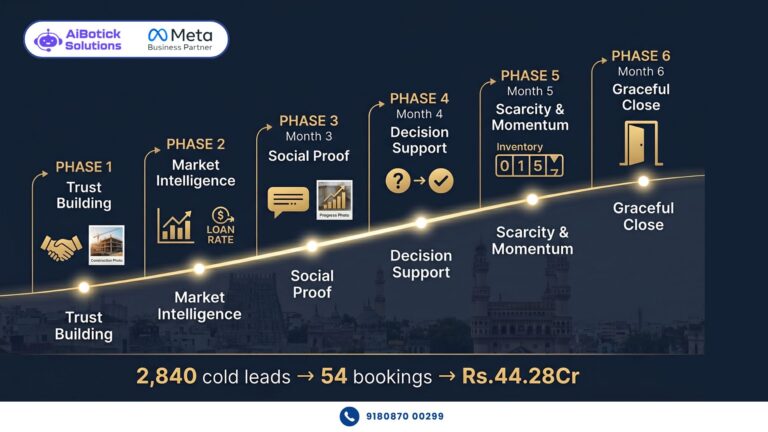
But they add one difference: A fully automated WhatsApp sales system — instant response bot, lead qualification, property brochure delivery, site visit booking, 6-month drip nurture.
Result: 1,310 leads over 6 weeks. 189 bookings. 14.4% conversion. Project sold out in 5 months.
Same market. Same product category. Same buyer pool.
2.7x better conversion. Project sold out in one-third the time.
That’s not a coincidence. That’s a system.
And the developers in Mumbai and Pune who’ve figured this out — they’re not keeping it a secret. Because the competitive advantage isn’t the technology. It’s the discipline to implement it properly and consistently.
Let me tell you exactly what they’re doing.
Why Mumbai and Pune Are India’s WhatsApp Real Estate Automation Frontline
Honest observation from 4+ years in WhatsApp automation across multiple cities — Mumbai and Pune buyers behave differently from buyers in Tier-2 and Tier-3 cities.
More digitally savvy. Higher expectations for response quality and speed. More comparison-shopping (typically evaluating 4-6 projects before deciding). Less patient with slow or manual communication. And critically — more likely to eliminate a developer from their shortlist based on communication quality alone, before the product is even properly evaluated.
This cuts both ways.
The bad news: Mumbai and Pune buyers are harder to impress and easier to lose.
The good news: A developer who communicates well — instantly, personally, informationally — stands out dramatically in a market where most competitors are still sending PDF brochures manually and calling back 6 hours late.
WhatsApp real estate automation is the tool that creates this differentiation. And the developers using it in these markets are cleaning up.
5 Mumbai and Pune Developers — What They’re Actually Doing Differently
These are composite examples — drawn from real implementations I’ve been involved in or observed directly, anonymised for privacy. But the systems, approaches, and numbers are real.
Developer 1 — Thane Township Project (2,000+ units)
The challenge: Large-scale township. Multiple configurations — 1, 2, 3 BHK across 8 towers. 12 sales executives handling thousands of leads. Chaos. Wrong configuration information sent to buyers. Agents forgetting follow-ups. No visibility on lead status.
What they implemented:
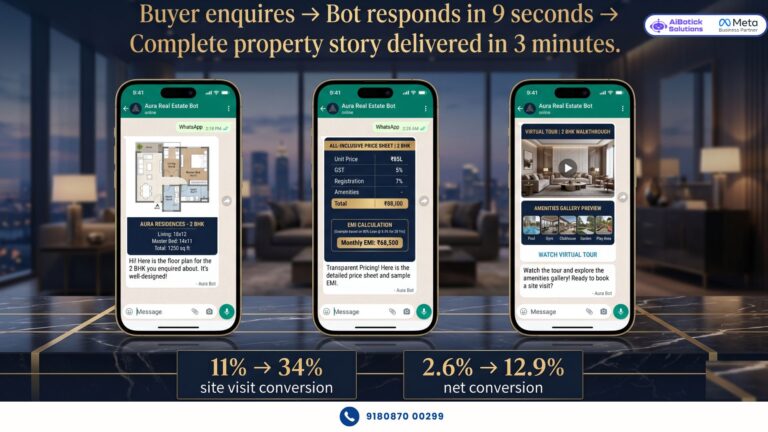
Full WhatsApp real estate automation with configuration-specific information flows. Buyer selects preferred configuration — bot delivers the exact floor plans, pricing, and amenity details for that specific unit type only. Not a generic brochure dump.
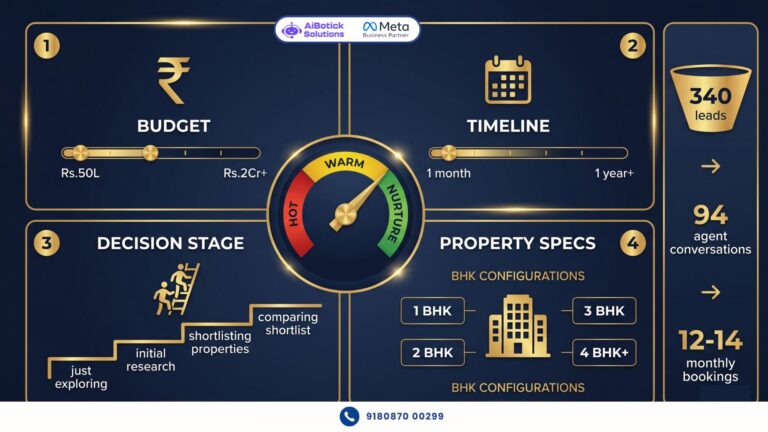
Lead scoring system with 4 dimensions (budget, timeline, self-occupier vs investor, configuration match). Hot leads immediately assigned to specific agents with full buyer context. Warm leads in 6-month nurture. All tracked in a centralised AiBotick dashboard.
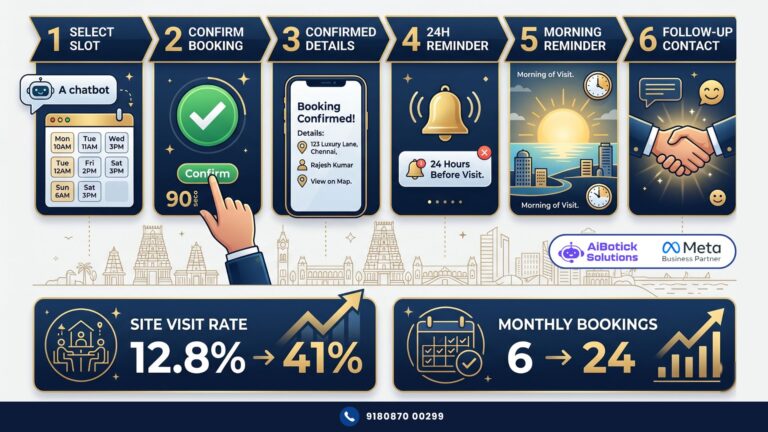
Site visit booking with automated reminders and no-show recovery.
Post-visit 14-day follow-up sequence — specific to what the buyer expressed interest in during the visit.
Result after 90 days:
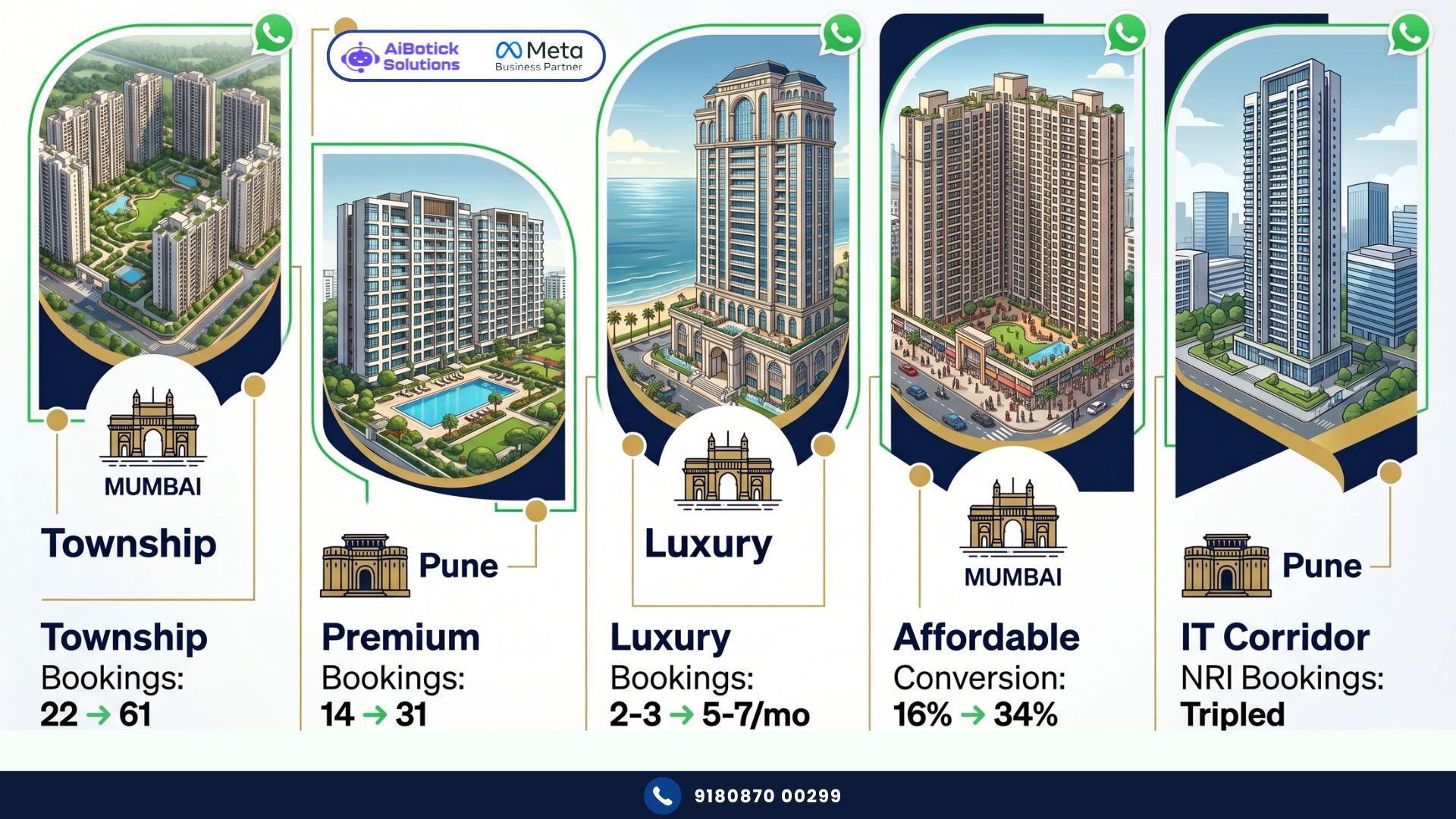
Site visit conversion from enquiry: from 11% to 38%. Booking conversion from site visit: from 20% to 29%. Monthly bookings: from 22 to 61. Agent time on scheduling/information delivery: from 60% to 18% (agents spend 82% of time now on actual sales conversations).
The thing that surprised them most: Agent retention improved. Three agents had submitted resignations before the system was implemented — citing “the work is exhausting and repetitive.” After implementation — all three withdrew their resignations. Because their job became more engaging and less administrative.
Developer 2 — Wakad Residential Project, Pune (380 units, Rs.65L-Rs.95L)
The challenge: Premium positioning, but competing against 4-5 similar projects in the same micro-market. Buyers comparing aggressively. Sales team struggling to differentiate in conversations.
What they implemented:
Differentiation through information quality. WhatsApp real estate automation set up to deliver deeper, more specific information than any competing developer.
Every lead received: Unit-specific floor plans (not generic). Micro-market analysis (why Wakad, what infrastructure is coming, appreciation data). Honest possession timeline with RERA details. Resident testimonials from their earlier completed project.
Most importantly — a “project comparison guide” message (Month 2 of nurture): “We know you’re comparing [Project Name] with [2-3 competitors typically mentioned by buyers]. Here’s an honest comparison across the 5 factors buyers tell us matter most: [Actual comparison on price/sq ft, amenities, possession security, developer track record, location advantage].”
Including the competitor names — and doing an honest comparison — was a calculated trust move. Most buyers were making that comparison anyway. By doing it for them, transparently, this developer gained enormous credibility.
Result:
Sales cycle reduced by 40%. Buyers who received the comparison guide were significantly more likely to book without extensive additional back-and-forth. The transparency about competition ironically accelerated commitment.
Monthly bookings improved from 14 to 31 within 90 days.
Developer 3 — South Mumbai Luxury Project (Rs.3.5Cr to Rs.8Cr)
The challenge: Ultra-premium positioning. Buyers at this price point — CEOs, senior professionals, NRIs — have very different expectations. They’re not impressed by standard automation responses. They need to feel personally attended to.
What they implemented:
Here’s where it gets interesting. They didn’t use automation to replace personal attention — they used it to enable better personal attention.
Bot handles the initial information delivery, qualification, and scheduling. But every message is written to sound like it came from the agent personally. Every message references specific buyer details captured in the qualification flow. Every site visit confirmation comes with the director’s personal note (written once, sent automatically but personalised).
And the key innovation — when a hot lead is identified, the agent receives not just the lead details but a 3-line brief: “Buyer profile: Senior executive, upgrading from current 3 BHK in Bandra, budget flexible up to Rs.7Cr, specific concern about south-facing unit availability, timeline: within 2 months.”
Agent walks into the conversation knowing exactly what to say and what not to say. First interaction feels like the agent has known the buyer for weeks.
Result:
This is a low-volume, high-value business. Before implementation — 2-3 bookings per month. After — 5-7 bookings per month. Not dramatic in number, but at average Rs.5Cr per booking — the revenue impact is Rs.1-2Cr additional monthly. From the same team, same leads.
Developer 4 — Kalyan Affordable Housing Project, Mumbai (Rs.35L-Rs.55L)
The challenge: Completely different problem. Affordable housing buyer — first-time buyer, often unfamiliar with the process, needs significant handholding on home loan eligibility, documentation, PMAY benefits, stamp duty. Sales team spending enormous time on education rather than selling.
What they implemented:
WhatsApp real estate automation specifically for first-time buyer education.
Dedicated bot flows for: PMAY subsidy eligibility check (bot asks income, existing property ownership, family size — instantly tells buyer if they qualify and approximate subsidy amount), home loan eligibility calculator (inputs income, existing EMIs, expected tenure — outputs eligible loan amount and monthly EMI), document checklist for booking and registration, step-by-step guide to the booking process.
All of this delivered conversationally on WhatsApp — the channel these buyers were already comfortable with.
Result:
First-time buyer anxiety — the #1 reason for purchase hesitation in affordable housing — reduced dramatically. Buyers arrived at site visits already understanding the financial picture, already knowing their eligibility, already familiar with the process.
Booking conversion from site visit went from 16% to 34%. Not because the product changed. Because the buyer’s confidence in the process changed.
Developer 5 — Hinjewadi IT Corridor Project, Pune (Rs.55L-Rs.85L, primarily IT professional buyers)
The challenge: IT professional buyers — young, analytical, research-oriented. Not easily impressed by sales pitches. High comparison shopping. And specific to this segment — many are NRIs or have NRI family members who are co-decision-makers living outside India.
What they implemented:
NRI-specific WhatsApp automation flow — time zone adjusted reminders, rupee and USD pricing alongside each other, NRI home loan eligibility guide, FEMA compliance information, power of attorney documentation process guidance.
For domestic IT buyers — ROI-focused content. Rental yield data for the micro-market. Historical appreciation rates. Comparison with alternative investment options (FD, mutual funds, this property). Not emotional appeals — financial analysis.
Result:
NRI buyer bookings tripled within 6 months. Not because there were more NRI leads — but because the NRI-specific communication flow addressed concerns that were previously being handled poorly (or not at all) by the sales team.
The Pattern Across All 5 — What They All Have in Common
Actually wait — looking across these 5 examples, I want to name the common thread explicitly. Because it’s not “they all used WhatsApp automation.” That’s the tool. The pattern is deeper.
Every single one of these developers stopped treating all buyers the same.
Township project: different flows for different configurations. Wakad project: different messaging for comparison-stage buyers. South Mumbai: different depth for ultra-premium buyers. Kalyan: different content for first-time buyers. Hinjewadi: different language and data for IT/NRI buyers.
WhatsApp real estate automation made this segmentation operationally possible. Because you can’t manually personalise at scale — it’s physically impossible. But with automation — every buyer gets a communication experience that feels tailored to them specifically.
That tailoring — that’s what converts.
What Most Mumbai and Pune Developers Still Get Wrong
Honestly bhai — one mistake above all others. And it’s surprising how common it is even among technically sophisticated developers.
They automate the top of the funnel. And ignore the post-booking journey.
Booking confirmed. Buyer hands over the token amount. And then — silence. Or at best, occasional project update emails that look like they were designed in 2010.
The post-booking period — from booking to possession — can be 2-4 years for under-construction projects. That’s 2-4 years of relationship with a buyer who:
- Has referral networks (friends, colleagues who are also looking for property)
- May want to invest in your next project
- Can provide testimonials for your marketing
- Is sharing their experience — positive or negative — with their social circle
Every interaction in that 2-4 year period either builds or erodes that relationship.
WhatsApp real estate automation for the post-booking journey: monthly construction updates, possession milestone celebrations, possession handover checklist, society formation updates, rental assistance for investors — all automated, all personal, all building loyalty that generates referrals.
The developers in this article who are doing this post-booking communication well — they report 25-35% of new bookings coming from referrals from existing buyers. That’s essentially free acquisition from buyers whose purchase journey you managed well.
For how lead qualification connects to the overall real estate WhatsApp automation system — our WhatsApp lead qualification guide shows how intelligent filtering makes the rest of the system work better.
What Makes 2026 Different — Why Now Is the Time
I want to address this specifically. Because I get asked: “Is WhatsApp real estate automation really mainstream now, or is it still early?”
Still early. Barely.
The developers in this article represent maybe 8-12% of mid-to-large developers in Mumbai and Pune who have implemented anything resembling a systematic WhatsApp real estate automation approach.
The other 88-92%? Still manually responding. Still sending PDF brochures. Still calling back 4-6 hours late. Still losing leads after hours.
Which means — the window for competitive advantage from WhatsApp automation in Mumbai and Pune real estate is still open. But it’s closing. Every month, a few more developers figure this out.
The ones implementing now — they’re building a system that takes 6-12 months to fully optimize. Leads nurtured today in 6-month drip sequences become bookings in H2 2026 and 2027. Relationships being built now compound.
The ones who wait another year? They’ll be implementing when most of their competitors already have a 12-18 month head start on lead databases, nurture sequences, and conversion optimization.
For how to calculate what this WhatsApp real estate automation system is worth for your specific project — our WhatsApp automation ROI guide has the real estate specific framework.
How to Start — Exactly What Mumbai and Pune Developers Do First
Based on watching multiple implementations — here’s the fastest path to measurable results:
Week 1: Instant response bot + basic property information delivery. This alone — 8-second response, 24×7 — immediately captures after-hours leads your team is currently missing. Measurable within 7 days.
Week 2-3: Lead qualification flow (4 dimensions). Agent notification with lead summary. Site visit booking with reminders. Site visit conversion improvement is visible within the first month.
Month 2: 6-month drip campaign for warm and cold leads. Starts building the pipeline that pays out in Month 4-6.
Month 3: Post-booking communication flow for all confirmed buyers. This is the referral engine. Slow to build but high compounding value.
Build in this order. Each layer delivers ROI before you invest in the next.
Toh yaar — ek direct question.
Aapka project Mumbai ya Pune mein hai. Competitors abhi bhi manually follow-up kar rahe hain. Buyers 11pm ko enquire kar rahe hain aur koi respond nahi kar raha.
Yeh window — competitors ke comfortable rehne ka — yeh hamesha nahi rahega.
The developers quoted in this article started implementing when most hadn’t. 12 months later — they’re not just ahead. They’re so far ahead that catching up requires more than implementation. It requires time — because lead nurturing databases, optimised sequences, and conversion learnings take months to build.
Tap below. 👇 Tell us your project location, unit count, average price, and current monthly lead volume — we’ll design your complete WhatsApp real estate automation system and show you what 90-day and 6-month impact looks like for your specific project.
— Mohit Shah | 15+ years in IT industry | 4+ years in WhatsApp automation | Worked with various MNC brands | Now helping businesses figure out what actually works
Q1: How are Mumbai and Pune real estate developers using WhatsApp automation differently in 2026?
A1: The most successful Mumbai and Pune developers in 2026 have moved beyond basic WhatsApp messaging to fully automated buyer journey systems — instant response bots (under 10 seconds, 24×7), configuration-specific property information delivery, 4-dimension lead qualification with automatic agent routing, site visit booking with reminder sequences, 6-month drip nurture for warm leads, and post-booking communication for confirmed buyers. The key differentiator is segmentation — different flows for different buyer types (first-time buyers, investors, NRIs, luxury buyers) rather than sending the same communication to all leads.
Q2: What conversion improvements are Mumbai and Pune developers seeing from WhatsApp real estate automation?
A2: Results vary by segment, but documented improvements include: township projects seeing site visit conversion improve from 11% to 38% and monthly bookings from 22 to 61; premium projects reducing sales cycle by 40% with bookings from 14 to 31 monthly; affordable housing projects improving site visit-to-booking conversion from 16% to 34% through buyer education flows; and luxury projects increasing monthly bookings from 2-3 to 5-7. The common thread across all segments is that buyers who receive timely, relevant, personalised WhatsApp communication convert at significantly higher rates than those handled through traditional manual follow-up.
Q3: Is it too late for Mumbai and Pune developers to gain competitive advantage from WhatsApp automation in 2026?
A3: No — the window is still open, though closing. Approximately 8-12% of mid-to-large developers in Mumbai and Pune have implemented systematic WhatsApp real estate automation. The majority are still using manual follow-up. Developers implementing now build a 6-12 month head start on lead database optimisation, nurture sequence refinement, and conversion learning that compounds over time. Developers who wait another 12-18 months will implement when competitors already have that advantage built in — making it operational catch-up rather than competitive differentiation.