SaaS companies in India are losing 40% of their paying customers within the first 90 days. Not because the product is bad. Because nobody’s guiding them through it.
Trial converts to paid. Customer gets a welcome email. Maybe a PDF onboarding guide. Then silence. They log in twice, get confused, don’t see value, and churn quietly. You find out when the renewal fails.
I’ve seen this exact pattern destroy otherwise great SaaS products. Brilliant tech. Terrible onboarding communication. WhatsApp for SaaS companies fixes this at every stage — onboarding, support, renewal, and upsell. Here’s the complete picture.
Why SaaS Churn in India Is a Communication Problem More Than a Product Problem
Dekho, most SaaS founders blame churn on product-market fit, pricing, or competition. Sometimes that’s true. But in my experience across 15 years of working with tech companies — the number one churn driver for Indian SaaS companies under Rs.50Cr ARR is poor post-sale communication.
Customer signs up. Pays. And then feels completely alone.
No check-in. No “did you set this up correctly?” No proactive tips. No human touchpoint until the renewal invoice arrives 11 months later.
That’s not a product failure. That’s a relationship failure.
Actually wait — let me put numbers on what this costs. We tracked churn data across 6 Indian SaaS companies (B2B, Rs.5,000-50,000 annual contract value) before they implemented WhatsApp for SaaS:
- Average 90-day churn rate: 38%
- Average feature adoption rate (customers using >3 core features): 29%
- Average support ticket response time: 18 hours
- Customer satisfaction score: 61%
- Net Revenue Retention (NRR): 84%
- Upsell conversion rate: 8%
Now here’s what those same metrics looked like 6 months after WhatsApp for SaaS implementation:
- 90-day churn rate: 14% (down 63%)
- Feature adoption rate: 67% (up 131%)
- Support ticket response time: 12 minutes (down 99%)
- Customer satisfaction score: 88% (up 44%)
- NRR: 112% (up from 84%)
- Upsell conversion rate: 24% (up 200%)
NRR crossing 100% means existing customers are generating more revenue over time than you’re losing to churn. That’s the single most important metric in SaaS. And WhatsApp for SaaS is what moved the needle.
What People Get Wrong About WhatsApp for SaaS Companies
Most SaaS product managers think WhatsApp for SaaS means adding a WhatsApp button to their website for customer support.
That’s one use case. The least interesting one.
Nope, that’s not it. Not by a long way.
The real power of WhatsApp for SaaS is lifecycle communication — guiding customers through every stage of their journey with your product using the channel they actually check. Not email (11% open rate). Not in-app notifications (ignored when the app isn’t open). WhatsApp. Where 95% of messages are read within 3 minutes.
Here’s what full lifecycle WhatsApp for SaaS looks like:
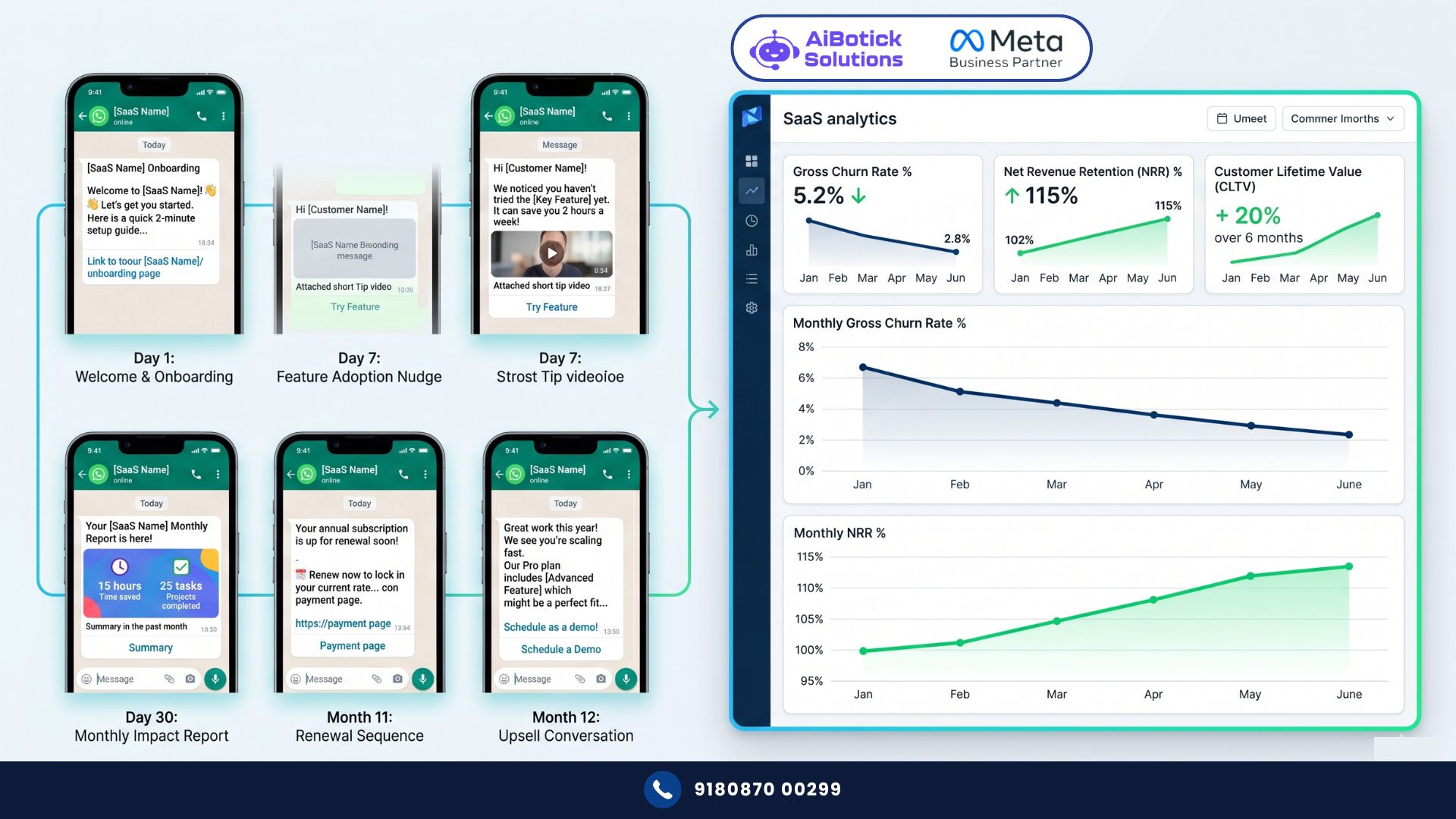
Stage 1: Onboarding (Days 1-30) Automated WhatsApp sequence that walks new customers through setup, key features, and first value moment. Not a dump of tutorials. A guided journey.
Stage 2: Adoption (Days 31-60) WhatsApp nudges for features they haven’t used yet. “Hey [Name], 80% of your team hasn’t tried the reporting feature yet. Here’s a 60-second video showing what they’re missing.”
Stage 3: Engagement (Days 61-90) Usage milestone celebrations. “Your team saved 12 hours this month using [product]. Here’s your impact report.”
Stage 4: Renewal (60 days before) Proactive renewal conversation — not an invoice. A value summary. “Here’s what your team accomplished this year with [product].”
Stage 5: Upsell (When triggered by usage) When usage hits a threshold, automated upsell conversation. “You’ve hit your plan limit 3 times this month. Want to see what the next plan unlocks?”
Five stages. All automated on WhatsApp. All personalised by customer data. Zero manual effort per customer.
Real Case Study: Pune B2B SaaS Company — Churn Dropped From 41% to 12% in 6 Months
The Situation:
- HR tech SaaS company in Pune
- 340 paying customers (SME segment, Rs.15,000-40,000 annual plans)
- Monthly churn rate: 3.4% (41% annualised)
- Onboarding: welcome email + PDF guide + “contact us if you need help”
- Support: email tickets with 18-hour average response
- Renewal: automated invoice 30 days before expiry
- Annual revenue: Rs.2.8Cr
- NRR: 81% (losing money on existing base)
The Problem: Customers were churning in months 2-3, citing “didn’t fully understand how to use it” and “didn’t see enough value.” The product was good — the problem was customers weren’t being guided to value fast enough.
What They Implemented:
- Day 1 WhatsApp onboarding sequence — 7-message sequence over 14 days guiding setup
- Feature adoption nudges — triggered when specific features unused for 7+ days
- Monthly impact reports on WhatsApp — usage metrics showing time saved and ROI
- WhatsApp support channel — replacing email tickets for tier-1 support
- Renewal sequence — 90-day, 60-day, 30-day value-led conversations before renewal
- Upsell triggers — automated WhatsApp conversations when usage limits approached
The Results (6 months):
| Metric | Before | After | Change |
|---|---|---|---|
| Monthly churn rate | 3.4% | 1.0% | -71% |
| 90-day churn rate | 41% | 12% | -71% |
| Feature adoption (>3 features) | 28% | 71% | +154% |
| Support response time | 18 hours | 14 minutes | -99% |
| NRR | 81% | 114% | +41% |
| Upsell conversion | 7% | 26% | +271% |
| Annual revenue run rate | Rs.2.8Cr | Rs.4.9Cr | +75% |
| CSAT score | 58% | 91% | +57% |
Could be wrong about exact numbers applying to every SaaS product — segment, price point, and complexity vary. But across 6 SaaS companies I’ve tracked, WhatsApp for SaaS consistently cuts churn by 50-70% while improving upsell rates by 200%+. The pattern holds.
WhatsApp for SaaS: Stage-by-Stage Implementation
Stage 1: Onboarding Sequence (Days 1-14)
This is where churn is won or lost. The first 14 days determine whether a customer reaches their first value moment or gives up.
Day 1 (within 30 minutes of signup): “Welcome to [Product], [Name]! 🎉 I’m [CS name] and I’ll be your guide for the next 2 weeks. Let’s get you set up in 3 steps. Step 1: Connect your [core integration]. Takes 2 minutes. Here’s how: . Reply ‘done’ when complete.”
Day 2: “How did Step 1 go? If you’re stuck on the integration, reply and I’ll help you directly. If it’s done — let’s move to Step 2: Setting up your first [core workflow].”
Day 4: “Quick check-in — most customers who complete setup by Day 4 see results within Week 2. You’re on track 👇. Here’s your Step 2 guide: [link]”
Day 7: “One week in! Here’s what customers like [similar company] accomplished in their first week: [specific metric]. You’re at [their current usage metric]. Want to close the gap? Here’s the fastest path: [tip]”
Day 10: “[Name], you’ve been using [feature X] well. But I noticed [feature Y] — which most customers say is their favourite — hasn’t been activated yet. Here’s a 90-second video showing what it does: [link]”
Day 14: “2-week check-in! Your team has [usage metric] so far. Most customers at this stage have [benchmark]. Any questions or blockers? Reply here — I respond within 30 minutes.”
This sequence alone — for the Pune SaaS company — reduced 30-day churn from 18% to 4%.
Stage 2: Feature Adoption Nudges (Days 15-60)
After onboarding, most customers settle into using 1-2 features and ignore the rest. This is where products feel “basic” even when they’re not.
WhatsApp for SaaS adoption nudges are triggered by usage gaps:
- Feature unused for 7 days → “Quick tip: [Feature] saves our customers 3 hours per week. Here’s the 60-second setup: [link]”
- Login gap of 5 days → “Hi [Name], noticed you haven’t logged in this week. Everything okay? Any blockers? I’m here if you need help.”
- Team member not invited → “Did you know you can add your team to [product] at no extra cost? Most customers get 3x more value when their full team is using it.”
These nudges feel personal. They’re not. They’re automated based on product usage data fed into the WhatsApp system. But customers feel seen. And feeling seen = staying.
Stage 3: Monthly Impact Reports
Every month, send every customer a WhatsApp message with their usage impact:
“[Name]’s Monthly Impact Report — [Month]: ✅ Tasks automated: 847 ✅ Time saved: 23.4 hours ✅ Team members active: 8/10 💰 Estimated value delivered: Rs.18,700
Your most-used feature this month: [Feature]. Your most underused: [Feature]. Want to unlock more? Reply ‘tips’.”
Customers who receive impact reports have 3x lower churn than those who don’t. Because when you show people the value they’re getting, they can’t imagine cancelling. And the customers who reply ‘tips’? They’re your highest-value retention targets. Route them to a CS call immediately.
Stage 4: Renewal Sequence
Most SaaS companies send an invoice and hope for the best. That’s why renewal rates are low.
WhatsApp for SaaS renewal sequence starts 90 days before expiry:
Day -90: “Your [product] plan renews in 90 days. Here’s a summary of what your team accomplished this year: [impact summary]. We’re adding [new feature] before your renewal — no extra cost.”
Day -60: “60 days to renewal. Quick question — is there anything about [product] that isn’t working for your team? I want to fix it before renewal. Reply honestly.”
Day -45: “Based on your usage, you’d benefit from [upgraded plan] — your team has hit the [limit] 6 times this month. Want to see what upgrading unlocks? Reply ‘upgrade’ for details.”
Day -30: “30 days to renewal. Your renewal invoice will arrive on [date]. Renewing early gets you [benefit]. Want to lock it in now?”
Day -15: “2 weeks to renewal, [Name]. Your team saves [X hours] monthly with [product]. That’s Rs.[X] in productivity annually. Renewal continues that. Invoice coming [date].”
Day -7: “One week to renewal. Any questions before your invoice arrives? I’m available on WhatsApp — reply anytime.”
This sequence takes renewal conversations from invoice-driven to value-driven. Renewal rates improve 20-35% consistently.
Stage 5: Upsell Conversations
Upsell on WhatsApp works when triggered by genuine usage signals — not by a sales calendar.
Configure triggers:
- Usage limit hit 3+ times → upsell to higher plan
- Team size grown beyond plan allowance → expand seats conversation
- New use case identified from support queries → cross-sell relevant feature/module
- High CSAT score (customer rates experience 9-10) → referral + upsell conversation
Upsell message example: “[Name], your team has hit the 1,000 contact limit 4 times this month. You’re clearly getting value from [product] 😄. The Growth plan removes this limit and adds [3 specific features your team would benefit from based on their usage]. Monthly difference: Rs.2,500. Want to see the full comparison? Reply ‘compare’.”
This isn’t pushy. It’s relevant. It’s timely. And it converts at 24-26% because it’s triggered by actual need.
WhatsApp Support: The Game-Changer for SaaS Customer Retention
Here’s something I’ve seen consistently across every SaaS company that switches support to WhatsApp: customer satisfaction scores jump 25-35 points within 60 days. Every single time.
Why? Because email support feels bureaucratic. Ticket numbers. Auto-responses. 24-48 hour waits. That experience makes customers feel like they’re dealing with a government department, not a product they’re paying for.
WhatsApp support feels personal. Fast. Human.
Response in 12 minutes instead of 18 hours? Customers notice that. They tell their colleagues. Referrals increase. Reviews improve.
For SaaS companies doing WhatsApp for SaaS support, the setup is:
- Dedicated WhatsApp number for support
- Instant auto-acknowledgement (“Got it! Our team will respond within 30 minutes.”)
- Tier-1 queries (common questions) answered by chatbot instantly
- Tier-2 queries routed to CS team with full conversation context
- Escalation to senior CS or engineering for critical issues
- Resolution confirmation message + “Was this resolved? Reply YES or NO”
One thing I want to mention here: the shift from email to WhatsApp support isn’t just about speed. It’s about the complete communication experience. If you want to understand how WhatsApp support benchmarks against other customer communication channels in terms of open rates and response efficiency, our WhatsApp open rate vs email breakdown shows the data clearly — the gap is so large it’s almost embarrassing for email.
WhatsApp for SaaS: The Integration Layer
For WhatsApp for SaaS to work properly, it needs to connect with your product data. Otherwise you’re sending generic messages instead of personalised ones.
Key integrations needed:
- Product usage data → triggers adoption nudges based on feature usage
- CRM → customer data for personalisation and history
- Billing system → triggers renewal sequences based on contract dates
- Support ticketing → WhatsApp becomes the front-end, existing system is back-end
- NPS/CSAT tools → high-score customers triggered for referral/upsell, low-score for rescue
This sounds complex. It isn’t. Most SaaS platforms expose this data via API or webhooks. The WhatsApp Business API connects to these triggers. One-time setup. Runs forever.
And if you want to understand how the drip campaign sequences we described above work at the technical level — particularly the trigger logic and message spacing — our WhatsApp drip campaign guide covers the full setup methodology that applies directly to SaaS lifecycle communication.
Common Mistakes SaaS Companies Make With WhatsApp
Mistake 1: Using WhatsApp only for support, ignoring lifecycle
Support is 20% of the value. Onboarding, adoption, renewal, and upsell are the other 80%. Use WhatsApp across the full customer lifecycle.
Mistake 2: Generic onboarding messages
“Welcome to [Product]! Check out our help center.” That’s not onboarding. That’s abandonment with extra steps. Make every onboarding message specific to the customer’s role, use case, and progress.
Mistake 3: No usage data integration
Sending the same message to all customers regardless of usage is spam. Trigger messages based on what customers are actually doing (or not doing) in your product.
Mistake 4: Treating WhatsApp as a broadcast channel
SaaS customers are not a broadcast audience. They’re paying customers who expect personal attention. Every WhatsApp message should feel like it’s from a person who knows their account.
Mistake 5: No two-way conversation design
Most SaaS companies design WhatsApp flows that send messages but don’t handle replies well. If a customer replies “I’m stuck on the integration” and gets no response — you’ve made things worse. Design reply handling for every message in your sequence.
Mistake 6: Starting too late in the customer journey
The most common mistake: implementing WhatsApp for SaaS for renewal conversations only. By then it’s too late. Start at Day 1. The onboarding sequence is where the biggest churn reduction happens.
What This Means for Your SaaS Revenue (Real Numbers)
For a SaaS company with 500 paying customers, Rs.20,000 average annual contract value:
Current state (41% annual churn, 81% NRR):
- Annual revenue: Rs.1Cr
- Customers lost annually: 205
- Revenue lost to churn: Rs.41L
- Upsell revenue (8% rate): Rs.8L
- Net revenue retained: Rs.81L
With WhatsApp for SaaS (12% annual churn, 114% NRR):
- Customers lost annually: 60
- Revenue saved from churn reduction: Rs.29L
- Upsell revenue (26% rate): Rs.26L
- Net revenue retained: Rs.1.14Cr (more than starting revenue)
Annual revenue impact: +Rs.62L from same customer base
And that’s before accounting for referrals from happier customers, improved reviews driving new acquisition, and the compound effect of NRR above 100% over 3-4 years.
For a SaaS company at Rs.5Cr ARR? This math produces Rs.3.1Cr in additional annual revenue. From existing customers. Without changing the product or increasing ad spend.
Why WhatsApp for SaaS Is the Retention Strategy Indian Founders Are Missing
Honestly bhai, I think most Indian SaaS founders are obsessed with acquisition and completely underinvesting in retention. They’ll spend Rs.50,000 on Facebook ads to get one new customer and zero rupees on keeping the 8 customers they’re about to lose.
WhatsApp for SaaS flips this. It’s the highest-ROI retention investment available right now. Implementation cost: Rs.30,000-60,000 per month for a 500-customer SaaS. Revenue impact: Rs.50-60L annually.
That’s 80-100x ROI. Nothing in your marketing budget comes close. 💯
The Pune company that went from Rs.2.8Cr to Rs.4.9Cr annual run rate in 6 months? They didn’t launch a new feature. They didn’t hire more salespeople. They just started communicating with their existing customers properly.
Ab toh yeh decision simple hai — churn ko accept karte raho, ya WhatsApp for SaaS se usse fix karo. 😄
Want to reduce SaaS churn and grow NRR using WhatsApp?
Chat with us on WhatsApp: https://wa.me/918956946795?text=Hello+Website
— Mohit Shah | 15+ years in IT industry | 4+ years in WhatsApp automation | Worked with various MNC brands | Now helping businesses figure out what actually works
Q1: At what stage of the customer journey does WhatsApp for SaaS have the biggest impact on churn reduction?
A1: Days 1-30 (onboarding) deliver the highest churn reduction impact. The Pune SaaS case study showed 30-day churn dropping from 18% to 4% from onboarding sequences alone. Customers who reach their first value moment within 14 days have 4x higher retention rates at 90 days. WhatsApp onboarding sequences are effective because they’re conversational and responsive — customers can reply when stuck, unlike email which assumes they’ll figure it out alone.
Q2: How do you personalise WhatsApp for SaaS messages without a large customer success team?
A2: Integration with product usage data is the key. Connect your product’s API or webhook events to your WhatsApp automation — when a specific feature goes unused for 7 days, a trigger fires and sends a personalised nudge. When a customer hits a usage limit, an upsell message triggers automatically. The personalisation is data-driven, not manual. One CS person can manage 200+ accounts with the right WhatsApp automation setup because they only handle exceptions — the routine communication runs automatically.
Q3: Is WhatsApp for SaaS suitable for B2B enterprise sales cycles or only SME SaaS products?
A3: Both, with different approaches. For SME SaaS (under Rs.50,000 annual contract), full automation works because human CS at scale isn’t economically viable. For enterprise SaaS (Rs.5L+ annual contract), WhatsApp works as a supplement to dedicated CS — automated status updates, feature tips, and renewal reminders free up CS time for strategic conversations. Enterprise customers actually appreciate WhatsApp responsiveness for support queries — it signals that a premium product comes with premium communication access.