Your sales team sleeps. Your AI chatbot doesn’t.
That’s the simplest way to explain why a WhatsApp AI chatbot has gone from “nice to have” to genuinely necessary for any Indian business running serious customer communication on WhatsApp.
But let me go deeper than that. Because “AI chatbot” is one of the most misused terms in our industry right now — and if you don’t understand what it actually means, you’ll buy the wrong thing, set it up wrong, and wonder why it’s not working.
What a WhatsApp AI Chatbot Actually Is — And What It Isn’t
Let’s clear this up immediately because the confusion here is costing businesses real money.
There are two very different things being sold as “WhatsApp AI chatbot” in the market:
Type 1 — Rule-based chatbot (NOT AI) This is a decision tree. You set up: if user says X, reply with Y. If user clicks button A, go to flow B. It’s logic, not intelligence. It cannot handle anything outside the pre-defined flow. Customer asks something unexpected — bot breaks, loops, or sends “I didn’t understand that.”
Most platforms sell this as an “AI chatbot.” It’s not. It’s a very sophisticated autocomplete.
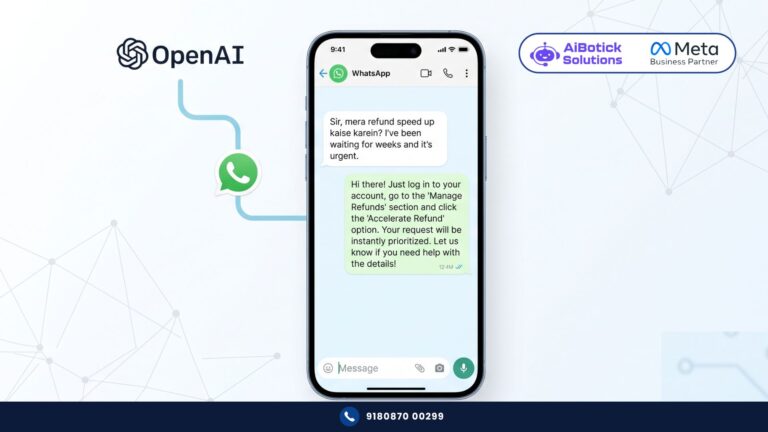
Type 2 — Actual AI chatbot (powered by LLMs like OpenAI or Gemini) This understands natural language. It can handle questions it’s never been specifically programmed to answer. It remembers context from earlier in the conversation. It detects intent — even when the customer phrases something unusually. It responds like a knowledgeable human, not like a machine reading a script.
This is what a real WhatsApp AI chatbot looks like. And this is what we’re talking about in this article.
Honestly? I think 80% of what’s marketed as “AI chatbot” in the WhatsApp space right now is Type 1 dressed up in Type 2 clothing. Ask any platform to demo a conversation where the customer asks something off-script. That’s your filter.
How a WhatsApp AI Chatbot Actually Works — Without the Technical Jargon
I’ve explained this to business owners across industries over the last 4 years. Here’s the version that makes it click.
Think of a WhatsApp AI chatbot as a very well-trained employee who:
- Has read every piece of content about your business — your website, your product catalog, your FAQs, your pricing, your policies
- Is available 24/7, never takes a day off, never gets tired
- Can handle 500 conversations simultaneously without getting confused
- Remembers what was discussed earlier in the same conversation
- Knows when to answer and when to say “let me connect you to a specialist”
- Gets smarter over time as it learns what customers are actually asking
Behind the scenes, here’s what’s happening technically — in plain language:
Step 1: Customer sends a message on WhatsApp.
Step 2: The message goes to the WhatsApp Business API.
Step 3: AiBotick’s platform receives the message and passes it to the AI engine (OpenAI or Gemini, depending on your setup).
Step 4: The AI engine processes the message — understanding intent, context, language (including Hinglish, regional phrasing, typos) — and generates a response.
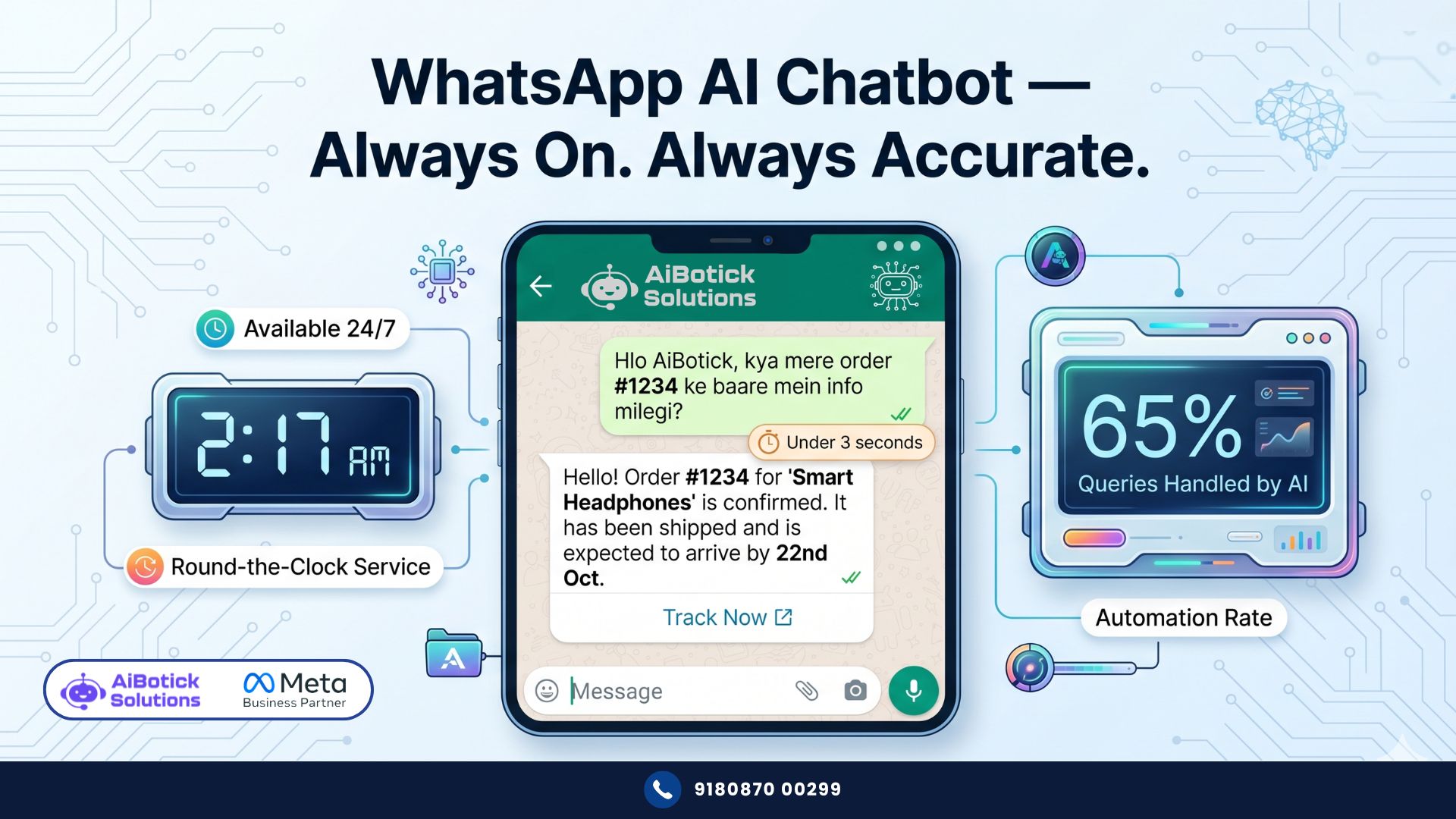
Step 5: The response comes back through AiBotick and is sent to the customer on WhatsApp. Usually in under 3 seconds.
Step 6: If the AI detects the query needs a human — a complaint, a complex negotiation, a sensitive situation — it flags the conversation and routes it to the right agent in the shared inbox.
The whole thing runs silently in the background. Customer sees a fast, helpful, conversational response. They have no idea whether it’s human or AI — and when it’s done well, they don’t care.
Why WhatsApp AI Chatbot Changes the Economics of Customer Communication
Here’s the business case — in numbers, not theory.
A typical Indian mid-size business with 200 inbound WhatsApp conversations per day across sales, support, and general enquiries:
Without a WhatsApp AI chatbot:
- Needs 4-5 agents to handle volume during business hours
- 0 responses between 8pm and 9am
- Average response time: 20-45 minutes during the day
- 40-50% of queries are repetitive (pricing, availability, process, status)
- Agent burnout on repetitive queries reduces quality of complex conversation handling
With a WhatsApp AI chatbot:
- AI handles 55-70% of queries automatically (all the repetitive ones)
- 24/7 availability — no lead or query goes unanswered
- Response time: under 5 seconds for automated queries
- Agents focus only on conversations that genuinely need humans — complex sales, complaints, edge cases
- Agent satisfaction goes up because work is more interesting and meaningful
The maths: if AI handles 65% of 200 daily conversations, that’s 130 conversations per day that don’t need a human. At 4 minutes average handling time per conversation — that’s 520 minutes of human time saved per day. Over a month: 260 hours. At a reasonable team cost — that’s significant real money.
And the business impact goes beyond cost savings. Because the AI is available at 2am when a motivated buyer is ready to purchase. Because the AI doesn’t have a bad day and give a short, unhelpful response. Because the AI scales instantly when you run a campaign and inbound volume triples overnight.
Real Example — How an EdTech Company Used WhatsApp AI Chatbot to Handle Admissions at Scale
A competitive exam coaching institute in Delhi. 3-month admission season. Average 400 inbound WhatsApp enquiries per day at peak.
Before WhatsApp AI chatbot: 6 counsellors, overwhelmed, average response time 3-4 hours, leads going cold overnight, conversion rate 9%.
They built a WhatsApp AI chatbot on AiBotick trained on:
- All their course information, fees, batch timings
- FAQs from 2 years of previous admissions
- Scholarship and payment plan details
- Comparison of their courses vs competitors (their own version, obviously)
The AI chatbot handled:
- Initial enquiry response — instantly, 24/7
- Course recommendation based on student’s exam target and current level
- Fee and batch queries — fully automated
- Demo class registration — via WhatsApp Flows, no human needed
- Follow-up sequences — Day 1, Day 3, Day 7 for non-converted leads
Counsellors only stepped in for: scholarship negotiations, students with complex academic backgrounds, and final conversion calls for high-intent leads.
Result in one admission season:
- Response time: from 3-4 hours to under 30 seconds
- Counsellor capacity effectively tripled (same team handling 3x volume)
- Conversion rate: from 9% to 21%
- Revenue impact: significant — same team, same marketing spend, 2.3x admission numbers
No no, scratch that — the most impressive number wasn’t conversion rate. It was the 11pm enquiries. Previously, those led to a morning response — by which time the student had enrolled somewhere else. With the AI chatbot running overnight, those 11pm enquiries got instant responses, course recommendations, and demo class registrations completed before midnight. Those students were already committed before any human had their morning chai. 😄
What Makes a Good WhatsApp AI Chatbot — The 6 Non-Negotiables
Not all WhatsApp AI chatbot implementations are equal. Here’s what separates the ones that work from the ones that frustrate customers and get switched off after 2 weeks.
1. Language Flexibility
Indian customers don’t communicate in textbook English. They write in Hinglish. They use regional phrasing. They make typos. They switch languages mid-message.
“Bhai course ka fee kitna hai?” needs to be understood as a pricing query. “Whts d last date 4 admission?” needs to be understood as a deadline query.
A good WhatsApp AI chatbot handles all of this without breaking. A rule-based bot fails on all of it.
2. Contextual Memory
If a customer says “I’m interested in the 6-month course” in message 1, and then asks “what’s included?” in message 3 — the bot needs to know they mean “what’s included in the 6-month course.” Without contextual memory, the bot asks “which course?” again. Annoying. Unprofessional. Customers leave.
3. Smart Escalation
The AI needs to know its limits. When a conversation turns emotional — a complaint, a refund request, a difficult situation — the AI should recognise this and hand off to a human immediately. With full context passed along, so the agent isn’t starting from scratch.
Actually wait — this is the feature most businesses don’t think about until it fails. Poor escalation = customer venting to a bot that keeps giving canned responses. That’s a PR disaster waiting to happen.
4. Knowledge Base Accuracy
The AI is only as good as what it’s trained on. Garbage in, garbage out. Your WhatsApp AI chatbot needs to be trained on accurate, up-to-date business information — pricing, policies, product details, FAQs. And it needs to be updated when things change.
5. Clear Human Handoff Path
Customers should always have a way to reach a human if they want to. “Talk to our team” as a button option at any point in the conversation. Transparency builds trust — even if the AI handles 70% of queries, customers should know humans are available.
6. Conversation Analytics
What are customers asking most? Where is the bot failing? Which questions are causing drop-off? A good WhatsApp AI chatbot implementation gives you this data — so you can continuously improve the bot’s responses and catch gaps before they hurt conversions.
For more on the underlying chatbot architecture and how to build your first flows — our guide on building a WhatsApp chatbot without coding walks through the practical setup in detail.
What People Get Wrong About WhatsApp AI Chatbots
Wrong belief #1: “AI chatbot will replace our entire team.”
Nope. AI chatbot replaces repetitive, low-value queries. It frees your team to focus on high-value conversations — the ones that actually need human judgment, empathy, and relationship-building. The businesses doing this well have happier human teams, not smaller ones.
Wrong belief #2: “Customers hate chatbots — they want humans.”
Customers hate BAD chatbots. They hate bots that don’t understand them, loop endlessly, or can’t escalate. A well-built WhatsApp AI chatbot that answers accurately in seconds — customers love that. The frustration is with poor implementation, not AI itself.
Wrong belief #3: “Setting up a WhatsApp AI chatbot is a huge technical project.”
On AiBotick — it’s not. The AI engine integration (OpenAI or Gemini) is built into the platform. You train it on your business information, define the escalation rules, test a few conversation flows, and you’re live. Most businesses are up and running in under a week. I’ve seen it done in 3 days for focused use cases.
Wrong belief #4: “AI chatbot is only for big companies.”
I’ve seen 8-person businesses completely transform their customer response capability with a WhatsApp AI chatbot. The technology isn’t big-company exclusive anymore. The cost is accessible. The setup is manageable. And the ROI kicks in faster for smaller teams because the relative impact of saving 3 hours of manual responses per day is much higher proportionally.
WhatsApp AI Chatbot Use Cases by Industry — Quick Reference
Different industries get different mileage from WhatsApp AI chatbots. Here’s where I’ve consistently seen the strongest impact:
Real Estate:
- Instant property enquiry handling at any hour
- Qualification questions (budget, location preference, timeline)
- Brochure and virtual tour delivery
- Site visit scheduling via WhatsApp Flows
Education:
- Admission enquiry handling during peak season
- Course recommendation based on student profile
- Fee and scholarship queries
- Demo class registration
E-commerce:
- Order status queries (fully automated with order integration)
- Return and refund initiation
- Product recommendations based on past purchases
- COD confirmation and abandoned cart recovery
Healthcare:
- Appointment booking and rescheduling
- Symptom triage and department routing
- Lab report delivery and query handling
- Post-consultation follow-up
Financial Services:
- Lead qualification for loans, insurance, investments
- Policy and product information queries
- Document checklist and status updates
- SIP and payment reminders
In each of these industries, the WhatsApp AI chatbot handles the volume, the repetition, and the after-hours queries — freeing human teams for the conversations that actually move the needle. For a comprehensive look at how this plays out specifically in customer support contexts, read our breakdown on how WhatsApp customer support automation handles 500 queries without a large team.
How to Get Started With a WhatsApp AI Chatbot on AiBotick
Seedha bolta hoon — here’s the practical path. No fluff.
Step 1 — Define your top 10 query types What are customers asking most? List the 10 questions your team answers repeatedly every day. These become the AI’s core training scenarios.
Step 2 — Prepare your knowledge base Compile: product/service details, pricing, FAQs, policies, process flows. The more accurate and detailed this is — the better the AI performs.
Step 3 — Set escalation rules Define exactly when the AI should hand off to a human. Keywords (refund, complaint, cancel, legal), emotional signals, query types that always need human judgment.
Step 4 — Build and train in AiBotick Upload your knowledge base, configure the AI engine, set escalation rules, define the conversation flow structure. Your onboarding team walks you through this.
Step 5 — Test with real scenarios Before going live — test 50 different customer messages. Include off-script questions, Hinglish, typos, emotional messages. See how the bot handles each. Fix what doesn’t work.
Step 6 — Go live and monitor week 1 closely First week is the learning week. Monitor conversations daily. Add to the knowledge base wherever the AI is underperforming. By week 2 — it’s typically running smoothly.
Step 7 — Review analytics monthly What’s the containment rate? What queries are still falling to humans? What’s the customer satisfaction on AI-handled conversations? Iterate based on data. 💯
Honestly? The Businesses Not Using WhatsApp AI Chatbots in 2026 Are Leaving Money on the Table
Could be wrong — but I’ve consistently seen this: the businesses that implement a well-built WhatsApp AI chatbot in 2026 are going to have a significant competitive advantage in their categories for the next 2-3 years.
Not because AI is magic. But because most of their competitors are still handling WhatsApp manually. Still missing 11pm enquiries. Still burning their team on repetitive queries. Still losing leads to faster-responding competitors.
The window where this is a differentiator is real. And it won’t stay open forever.
If you’re a business doing Rs.50L+ in revenue with real WhatsApp customer communication volume — a WhatsApp AI chatbot is not a luxury. It’s infrastructure. 😄
If you want to see a WhatsApp AI chatbot in action for your specific use case — Chat with us on WhatsApp and we’ll show you exactly how it would work for your business, your industry, and your team.
— Mohit Shah | 15+ years in IT industry | 4+ years in WhatsApp automation | Worked with various MNC brands | Now helping businesses figure out what actually works
Q1: What is the difference between a WhatsApp AI chatbot and a regular chatbot?
A1: A regular WhatsApp chatbot is rule-based — it follows pre-programmed decision trees and can only handle queries it’s been specifically set up for. If a customer asks something outside the flow, it breaks or loops. A WhatsApp AI chatbot uses large language models like OpenAI or Gemini to understand natural language, including Hinglish, typos, and unexpected phrasing. It can handle queries it’s never been specifically programmed for, remembers context from earlier in the conversation, and improves over time. The practical difference: rule-based bots handle predictable queries only; AI chatbots handle real conversations.
Q2: How much does a WhatsApp AI chatbot cost for an Indian business?
A2: The cost has two components. First, the platform subscription — AiBotick’s Scale plan (which includes AI chatbot capability powered by OpenAI and Gemini) starts at Rs.45,000 per year for businesses with Rs.1Cr to Rs.10Cr turnover. Second, Meta’s conversation charges, billed separately based on your actual message volume. There are no per-query AI charges on top of the platform fee. For most Indian mid-size businesses, the total monthly cost of running a WhatsApp AI chatbot — platform plus Meta charges — is significantly less than the cost of one full-time support executive, while handling several times the volume.
Q3: Can a WhatsApp AI chatbot handle Hindi and regional language queries?
A3: Yes — this is one of the core advantages of AI-powered chatbots over rule-based ones. A WhatsApp AI chatbot built on models like OpenAI GPT or Google Gemini understands Hinglish, common regional phrasing, informal grammar, and even queries with significant typos or abbreviations. “Bhai price kya hai?” and “What is the cost?” are understood as the same intent. This makes AI chatbots particularly effective for Indian businesses whose customers communicate in a mix of languages and styles — which is essentially every Indian business with a diverse customer base.