Let me tell you what happened in a kirana store in Andheri last October.
The owner — 58 years old, never owned a laptop in his life — was taking orders on WhatsApp, confirming payments via WhatsApp Pay, and sending delivery updates to 340 regular customers. All from one phone. Zero staff added. Zero app built. Zero investment in technology beyond a Rs.25,000 per year WhatsApp Business API subscription.
His monthly revenue had grown 31% in 8 months. Not because the neighbourhood changed. Not because he got cheaper. Because he got reachable in the way his customers actually wanted to reach him.
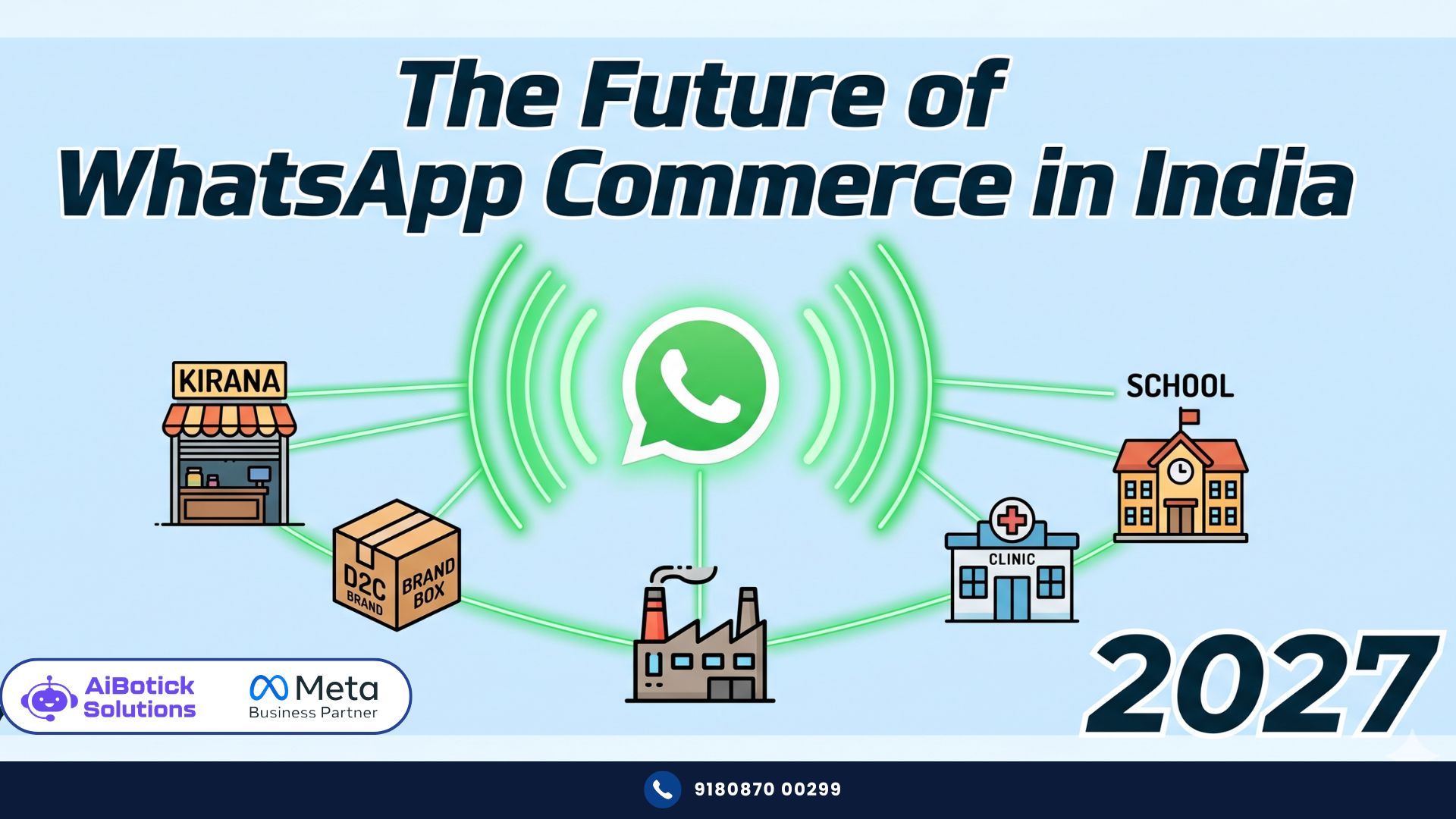
That kirana store owner is not an outlier. He’s the early signal of something much larger that’s about to reshape how commerce works in India. And by 2027 — what he’s doing today will look primitive compared to where WhatsApp commerce India is heading.
Let me take you through it properly.
First — Where We Are Right Now With WhatsApp Commerce India
Before predicting where it’s going, be honest about where it stands today.
As of 2026, WhatsApp commerce India is in what I’d call the infrastructure phase. The pipes are being laid. The API is mature. Meta is actively investing in India as its largest WhatsApp market — 500+ million users, the single biggest country base on the platform globally.
What’s already working at scale right now:
- Broadcast marketing — businesses sending promotional messages to opted-in lists. Mature, widespread, measurable.
- Chatbot automation — lead qualification, appointment booking, FAQ handling, order confirmation. Growing fast.
- Catalogue and in-chat shopping — WhatsApp product catalogues, order collection inside chat. Growing but still underutilised.
- WhatsApp Payments — UPI-based peer-to-peer and business payments inside WhatsApp. Available, functional, but not yet mainstream for business transactions.
- Click-to-WhatsApp ads — Meta’s fastest-growing ad format in India. Brands running Facebook and Instagram ads that open directly in WhatsApp. Explosive growth in 2025-26.
That’s the current state. Solid foundation. But what comes next is genuinely different in scale and nature.
What Changes Between Now and 2027 — The 5 Shifts That Will Define WhatsApp Commerce India
Shift 1 — WhatsApp Becomes the Default Checkout for Indian SMEs
Right now, most WhatsApp commerce still requires a handoff. Customer discovers product on WhatsApp → goes to website or calls to pay → comes back to WhatsApp for updates.
That handoff is dying.
Meta has been building WhatsApp Flows — interactive, form-like experiences inside WhatsApp — specifically to eliminate this friction. By 2027, a complete purchase journey will happen entirely within WhatsApp for a significant portion of Indian SME transactions:
- Browse product catalogue
- Select variant (size, colour, quantity)
- Enter delivery address via a WhatsApp Flow
- Pay via WhatsApp Pay / UPI
- Receive order confirmation in the same thread
- Track delivery in the same thread
- Leave review in the same thread
No app. No website. No redirect. One conversation thread from discovery to post-delivery.
Dekho — for the 63 million SMEs in India who cannot afford to build and maintain a proper ecommerce website, this is not a nice-to-have. This is the ecommerce infrastructure they’ve been waiting for. And it’s arriving.
Shift 2 — AI Agents Replace Rule-Based Chatbots Entirely
Currently, most WhatsApp chatbots in India are rule-based. If customer says X, bot replies Y. If customer says something unexpected, bot breaks and says “I didn’t understand that.”
Yaar, this is already starting to look outdated.
By 2027, the dominant WhatsApp chatbot in Indian businesses will be an AI agent — powered by large language models — that can:
- Understand free-form, colloquial Hindi-English messages (“bhai yeh waali kurta kya L size mein aati hai red color mein?”)
- Answer complex product questions without pre-scripted responses
- Negotiate within defined parameters (“I can offer you 10% off if you order 3 pieces”)
- Handle complaints with genuine empathy, not canned responses
- Escalate to human agents intelligently — not randomly
Actually wait — the implications for customer support costs are staggering. A mid-size Indian D2C brand handling 500 WhatsApp queries a day currently needs 6-8 support agents. With a properly trained AI agent on WhatsApp? That drops to 2 humans handling escalations only. Same service quality. Dramatically lower cost.
I’ve already seen early versions of this working in 2025-26. By 2027, it won’t be cutting-edge — it’ll be the baseline expectation.
Shift 3 — WhatsApp Commerce India Goes Vernacular at Scale
Here’s something most WhatsApp automation providers won’t tell you because they haven’t figured it out yet.
90% of India’s internet users by 2027 will prefer consuming content in their regional language. Not English. Not even Hindi for large swaths of the country.
Tamil Nadu. Karnataka. West Bengal. Andhra Pradesh. Kerala. Maharashtra’s non-metro regions. Hundreds of millions of consumers who are comfortable on WhatsApp, active on smartphones, ready to buy — but not in English.
WhatsApp commerce India’s next frontier is vernacular automation. Tamil chatbots for Chennai businesses. Marathi flows for Pune’s tier-2 markets. Bengali sequences for Kolkata traders.
Meta’s AI translation infrastructure is already building toward this. By 2027, a WhatsApp chatbot that seamlessly switches between English, Hindi, Tamil, and Telugu within a single conversation — based on what the customer writes in — will be technically feasible and commercially available.
The businesses that build vernacular WhatsApp commerce first in their regional markets will own those markets. The ones that wait will scramble to catch up.
No no, scratch the diplomatic framing — this is going to be one of the biggest competitive moats available to regional Indian businesses in the next 18 months. And almost nobody is talking about it.
Shift 4 — WhatsApp Becomes India’s B2B Trade Infrastructure
This one is personally the most exciting to me. 😄
B2B trade in India — distributors, wholesalers, retailers, manufacturers — still runs largely on phone calls, WhatsApp groups, Excel sheets, and handwritten order books.
A manufacturer in Surat takes fabric orders from 200 retailers across Gujarat via WhatsApp personal numbers. Someone writes down the order. Someone enters it into a tally system. Someone follows up on payment. Manual, error-prone, unscalable.
By 2027, WhatsApp Business API with proper automation will become the B2B trade operating system for Indian SME supply chains:
- Retailer sends order via WhatsApp → automatically enters inventory system
- Distributor gets dispatch confirmation via WhatsApp
- Payment due reminders automated on WhatsApp
- Credit limit alerts automated
- New product launches announced to entire retailer network in one broadcast
- Returns and complaints tracked via WhatsApp threads
I’ve worked with enough manufacturing and distribution businesses to know — the pain here is severe and the willingness to pay for a solution is real. WhatsApp commerce India’s B2B layer is massively underpenetrated right now. That changes fast.
For businesses already thinking about B2B WhatsApp automation, our WhatsApp B2B sales guide covers the current state of what’s working — the 2027 version will be built on this foundation.
Shift 5 — WhatsApp Payments Becomes Mainstream for Business Transactions
Seedha bolta hoon — WhatsApp Payments has been available in India since 2020. It has not taken off the way Meta hoped. The reasons are multiple: UPI app habit is strong (PhonePe, GPay deeply entrenched), WhatsApp Payments had regulatory restrictions on user numbers for years, and businesses weren’t set up to accept payments directly on WhatsApp at scale.
By 2027, this changes. Here’s why I believe that:
- Meta received full NPCI approval for unlimited WhatsApp Payments users in India in late 2024
- Meta is actively incentivising WhatsApp Payments adoption among business accounts
- The convenience factor — paying in the same app where you’re already chatting about the product — is genuinely compelling once people try it
- UPI interoperability means WhatsApp Pay works with any UPI-linked bank account
Could be wrong, but I’ve seen this consistently — payment friction is the single biggest drop-off point in WhatsApp commerce flows right now. The moment a customer has to switch apps to pay, you lose 20-30% of them. WhatsApp Payments eliminating that friction will directly increase conversion rates across the board.
By 2027, “pay here on WhatsApp” will be a normal instruction from Indian businesses. Not a novelty.
The Businesses That Will Win WhatsApp Commerce India by 2027
Let me be honest about who this benefits most — because it’s not everyone equally.
Who wins big:
- Indian D2C brands under Rs.50Cr revenue — too small for enterprise ecommerce solutions, WhatsApp becomes their complete commerce stack
- Regional and tier-2/tier-3 businesses — finally have enterprise-grade customer communication without enterprise budgets
- B2B wholesalers and distributors — the operational efficiency gains are enormous
- Service businesses with repeat customers — salons, clinics, coaching institutes, travel agents — relationship-based commerce is WhatsApp’s natural home
- Businesses that start building their WhatsApp contact lists NOW — the list you build today is the revenue engine of 2027
Who loses:
- Businesses that keep waiting for “the right time” to start — the right time was 2023. The second best time is now.
- Businesses that treat WhatsApp as a broadcast channel only and ignore the conversation layer
- Businesses that build on grey-market bulk senders and get banned — losing their contact list overnight
What Nobody Is Saying About WhatsApp Commerce India’s Challenges
This article would be dishonest if I didn’t include this section.
There are real challenges ahead. Not reasons to avoid — reasons to prepare.
Challenge 1 — Opt-in fatigue
As more businesses use WhatsApp for marketing, Indian consumers will become more selective about who they opt into. The businesses that built trashy, high-frequency, low-value broadcast habits in 2024-25 are already seeing opt-out rates spike. By 2027, if your WhatsApp communication isn’t genuinely valuable — not just promotional — your contact list will erode faster than you can grow it.
Challenge 2 — Meta’s increasing control over messaging quality
Meta is not a passive infrastructure provider. They are actively monitoring message quality scores, complaint rates, and opt-out rates. Businesses with poor quality scores get their messaging limited or suspended. By 2027, Meta’s quality enforcement will be stricter, not looser.
The businesses that win will be the ones treating WhatsApp communication as a trust asset — not a broadcast machine.
Challenge 3 — Pricing evolution
Meta’s conversation pricing has changed multiple times since 2021 and will continue to change. Free service conversations, paid marketing conversations — the economics will evolve. Businesses that build WhatsApp commerce strategies with proper ROI tracking will navigate this fine. Businesses treating WhatsApp as a “cheap marketing channel” without measurement will get surprised by cost increases.
For businesses tracking this properly, our WhatsApp metrics guide gives you the measurement framework you need to stay ahead of pricing changes without panicking.
Challenge 4 — The AI quality gap
As AI agents become mainstream on WhatsApp, the gap between a well-trained AI agent and a poorly configured one will be visible to every customer. A bad AI chatbot on WhatsApp in 2027 — one that misunderstands, gives wrong information, or frustrates customers — will damage brand reputation faster than it did in 2023, because customer expectations will be higher.
Quality of implementation matters. Who you build with matters.
What You Should Be Doing Right Now — Before 2027 Arrives
Ab toh, theek se suno. Because this is the practical part.
The businesses that will dominate WhatsApp commerce India in 2027 are making specific moves right now in 2026. Not in planning documents. Actually making them.
Move 1: Build your opted-in WhatsApp contact list aggressively
Every customer interaction — in-store, online, delivery, service — should end with an explicit WhatsApp opt-in. QR code at the counter. Checkbox on your website. Link in your email signature. WhatsApp is only as powerful as the list you can broadcast to. Build the list before you need it.
Move 2: Get on official WhatsApp Business API now
Not when you “grow bigger.” Now. The learning curve, the template approval process, the team training — these take time. Businesses that start in 2026 will have mature, optimised WhatsApp operations by 2027. Businesses that start in Q3 2027 will still be figuring out their first chatbot flow.
Move 3: Start measuring everything
Open rates, response rates, opt-out rates, conversion rates from WhatsApp, revenue attributed to WhatsApp broadcasts. Build the measurement habit now. It will tell you exactly what to optimise as the platform evolves.
Move 4: Invest in communication quality, not just automation
The businesses that win long-term on WhatsApp are the ones whose messages people actually want to receive. That means valuable content, not just promotions. Helpful automation, not just broadcast sequences. Personal tone, not corporate copy-paste.
Quality of communication is the moat. Technology is just the enabler.
The Honest Summary — WhatsApp Commerce India in 2027
WhatsApp is not becoming one of the channels for Indian commerce. It’s becoming the channel for a very large segment of it.
The infrastructure — API maturity, AI agents, WhatsApp Flows, WhatsApp Payments, vernacular support — is converging in a way that makes 2027 a genuinely different moment from 2024.
The kirana owner in Andheri who’s running his business on WhatsApp today? By 2027 he’ll have an AI agent handling customer queries in Marathi, accepting payments inside WhatsApp, and sending personalised restock alerts to customers based on their purchase history.
And he’ll still be doing it on one phone.
That’s the future of WhatsApp commerce India. Not some distant vision. A logical next step from what’s already working today — built on infrastructure that exists, by businesses that started now.
If you want to build that future for your business — not just read about it — AiBotick is where that conversation starts. Personalised onboarding. Live training. Dedicated support group. Not just software. A partner that stays until it works. 💯
— Mohit Shah │ 15+ years in IT industry │ 4+ years in WhatsApp automation │ Worked with various MNC brands │ Now helping businesses figure out what actually works
Q1: What is WhatsApp commerce India and why is it growing so fast?
A1: WhatsApp commerce India refers to the use of WhatsApp Business API to conduct end-to-end commercial transactions — from product discovery and customer communication to payment collection and post-purchase support — entirely within WhatsApp. It’s growing because India has 500+ million WhatsApp users, extremely high open rates compared to email, and a massive SME base that needs ecommerce infrastructure without the cost of building and maintaining a website or app.
Q2: When will WhatsApp Payments become mainstream for Indian businesses?
A2: WhatsApp Payments received full NPCI approval for unlimited Indian users in late 2024. By 2027, in-chat payment completion is expected to become standard for WhatsApp commerce transactions — eliminating the current friction of switching to PhonePe or GPay to complete a purchase. Businesses setting up WhatsApp Business API now will be positioned to adopt WhatsApp Payments natively as it scales.
Q3: Should Indian businesses invest in WhatsApp commerce now or wait until the technology matures further?
A3: The businesses that will lead WhatsApp commerce India in 2027 are the ones building their opted-in contact lists, refining their chatbot flows, and developing communication quality habits in 2026. The technology is already mature enough for serious commercial use — what takes time is building the list, the team capability, and the brand trust on the channel. Waiting means starting that process 12-18 months later than your competitors.