🙏 Jai Shree Ram. Better than previous. Let’s go.
WhatsApp for Hotels: How to Increase Direct Bookings and Cut OTA Dependency in 2026
Every hotel owner in India knows this number. And most hate it.
18-25%.
That’s what OTAs — MakeMyTrip, Booking.com, Expedia, Goibibo — charge as commission on every room booked through their platform.
You run a Rs.5,000/night room. OTA charges 20% = Rs.1,000 per night goes straight to them. For a 2-night booking — Rs.2,000 in commission. For 100 such bookings a month — Rs.2,00,000 per month. Rs.24,00,000 per year. Straight out of your revenue. To a platform that has zero stake in your hotel’s quality.
And here’s what makes it worse — the guest staying in your hotel. They didn’t book directly with you. They booked through the OTA. They’re loyal to the OTA, not to you. Next time they travel — they’ll go back to the OTA. And you’ll pay the commission again.
WhatsApp for hotels breaks this cycle. Not dramatically overnight. But systematically, booking by booking — it builds a direct communication channel with every guest who has ever stayed at your property. And a direct channel means direct bookings. Which means no commission.
I’ve worked with hospitality clients over the last 4+ years in WhatsApp automation. And WhatsApp for hotels is one of the most financially clear-cut implementations I’ve seen. The commission savings alone — even if direct bookings increase by 15-20% — transform the P&L.
Let me show you exactly how it works.
The OTA Dependency Problem — Exactly How Expensive It Really Is
Before the solution, let me make the problem viscerally clear.
A boutique hotel in Rishikesh. 20 rooms. Average room rate Rs.4,500/night. Occupancy 72% average across year.
Monthly room revenue: 20 rooms × 0.72 occupancy × 30 days × Rs.4,500 = Rs.19,44,000/month.
If 75% of bookings come through OTAs at 20% commission: Rs.19,44,000 × 0.75 × 0.20 = Rs.2,91,600/month in OTA commissions.
Per year: Rs.34,99,200.
Rs.35 lakh per year. Going to OTAs. From a 20-room boutique hotel.
Now — what if WhatsApp for hotels increases direct bookings from 25% to 45%? (A realistic 90-day target based on what I’ve seen.)
OTA share drops from 75% to 55%. Monthly commission: Rs.19,44,000 × 0.55 × 0.20 = Rs.2,13,840. Commission savings: Rs.2,91,600 – Rs.2,13,840 = Rs.77,760/month. Annual savings: Rs.9,33,120.
Rs.9.3 lakh per year. Saved. From the same number of guests. Just by shifting 20% of bookings from OTA to direct.
And Rs.9.3 lakh for a 20-room boutique hotel — that’s the difference between a thin year and a good year.
WhatsApp for hotels is the tool that makes this shift possible.
How Guests Actually Make Repeat Booking Decisions — The Psychology Hotels Miss
Here’s something most hotel owners don’t fully understand.
A guest had a great stay at your property. They genuinely enjoyed it. If asked “would you stay there again?” — they’d say yes.
But when they next plan a trip to the same destination — or a similar one — they open MakeMyTrip. Not your hotel’s website. Not your WhatsApp. MakeMyTrip. Because that’s where they “find hotels.”
The positive stay memory exists. The direct booking connection doesn’t.
Why? Because at checkout — you gave them a printed bill, maybe a candy, said “please come again.” And then nothing. No connection maintained. No communication. No way for them to reach you directly when next they want to book.
WhatsApp for hotels changes this. Every guest who provides their number at check-in — they become part of your direct communication ecosystem. Future availability messages reach them directly. Seasonal offers reach them directly. “Welcome back” messages when they enquire again — personally.
The guest who had a great stay now has a direct line to you. And humans, being creatures of comfort and familiarity — they’d rather book directly with a property they know and trust, than search OTAs again. If you’ve made it easy enough.
WhatsApp makes it easy enough.
The Complete WhatsApp for Hotels System — Every Flow
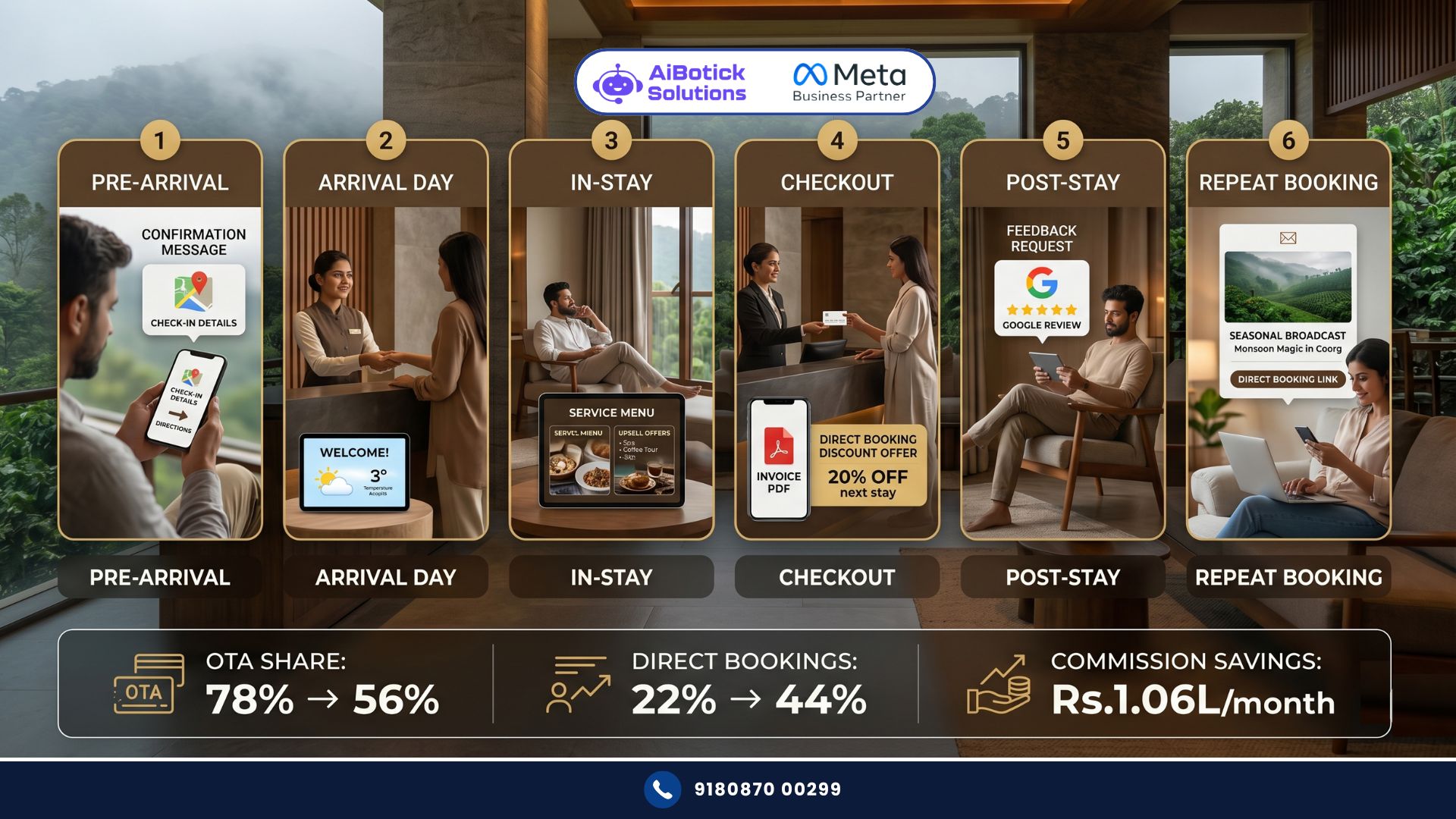
Let me build this out completely. Six flows. All working together.
Flow 1 — Pre-Arrival Guest Communication
Booking confirmed (through any channel — OTA or direct). Guest’s WhatsApp number collected.
3 days before arrival:
“Namaste [Guest Name]! 🙏
We’re looking forward to welcoming you at [Hotel Name] in [X days].
Your booking summary: 📅 Check-in: [Date] from [Time] 🛏️ Room: [Room Type] 👤 Guests: [Number] 📍 [Hotel Name] — [Address] 🗺️ [Google Maps Link]
A few things to make your arrival smoother: 🚗 If driving — [Specific parking instruction] 🚌 From station/airport — [Best transport option, approx cost and time] ⏰ Early check-in available if needed — reply to check availability
We’ve noted your stay and will have everything ready. Any special requests? Just reply here. — [Staff Name], [Hotel Name]”
The “early check-in available — reply to check” line is a subtle upsell. Some guests genuinely want early check-in. You can charge Rs.500-1,000 for it. And now there’s a frictionless way for them to request it. WhatsApp for hotels creates upsell opportunities that the traditional check-in process never captured.
Day of arrival:
“Good [morning/afternoon], [Guest Name]! 🌟 Today’s the day.
Check-in is from [Time]. Your room is being prepared.
Weather today at [Destination]: [Brief — eg: ‘Clear skies, 28°C. Perfect for [activity relevant to destination]’]
If you’re on your way and need anything — directions, a late check-in update, restaurant recommendation for lunch nearby — just reply here. We’re on.
See you soon! 😊 — [Hotel Name]”
Flow 2 — In-Stay Service (The Guest Experience Layer)
This is where WhatsApp for hotels gets genuinely exciting. And where most hotels haven’t even started thinking.
30 minutes after check-in:
“[Guest Name], hope your room is everything you expected! 😊
A few things worth knowing during your stay:
🍽️ Restaurant timing: [Breakfast/Lunch/Dinner timings] 🏊 Pool/Spa: [Timings and booking process] 🚗 Complimentary services: [List — airport drop, bicycle rental, etc.] 📞 Room service: Available [timings] — reply ‘ROOM SERVICE’ for menu
Any requests — laundry, extra towels, specific pillows, restaurant reservation — just reply here. We’ll take care of it.
[Relevant local tip: ‘The sunset at [local spot] is spectacular at [time]. Many of our guests call it the highlight of their trip.’] — [Hotel Name]”
The local tip — this is relationship-building disguised as information. A staff member sharing a genuine recommendation feels personal. Guest feels like they have an insider’s guide, not a front desk checklist.
Upsell during stay:
“[Guest Name], enjoying your stay? 😊
A few experiences you might love:
🧘 Yoga session tomorrow morning 6:30am — [Location]. Rs.500/person. Limited spots. 🚤 [Local activity] — we can arrange with our trusted partner. Rs.[Amount]. Reply ‘ACTIVITY’ for details. 🍽️ Special dinner at our rooftop tomorrow — [Description, price]. Reply ‘DINNER’ to reserve.
No pressure — just wanted you to know these are available if you’re interested. — [Hotel Name]”
Revenue from in-stay upsells — spa, activities, special dinners, room upgrades — can add 15-25% to the average booking value. WhatsApp for hotels makes these upsell opportunities conversational and non-intrusive. Much higher conversion than a brochure on the bedside table.
Flow 3 — Checkout Communication
Morning of checkout:
“Good morning [Guest Name]! 🌟 It’s your checkout day.
Checkout time: [Time]
Late checkout available until [Time] — Rs.[Amount] additional charge. Reply ‘LATE CHECKOUT’ if interested.
Your bill will be ready at the front desk. We can also send it to this WhatsApp for your reference.
It’s been a genuine pleasure having you. 🙏 — [Hotel Name]”
On checkout (or within 2 hours after):
“[Guest Name], we hope your stay was wonderful. 😊
Your bill summary: 🛏️ Room charges: Rs.[Amount] 🍽️ Restaurant/extras: Rs.[Amount] 💰 Total: Rs.[Amount] ✅ Settlement: [Paid / Balance: Rs.Amount]
Soft copy of invoice: [PDF Attached]
Safe travels ahead! 🙏
P.S. — Next time you visit [Destination], we’d love to have you back. Book directly through us for 10% off your next stay: [Direct booking link]“*
That P.S. — this is the beginning of the OTA displacement strategy. Guest is leaving. Experience is fresh and positive. Right now — at this peak goodwill moment — you’re planting the direct booking seed. Not aggressively. As a natural offer. A 10% discount for booking directly — that’s less than what you’d pay OTA. Win for guest. Win for you.
Flow 4 — Post-Stay Engagement (The Revenue Engine)
24 hours after checkout:
“[Guest Name], hope you’re back home safely! 😊
How was your stay at [Hotel Name]? We’d love your honest feedback:
⭐⭐⭐⭐⭐ Excellent | ⭐⭐⭐⭐ Good | ⭐⭐⭐ Average | ⭐⭐ Below expectations | ⭐ Poor
Your feedback genuinely shapes how we improve. — [Hotel Name] Team”
4-5 stars → Google review invitation with direct link. 1-3 stars → Private concern collection, resolution.
30 days after stay:
“[Guest Name], it’s been a month since your stay at [Hotel Name]. Hope the memories are still fresh! 😄
Planning your next visit to [Destination] or somewhere nearby?
We have some exciting availability coming up: 📅 [Peak season] — [Special offer or availability update] 🌿 [Seasonal highlight relevant to destination]
Book directly with us at 10% off — no OTA fees, personal attention: [Direct Booking Link]
Or just reply and we’ll put together something special for your next visit. 🙏 — [Hotel Name]”
Seasonal campaigns — broadcast to all past guests:
“Namaste [Guest Name]! 😊
[Festival/Season] is approaching — and [Destination] is absolutely magical this time of year.
We have [X] rooms available for [Dates]. Rates from Rs.[Amount]/night.
Past guests get priority — and our best rates when booking directly.
Interested? Reply here or book instantly: [Direct Booking Link]
Limited availability — [Destination] fills up fast during [Festival/Season]. 🙏 — [Hotel Name]”
This broadcast to your past guest list — this is WhatsApp for hotels at its most powerful. You’re marketing to warm, already-converted, already-satisfied customers. The cost per booking from this channel: near zero. The conversion rate from this channel: dramatically higher than cold OTA traffic.
Real Numbers — Coorg Boutique Resort (32 Rooms)
Specific. Documented. Real.
Boutique nature resort. Coorg. 32 rooms. Mix of cottages and tree houses. Average rate Rs.7,500/night. Popular with Bangalore weekend travellers.
Before WhatsApp for hotels:
- OTA share of bookings: 78%
- Direct bookings: 22%
- Monthly OTA commissions (at 19% average): Rs.3,80,000/month
- Repeat guest rate: 11% (guests returning within 18 months)
- In-stay upsell revenue: Rs.45,000/month (spa, activities, special dinners — all manually promoted)
- Guest satisfaction score: 4.2/5 on OTAs (reviews were their only feedback channel)
After 90 days with WhatsApp for hotels:
- OTA share: 56%
- Direct bookings: 44% (doubled)
- Monthly OTA commissions: Rs.2,73,600
- Commission savings: Rs.1,06,400/month
- Repeat guest rate: 26% (past guest broadcasts driving this)
- In-stay upsell revenue: Rs.1,12,000/month (WhatsApp upsells dramatically increased uptake)
- Guest satisfaction score: 4.7/5
Total monthly revenue impact:
Commission savings: Rs.1,06,400 In-stay upsell improvement: Rs.67,000 additional Repeat guest revenue increase: Rs.54,000 additional (conservative)
Combined: Rs.2,27,400 additional monthly profit.
Platform cost: Rs.45,000/year = Rs.3,750/month.
60x monthly ROI.
And the repeat guest rate improvement — from 11% to 26% — this compounds dramatically over 2-3 years as the past guest list grows and each guest has a higher probability of returning directly.
The resort owner told me: “Pehle main OTA ka slave tha. Ab unhe commissions deta hoon sirf new customers ke liye. Repeat customers seedha mujhe book karte hain.” 😄
That’s the shift. That’s exactly what WhatsApp for hotels delivers.
What Hotels Get Wrong About WhatsApp for Hotels
One assumption. Common. Expensive.
“WhatsApp is too informal for our brand positioning.”
I’ve heard this specifically from boutique and luxury properties. “We’re a premium brand. WhatsApp feels cheap. Our guests expect formal communication channels.”
No no, scratch that thinking entirely.
WhatsApp is the most personal communication channel on a guest’s phone. A message that arrives there — addressed to them by name, from a human-sounding sender, warm and helpful — feels more premium than a formal email template from a hotel management system.
Think about it from the guest’s perspective. They’re at your beautiful resort in Coorg. They want to book a sunset river safari for tomorrow. They could: a) Call the front desk and explain what they want to a stranger b) Walk to the front desk c) Message the hotel’s WhatsApp — “Can we arrange a sunset safari for tomorrow evening?” and get a response in 2 minutes
Option C feels like having a personal concierge at your fingertips. That’s not informal. That’s intimate and premium service.
The “WhatsApp is informal” concern comes from thinking of WhatsApp as a casual chat app. In the context of WhatsApp for hotels — it’s a personal service channel. The premium-ness comes from how you use it. Not from which channel you use.
For the complete framework on how WhatsApp automation ROI compounds in hospitality across direct bookings, upsells, and repeat guests — our WhatsApp automation ROI guide shows the exact calculation methodology.
The Corporate Guest Strategy — A Separate Revenue Opportunity
Corporate guests — traveling for work, staying multiple nights, booking through company accounts — are typically 20-30% of urban hotel occupancy. And they’re dramatically underserved by WhatsApp for hotels currently.
Corporate guests need:
- Fast invoice with GST details after checkout (not 3 days later)
- Expense report-ready billing summary
- Rebooking for return trips with same preferences remembered
- Corporate rates offered proactively for their company’s travel programme
WhatsApp for hotels handles corporate guest communication specifically:
Post-checkout: GST invoice delivered automatically with all required fields.
30 days later: “Hi [Guest Name], you’re likely back in [Destination] soon? Your previous room preferences and corporate rate are saved — just reply to rebook.”
Quarterly: “Your company’s travel programme with [Hotel Name] — we’ve had [X] employees stay this year. Corporate rate extended to [Amount] for next quarter. Reply to formalise.”
Corporate guests who book repeatedly — they’re the most valuable guests in hospitality. WhatsApp for hotels builds that relationship systematically. Not just the first stay. Every stay.
For how WhatsApp automation handles business relationship management across multiple touchpoints — our WhatsApp for travel agents guide shows parallel principles that apply to hotel corporate accounts.
Setting Up WhatsApp for Hotels — Exactly What to Do First
Week 1 — Foundation:
Connect your PMS (Property Management System) — FCS, Hotelogix, Stayflexi, or whatever system you use — to AiBotick via API or webhook. When booking is confirmed in PMS → WhatsApp pre-arrival message fires automatically.
If your PMS doesn’t have easy API access — manual trigger works too. Reservation team adds guest number to AiBotick when booking is confirmed. Slightly more manual but operational.
Week 2 — Guest experience flows:
Build in-stay service message (30 min after check-in), upsell message (Day 2 of stay for stays 3+ nights), checkout message (morning of), invoice delivery (on/after checkout).
Week 3 — Post-stay engagement:
24-hour feedback message, 30-day past guest message, seasonal broadcast setup.
Week 4 — Past guest broadcast list:
Upload all past guest numbers (with consent) to AiBotick. Build your first broadcast campaign for the upcoming season. This is your first OTA displacement campaign.
Ongoing:
Every new guest added to broadcast list automatically after checkout. Past guest list grows every month. Every future broadcast reaches more people. Every future campaign costs the same but generates more bookings.
The past guest list — this is your most valuable long-term asset from WhatsApp for hotels. Protect it. Grow it. Use it consistently.
Toh hotel owners se seedha baat:
Pichle mahine aapne OTA commission mein kitna diya?
Ab calculate karo — agar direct bookings 20% badh jayein, tab kitna bachega per month?
That number — that’s your motivation. That’s what WhatsApp for hotels is worth to your specific property.
The Coorg resort saved Rs.1 lakh per month from commission reduction alone. In addition to upsell and repeat booking revenue.
For a hotel your size — the number will be different. But the direction will be the same.
Tap below. 👇 Tell us your property type, number of rooms, average room rate, and current OTA dependency percentage — we’ll calculate your direct booking potential and design your complete WhatsApp for hotels system.
— Mohit Shah | 15+ years in IT industry | 4+ years in WhatsApp automation | Worked with various MNC brands | Now helping businesses figure out what actually works
Q1: How does WhatsApp for hotels reduce OTA dependency and increase direct bookings?
A1: WhatsApp for hotels reduces OTA dependency through three mechanisms — post-checkout direct booking offers (10% discount for direct bookings planted at peak goodwill moment), 30-day past guest reactivation messages reaching guests before they open OTAs for their next trip, and seasonal broadcast campaigns to the growing past guest list. A Coorg boutique resort increased direct bookings from 22% to 44% in 90 days using these flows, saving Rs.1.06L monthly in OTA commissions. The past guest list grows with every new guest and compounds value with every future campaign.
Q2: What in-stay upsells can WhatsApp for hotels automate?
A2: WhatsApp for hotels can automate upsell opportunities including early check-in and late checkout offers (sent in pre-arrival and checkout messages), spa and activity bookings (mid-stay message listing available experiences with pricing and instant reply booking), special dining experiences like rooftop dinners or candlelit setups, room upgrades during low-occupancy periods, and local tour arrangements with trusted partners. The Coorg resort grew in-stay upsell revenue from Rs.45,000 to Rs.1,12,000 monthly — because WhatsApp upsells have dramatically higher conversion than brochures or front desk verbal offers.
Q3: Is WhatsApp appropriate for luxury and boutique hotel brands, or does it feel too informal?
A3: WhatsApp for hotels is exceptionally well-suited for premium and boutique properties — not despite its personal nature but because of it. A message that arrives on the guest’s personal phone, addressed by name, with a warm and helpful tone from the hotel’s team, feels like a personal concierge — which is exactly the experience premium properties aim to deliver. The premium-ness of WhatsApp for hotels communication comes from how you craft and deliver messages, not from which channel you use. Formal email from a PMS template feels corporate. A warm, personalised WhatsApp from “[Staff Name], [Hotel Name]” feels intimate and premium.