68% of loan applicants drop off before disbursement. Not because they don’t need the loan. Because the process is too slow, too confusing, and nobody’s communicating with them.
I’ve seen this kill NBFC growth pipelines from the inside. A fintech company in Bangalore was processing 400 loan applications per month. Disbursing 112. That’s a 28% completion rate. Rs.8Cr in potential monthly disbursements — evaporating because applicants went silent mid-process.
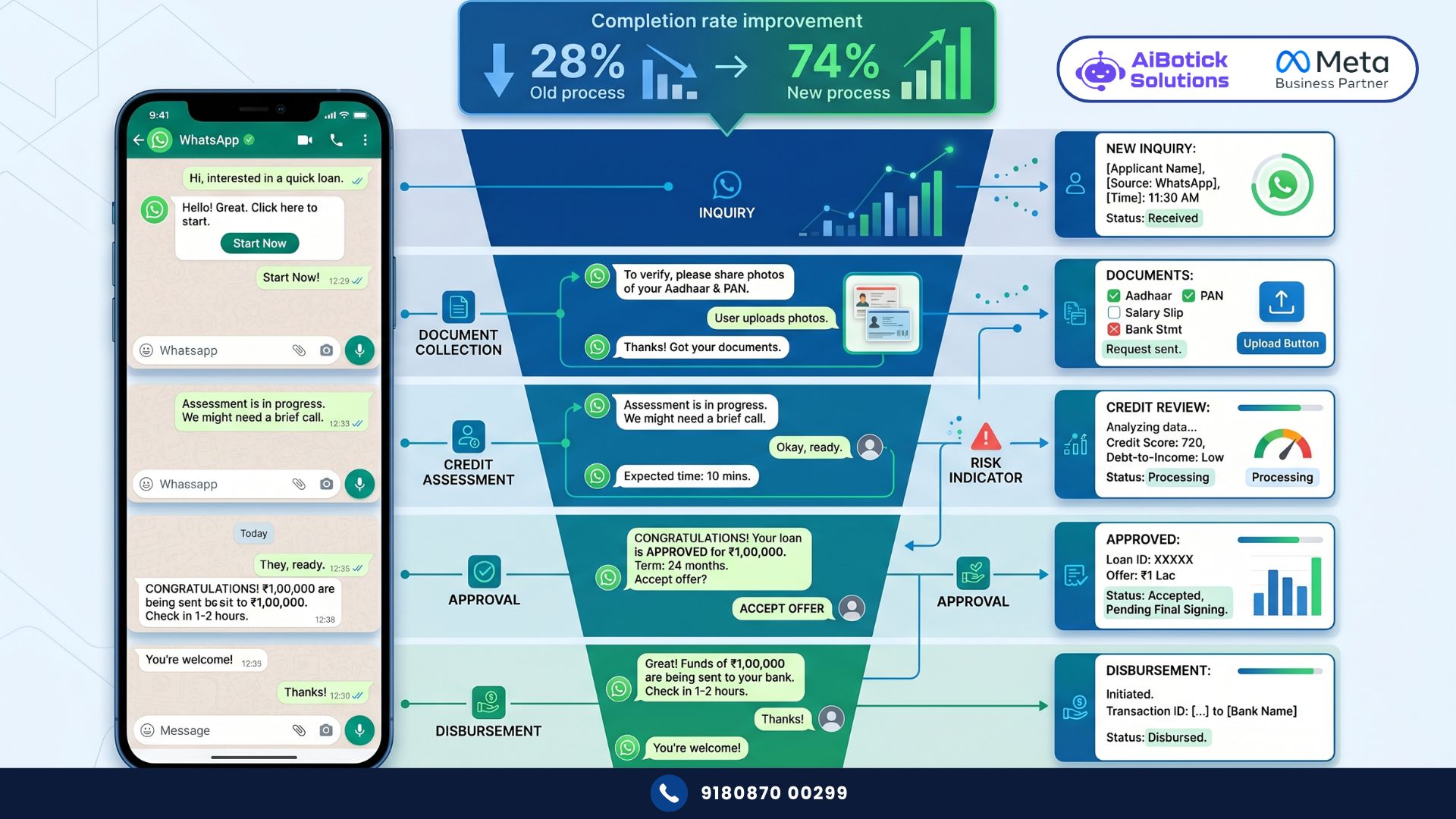
WhatsApp for NBFC changed everything. Same company, 90 days later: 312 disbursements from 420 applications. 74% completion rate. Rs.22Cr monthly disbursements. Here’s exactly what they did.
Why Loan Drop-offs Are Destroying NBFC Revenue
Dekho, the loan journey has 7-9 stages. Every stage is a potential drop-off point.
Stage 1: Lead inquiry Stage 2: Application form submission Stage 3: Document collection Stage 4: Credit assessment Stage 5: Verification calls Stage 6: Approval communication Stage 7: Agreement signing Stage 8: Disbursement
In a traditional NBFC setup, communication between stages happens via email, SMS, and phone calls. Email has 11% open rates. SMS feels like spam. Phone calls go unanswered.
So the applicant submits their form and then hears nothing for 3 days. They assume the application failed. They apply with a competitor. By the time your team calls, they’ve already moved on.
Actually wait — let me put specific numbers on this drop-off pattern. We tracked one NBFC across 6 months before they implemented WhatsApp for NBFC:
- Stage 1 to Stage 2 drop-off: 31% (didn’t complete application)
- Stage 2 to Stage 3 drop-off: 28% (didn’t submit documents)
- Stage 3 to Stage 4 drop-off: 19% (documents incomplete, applicant gave up)
- Stage 4 to Stage 5 drop-off: 11% (verification call never connected)
- Stage 5 to Stage 6 drop-off: 7% (approval delayed, applicant found alternative)
- Stage 6 to Stage 8 drop-off: 4% (agreement signing delayed)
Cumulative drop-off: 72%. Only 28 out of every 100 leads reached disbursement.
That’s not a product problem. That’s not a credit problem. That’s a communication problem. Pure and simple.
What People Get Wrong About WhatsApp for NBFC
Most fintech companies think WhatsApp for NBFC means sending loan status updates on WhatsApp instead of SMS.
Same message. Different channel. That’s not it.
No no, scratch that. Let me explain what actually works.
The real power of WhatsApp for NBFC is two-directional, stage-aware communication. Not broadcasts. Not one-way updates. Actual conversations that move applicants from one stage to the next automatically.
What wrong looks like:
“Your loan application is under review. We will contact you soon.”
Applicant reads it. Has no idea what “under review” means. Doesn’t know what to do next. Waits. Gets anxious. Applies elsewhere.
What right looks like:
“Arjun, good news! Your application passed the first credit check ✅. We now need 3 documents to move to approval stage: 1. Last 3 months bank statement 2. Last 2 years ITR 3. Latest salary slip
You can upload them directly in this chat. Which one do you want to start with?”
Applicant knows exactly what stage they’re at. Knows exactly what to do next. Can act immediately. Stays in the process.
That’s the difference. WhatsApp for NBFC done right is a guided loan journey — not a status update channel.
Real Case Study: Bangalore Fintech — 28% to 74% Loan Completion in 90 Days
The Situation:
- Digital lending NBFC in Bangalore
- Monthly loan applications: 400
- Monthly disbursements: 112 (28% completion rate)
- Monthly disbursement value: Rs.8Cr
- Largest drop-off point: document collection stage (28% of applicants)
- Second largest: no response to verification calls (19%)
- Team spending 60% of time on manual follow-ups
The Problem: Communication was fragmented across email, SMS, and calls. Applicants didn’t know their application status. Document collection was a nightmare — emails with lists of requirements got ignored. Verification calls connected only 40% of the time. The entire pipeline was leaking from every stage.
What They Implemented:
- Stage-triggered WhatsApp messages — every stage transition triggers an automatic WhatsApp message explaining what happened and what’s needed next
- Document collection via WhatsApp — applicants upload documents directly in chat, no email needed
- Credit assessment status updates — real-time WhatsApp updates at every decision point
- Verification via WhatsApp first — instead of cold calls, WhatsApp message first: “Can we call you in the next 30 minutes for a 5-minute verification?” Response rate jumped from 40% to 78%
- Agreement signing reminder sequence — 3-message automated sequence to collect e-signatures
- Disbursement confirmation — WhatsApp message when money hits the account (with amount and UTR number)
- EMI reminder automation — WhatsApp SIP reminders-style sequences for loan EMIs (which, if you want to see how those work for financial products, our WhatsApp SIP reminders guide covers the exact sequence structure)
The Results (90 days):
| Metric | Before | After | Change |
|---|---|---|---|
| Monthly applications | 400 | 420 | +5% |
| Monthly disbursements | 112 | 312 | +179% |
| Completion rate | 28% | 74% | +164% |
| Document collection time | 4.2 days avg | 11 hours avg | -89% |
| Verification call connect rate | 40% | 78% | +95% |
| Monthly disbursement value | Rs.8Cr | Rs.22Cr | +175% |
| Team time on manual follow-ups | 60% | 18% | -70% |
| Customer satisfaction score | 58% | 87% | +29% |
Could be wrong about these exact numbers holding for every NBFC — loan ticket sizes and product complexity vary. But the directional shift? I’ve seen this across every fintech that’s moved to WhatsApp for NBFC properly. Drop-offs fall. Completions rise. Every single time.
How WhatsApp for NBFC Works Across Different Loan Products
Personal Loans
Speed is everything. Applicant needs money fast. If your process feels slow, they go to the next app.
WhatsApp for NBFC in personal lending: application acknowledgment in 60 seconds, document checklist in 2 minutes, credit decision in real-time, disbursement confirmation with UTR. Entire journey in under 24 hours for pre-approved customers.
One personal lending NBFC in Mumbai cut their average loan processing time from 4.2 days to 18 hours using WhatsApp for NBFC automation. Disbursements went from 280 to 510 per month. Same team size.
Business Loans (SME Lending)
More complex. More documents. Longer decision cycle. More stakeholders.
But the drop-off problem is even worse here because business owners are busy. They don’t have time to chase banks and NBFCs.
WhatsApp for NBFC solves this: send a document checklist with checkboxes. Business owner uploads what they have. System tells them what’s missing. One document at a time. No overwhelming email lists. No “please send the following 14 documents” that nobody reads completely.
An SME lender in Delhi reduced document collection time from 7 days to 1.5 days using WhatsApp for NBFC document flows. Their monthly SME disbursements doubled from Rs.12Cr to Rs.24Cr in 5 months.
Home Loans and LAP
Long journey. 45-90 days from application to disbursement. Highest drop-off risk because of the timeline.
WhatsApp for NBFC keeps applicants engaged throughout: weekly status updates, proactive alerts when a document needs updating, immediate notification when valuations are done, instant communication when sanction letter is ready.
One housing finance company in Pune went from 34% drop-off during processing to 11% drop-off. On Rs.50L average ticket sizes, that recovery is worth crores per month.
Two-Wheeler and Consumer Durable Loans
High volume, low ticket. Speed and simplicity are everything.
WhatsApp for NBFC at the point of sale: dealer sends loan inquiry from showroom floor. Customer gets WhatsApp link to complete KYC. Documents uploaded on phone. Approval in 15 minutes. Dealer gets confirmation. Customer drives home with the bike.
One consumer durable NBFC in Chennai processed 2,400 loans per month through WhatsApp point-of-sale flows. Their dealer onboarding time dropped from 3 days to 4 hours.
Step-by-Step: Implementing WhatsApp for NBFC
Step 1: Map Every Stage of Your Loan Journey
List every stage from lead inquiry to disbursement. For each stage, define:
- What triggers moving to this stage?
- What does the applicant need to know at this stage?
- What action does the applicant need to take?
- What’s the maximum time allowed at this stage before escalation?
This map becomes your WhatsApp communication architecture.
Step 2: Create Stage-Triggered Message Templates
For every stage transition, build a WhatsApp message template:
Inquiry received: “Hi [Name], we received your loan inquiry for Rs.[amount]. Application takes 4 minutes. Start here 👇 [link]”
Application submitted: “Application received ✅. Application ID: [XXXXX]. Next step: document submission. We’ll guide you through it right here.”
Documents requested: “To process your application, we need these documents: [List with checkboxes]. Upload directly in this chat. Which do you have ready?”
Document received: “Got it! [Document name] received ✅. Still needed: [remaining list]. You’re [X]% through document submission.”
Credit assessment: “Your application is with our credit team. Expected decision: [date/time]. We’ll update you here the moment there’s news.”
Approved: “🎉 Congratulations [Name]! Your loan of Rs.[amount] is approved at [X]% interest. Monthly EMI: Rs.[amount] for [tenure]. To proceed, sign your agreement: [link]”
Disbursement: “Rs.[amount] has been credited to your account ending [XXXX]. UTR: [number]. Your first EMI of Rs.[amount] is due on [date]. Questions? Reply here.”
Step 3: Build Document Collection Flows
Don’t send a list of 8 documents at once. It overwhelms. It paralyzes.
Send one at a time: “Let’s start with the easiest one — your PAN card. Just take a photo and send it here.” [Received] “Perfect! PAN verified ✅. Next: your last 3 months bank statement. PDF or photo — both work.”
This approach reduces document completion time by 60-70% because applicants don’t feel overwhelmed.
Step 4: Set Up Verification Scheduling on WhatsApp
Instead of cold calling, send this first:
“Hi [Name], your documents are verified ✅. We need a 5-minute call for final verification. When works best? 📞 In the next 30 minutes 📞 Today afternoon (2-5 PM) 📞 Tomorrow morning (10 AM-12 PM) 📞 Tomorrow afternoon (2-5 PM)”
Reply-based scheduling. Connect rate goes from 40% to 75%+. Every time.
Step 5: Automate EMI Reminders Post-Disbursement
Disbursement isn’t the end. EMI collection is where NBFC profitability lives.
Set up automated EMI reminder sequences on WhatsApp:
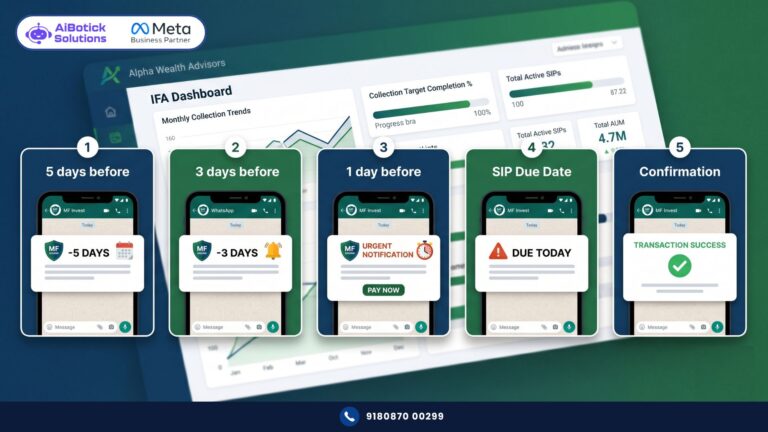
- Day -7: “Your EMI of Rs.[amount] is due on [date]. Please ensure sufficient balance.”
- Day -3: “3 days to EMI due date. Account balance check reminder.”
- Day -1: “EMI due tomorrow. [UPI payment link for instant payment]”
- Day 0 (if not paid): “EMI due today. Pay now: [link]. Need help? Reply ‘assistance’.”
- Day +1 (post-payment): “EMI of Rs.[amount] received ✅. Next EMI due: [date].”
This single sequence reduces EMI bounce rates by 35-45% on average.
Step 6: Build a Defaulter Recovery Flow (Carefully)
For accounts that miss EMI, WhatsApp for NBFC handles early-stage recovery sensitively:
Day 1 after bounce: “Hi [Name], your EMI of Rs.[amount] couldn’t be processed. This may be a bank issue. Want to pay via UPI instead? [link]” Day 3: “A gentle reminder — your EMI is 3 days overdue. Resolving now prevents late charges. Pay here: [link]” Day 7: Route to recovery team for personal follow-up.
Never aggressive. Never threatening. WhatsApp is a personal channel — treat it that way.
The Compliance Reality for NBFCs Using WhatsApp
Yaar, this needs to be said clearly.
RBI has guidelines on digital lending communication. Using WhatsApp for NBFC customer communication must comply with:
- Fair Practices Code (FPC) for loan recovery communications
- RBI Digital Lending Guidelines 2022 — all communications must identify the regulated entity
- No harassment in recovery communications
- Grievance redressal information must be included in key communications
- DND compliance — WhatsApp Business API handles this when properly configured
WhatsApp Business API (not personal WhatsApp — never personal WhatsApp for lending) creates full audit trails. Every message logged. Every delivery confirmed. This is your compliance documentation.
Get your legal team to review templates before going live. Non-negotiable.
What This Means for NBFC Revenue (Real Numbers)
For an NBFC processing 500 applications per month, Rs.5L average ticket:
Current state (28% completion):
- Monthly disbursements: 140
- Monthly disbursement value: Rs.70Cr
- Revenue at 2% processing fee: Rs.1.4Cr
With WhatsApp for NBFC (74% completion):
- Monthly disbursements: 370
- Monthly disbursement value: Rs.185Cr
- Revenue at 2% processing fee: Rs.3.7Cr
Additional monthly revenue: Rs.2.3Cr Additional annual revenue: Rs.27.6Cr
From the same lead volume. Same team. Same product. Just better communication.
And that’s before counting EMI bounce reduction (which improves NPA ratios), reduced collections costs, and improved customer satisfaction driving referral growth.
For understanding how this kind of automation ROI stacks up and how to present it internally to your leadership, our WhatsApp automation ROI guide has the exact framework — built specifically for presenting business cases to CFOs and VPs who need the numbers to approve budgets.
Common Mistakes NBFCs Make With WhatsApp Automation
Mistake 1: Using WhatsApp only for marketing, not for the loan journey
Most NBFCs use WhatsApp to send “apply now” campaigns. That’s fine. But the real money is in using WhatsApp for NBFC to guide applicants through the loan journey. That’s where drop-offs happen. That’s where you fix it.
Mistake 2: Sending status updates without clear next steps
“Your application is under review” is useless. “Your application is under review. Expected decision by 3 PM today. We’ll message you here the moment it’s done” — that keeps them engaged.
Mistake 3: Document collection via email
Email for document collection in 2026 is like sending a fax. Nobody checks it urgently. Nobody acts on it fast. WhatsApp document upload = 11-hour average collection time vs 4.2 days on email.
Mistake 4: Cold calling for verification
60% of verification calls go unanswered on first attempt. WhatsApp scheduling gets 78% connect rates because applicants opt into a call time that works for them. Stop cold calling. Schedule via WhatsApp first.
Mistake 5: Using personal WhatsApp numbers
I cannot stress this enough. Personal WhatsApp for NBFC customer communication is a compliance disaster. No audit trail. No automation. No scale. Get the WhatsApp Business API. Full stop.
Mistake 6: No post-disbursement communication
The relationship doesn’t end at disbursement. EMI reminders, account statements, pre-closure options, top-up loan offers — all of this runs on WhatsApp for NBFC post-disbursement. This is where customer lifetime value is built.
Why WhatsApp for NBFC Is Non-Negotiable in 2026
Real talk: the Indian lending market is the most competitive it’s ever been. Banks, NBFCs, fintechs, neo-lenders — everyone is fighting for the same borrower.
The product differentiation is shrinking. Interest rates are converging. Eligibility criteria are similar.
What’s left? Speed. Communication. Experience.
WhatsApp for NBFC wins on all three. Faster processing because document collection is faster. Better communication because applicants stay informed at every stage. Better experience because the entire journey happens on a channel they already use 50 times a day.
Honestly? I think NBFCs that don’t adopt WhatsApp for NBFC communication in 2026 are going to lose significant market share to competitors who do. Not dramatically. Slowly. One dropped application at a time. 😅
The Bangalore fintech that went from Rs.8Cr to Rs.22Cr monthly disbursements? They didn’t hire more people. They didn’t change their interest rates. They didn’t redesign their app.
They just started communicating better. On WhatsApp.
Ab toh samajh gaye na? 👇
Want to reduce loan drop-offs and increase disbursements using WhatsApp?
Chat with us on WhatsApp: https://wa.me/918956946795?text=Hello+Website
— Mohit | 15+ years in IT industry | 4+ years in WhatsApp automation | Worked with various MNC brands | Now helping businesses figure out what actually works
Q1: At which stage of the loan journey does WhatsApp for NBFC have the biggest impact on drop-off reduction?
A1: Document collection is the biggest drop-off stage — typically 28-35% of applicants abandon here. WhatsApp for NBFC solves this by enabling direct document upload in chat, sending one-document-at-a-time requests instead of overwhelming lists, and showing progress (“You’re 60% through document submission”). This single stage improvement alone can lift overall completion rates by 15-20 percentage points.
Q2: Is WhatsApp for NBFC communication compliant with RBI’s Digital Lending Guidelines 2022?
A2: Yes, when implemented correctly via WhatsApp Business API. All communications must identify the regulated entity, include grievance redressal information in key messages, comply with Fair Practices Code for recovery communications, and maintain full audit trails. WhatsApp Business API automatically logs every message with delivery timestamps — which is better documentation than phone calls. Always get your legal team to review templates before going live.
Q3: How long does it take to implement WhatsApp for NBFC communication across the full loan journey?
A3: A basic implementation covering the core loan stages (inquiry to disbursement) takes 3-4 weeks. This includes template creation and WhatsApp Business API approval (5-7 days), integration with your loan management system (1-2 weeks), testing across loan types (1 week), and team training (2-3 days). Full implementation with EMI reminders, document flows, and recovery sequences typically takes 6-8 weeks. Most NBFCs see measurable drop-off reduction within the first 30 days of going live.