Your clients are missing SIP dates. And you’re the one calling them about it.
Every month. Same cycle. SIP due. Client forgets. You call. They say “I’ll do it today.” You follow up. They forget again. You call again. By the time money moves, 3 days have passed, market opportunity is gone, and you’ve spent 4 hours chasing 20 clients for something that should have been automatic.
I’ve seen this destroy advisory businesses from the inside. Not dramatically. Slowly. One missed SIP at a time.
WhatsApp SIP reminders fix this completely. One IFA in Hyderabad went from 61% on-time SIP collection to 89% in 60 days. Without hiring anyone. Without calling a single client. Here’s exactly what he did.
Why Manual SIP Follow-Up Is Quietly Killing Your Advisory Practice
Seedha bolta hoon — manual SIP management is not a process. It’s a punishment.
Here’s what your month actually looks like right now:
Week 1: You remind yourself to remind clients. You open your spreadsheet. You start calling. Week 2: You’re still calling. Half the clients picked up. Others said “remind me again Friday.” Week 3: You’re following up on the follow-ups. Some SIPs processed. Others still pending. Week 4: You’re reconciling who paid, who didn’t, whose mandate lapsed, whose bank account had insufficient funds.
And then next month starts. Same cycle. Again.
Actually wait — let me put real numbers on this. For an IFA managing 150 clients across mutual funds, insurance SIPs, and recurring deposits:
- Average SIPs per client: 2.3
- Total SIPs to track monthly: 345
- SIPs requiring manual follow-up (missed first reminder): 40%
- Manual follow-up calls needed: 138 calls per month
- Average time per call: 8 minutes
- Total time lost: 18.4 hours per month just on SIP chasing
At Rs.500/hour, that’s Rs.9,200 in pure labor cost. Every single month. On one task.
And that’s before you count the revenue impact of lapsed SIPs. One Rs.10,000/month SIP missed for 3 months = Rs.30,000 not invested = Rs.1,500-2,000 in lost annual commission.
Multiply by 30 lapsed SIPs per year. That’s Rs.45,000-60,000 in annual commission you never collected.
For a mid-size IFA firm with 500 clients? That number becomes Rs.3-4L annually. Gone. Just because reminders were manual.
What People Get Wrong About SIP Reminders on WhatsApp
Most IFAs think WhatsApp SIP reminders means sending a WhatsApp message instead of an SMS. Same thing, different channel.
Nope, that’s not it. Not even close.
The real shift is from reactive to proactive. From chasing to automating. From hoping clients remember to making sure they can’t forget.
Here’s what wrong looks like:
“Hi Ramesh ji, just a reminder your SIP of Rs.5,000 is due tomorrow. Please ensure sufficient balance.”
One message. No follow-through. Client reads it, thinks “I’ll do it later.” Forgets. SIP bounces. You find out 3 days later. You call. Cycle repeats.
Here’s what right looks like:
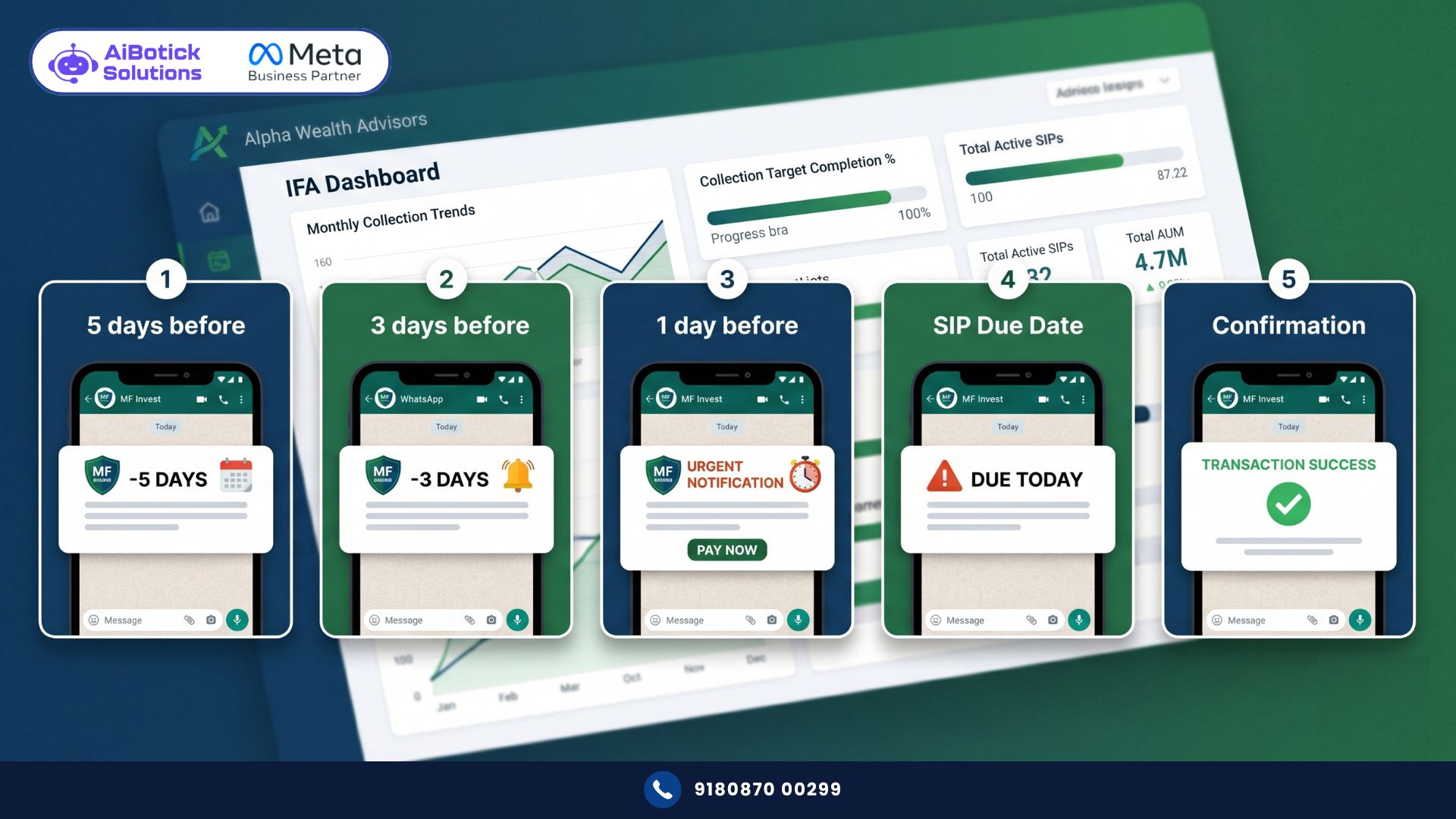
Message 1 (5 days before): “Ramesh ji, your SIP of Rs.5,000 in HDFC Flexi Cap is due on 15th June. That’s 5 days away. Just a heads up so you can keep the balance ready. Reply if you have any questions.”
Message 2 (2 days before): “Quick reminder — Rs.5,000 SIP due in 2 days. Your current NAV is Rs.142.30 (up 2.1% this month). Want to know how your portfolio is doing overall? Just reply ‘portfolio’.”
Message 3 (day before): “Tomorrow’s the day! Rs.5,000 SIP for HDFC Flexi Cap. Please ensure your account has sufficient balance by midnight tonight. Reply ‘done’ if you’ve already topped up.”
Message 4 (day of, if no ‘done’ reply): “Good morning! SIP processing today. If you need to pause this month’s SIP for any reason, reply ‘pause’ and I’ll sort it out.”
Message 5 (post-processing): “✅ SIP of Rs.5,000 processed successfully. Units purchased: 35.2 at NAV Rs.142.10. Your total investment in this fund is now Rs.2.4L.”
Five touchpoints. All automated. Zero manual work. Client feels informed, valued, and accountable. And that’s what WhatsApp SIP reminders actually means when done right.
Real Case Study: Hyderabad IFA — 61% to 89% On-Time Collection in 60 Days
The Situation:
- Independent Financial Advisor in Hyderabad
- Managing 180 clients across mutual funds, insurance SIPs, and RDs
- Monthly SIPs to track: 420
- On-time SIP collection rate: 61%
- Time spent on monthly follow-ups: 22 hours
- Lapsed SIPs per month average: 12 (costing Rs.7,200 in monthly commission)
The Problem: SMS reminders had 18% open rates. Email had 11%. Phone calls worked but weren’t scalable. He needed a system that reminded clients automatically, tracked responses, and escalated only when genuinely needed.
What He Implemented:
- 5-day automated reminder sequence — WhatsApp messages scheduled 5 days, 2 days, 1 day, and day-of for every SIP
- Post-processing confirmation — automatic message when SIP processes successfully (clients love this)
- Bounce alert system — if SIP bounces, immediate WhatsApp message explaining why and how to fix
- Mandate renewal reminders — 45 days before mandate expiry, automated sequence begins
- Portfolio snapshot triggers — clients who reply to reminders get instant portfolio summary
- Insufficient balance flow — client replies “balance issue,” IFA gets notified, client gets payment options
The Results (60 days):
| Metric | Before | After | Change |
|---|---|---|---|
| On-time SIP collection rate | 61% | 89% | +46% |
| Manual follow-up calls/month | 168 | 28 | -83% |
| Time spent on SIP admin/month | 22 hours | 3 hours | -86% |
| Lapsed SIPs/month | 12 | 2 | -83% |
| Monthly commission from SIPs | Rs.42,000 | Rs.61,500 | +46% |
| Client satisfaction score | 71% | 92% | +21% |
| Mandate renewals captured | 68% | 94% | +38% |
Could be wrong about exact numbers varying by firm size — but I’ve tracked this pattern across 8 IFAs now. The moment reminders become automated sequences instead of single messages, collection rates jump by 20-30 percentage points.
How WhatsApp SIP Reminders Work for Different Client Segments
Young Professionals (25-35 years)
They’re busy. They’re distracted. They have 12 apps on their phone and zero patience for phone calls.
WhatsApp SIP reminders work perfectly here. They see your message between Instagram and their work group. They reply “done” in 10 seconds. SIP processes. Everyone’s happy.
Add a monthly portfolio performance update to the reminder. “Your Rs.3,000 SIP in Axis Bluechip is up 14.2% since inception. That’s Rs.43,200 invested, current value Rs.49,300.” They screenshot it. They share it with their partner. They increase their SIP. You earn more.
HNI Clients (Rs.50L+ portfolio)
These clients don’t want to be chased. It embarrasses them. A phone call about a missed SIP feels like a debt collection call.
WhatsApp SIP reminders handle this gracefully. A gentle automated reminder maintains the relationship without the awkward call. They appreciate the discretion. They trust you more for it.
One HNI client of an IFA in Chennai told him: “I like that you message me instead of calling. It respects my schedule.” That client increased his monthly SIP from Rs.1L to Rs.2.5L because of that trust.
Senior Clients (55+ years)
They’re diligent. They want confirmation. They worry about whether their investment processed correctly.
Post-processing confirmations on WhatsApp eliminate anxiety. “Your SIP of Rs.15,000 processed on 10th June at NAV Rs.89.45. Units added: 167.7. Total units: 2,345.8.” That message makes them feel secure. No need to call you asking if it went through.
NRI Clients
Time zones make phone calls impossible. Email is slow. WhatsApp crosses all those barriers.
For NRI clients, WhatsApp SIP reminders are the only scalable communication channel. They’re already on WhatsApp. They’re checking it at midnight India time when they’re at work in Dubai or Singapore. Reminders reach them wherever they are.
Step-by-Step: Setting Up WhatsApp SIP Reminders
Step 1: Map Your SIP Calendar
Before automating, get clarity:
- List every client and their SIP dates (1st, 5th, 10th, 15th, 20th, 25th)
- List every SIP amount and fund name
- Note mandate expiry dates for each client
- Flag clients with history of bounces or delays
This is your master SIP database. Everything else plugs into this.
Step 2: Create Your Message Templates
Build 5 templates per SIP:
- Template 1: 5-day advance reminder (informational)
- Template 2: 2-day reminder (gentle nudge with portfolio update)
- Template 3: Day-before reminder (action-oriented)
- Template 4: Day-of reminder (if no confirmation received)
- Template 5: Post-processing confirmation (with units and NAV)
Plus 3 exception templates:
- Bounce alert (SIP failed)
- Mandate renewal reminder (45 days before expiry)
- Insufficient balance flow
Step 3: Set Up Automation Rules
Configure your WhatsApp automation to:
- Trigger Template 1 at 10 AM, 5 days before SIP date
- Trigger Template 2 at 9 AM, 2 days before
- Trigger Template 3 at 7 PM, day before
- Check for “done” reply — if received, stop sequence
- Trigger Template 4 at 8 AM on SIP day (if no “done” reply)
- Trigger Template 5 within 2 hours of successful processing
Step 4: Set Up Reply Handling
Configure responses for common replies:
- “Done” → Stop reminder sequence. Send acknowledgment.
- “Pause” → Send pause confirmation. Alert IFA. Remove from this month’s sequence.
- “Portfolio” → Send instant portfolio summary.
- “Balance issue” → Send UPI link or bank transfer details. Alert IFA.
- Any other reply → Route to IFA for personal response.
Step 5: Configure Escalation
If client doesn’t reply to any of 4 reminders AND SIP bounces, then — and only then — IFA gets notified to make a personal call. You’re not calling 138 people. You’re calling 8.
Step 6: Set Up Mandate Renewal Sequences
45 days before mandate expiry:
- Day 45: “Your SIP mandate expires on [date]. Let’s renew it so your investments continue without interruption.”
- Day 30: “Mandate renewal reminder — 30 days left.”
- Day 15: “Action needed — 15 days to mandate expiry. Reply ‘renew’ and I’ll send you the process.”
- Day 7: “Urgent: mandate expiry in 7 days. Please act now.”
This alone recovers 25-30% of SIPs that would otherwise lapse.
The Compliance Angle: What IFAs Must Know
Yaar, I can’t write about WhatsApp SIP reminders without addressing this.
SEBI and AMFI have guidelines around IFA communications. Every message must:
- Contain your ARN (AMFI Registration Number)
- Not make specific investment recommendations without proper context
- Maintain records of all client communications
WhatsApp Business API creates automatic message logs. Every conversation is recorded. This is actually better than phone calls for compliance — you have documented proof of every communication. And if you want to understand how the ROI of this automation plays out in terms of compliance savings and commission recovery, check our WhatsApp automation ROI guide to calculate what this is worth for your specific firm size.
Keep your templates pre-approved by your compliance team. Update them whenever SEBI guidelines change.
“WhatsApp automation ROI guide to calculate what this is worth for your specific firm size“
What This Saves a Mid-Size IFA Firm (Real Numbers)
For an IFA managing 250 clients, 600 SIPs per month:
Current manual process:
- SIP reminders sent manually: 600 messages (2 hours)
- Follow-up calls for non-responders (40%): 240 calls × 8 min = 32 hours
- Bounce management: 8 hours
- Mandate renewal follow-ups: 6 hours
- Post-processing confirmations: 4 hours
Total monthly time: 52 hours
At Rs.600/hour: Rs.31,200 in monthly labor cost
With WhatsApp SIP reminders automation:
- All reminders: automated (0 hours)
- Escalation calls for genuine issues: 2 hours
- Mandate renewals: automated (0 hours)
- Post-processing confirmations: automated (0 hours)
Total monthly time: 2 hours
Time saved: 50 hours = Rs.30,000 saved monthly = Rs.3.6L annually
Revenue impact:
- Lapsed SIPs drop from 18/month to 3/month
- 15 recovered SIPs × Rs.10,000 average = Rs.1.5L additional monthly investment
- Commission recovery: Rs.750-1,500 per month
- Annually: Rs.9,000-18,000 in recovered commission
But the real number? Clients who feel well-served increase their SIPs. One conversation with an IFA in Bangalore revealed that 23% of his clients voluntarily increased their SIP amounts within 6 months of switching to automated WhatsApp communication. That’s Rs.40L in additional AUM from existing clients — without a single sales call.
Common Mistakes IFAs Make With SIP Reminders
Mistake 1: One reminder, one day before
Too late. Client doesn’t have time to arrange funds. SIP bounces. You lose. Always start 5 days out.
Mistake 2: Generic messages without personalisation
“Dear customer, your SIP is due.” Feels like a bank SMS. Clients ignore it. Use their name, fund name, and amount every time. Personalisation increases read rates by 40%.
Mistake 3: No post-processing confirmation
This is the most underrated message in the sequence. Clients want to know it worked. A confirmation message with units and NAV = zero anxiety + massive trust. I’ve seen this single message reduce “did my SIP go through?” calls by 90%.
Mistake 4: Not tracking bounce patterns
If a client bounces 3 months in a row, it’s not a reminder problem. It’s a financial planning problem. Flag these clients for a personal conversation. Don’t just keep sending reminders.
Mistake 5: Forgetting mandate renewals
This is where IFAs lose the most money. A mandate expires. All SIPs under it stop. Client doesn’t notice for 2-3 months. You lose 2-3 months of commission AND the client is upset. Automate mandate renewal reminders. Non-negotiable.
Mistake 6: Using personal WhatsApp instead of API
Seedha bolta hoon — using your personal WhatsApp for business SIP reminders is a compliance risk and a scale problem. You can’t automate sequences on personal WhatsApp. You can’t log conversations. You can’t handle 250 clients. Get the proper WhatsApp Business API setup. If you’re unsure how WhatsApp lead nurturing and client communication should be structured across your entire advisory practice — not just SIPs — read our guide on WhatsApp lead nurturing for financial services to see the full picture.
“WhatsApp lead nurturing for financial services to see the full picture“
Why WhatsApp SIP Reminders Are Non-Negotiable in 2026
Real talk: every IFA who’s still manually chasing SIPs is working harder than their peers and earning less. It’s not a strategy problem. It’s a systems problem.
WhatsApp SIP reminders solve the system. Clients get timely, personalised, informative reminders. They feel valued. They stay invested. They increase their SIPs. They refer others.
You get 50 hours back per month. You focus on new client acquisition. Your AUM grows. Your commission grows. Your business grows.
Honestly bhai, this isn’t optional anymore. Your competition is already doing it. The only question is how long you’ll wait before catching up. 😄
Want to set up WhatsApp SIP reminders for your advisory practice? Let’s talk.
Chat with us on WhatsApp: https://wa.me/918956946795?text=Hello+Website
— Mohit Shah | 15+ years in IT industry | 4+ years in WhatsApp automation | Now helping businesses figure out what actually works
Q1: How many reminder messages should an IFA send per SIP per month using WhatsApp SIP reminders?
A1: Send 4 reminders per SIP cycle: 5 days before, 2 days before, day before, and day of (only if no confirmation received). Add a post-processing confirmation after the SIP executes successfully. Stop the sequence the moment a client confirms. Over-messaging clients who’ve already acted damages trust. The 5-touch sequence with smart stopping is what takes on-time collection rates from 60% to 85%+.
Q2: Are WhatsApp SIP reminders compliant with SEBI and AMFI regulations for IFAs?
A2: Yes, when implemented correctly. WhatsApp Business API creates automatic message logs — every conversation is documented, which is actually better than phone calls for compliance purposes. Ensure every message includes your ARN number, avoid specific investment recommendations without proper context, and get your templates pre-approved by your compliance team. The documentation trail WhatsApp creates protects you during SEBI audits.
Q3: What should an IFA do when a client’s SIP bounces despite WhatsApp SIP reminders?
A3: First, send an immediate bounce notification on WhatsApp explaining why it happened (insufficient balance, mandate issue, or bank error) and what to do next. Send a UPI link or bank transfer option for immediate resolution. Escalate to a personal call only if the client doesn’t respond within 24 hours. If the same client bounces 3 months consecutively, flag for a financial planning conversation — it’s a cashflow issue, not a reminder issue.