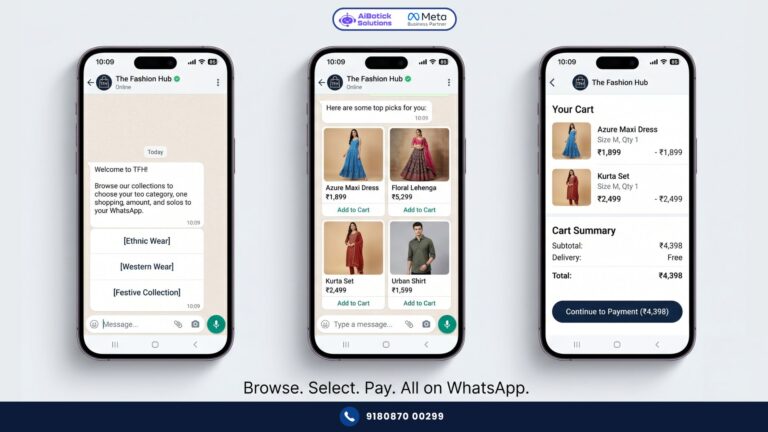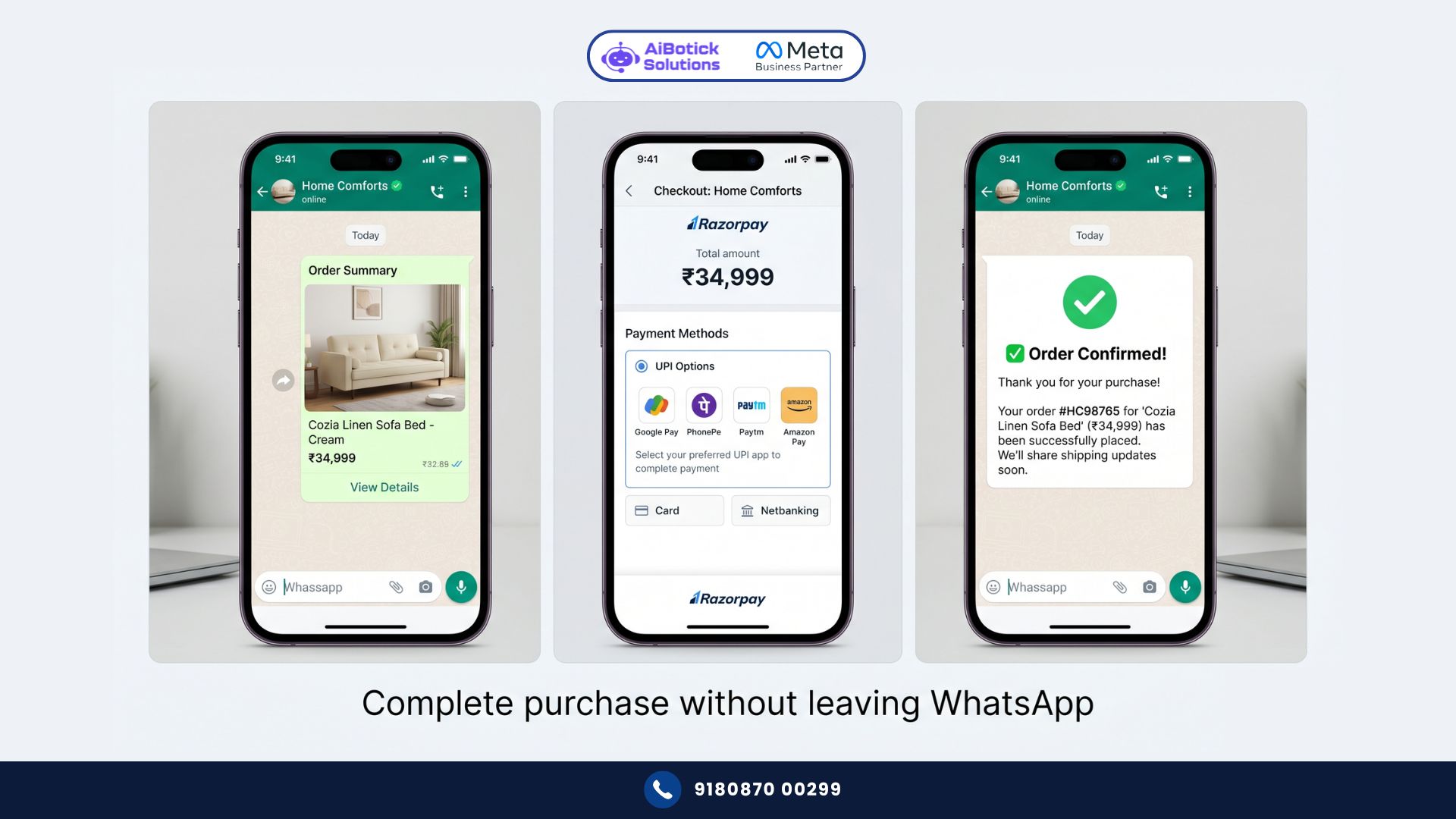
A customer browses your catalog on WhatsApp. Picks a product. Asks one question. Gets an instant answer.
And then — without leaving WhatsApp, without visiting your website, without filling a form, without creating an account — they pay.
Order confirmed. Payment received. All inside one chat.
That’s not a future concept. That’s what WhatsApp payments and payment integrations can do for Indian ecommerce brands right now in 2026.
And yet — most brands are still breaking the purchase journey. Customer decides to buy on WhatsApp, gets redirected to a website, creates an account, fills 6 fields, gets an OTP, payment page loads slowly on mobile, session times out, customer gives up.
Cart abandonment at the payment stage. The most expensive place to lose a customer. Because they already decided to buy.
Main yeh conversion leakage 4 saal se dekh raha hoon. Aur iska solution abhi se clearly available hai. Let me show you exactly what’s possible — and what isn’t.
Two Very Different Things — Don’t Confuse Them
First — important clarity. Because there are two separate things people mean when they say “WhatsApp payments.”
Thing 1 — WhatsApp Pay (Meta’s native payment feature)
Built directly into WhatsApp. UPI-based. Available in India. Customer pays directly within the WhatsApp interface without any external link.
Currently limited — available only in the WhatsApp Business App, not fully rolled out for API-based business accounts at scale yet. Regulatory approvals, NPCI limits, ongoing Meta-NPCI negotiations. Still evolving.
Thing 2 — Payment gateway integration within WhatsApp API flows
This is what’s fully available right now. Your WhatsApp bot sends a payment link inside the chat — Razorpay, PhonePe, Paytm, Stripe, PayPal, Instamojo, or 15+ other gateways. Customer taps the link, pays within their preferred app or browser, payment confirmed, WhatsApp receives confirmation, bot sends order confirmation. All within 90 seconds.
This second approach — payment integration within WhatsApp flows — is what AiBotick supports with 20+ payment gateways. And it’s what this article is primarily about.
Both are “WhatsApp payments” in spirit. But one is fully available today at scale. One is still evolving. Know the difference before anyone oversells you on anything.
Why Payment Integration Inside WhatsApp Changes Conversion Completely
Here’s the conversion funnel problem every ecommerce brand faces.
Customer journey without WhatsApp payment integration:
- Customer on WhatsApp — interested, warm, ready to buy
- “Here’s our website link to purchase” → clicks link
- Website loads (2-4 seconds on mobile, longer on 3G)
- “Create account or continue as guest” → friction point
- Fill name, email, phone, address → more friction
- Choose payment method → more friction
- OTP or card details → more friction
- Payment processing → final drop-off point
By step 4 — you’ve lost 40-50% of people who were genuinely ready to buy at step 1.
Customer journey with WhatsApp payment integration:
- Customer on WhatsApp — interested, warm, ready to buy
- “Here’s your order summary and payment link” → all details pre-filled from WhatsApp conversation
- Customer taps link — lands directly on payment page, amount and order details pre-populated
- Pays via UPI, card, netbanking, or wallet
- Payment confirmed — WhatsApp bot sends order confirmation instantly
Two steps effectively. Zero account creation. Zero address re-entry if you’ve collected it in the bot flow. Zero website loading wait.
The friction difference is dramatic. And friction difference equals conversion difference.
The 20+ Payment Gateways AiBotick Supports — What to Use for India
Not all gateways are equal for Indian ecommerce. Here’s my honest take after 4 years of seeing what works.
For Indian customers — use these:
Razorpay — First choice for most Indian ecommerce brands. Supports UPI, cards, netbanking, wallets, EMI, pay later. Dashboard is clean. Settlement is fast. Integration with WhatsApp flows is smooth. If you’re choosing one gateway — start here.
PhonePe Business — Excellent for brands whose customer base is heavily UPI-first. High success rates on UPI transactions. Growing fast.
Paytm for Business — Strong brand recognition, especially in tier-2 and tier-3 cities. If your customer demographic skews older or less tech-savvy — Paytm’s familiarity helps conversion.
Instamojo — Good for smaller brands, freelancers, service businesses. Simpler setup. Lower transaction volumes.
Cashfree — Strong for subscriptions and recurring payments. If your ecommerce model has any subscription component — worth considering.
For international customers:
Stripe — Global standard. If you’re selling to UAE, UK, Southeast Asia, or anywhere internationally — Stripe is the answer. Clean API, reliable, trusted globally.
PayPal — Still relevant for international NRI customers and older demographic globally.
Xendit — Specifically for Southeast Asia — Indonesia, Philippines, Malaysia. If you’re expanding there — Xendit is purpose-built for those markets.
Honestly? For 90% of Indian ecommerce brands — Razorpay handles everything you need. Start there. Add others only when specific customer segments demand it.
What a Complete WhatsApp Payment Flow Looks Like — Step by Step
Let me walk through a real purchase journey. Fashion brand. Mumbai. Customer is buying a kurta set.
Step 1 — Product discovery Customer messages: “Do you have something in cotton kurta sets under Rs.2,500?”
Bot shows catalog — 6 options in their budget, with images, prices, fabric details.
Step 2 — Selection Customer: “I like the third one. Size M. Navy blue.”
Bot: “Great choice! 😊 The Navy Cotton Kurta Set (Size M) — Rs.2,199. Before I send your payment link, quick question — cash on delivery or online payment?”
Step 3 — Address collection (if online payment) Customer chooses online payment.
Bot: “Perfect! Please share your delivery address or type it below.”
Customer shares address. Bot confirms.
Step 4 — Order summary Bot: “Here’s your order summary:
🛍️ Navy Cotton Kurta Set — Size M 💰 Rs.2,199 + Rs.99 shipping = Rs.2,298 📦 Delivery to: [Address] ⏱️ Expected delivery: 4-6 business days
Looks good? Tap below to pay securely 👇 [Pay Now — Rs.2,298]”
Step 5 — Payment Customer taps the Razorpay link. Pays via UPI in 20 seconds.
Step 6 — Confirmation Payment gateway notifies AiBotick. Bot immediately sends:
“Payment confirmed! 🎉 Your order #ORD7291 is placed. You’ll receive shipping updates on this chat. Thank you for shopping with us! 🙏”
Simultaneously — order created in WooCommerce/Shopify. Fulfilment team notified.
Total time from “I like the third one” to “payment confirmed” — under 4 minutes. Entirely inside WhatsApp. Zero website visits.
Real Numbers — Bengaluru Ethnic Wear Brand
Concrete. Because I won’t ask you to trust me without proof.
Ethnic wear brand. Bengaluru. Primarily sold through Instagram DMs before WhatsApp.
The problem: Instagram DM to website to payment — 73% drop-off between DM interest and completed payment. Out of every 100 interested customers — 27 completed purchase.
After WhatsApp payment integration (Razorpay + AiBotick):
- Drop-off between WhatsApp interest and payment completion: 34%
- Out of every 100 interested customers — 66 completed purchase
- Conversion rate improvement: 144%
Same products. Same prices. Same traffic source. Just a dramatically shorter, frictionless purchase journey.
Monthly revenue impact: Rs.8.4L → Rs.14.2L in 90 days. Without increasing marketing spend.
The Rs.5.8L additional monthly revenue — it was always there. Just leaking through the conversion funnel because of unnecessary friction.
WhatsApp payments integration — plug the leak.
What People Get Wrong About WhatsApp Payments
One assumption kills more implementations than anything else.
“We’ll just send a payment link at the end. Customer will figure it out.”
No no, scratch that thinking entirely.
The payment link isn’t the end of the flow. It’s the middle. What comes before and after the link determines whether customers pay.
Before the link matters:
- Has the bot collected delivery address first? (Don’t ask for address after payment — it breaks the flow and confuses customers)
- Is the order summary clear before the payment link? (Never send a payment link without a clear summary — customers don’t pay for ambiguity)
- Has the customer confirmed everything is correct? (One confirmation step before payment eliminates most “I paid for the wrong thing” support tickets)
After the link matters:
- Is the payment confirmation instant? (20+ second delay after payment = customer thinks it failed, contacts support)
- Does the order automatically create in your store? (Manual order creation after WhatsApp payment is a disaster waiting to happen at scale)
- Does the customer get a WhatsApp update when order ships? (Complete the journey — don’t stop at payment)
WhatsApp payments is not a feature you switch on. It’s a flow you design. Get the full flow right — the results are extraordinary. Get just the link right but ignore the rest — mediocre results and confused customers.
For the full ecommerce flow picture including how payments connect to order updates and customer support — our WhatsApp customer support guide covers the complete post-payment journey.
COD Through WhatsApp — Still Important for India
Quick but critical note.
India mein COD abhi bhi 50-60% of ecommerce orders hai. That’s not changing overnight.
WhatsApp handles COD beautifully too — just differently.
COD order placed → instant WhatsApp confirmation request (as covered in detail in our COD verification guide) → confirmed or cancelled → fulfilment proceeds.
The WhatsApp payments infrastructure handles both prepaid and COD seamlessly. You don’t have to choose one. Most Indian ecommerce brands run both — and the bot intelligently routes the payment flow based on customer’s payment preference.
How to Set Up WhatsApp Payment Integration — Exactly What to Do
Simple. Four steps.
Step 1 — Choose your primary gateway For most Indian brands — Razorpay. Create a Razorpay business account if you don’t have one. Get your API keys.
Step 2 — Connect to AiBotick In AiBotick’s payment integration settings — connect your Razorpay account via API. 10-minute setup. AiBotick’s onboarding team does this with you.
Step 3 — Build your payment flow In AiBotick’s flow builder — design the complete purchase journey. Product selection → address collection → order summary → payment link generation → confirmation. Each step is a visual block.
Step 4 — Test completely Place a real test order. Pay Rs.1 to yourself. Confirm payment confirmation fires. Confirm order creates in your store. Confirm customer receives the right WhatsApp updates throughout.
Do not skip the test. I’ve seen brands skip testing, go live, realise the order confirmation wasn’t firing, lose 48 hours of orders with no fulfilment. Not fun. Test everything.
Ab seedha baat —
Agar aapka ecommerce brand customers ko WhatsApp se website pe redirect kar raha hai payment ke liye — aap 40-70% conversions chhod rahe ho at that exact moment.
Rs.5.8L additional monthly revenue. That Bengaluru brand got that back. From existing traffic. Without new ads.
Payment integration isn’t a nice-to-have feature for ecommerce. It’s the difference between a WhatsApp presence and a WhatsApp revenue channel.
Tap below. 👇 Tell us your monthly WhatsApp-driven order volume and current payment method — we’ll show you exactly what the integration looks like for your setup.
— Mohit Shah | 15+ years in IT industry | 4+ years in WhatsApp automation | Worked with various MNC brands | Now helping businesses figure out what actually works
Q1: What is the difference between WhatsApp Pay and payment gateway integration for Indian ecommerce?
A1: WhatsApp Pay is Meta’s native UPI payment feature built directly into WhatsApp — still evolving for API-based business accounts at scale in India. Payment gateway integration (Razorpay, PhonePe, Paytm, etc.) sends a secure payment link inside the WhatsApp chat — customer taps, pays via their preferred method, confirmation returns to WhatsApp automatically. The gateway integration approach is fully available today at scale and supports 20+ payment methods including UPI, cards, netbanking, and wallets.
Q2: Which payment gateway works best for WhatsApp payments in India?
A2: Razorpay is the recommended first choice for most Indian ecommerce brands — it supports UPI, cards, netbanking, wallets, EMI, and pay-later options with fast settlement and reliable WhatsApp flow integration. For UPI-heavy customer bases — PhonePe Business performs strongly. For tier-2/3 city demographics — Paytm’s brand familiarity helps conversion. For international customers — Stripe handles global payments cleanly. Most brands start with Razorpay and add others only when specific customer needs require it.
Q3: How much can WhatsApp payment integration improve ecommerce conversion rates?
A3: Conversion improvement depends on your current drop-off rate between WhatsApp interest and completed payment. A Bengaluru ethnic wear brand improved conversion from 27% to 66% — a 144% improvement — by eliminating the WhatsApp-to-website redirect for purchases. The improvement comes from removing friction: no account creation, no address re-entry, no website loading delays, no session timeouts. Brands with high WhatsApp engagement but low purchase completion typically see the most dramatic conversion improvements.