Acquiring a new customer in India costs 5x more than retaining an existing one.
Five times.
And yet — most Indian D2C brands spend 90% of their marketing budget on acquisition. Meta ads, Google ads, influencer collabs, discount codes for first purchase. All chasing new customers.
Meanwhile — their existing customers. The people who already bought. Already trusted the brand. Already gave their phone number. Sitting there. Untouched. Uncontacted. Slowly forgetting the brand ever existed.
Main yeh galti 15 saal se dekh raha hoon. IT industry mein bhi. D2C mein bhi. Har jagah same story.
You worked so hard to get that first sale. And then you just… let them walk away.
WhatsApp repeat purchase automation changes this equation permanently. And the numbers — when you actually sit down and calculate them — are borderline shocking.
Why Repeat Purchases Are the Most Underrated Revenue Lever in D2C
Let me put some math in front of you. Real math.
Say your D2C brand does Rs.20L GMV monthly. 800 orders. Average order value Rs.2,500.
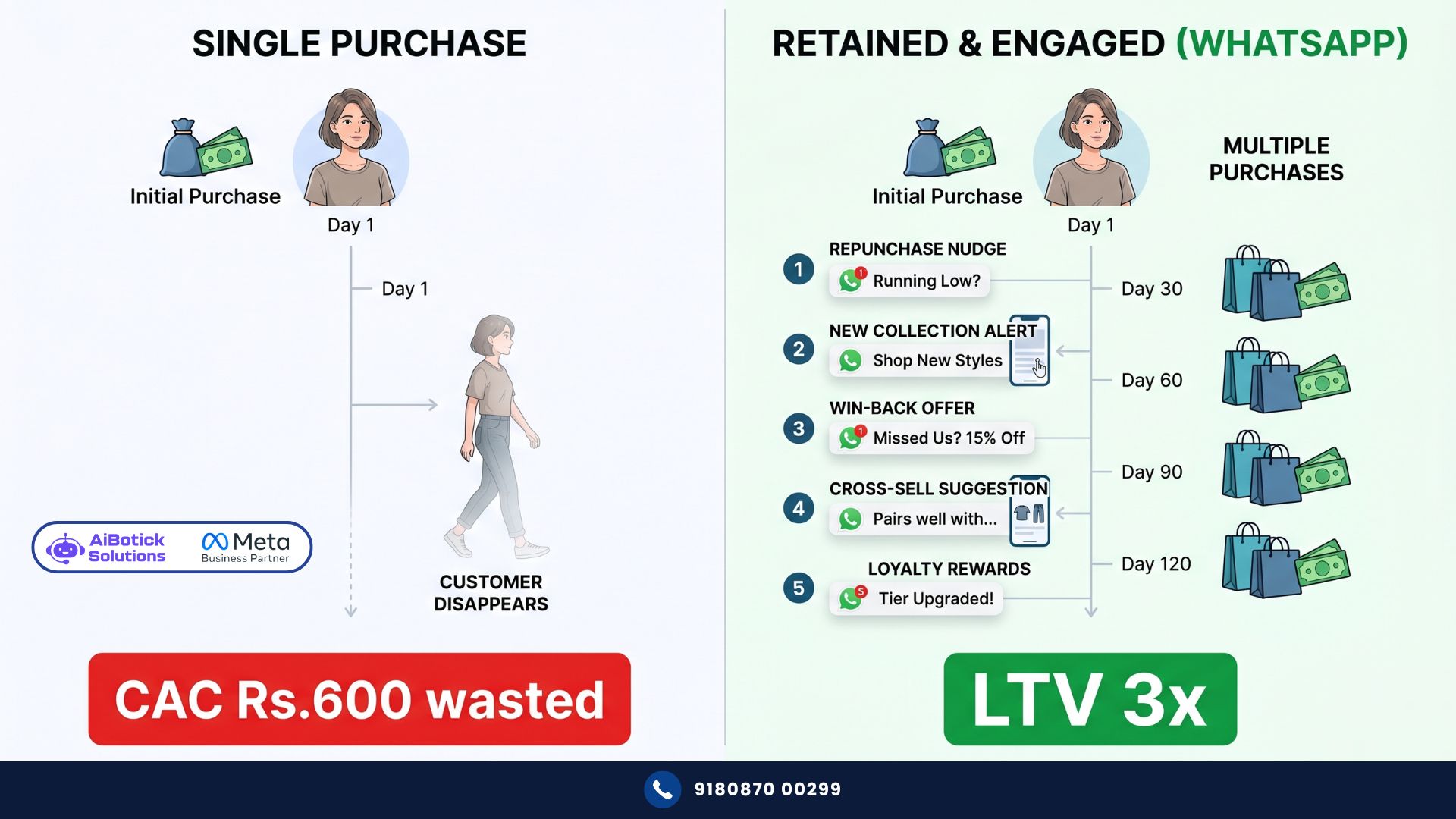
New customer acquisition cost: Rs.600 per customer (Meta ads, rough average). Repeat customer reactivation cost via WhatsApp: Rs.0.88 per conversation (Meta charge) + Rs.3,750/month platform fee shared across all messages.
Effectively — re-engaging an existing customer costs you 99% less than acquiring a new one.
Now — what if your repeat purchase rate goes from 18% to 28% within 90 days?
That’s 80 additional repeat orders per month. At Rs.2,500 AOV = Rs.2,00,000 additional monthly revenue.
Without increasing ad spend. Without acquiring new customers. Without changing your product.
Just — staying in touch with people who already love what you sell.
Yeh WhatsApp repeat purchase automation ka jadoo hai. 💯
The Real Reason Customers Don’t Come Back — It’s Not What You Think
Most brand owners assume customers don’t repurchase because:
- They didn’t like the product
- They found a cheaper competitor
- They only needed it once
Sometimes true. But honestly? In my experience — the biggest reason customers don’t come back is embarrassingly simple.
They forgot about you.
Not dramatically. Not because of a bad experience. Just — life happened. They got busy. Your brand slipped out of their mind. Someone else’s ad showed up first when they needed something similar.
Out of sight, out of mind. Yeh duniya ka oldest problem hai.
WhatsApp repeat purchase automation solves this at the root. You stay visible. You stay relevant. You show up — not as an interruption, but as a helpful reminder — at exactly the right moment.
That’s the entire game. Being there when they’re ready to buy again.
The WhatsApp Repeat Purchase Playbook — Every Flow You Need
Here’s exactly what to build. In order of impact.
Flow 1 — The Repurchase Nudge (Highest ROI)
Every product has a natural repurchase cycle. Skincare — 30-45 days. Coffee — 20-25 days. Supplements — 30 days. Clothing — 60-90 days.
Build this flow once. It runs forever.
Day X after delivery (based on your product’s repurchase cycle):
“Hey [Name]! 😊 Running low on your [Product]? Most of our customers reorder around this time. Your favourites are in stock — shall I send you the link?”
Simple. Helpful. Not pushy. Timed perfectly.
Customer who’s genuinely running low — clicks and reorders. Customer who’s not ready — ignores it. No damage done.
What this does: Catches the customer exactly when repurchase intent is highest — before they’ve searched for alternatives. Before competitor ads have reached them.
Flow 2 — New Collection / Restock Alert
Customer bought a blue kurta from you 60 days ago. New festive collection just launched.
“[Name], our Navratri collection just dropped — and based on what you bought earlier, you’re going to love these. First look before we announce publicly 👇 [Catalog Link]”
Two things happening here. First — personalised recommendation based on purchase history. Second — exclusivity signal (“first look before public announcement”). Both increase open and response rates dramatically.
Flow 3 — Win-Back Campaign (For Lapsed Customers)
Customer hasn’t purchased in 90+ days. They’re going cold. Time to act.
“[Name], it’s been a while! We miss you 😄 A lot has changed — new collections, better prices, and honestly we’ve improved a lot based on customer feedback. Here’s Rs.150 off your next order — just for coming back: [Code] [Shop Link]”
Small incentive. Genuine tone. No desperation.
Win-back campaigns via WhatsApp — I’ve seen 12-18% conversion rates on lapsed customer lists. Via email — same list, same offer — 3-4%. The channel difference is that dramatic.
Flow 4 — Cross-Sell Based on Purchase History
Customer bought a formal shirt. Suggest matching trousers. Customer bought a yoga mat. Suggest a foam roller or resistance bands.
“[Name], customers who bought your [Product] absolutely love pairing it with [Complementary Product]. Makes sense if you think about it — [one line why]. Want to take a look? [Link]”
Cross-sell done right doesn’t feel like selling. It feels like advice from someone who knows your taste.
Done wrong — it feels like Amazon’s “you might also like” section that recommends phone covers when you just bought a TV.
The difference is specificity. Be specific. Be relevant. Or don’t send.
Flow 5 — Loyalty Recognition
Customer has placed 3+ orders. They’re a loyal customer. Tell them.
“[Name], you’ve been with us since [First Order Month] — and honestly, customers like you are why we keep going. 🙏 As a small thank you — here’s early access to our next sale + an exclusive Rs.200 off code: [Code]. Valid for 7 days — just for you.”
This message does something money can’t buy — it makes the customer feel seen. Valued. Not like a transaction.
The emotional connection built here — it’s worth more than any discount. Because customers who feel emotionally connected to a brand refer others. They defend the brand when someone says something negative online. They become advocates.
Real Numbers — Delhi Organic Skincare Brand
Concrete. Because you deserve specifics.
Organic skincare brand. Delhi. Doing Rs.16L GMV monthly. 70% new customers, 30% repeat.
Problem: Repeat purchase rate stuck at 14%. Every month — chasing new customers to maintain revenue. CAC rising. Margins shrinking.
What they set up:
- Repurchase nudge at Day 35 (their average product cycle)
- New collection alerts to past buyers segment
- 90-day win-back campaign for lapsed customers
- Cross-sell flow based on product category purchased
Results after 90 days:
- Repeat purchase rate: 14% → 26%
- Monthly repeat revenue: Rs.4.8L → Rs.8.8L (Rs.4L additional)
- New customer acquisition budget: stayed the same
- Overall monthly GMV: Rs.16L → Rs.20.8L
Rs.4L additional monthly revenue. From existing customers. Zero additional ad spend.
Annual impact: Rs.48L in incremental revenue from one strategic shift in how they communicate with existing customers.
Platform cost for the year: Rs.45,000.
Ab bolo — kaunsa CFO is deal ko reject karega? 😅
What People Get Wrong About WhatsApp Repeat Purchase Campaigns
One thing. And it’s big.
They send the same message to everyone.
New customer who bought 3 days ago — gets the same “come back” message as a customer who bought 6 months ago.
Customer who bought skincare — gets the same cross-sell as a customer who bought home decor.
Customer who spent Rs.8,000 across 4 orders — treated exactly the same as a customer who bought Rs.400 worth once.
This is not personalisation. This is broadcast pretending to be personalisation.
Real WhatsApp repeat purchase automation segments customers. By recency. By category. By order value. By number of purchases. And sends genuinely relevant messages to each segment.
AiBotick’s platform lets you create custom fields and labels for every customer — and trigger different flows based on those attributes. A Rs.8,000 loyal customer gets the loyalty recognition flow. A 3-day post-purchase customer gets the thank you + review request. A 90-day lapsed customer gets the win-back.
Same platform. Different messages. Dramatically better results.
For the full breakdown on how to measure what these flows actually return for your business — our WhatsApp automation ROI guide walks through the exact calculation framework.
Building Your Repeat Purchase Engine — Exactly What to Do First
Don’t try to build all 5 flows in week 1. That’s how you build nothing properly.
Week 1 — Build this: Repurchase nudge flow. Calculate your product’s repurchase cycle. Build one message. Set the trigger. Go live.
This single flow delivers the fastest, most measurable ROI of any repeat purchase automation.
Week 2-3 — Add this: New collection / restock alert flow. Build your segmentation — tag customers by product category purchased. Set up the broadcast template.
Month 2 — Add this: Win-back campaign for customers 90+ days inactive. Pull the list. Write the message. Test on 200 customers first. Refine based on response. Then roll out.
Month 3 — Add this: Cross-sell flows and loyalty recognition. These require more thought — but by month 3, you’ll have enough purchase history data to make genuinely relevant recommendations.
Build in layers. Each layer compounds on the previous one.
And the beautiful thing — once these flows are built and live, they run forever. Automatically. For every customer who enters those segments. Without anyone on your team doing anything.
That’s not just automation. That’s leverage. Real leverage.
For a complete understanding of how WhatsApp catalog and repeat purchase flows work together as one shopping experience — our WhatsApp product catalog guide shows the full picture.
Toh yaar — ek last question before you tap below.
Your existing customers. The ones who bought from you last month. Last quarter. Last year.
Who’s talking to them right now?
If the answer is “nobody” — you know what to do.
Tell us your D2C category and monthly order volume — we’ll map out exactly which repeat purchase flows to build first and what revenue impact to realistically expect within 90 days.
— Mohit Shah | 15+ years in IT industry | 4+ years in WhatsApp automation | Worked with various MNC brands | Now helping businesses figure out what actually works
Q1: How does WhatsApp repeat purchase automation work for Indian D2C brands?
A1: WhatsApp repeat purchase automation uses customer purchase history to trigger personalised messages at the right time — repurchase nudges timed to the product’s natural cycle, new collection alerts to relevant customer segments, win-back campaigns for lapsed customers, cross-sell recommendations based on what they bought, and loyalty recognition for high-value repeat buyers. All flows run automatically, 24×7, without manual intervention.
Q2: What is the most effective WhatsApp repeat purchase flow to set up first?
A2: The repurchase nudge — timed to your product’s natural repurchase cycle — delivers the fastest, most measurable ROI. Calculate when your average customer runs low (Day 30 for skincare, Day 20 for coffee, Day 60 for clothing) and send one warm, helpful WhatsApp at that exact point. This single flow alone can increase repeat purchase rates by 5-8 percentage points within the first 30 days.
Q3: How much can WhatsApp repeat purchase automation increase revenue for a D2C brand?
A3: Results vary by product category and customer list quality, but a Delhi organic skincare brand doing Rs.16L monthly GMV increased their repeat purchase rate from 14% to 26% using 4 WhatsApp flows — generating Rs.4L additional monthly revenue (Rs.48L annually) without increasing ad spend. Most D2C brands see measurable repeat purchase improvement within the first 30-60 days of implementing even basic WhatsApp retention flows.