Tell me if this sounds familiar.
WhatsApp vs email — yeh debate Indian businesses mein 2026 ki sabse important conversation ban gayi hai.
You send a carefully written email to a lead. Subject line crafted. Body edited three times. Nice signature at the bottom.
And then… nothing.
You follow up three days later. Nothing again.
You call them. “Oh haan, email aaya tha — but I haven’t checked my inbox in a week.”
Meanwhile your competitor sent them a WhatsApp. They replied in 11 minutes. Deal done.
Yaar, I’ve watched this happen hundreds of times. And every time — it’s not the product that lost the deal. It’s the channel.
WhatsApp vs Email — The Number That Should Scare Every Marketer
95% vs 20%.
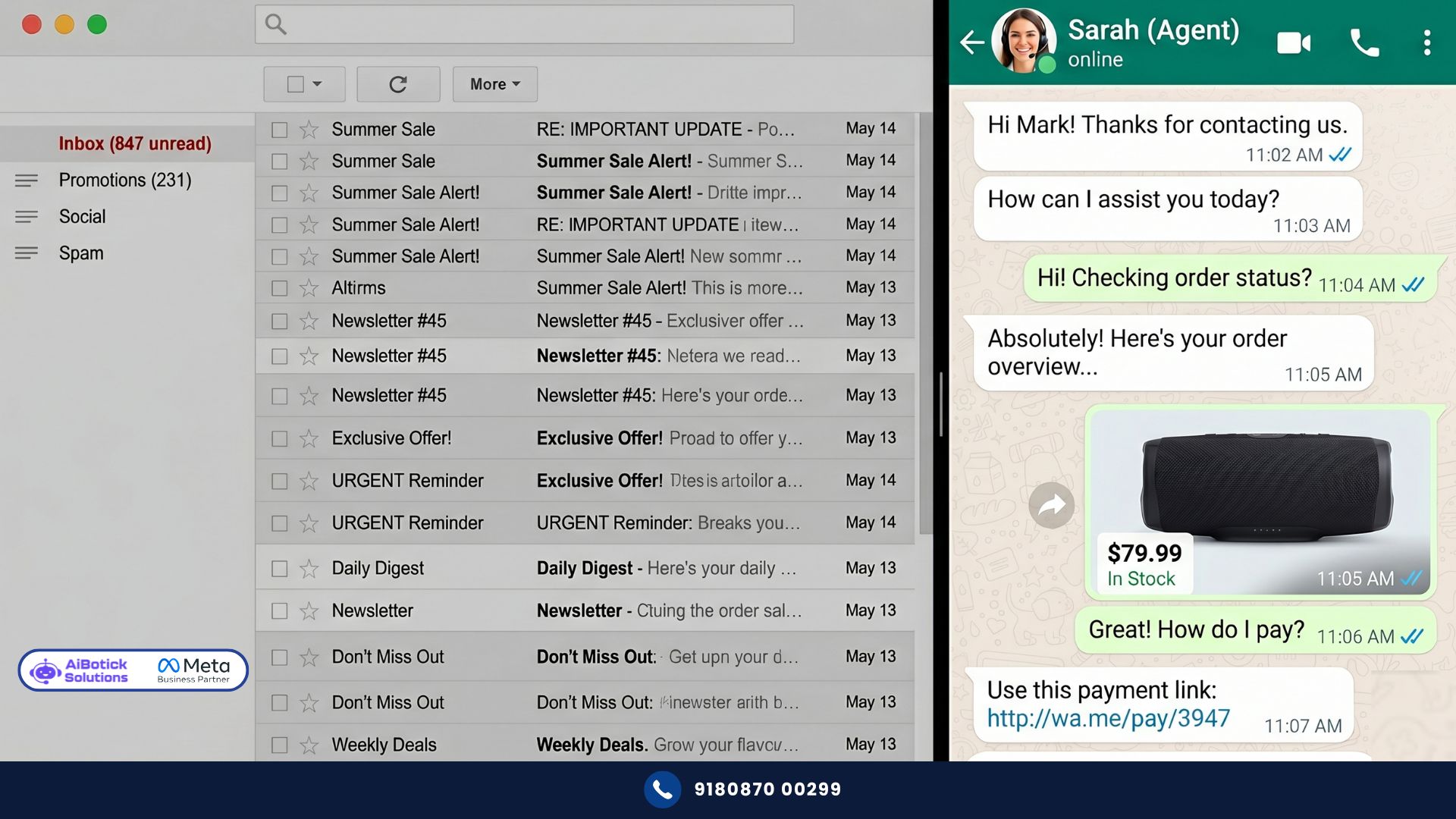
That’s WhatsApp open rate vs email open rate in India right now.
Actually — scratch that. 20% is generous for email. Most B2C email campaigns in India are seeing 12-15% open rates. And “open” doesn’t even mean they read it. It means the email technically loaded. They probably saw the subject line and moved on.
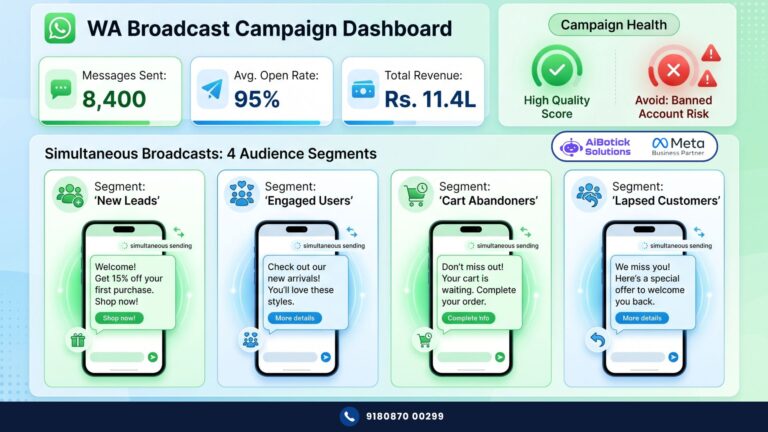
WhatsApp? 95% open rate. And most messages — read within 3-5 minutes of delivery.
Now before someone jumps in with “but Mohit bhai, email is more professional” — yes, yes, I know. We’ll get there. But first let me show you what this number actually means for your business.
Want to understand exactly what WhatsApp automation is? Read our plain-English guide here.
What 95% vs 20% Looks Like in Real Money
Let’s say you have 1,000 leads in your database.
You send an email campaign promoting a new offer.
- 200 people open it (20% — and that’s optimistic)
- Maybe 3-4% click something = 6-8 people
- Maybe 1-2 actually enquire or buy
Same 1,000 people. WhatsApp broadcast instead.
- 950 people see the message (95%)
- Response rate on a well-crafted WhatsApp? 15-25% easily
- That’s 150-250 people actively engaging with your offer
Same list. Same offer. Same effort.
One channel gives you 1-2 responses. Other gives you 150-250.
Bhai, yeh math hai. Simple math.
And I’m not making these numbers up — I’ve watched this play out at companies I’ve worked with. The shift from email campaigns to WhatsApp campaigns literally changed quarterly revenue numbers. Not by 5-10%. By 3-4x.
This is the core of the WhatsApp vs email debate for Indian businesses.
WhatsApp vs Email in India — Why the Gap is Even Bigger Than You Think
Okay — this is actually interesting. Because it’s not just about the app.
It’s about Indian behaviour. And this is something I don’t think enough people talk about.
India never really had an email culture.
Think about it. The West built its digital communication habits around email — because that’s what existed when the internet arrived there. Email was THE thing for 20 years.
India? We jumped straight to mobile. Straight to messaging apps. A massive chunk of India’s internet users got online via smartphone — not desktop. And on a smartphone, nobody naturally gravitates toward email. They go to WhatsApp.
My own family — my mother, my chaiwala near office, the real estate agent I dealt with last year — none of them check email more than once a week. All of them check WhatsApp every 30 minutes.
So when you send your customer an email — you’re speaking to them in a language they technically understand but almost never use.
When you send a WhatsApp — you’re speaking to them where they actually live.
“But My Customers Are Corporate — They’re on Email”
Okay. Fair point. Let me address this honestly.
Yes — formal B2B communication still happens over email. Proposals, contracts, invoices, official correspondence. Email isn’t going anywhere for that.
But here’s what even corporate people in India do:
They check WhatsApp first thing in the morning. Before email. Before LinkedIn. WhatsApp.
I’ve sat in meetings with VPs and Directors at companies doing hundreds of crores — and mid-meeting, WhatsApp notification pops up on their phone and they glance at it. Email? They batch-check maybe twice a day.
So even in B2B — the initial contact, the quick follow-up, the “just checking if you got my proposal” message — WhatsApp converts faster.
Actually wait. Better example than anything I can make up:
A software company I know — selling to mid-size corporates, average deal size Rs.2-3 lakh — switched their lead follow-up from email to WhatsApp. Same leads. Same sales team. Same product.
Follow-up response rate went from 8% to 41%.
41%. On corporate B2B leads.
Email isn’t dead for corporates. But WhatsApp is faster. And in sales — faster almost always wins.
The 5 Situations Where WhatsApp Destroys Email. Every Time.
1. Lead follow-up Someone filled your website form. You have maybe 5-10 minutes before their interest starts cooling. Email takes hours to get noticed. WhatsApp gets seen in minutes. The first business to respond wins — and WhatsApp gets you there first. Every. Single. Time.
2. Customer support Email support chains are honestly a nightmare. Customer sends email. You reply 4 hours later. They reply next morning. You reply afternoon. Simple problem = 3 days to resolve. WhatsApp? Same conversation happens in 15 minutes. Customer is happy. Your team moves on. Done.
3. Payment reminders “We sent you an invoice on email.” “Oh, I didn’t see it.” This conversation happens every day in every business in India. Send the same reminder on WhatsApp — seen, responded to, paid. Often same day.
4. Abandoned cart recovery This one is specifically for ecommerce. Email abandoned cart sequences recover maybe 3-5% of carts. WhatsApp abandoned cart messages recover 8-15%. Almost 3x. Because the message gets seen before the customer has moved on completely.
5. Event reminders and confirmations Webinar reminders via email — 30-40% attendance. Same reminder via WhatsApp — 60-70% attendance. Demo confirmations, appointment reminders, class notifications — WhatsApp response and show-up rates are consistently higher. No contest.
Where Email Still Wins (Being Honest Here)
Look — I’m not here to tell you to delete your email account. That would be stupid advice.
Email still makes sense for:
- Formal documentation — Contracts, agreements, official letters. Email has legal standing. WhatsApp messages don’t (yet, for most purposes).
- Long-form content — Detailed proposals, reports, newsletters with lots of reading material. WhatsApp isn’t designed for 2,000-word emails.
- Cold outreach to businesses — First contact with a completely unknown corporate prospect. Email is still more acceptable here than a cold WhatsApp.
- Transactional records — Invoices, receipts, order confirmations where the customer needs something to refer back to in their inbox.
So the smart move isn’t “abandon email.” The smart move is — use each channel for what it’s actually good at.
WhatsApp for speed, engagement, follow-up, support, campaigns. Email for formality, documentation, long-form.
Yeh dono saath mein chalte hain. It’s not either/or.
The Real Cost of Not Making This Shift
This is the part most business owners don’t calculate.
Every day you’re relying on email for customer engagement — you’re leaving something on the table.
Not dramatically. Not obviously. Just quietly, consistently, every single day.
- The lead who didn’t reply to your email follow-up — but would have replied to a WhatsApp
- The cart that wasn’t recovered — because your email took 4 hours to arrive and they’d already bought from a competitor
- The appointment that was missed — because the email reminder went to spam
- The upsell that never happened — because the customer never saw your campaign
None of these feel catastrophic individually. But add them up over a month? Over a year?
For a business doing Rs.50L/month — even a 5% improvement in lead conversion, recovery rate, and repeat purchase rate adds up to Rs.2-3L extra per month. Minimum.
And that’s conservative.
So What’s Actually Stopping Businesses From Making the Switch?
Honestly? Three things. And none of them are good reasons.
“We’ve always done email.” Ab toh band karo yaar. “We’ve always done it” is how businesses become irrelevant. Blockbuster always did DVDs. Nokia always did keypad phones.
“Setting up WhatsApp automation seems complicated.” It’s not. I promise. The right platform has you live in 48 hours. No IT team needed. If you can use WhatsApp personally — you can use a WhatsApp automation platform.
“Our customers prefer email.” Have you actually asked them? Or are you assuming? Because every data point I’ve seen from Indian businesses says the opposite — customers respond faster, more often, and more warmly on WhatsApp than email. Every time.
Not sure if your business is ready to make the switch? Here are 10 signs you need WhatsApp automation.
The Shift is Already Happening. The Question is Whether You’re Leading It or Chasing It.
Dekho — your competitors are figuring this out. Some already have.
The businesses that moved to WhatsApp-first communication 2-3 years ago? They have a head start you’re going to struggle to catch up to. Better response rates, better client relationships, better retention, better conversion.
The businesses making the move now? Still ahead of the majority. Still early enough to build a real advantage.
The businesses waiting? They’ll make the move eventually. But by then — it won’t be an advantage anymore. It’ll just be table stakes.
Where do you want to be?
If you want to see what WhatsApp-first customer communication actually looks like for your specific business — what gets automated, what campaigns look like, how your team would use it — just tap below. 👇
Real conversation. No forms. No pitch. Just us figuring out if it makes sense for you.
— Mohit Shah | 15+ years – Learning & Growing | Now helping businesses figure out what actually works
Q1: Is WhatsApp better than email for business communication in India?
A1: For most Indian businesses — yes, significantly. WhatsApp has 95%+ open rates vs email’s 15-20% in India. Messages are read within minutes, not hours. Customers respond faster, leads convert quicker, and support queries get resolved without back-and-forth email chains. For marketing, customer support, and lead follow-up — WhatsApp wins every time in the Indian context.
Q2: Should Indian businesses completely stop using email?
A2: No. Email still has its place — formal documents, invoices, long-form communication, B2B contracts. But for day-to-day customer engagement, lead follow-up, support, and marketing campaigns — WhatsApp outperforms email by a wide margin in India. Smart businesses use both — WhatsApp for speed and engagement, email for formality and documentation
Q3: Why do WhatsApp messages get higher open rates than email in India?
A3: Three reasons. First — WhatsApp notifications are harder to ignore than email notifications. Second — Indians check WhatsApp dozens of times a day; email maybe once or twice. Third — WhatsApp feels personal and conversational, not promotional. A message that feels like it came from a person gets opened. A message that looks like a newsletter gets ignored