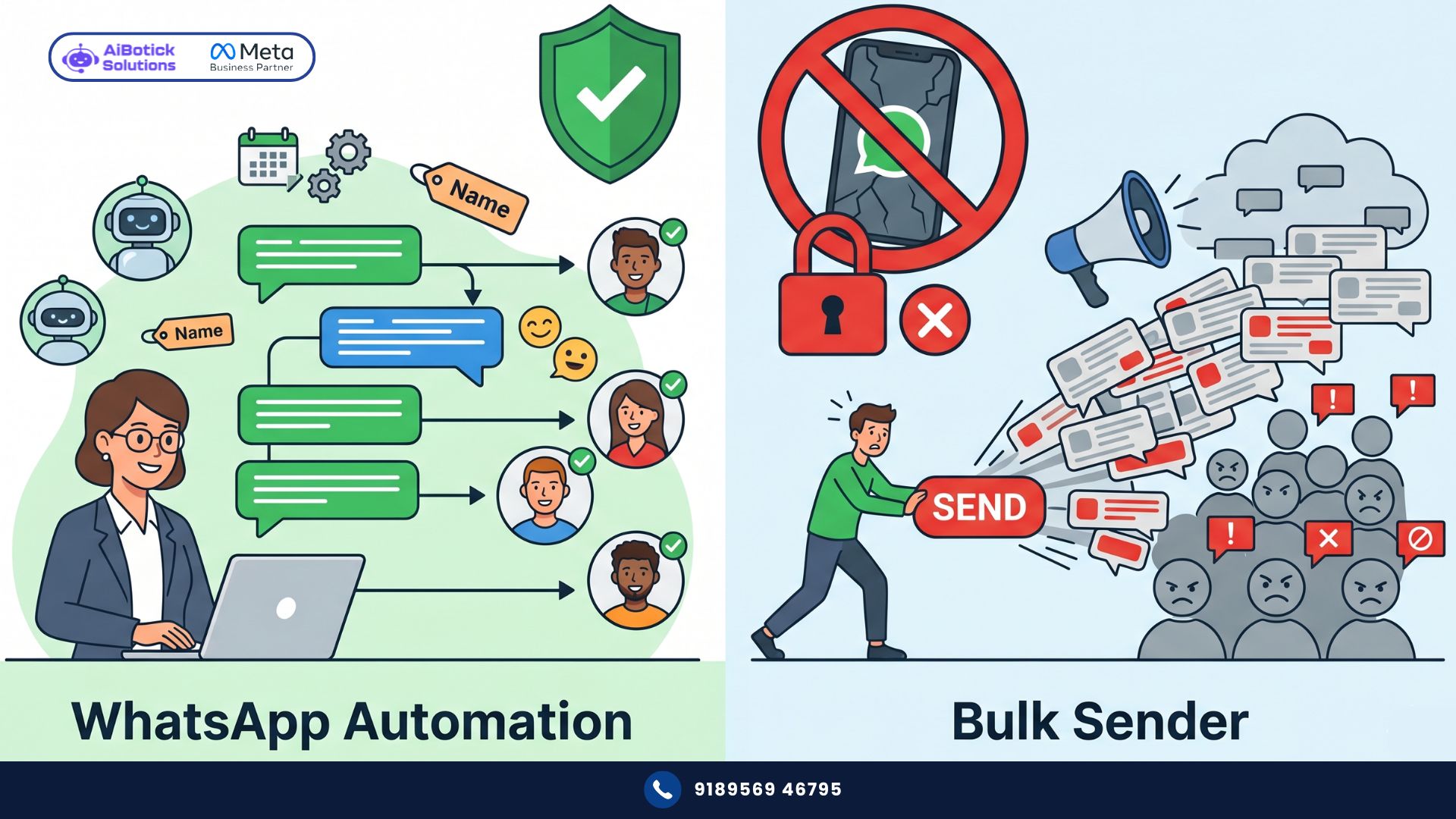
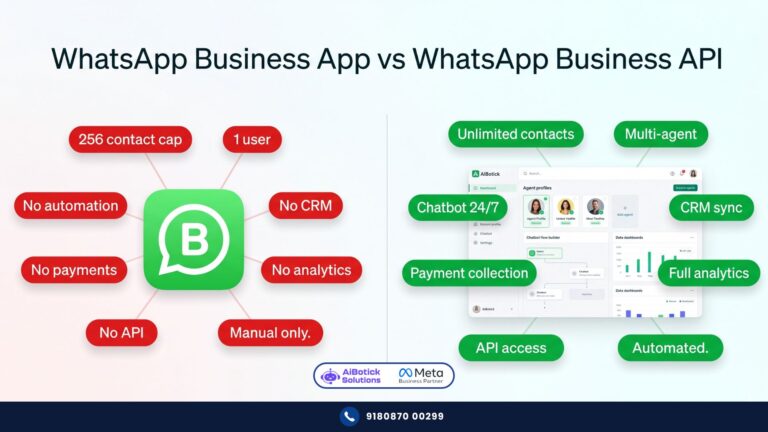
WhatsApp Automation vs Bulk Sender software fights going since ages & it’ll going to continue because it is price vs. value.
Here’s a story I’ve told probably 200 times in 15 years.
Business owner buys a “WhatsApp bulk sender” software for Rs.2,000 from some guy on Instagram. Sends 50,000 messages in one afternoon. Feels like a marketing genius.
Three days later — WhatsApp number banned. Permanently.
Now they can’t use WhatsApp for business at all. New number needed. New contacts needed. Reputation with existing customers — damaged. And that Rs.2,000 software? Gone. Refund? Obviously not.
I’ve watched this happen to small businesses. I’ve watched it happen to companies doing Rs.10 crore a year. The software doesn’t discriminate.
And the worst part — every single one of them thought they were doing WhatsApp marketing. They weren’t. They were doing WhatsApp suicide.
So today — let’s kill this confusion permanently. What’s the difference between bulk WhatsApp senders and proper WhatsApp automation? Why does one get you banned and the other builds your business? And how do you tell them apart before you spend a single rupee?
First — What Exactly IS a Bulk WhatsApp Sender?
Bulk WhatsApp senders are third-party software tools — usually sold cheaply, often through Instagram ads, Telegram groups, or shady websites — that allow you to blast messages to thousands of numbers simultaneously using the regular WhatsApp or WhatsApp Business App.
They work by essentially hacking WhatsApp’s interface. Automating clicks. Simulating human behaviour. Tricking the app into sending mass messages.
They are Not Authorised by Meta. Not even slightly.
Some of them look surprisingly professional. Fancy dashboard. Import contacts via Excel. Schedule messages. Personalise with names. Looks legit.
It’s not.
And Meta — with 500 million+ Indian users generating data every second — has gotten extremely good at detecting exactly this behaviour.
How Does Meta Detect and Ban These Senders?
This is the part that surprises people.
Meta doesn’t just look at volume. They look at patterns.
- Sending to numbers that haven’t saved your contact? Flag.
- High percentage of recipients blocking or reporting you? Flag.
- Message delivery pattern inconsistent with human behaviour? Flag.
- Same message template sent to thousands of numbers in minutes? Flag.
- Using unofficial API access or modified WhatsApp client? Immediate flag.
When enough flags accumulate — ban. Sometimes temporary (24-72 hours). Often permanent.
And here’s what makes it worse — Meta doesn’t just ban the number. They ban the device. Sometimes the account. Getting a permanently banned number reinstated is nearly impossible. I’ve seen businesses try for months. Never got it back.
Ek baar ban hua — toh woh number gone. No second chances on permanent bans.
Want to understand how the official WhatsApp Business API actually works? Here’s our plain-English guide.
What Is Proper WhatsApp Automation?
Completely different animal.
WhatsApp automation — done correctly — works through the Official WhatsApp Business API. Authorised directly by Meta. Designed specifically for businesses that need to communicate at scale.
The key differences:
It’s opt-in based. You can only message people who have explicitly given you permission to contact them on WhatsApp. No cold blasting random numbers. This single rule is what separates legitimate automation from spam.
Messages go through Meta’s servers officially. No hacking. No simulating clicks. Your platform connects directly to Meta’s API infrastructure. Meta knows exactly who you are, what you’re sending, and to whom.
Templates are pre-approved. Any outbound marketing or utility message must be reviewed and approved by Meta before you can send it. This ensures quality, relevance, and compliance.
You have a quality rating. Meta gives your WhatsApp number a quality rating — Green, Yellow, or Red — based on how recipients respond to your messages. High block rates = rating drops = sending limits reduced. This incentivises businesses to send genuinely useful messages.
Nobody gets banned for using it correctly. In last 4 years — I have never once seen a business get banned for using the official WhatsApp Business API properly. Never. Not once.
WhatsApp Automation vs Bulk Sender — Every Difference That Matters
Let me make this impossible to misunderstand.
| Parameter | Bulk WhatsApp Sender | WhatsApp Business API |
|---|---|---|
| Authorised by Meta? | ❌ No — completely unofficial | ✅ Yes — officially authorised |
| Ban risk | 🔴 Extremely high — permanent bans common | 🟢 Zero if used correctly |
| Contact requirement | Send to anyone — saved or not | Opted-in contacts only |
| Message approval | No approval needed | Meta approves templates first |
| Chatbot capability | Basic or none | Full AI-powered chatbot flows |
| Team inbox | ❌ No | ✅ Multiple agents, one number |
| CRM integration | ❌ No | ✅ Full integration capability |
| Ecommerce integration | ❌ No | ✅ Shopify, WooCommerce, etc. |
| Analytics | ❌ None | ✅ Delivery, read rates, campaign data |
| Customer experience | Spam-like, impersonal | Professional, personalised, conversational |
| Long-term viability | ❌ Business-ending risk | ✅ Scales with your business |
| Cost | Rs.500-5,000 one-time | Rs.15,000-60,000/year + Meta charges |
| What you actually get | A ban waiting to happen | A 24×7 sales and support engine |
“But Mohit Bhai — Bulk Senders ARE Working for Some People”
Yeah. I hear this.
And honestly — some people do use bulk senders for months without getting banned. I won’t pretend otherwise.
But here’s the reality of that situation.
It’s like driving without a seatbelt. Most trips — nothing happens. Until the one trip where everything goes wrong. And then it goes very, very wrong.
The businesses I’ve seen using bulk senders “successfully” for 6 months — they’re living on borrowed time. Meta’s detection keeps improving. What works today gets caught tomorrow.
And when the ban comes — it doesn’t come with a warning. It comes on the morning of your biggest sale. Or the day you’re following up on your most important lead. Or during peak festive season when your entire revenue depends on customer communication.
That’s not a risk worth taking for any serious business.
Actually — let me tell you what happened to one specific business I know. A D2C fashion brand in Surat. Doing Rs.40L/month. Used a bulk sender for their Diwali campaign. 80,000 messages sent. Number banned permanently within 48 hours. Entire festive season communication channel — gone. They had to scramble to rebuild on a new number, re-collect opt-ins, restart everything. Cost them an estimated Rs.8-10L in lost festive revenue.
The bulk sender software cost them Rs.3,500.
The Real Cost Comparison Nobody Does
People look at bulk sender pricing (Rs.2,000-5,000) vs WhatsApp API pricing (Rs.25,000-45,000/year) and think bulk sender is cheaper.
Wrong calculation entirely.
Real cost of bulk sender:
Rs.3,500 software + Risk of permanent ban + Lost business during ban recovery + Damage to customer relationships + Time rebuilding from zero + Mental stress of running an illegal operation on your most important communication channel.
Real cost of WhatsApp API:
Rs.25,000-45,000/year + Meta charges + A platform that legally, reliably, professionally handles your entire WhatsApp operation 24×7 with chatbots, team inbox, integrations, analytics, and zero ban risk.
Which one is actually cheaper? Not even a close question.
Already convinced you need the real thing? Here’s the complete WhatsApp Business API pricing breakdown for India.
Three Types of “WhatsApp Marketing” People — Which Are You?
Based on my experience, I’ve seen three categories.
Type 1 — The Gambler Uses bulk senders. Knows it’s risky. Does it anyway because it’s cheap. Wakes up one day to a banned number and loses months of work overnight. Comes to proper platforms after the ban. Wishes they’d started there.
Type 2 — The Confused One Doesn’t understand the difference. Thinks all WhatsApp marketing is the same. Gets sold a bulk sender by someone on Instagram and believes it’s legitimate. Victim of bad information.
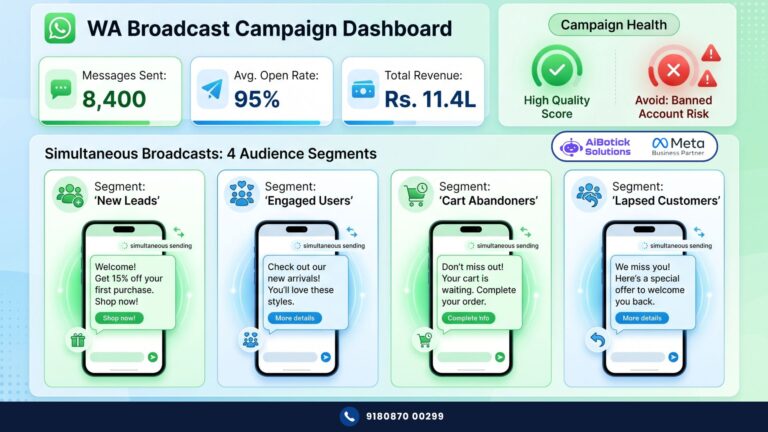
Type 3 — The Builder Uses official WhatsApp Business API from day one. Builds opted-in contact lists properly. Sends relevant, wanted messages. Gets 90%+ open rates on campaigns. Has a chatbot handling enquiries at 2am. Scales without fear.
Every business I’ve seen build something real on WhatsApp — they’re Type 3.
Every business I’ve seen crash and burn — Type 1 or Type 2.
Choose which one you want to be. Before the choice gets made for you.
How to Identify a Bulk Sender Before You Get Trapped
Quick checklist. If any of these describe a tool being pitched to you — run.
- Most Imp : No mention of Meta approval or WhatsApp Business API
- No business verification process required
- Sold via Instagram DM or Telegram group
- “Send to unlimited contacts” with no mention of opt-in
- One-time payment with no ongoing platform relationship
- Promises of “100% delivery guaranteed” to any number
- Customer support is a WhatsApp number or email with no company details
Legitimate WhatsApp automation platforms — they’ll always mention WhatsApp Business API. They’ll always talk about opt-in requirements. They’ll always have a business verification process. They’ll always be transparent about Meta charges.
If someone is hiding these things — they’re hiding them for a reason.
What Proper WhatsApp Automation Actually Looks Like
Just so you have a complete picture — here’s what you get when you do this right.
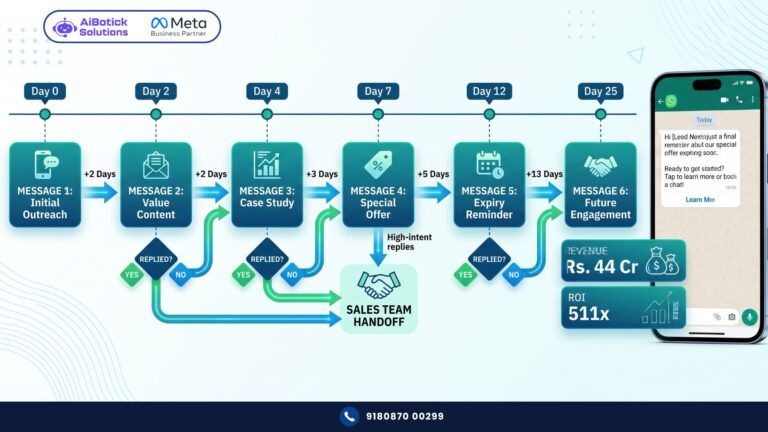
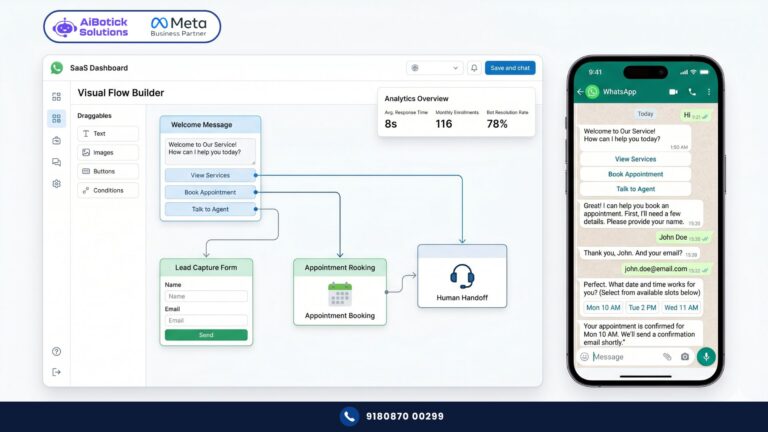
Your customer fills a form on your website at 11pm. Instant WhatsApp message — personalised, relevant, from your official business number. They reply. Chatbot handles the conversation — answers questions, shares catalog, books a demo slot. Your team wakes up to a warm, qualified lead with full conversation history.
No human involved until the human was actually needed.
That’s not possible with a bulk sender. Not even close.
Agar aap seriously WhatsApp ko ek revenue channel banana chahte ho — not a spam machine, not a ban waiting to happen — tap below. 👇
We’ll show you exactly what proper WhatsApp automation looks like for your specific business. Live demo. Real flows. Your industry.
— Mohit Shah | 15+ years Learning & Growing | Now helping businesses figure out what actually works
Q1: What is the difference between WhatsApp automation and bulk WhatsApp senders?
A1: WhatsApp automation uses the official Meta-authorised WhatsApp Business API — opt-in based, template-approved, with full chatbot and integration capability. Bulk WhatsApp senders are unauthorised third-party tools that blast messages to any number without Meta’s approval. The first builds your business legally and sustainably. The second risks permanent number bans, often with no warning and no recovery.
Q2: Can WhatsApp permanently ban my number for using bulk senders?
A2: Yes — permanently. Meta detects unauthorised bulk sending through multiple signals including unnatural sending patterns, high block/report rates, and unofficial API access. Permanent bans cannot be reversed in most cases. Businesses have lost months of customer relationships and entire festive season revenue overnight from a single bulk sender campaign.
Q3: Is WhatsApp Business API worth the higher cost compared to bulk senders?
A3: Without question. The real cost of a bulk sender includes the software price plus the risk of permanent ban, lost business during recovery, damaged customer relationships, and starting from zero on a new number. WhatsApp Business API costs more upfront but delivers chatbots, team inbox, campaign analytics, ecommerce integrations, and zero ban risk — all of which generate measurable ROI within the first few months for most businesses.