Your sales team is following up with leads manually. Every. Single. Day.
Someone inquired 3 days ago. Got a response. Said “I’ll think about it.” Your salesperson called twice. No answer. Now the lead is sitting in a spreadsheet marked “follow up later” — and “later” never comes.
WhatsApp drip campaigns fix this permanently. The lead gets a sequence of perfectly timed, personalised messages automatically — no salesperson required — until they’re ready to buy. Or until they’re clearly not interested. Either way, you know. And you spent zero manual effort finding out.
Here’s how to build WhatsApp drip campaigns that actually convert.
Why Manual Follow-Up Is Destroying Your Sales Pipeline
Seedha bolta hoon — manual lead follow-up doesn’t scale. It never did. And in 2026, it’s costing Indian businesses crores in lost revenue they don’t even know they’re losing.
Here’s the math. A sales team of 5 manages 200 leads per month. Each lead needs 5-7 touchpoints before making a decision (industry average). That’s 1,000-1,400 individual follow-up actions per month — across calls, messages, emails.
Your team completes maybe 400 of them. The other 600-1,000? They fall through. Lead goes cold. Revenue evaporates.
I’ve seen this across businesses of every size. One time I was working with a real estate developer in Pune — solid team, 8 salespeople, handling 180 monthly leads. I asked them: “How many follow-ups does each lead get on average?” They thought about it and said “3-4.” I pulled their actual data. Average was 1.8.
1.8 touchpoints on leads that needed 6-7 to convert. They were leaving 60% of their potential sales on the table — and blaming the market.
WhatsApp drip campaigns guarantee every lead gets every touchpoint. Automatically. On schedule. Personalised. Without your team lifting a finger for the routine touches.
What People Get Wrong About WhatsApp Drip Campaigns
Most marketers think WhatsApp drip campaigns means sending promotional messages on a schedule.
Message Monday: “Check out our offer!” Message Wednesday: “Limited time deal!” Message Friday: “Don’t miss out!”
That’s not a drip campaign. That’s spam with a calendar.
Nope, that’s not it at all.
A real WhatsApp drip campaigns is a behaviour-triggered conversation sequence that adapts to what the lead does. The messages aren’t just scheduled — they’re intelligent.
Here’s what intelligent looks like:
Lead inquires about your product → Drip starts.
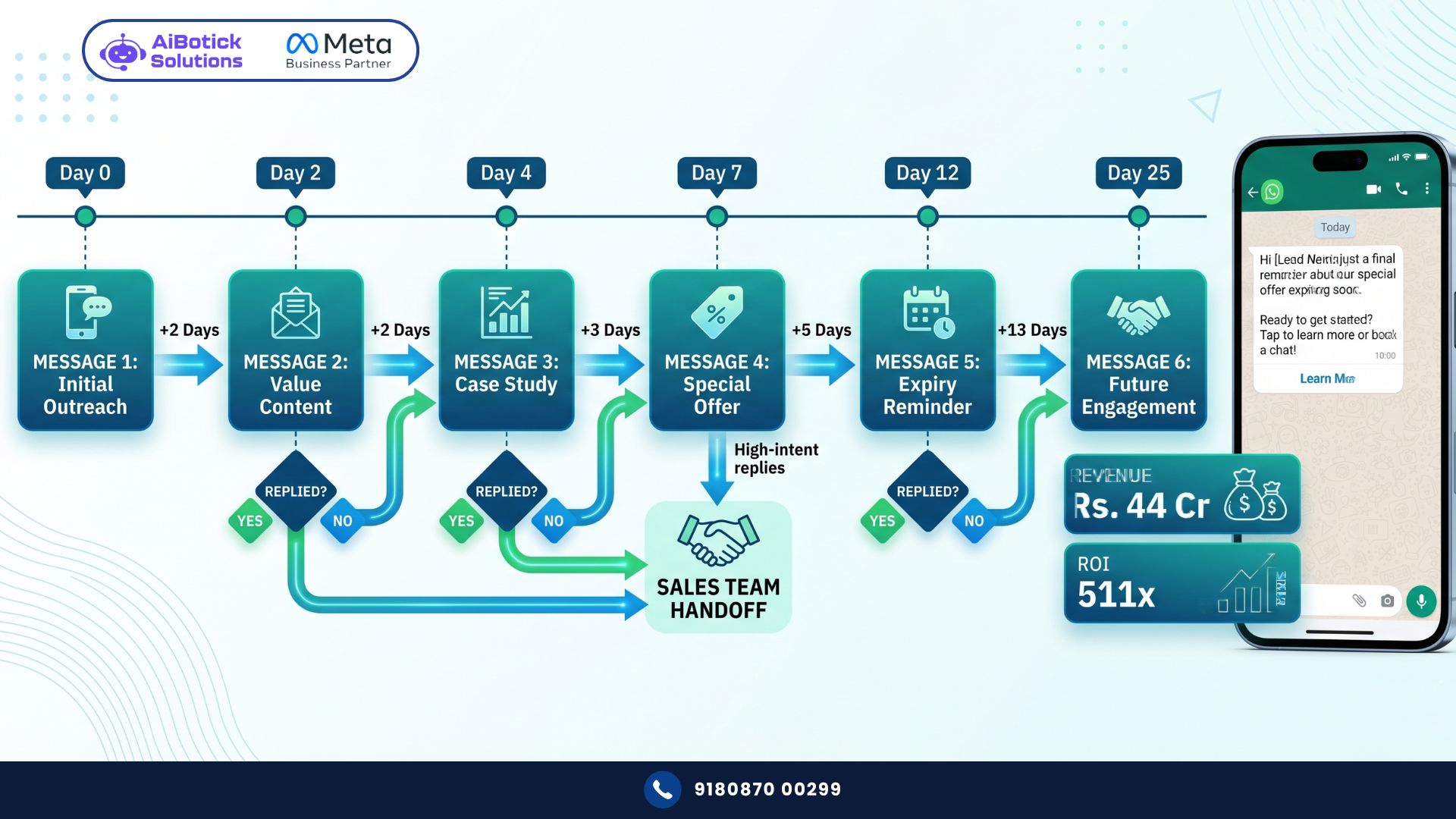
Day 0 (immediate): “Thanks for your interest in [Product], [Name]! Here’s a quick overview: [link]. What specific feature are you most interested in? Reply A, B, or C.”
→ Lead replies “A” → Next message is specifically about Feature A. → Lead doesn’t reply → Different Day 2 message than if they had replied.
Day 2 (if no reply): “Hi [Name], did you get a chance to look at [Product]? Most customers in [their industry] find [specific benefit] the most valuable. Curious what matters most to you?”
Day 4: “Quick case study — [similar company] used [Product] and [specific result]. Would this kind of outcome be valuable for your business? Reply YES and I’ll send more details.”
Day 7: “Last follow-up from my side, [Name]. If the timing isn’t right, no problem. If you want to revisit this in 30 days, just reply LATER and I’ll reach out then.”
Different replies at any stage trigger different branches. Lead says “LATER” — system pauses and creates a 30-day follow-up automatically. Lead says “YES” — routes to sales team immediately with full conversation history.
That’s a WhatsApp drip campaign. Intelligent. Adaptive. Personalised.
Real Case Study: Pune Real Estate Developer — Rs.44Cr From 2,840 Cold Leads
This is from our detailed WhatsApp drip campaign real estate breakdown — but the mechanics deserve explanation here because it perfectly illustrates drip campaign power.
The Situation:
- Residential developer in Pune, 3 projects in the Rs.60L-1.5Cr range
- Lead database: 2,840 cold leads (inquired 3-18 months ago, never converted)
- These leads had been “followed up” inconsistently — some got 1 call, some got none
- Active sales team: 6 people
The Problem: 2,840 leads. Dead database. Sales team had essentially written them off. Marketing wanted to run ads to generate fresh leads instead.
Mohit’s suggestion: don’t run more ads. Run a WhatsApp drip campaign on the 2,840 you already paid to acquire.
The 6-Week Drip Campaign:
Week 1 — Re-engagement: “Hi [Name], it’s been a while since you enquired about [Project]. We’ve had some exciting developments — [specific update relevant to their previous inquiry]. Still exploring options in [area]? Reply YES and I’ll send you what’s new.”
Week 2 (if YES or opened): “Thanks for your interest! Here’s what’s changed at [Project]: [2-3 specific updates — price revision, new amenities, possession date update]. Which matters most to you — possession timeline or amenities? Reply 1 or 2.”
Week 3 — Social proof: “[Name], 47 families have moved into [Project] Phase 1 already. Here’s what one of them said: [specific testimonial from actual resident]. Would you like to see the project — in-person or virtual tour? Reply VISIT or VIRTUAL.”
Week 4 — Value creation: “Did you know: Properties in [area] have appreciated 18% in the last 2 years? At [Project]’s current price of Rs.[X], your investment at today’s value… [ROI calculation]. Want our full investment analysis? Reply ANALYSIS.”
Week 5 — Urgency (genuine): “[Name], quick update: We have 12 units remaining in the price band you enquired about. Prices revise in [month]. Thought you’d want to know before it changes. Want to lock in current pricing? Reply LOCK.”
Week 6 — Final touch: “Last message from our side, [Name]. If you’re not looking right now, completely fine. If you’d like us to reach you when our next phase launches, reply NEXT. Otherwise, we’ll stop here and wish you all the best in your home search.”
The Results:
| Metric | Number |
|---|---|
| Total leads in drip | 2,840 |
| Week 1 response rate | 34% (964 leads) |
| Qualified leads identified | 312 |
| Site visits generated | 187 |
| Bookings from drip campaign | 44 |
| Average booking value | Rs.1Cr |
| Total revenue from dead database | Rs.44Cr |
| Campaign cost (WhatsApp + platform) | Rs.86,000 |
| ROI | 511x |
Rs.44Cr from leads they’d written off. Rs.86,000 spent. That’s what WhatsApp drip campaigns can do when built properly.
The 4 Drip Campaign Types Every Indian Business Should Have
Type 1: Lead Nurturing Drip
For: Any business with a long sales cycle (real estate, education, financial products, B2B sales, high-ticket services)
Purpose: Keep leads warm from first inquiry to decision — over days, weeks, or months.
Sequence length: 6-12 messages over 2-8 weeks depending on typical decision timeline.
Key principle: Each message provides value or moves the conversation forward. Never just “following up.”
Type 2: Onboarding Drip
For: SaaS, EdTech, coaching, subscription services, membership businesses.
Purpose: Guide new customers to their first success moment before they have a chance to feel confused or abandoned.
Sequence length: 5-7 messages over first 14 days.
Key principle: Each message corresponds to a specific action you want the customer to take. “Set up your profile” → “Connect your first integration” → “Run your first campaign” — not generic “welcome” messages.
Type 3: Re-engagement Drip
For: Any business with a customer database of people who haven’t purchased or engaged in 30-90 days.
Purpose: Win back dormant leads and customers before they forget you exist.
Sequence length: 3-5 messages over 2-3 weeks.
Key principle: Lead with value, not desperation. “Here’s something new/useful” before “we miss you, please come back.”
Type 4: Post-Purchase Drip
For: Ecommerce, D2C, retail, subscription businesses.
Purpose: Drive repeat purchase, upsell, referral, and review — from customers who already trust you.
Sequence length: 4-6 messages over 30-60 days post-purchase.
Key principle: Treat this as relationship building, not selling. Tips, appreciation, community, then gentle upsell.
Step-by-Step: Building Your First WhatsApp Drip Campaign
Step 1: Define Your Goal Clearly
Before writing a single message, answer: What specific action do you want the lead to take by the end of this sequence?
Examples:
- Book a site visit (real estate)
- Enroll in a demo class (education)
- Book a consultation call (services)
- Make a repeat purchase (ecommerce)
- Upgrade their plan (SaaS)
Every message in your drip should move toward this goal. If a message doesn’t serve the goal, cut it.
Step 2: Map the Customer’s Journey and Objections
What does a lead think about between inquiry and decision? What questions do they have? What objections are they carrying?
For a coaching institute: “Is this worth the fees?” “Do I have time for this?” “How is this different from YouTube?” “What if I fail again?”
Your drip campaign answers these objections before the lead has to ask — and before those objections kill the sale.
Step 3: Write the Sequence
Rules for drip campaign messages:
- Message 1 (immediate): Warm, helpful, acknowledging. No selling yet.
- Messages 2-3: Value delivery. Content, case studies, information they actually need.
- Messages 4-5: Social proof and objection handling. Real stories from real customers.
- Message 6+: Soft CTA with genuine urgency (if any). Clear next step.
- Final message: Clean exit. “Last message from me. Reply [X] if you want to reconnect later.”
Keep each message under 150 words. One idea per message. One CTA per message.
Step 4: Configure Triggers and Conditions
In your WhatsApp drip campaigns platform, set:
- Trigger: What starts this sequence? (New lead form submission, specific keyword reply, tag applied in CRM)
- Delays: How many days between each message?
- Conditions: What reply stops the sequence? What reply triggers a different branch?
- Exit conditions: What ends the sequence? (Positive reply → route to sales. “STOP” reply → remove from all sequences.)
Step 5: Personalise Every Message
Minimum personalisation: First name. Always.
Better personalisation: Industry, location, specific product they inquired about, their stated budget, their timeline.
Best personalisation: References their specific situation — “You mentioned you’re looking in Baner area” or “Since you’re in manufacturing, this case study from a Pune factory might be relevant.”
The more specific the message, the higher the response rate. Generic drips get generic results.
Step 6: Test Before Launching
Send the complete sequence to yourself. Read it as a prospect would.
Ask: Does this feel helpful or pushy? Does each message make sense on its own? Are the delays right (not too fast, not too slow)? Does every branch work correctly?
Fix everything before sending to real leads. A broken drip that sends the wrong message to 500 prospects in your pipeline is hard to recover from.
Step 7: Monitor and Optimise
After your first 2 weeks live, check:
- Which message has the lowest response rate? → Rewrite it.
- Where are leads exiting the sequence? → Reduce friction at that point.
- Which message generates the most positive replies? → Can you move it earlier in the sequence?
- What percentage of leads reach the final message without converting? → Is your sequence too long? Too short?
The best WhatsApp drip campaigns are built over time based on real data — not designed perfectly on day one.
How to Write WhatsApp Drip Messages That Get Replies
This is where most businesses fail. The strategy is right, the sequence structure is right — but the messages themselves are flat, generic, and forgettable.
Here’s what separates messages that get replies from messages that get ignored:
Bad drip message: “Hi, just following up on your inquiry. Let me know if you have any questions. We’d love to help you. Please feel free to reach out anytime.”
Why it fails: No specific value. No question. No reason to reply. Sounds automated.
Good drip message: “Hi [Name], quick question — when you enquired about [course], was it more for career change or career growth? The resources I’d send you are different depending on which one. Just reply 1 (career change) or 2 (career growth).”
Why it works: Requires a simple response. Offers personalised value as the reward for replying. Feels like it’s from a human who actually cares about giving the right information.
The fundamental rule: every WhatsApp drip campaign message should end with either a question or a single clear action. Never just information with no path forward.
Timing Your WhatsApp Drip Campaigns
Timing matters more than most businesses realise. Getting the delay intervals right is the difference between “helpful and timely” and “annoying and desperate.”
General guidelines for B2C (education, real estate, financial products):
- Message 1: Immediate (within 5 minutes of trigger)
- Message 2: Day 2
- Message 3: Day 4
- Message 4: Day 7
- Message 5: Day 12
- Message 6: Day 18
- Final message: Day 25
General guidelines for B2B (IT, SaaS, manufacturing, agency services):
- Message 1: Immediate
- Message 2: Day 3
- Message 3: Day 7
- Message 4: Day 14
- Message 5: Day 21
- Final message: Day 30
Send time matters too:
- B2C: 10 AM-12 PM or 6 PM-8 PM. Never after 9 PM.
- B2B: 9:30 AM-11 AM or 3 PM-5 PM on weekdays.
- Never Sunday mornings.
- Festival days: skip or send a festive message instead of your scheduled drip.
Could be wrong about exact timing for every industry — test your specific audience. But these ranges consistently outperform random send times across the businesses I’ve tracked.
Integrating WhatsApp Drip Campaigns With Your Sales Process
The biggest mistake I see with WhatsApp drip campaigns is treating them as a replacement for the sales team.
They’re not. They’re a filter and a qualifier.
The drip’s job is to identify which leads are warm enough to be worth a salesperson’s time — and to deliver those leads with full context, at the exact moment they’re ready.
Here’s the integration that works:
- Lead enters drip sequence
- Lead replies positively (“VISIT”, “YES”, “INTERESTED”) → drip pauses → sales team gets alert with lead name, inquiry details, and full drip conversation history
- Salesperson calls within 30 minutes with full context — no “can you remind me what you were looking at?”
- If meeting or demo booked → drip stays paused
- If lead goes cold again after salesperson call → drip resumes from next message
This integration means your sales team spends time only on warm, engaged leads. Cold lead management is fully automated. Team productivity doubles or triples. And the leads who reach sales are better qualified, more informed, and closer to a decision — making the salesperson’s job dramatically easier.
And if you want to see how WhatsApp drip campaigns connect to a broader lead nurturing strategy that covers the complete journey from cold lead to loyal customer, our WhatsApp lead nurturing comprehensive guide covers the full funnel — including how drip sequences connect with broadcast campaigns and one-on-one conversation workflows.
What WhatsApp Drip Campaigns Cost (Real Numbers)
Let’s be specific because this question always comes up.
Meta conversation charges for WhatsApp drip campaigns:
- Marketing conversations: Rs.0.8631 per conversation (per 24-hour window)
- A 6-message drip to one lead over 25 days = 6 separate 24-hour windows = Rs.5.18 per lead
Cost to run drip campaign for 1,000 leads: 1,000 × Rs.5.18 = Rs.5,180 in Meta charges Platform cost: Rs.3,000-8,000/month (depending on platform and volume)
Total for 1,000 leads: Rs.8,000-13,000
Revenue if 5% of 1,000 leads convert: 50 customers × whatever your average order/sale value is.
For the Pune real estate developer: 50 bookings × Rs.1Cr = Rs.50Cr from Rs.86,000 spend. For a coaching institute: 50 enrollments × Rs.30,000 = Rs.15L from Rs.8,000 spend. For a D2C brand: 50 purchases × Rs.2,000 = Rs.1L from Rs.8,000 spend.
The math works at almost any price point. The only requirement: your drip messages have to be good enough to convert 5% of cold leads. And based on everything in this guide, that’s absolutely achievable. 😄
Common Mistakes With WhatsApp Drip Campaigns
Mistake 1: Too many messages too fast
Sending 3 messages in 3 days to a cold lead feels like harassment. Space them out. Give people room to breathe.
Mistake 2: All messages are promotional
“Buy now!” “Limited offer!” “Don’t miss out!” — all 6 messages. This is how you get blocked. Mix value, social proof, education, and gentle CTAs.
Mistake 3: No exit when lead says no
If a lead replies “not interested” or “STOP” — the drip must immediately stop. Continuing to message after a no is a compliance violation and a trust destroyer. Configure your exits properly.
Mistake 4: Not tracking which messages perform
If you’re not checking response rates per message, you’re flying blind. The data tells you what’s working. Use it.
Mistake 5: Same drip for all lead types
A lead who downloaded your brochure and a lead who attended your webinar are at completely different stages. Build separate drip sequences for different lead sources and intent levels.
Mistake 6: Forgetting the handoff to sales
A drip that converts a lead to “interested” but doesn’t immediately notify sales is a leaky bucket. The handoff must be instant and automatic.
Why WhatsApp Drip Campaigns Are the Highest-ROI Marketing System Available
Honestly? The ROI on WhatsApp drip campaigns is unlike anything else in the marketing toolkit. And I don’t say that lightly — I’ve worked with ad campaigns, content programs, SEO, email funnels, the full range.
Nothing else combines:
- 95% open rate (vs 20% email)
- Personalised, adaptive sequences
- Two-way conversation capability
- Automatic lead qualification
- Sales team handoff with full context
- Rs.5 per lead for 6 touchpoints
The Pune developer with Rs.44Cr from Rs.86,000 spend is the most dramatic example I’ve shared. But Rs.11L from Rs.8,000, Rs.4.2L from Rs.3,500 — these numbers are consistent across businesses that build their WhatsApp drip campaigns properly.
The businesses that master this in 2026 will have a lead conversion engine that runs 24/7 without burning out your sales team.
Ab toh yeh samajh lo — WhatsApp drip campaigns are not optional for businesses that want to scale. They’re the foundation. Everything else is secondary. 💯
Want to set up WhatsApp drip campaigns for your business?
— Mohit Shah | 15+ years in IT industry | 4+ years in WhatsApp automation | Worked with various MNC brands | Now helping businesses figure out what actually works
Q1: How many messages should a WhatsApp drip campaigns have for maximum conversion?
A1: For B2C businesses (education, real estate, financial products), 6-8 messages over 25-30 days is the sweet spot. For B2B (IT services, SaaS, agencies), 5-6 messages over 30 days. More than 8 messages produces diminishing returns and increasing unsubscribes. Less than 5 messages doesn’t give enough touchpoints for complex purchases. The Pune real estate drip used 6 messages over 6 weeks and achieved 34% response rate on cold leads. Quality of each message matters far more than quantity — one genuinely valuable message beats three generic ones every time.
Q2: Can WhatsApp drip campaigns run simultaneously for different segments of leads?
A2: Yes — and they should. Running the same drip for all leads is a fundamental mistake. Configure separate drip sequences for: new inquiries (warm leads who just expressed interest), cold leads (inquired 30+ days ago with no conversion), re-engagement (previous customers who haven’t purchased recently), and post-purchase (existing customers for upsell and retention). Each segment needs different messaging, timing, and CTAs. Modern WhatsApp Business API platforms let you run unlimited simultaneous drip campaigns to different segments without any interference between sequences.
Q3: How do WhatsApp drip campaigns handle leads who reply at different times or with unexpected messages?
A3: This is where trigger and condition configuration becomes critical. Set up keyword triggers for common responses: “YES/INTERESTED” → pause drip, alert sales team immediately. “LATER/NOT NOW” → pause drip, create 30-day follow-up task. “STOP/NOT INTERESTED” → exit drip permanently, mark as closed. “?” or any question → route to human agent, pause drip until resolved. For truly unexpected replies that don’t match any keyword, configure a fallback: route to human agent. The drip resumes only if the human agent marks the conversation as “continue nurturing.” This hybrid approach ensures no lead falls through while maintaining automation for the majority of interactions.