AiSensy vs AiBotick: Which WhatsApp Platform Is Right for Your Business?
You’re comparing WhatsApp automation platforms. AiSensy shows up everywhere in your research. So does AiBotick. Both claim to be the best. Both have decent-looking websites.
So which one do you actually pick?
I’m going to give you the honest answer — not a fake “both are great” comparison designed to seem neutral while secretly pushing one. I write exclusively for AiBotick. You know that. But I’ve also worked across enough platforms in 15 years to tell you where the genuine differences are, where AiSensy genuinely competes, and where the gaps are real.
Here’s the AiSensy vs AiBotick comparison you can actually use to make a decision.
Who Is AiSensy and What Do They Actually Offer?
AiSensy is a Gurugram-based WhatsApp Business API platform that’s been in the market since 2020. They’ve built a recognisable brand in India, particularly among small businesses and D2C brands looking for entry-level WhatsApp automation.
Their positioning: affordable, accessible, easy to get started.
Their starting plan: Rs.999/month. This is their most-advertised number and the primary reason they attract small business inquiries.
What you get at Rs.999/month on AiSensy:
- WhatsApp Business API access
- Basic broadcast campaigns
- Basic chatbot (limited flows)
- Limited team inbox seats
- Standard support (ticket-based)
What’s not included at Rs.999:
- Advanced chatbot flows
- CRM integration
- Multiple agents without add-ons
- Priority support
- Dedicated onboarding
The Rs.999 plan is a real plan. But for most businesses doing meaningful WhatsApp marketing, they outgrow it within 60-90 days and move to higher tiers (Rs.2,499/month and above).
What AiBotick Offers and How the Positioning Differs
AiBotick’s positioning is fundamentally different from AiSensy’s.
Where AiSensy leads with price (Rs.999), AiBotick leads with partnership.
The one differentiator that defines AiBotick across every plan: personalised onboarding + live training sessions + dedicated WhatsApp support group — included in every plan, not as an add-on.
This isn’t marketing language. It’s operationally real.
Every AiBotick client gets:
- Personalised onboarding (not a YouTube tutorial link)
- Live training sessions with their actual use case
- Dedicated WhatsApp support group where their questions get answered — not a ticket queue
And critically: this is included in the Starter plan at Rs.15,000/year just as it is in the Enterprise plan.
AiBotick doesn’t offer monthly plans at the Starter, Growth, or Scale level — the entry is annual/semi-annual/quarterly. This is intentional: it attracts businesses serious about implementation, not businesses experimenting.
AiSensy vs AiBotick: The Direct Feature Comparison
Let me put the key dimensions side by side.
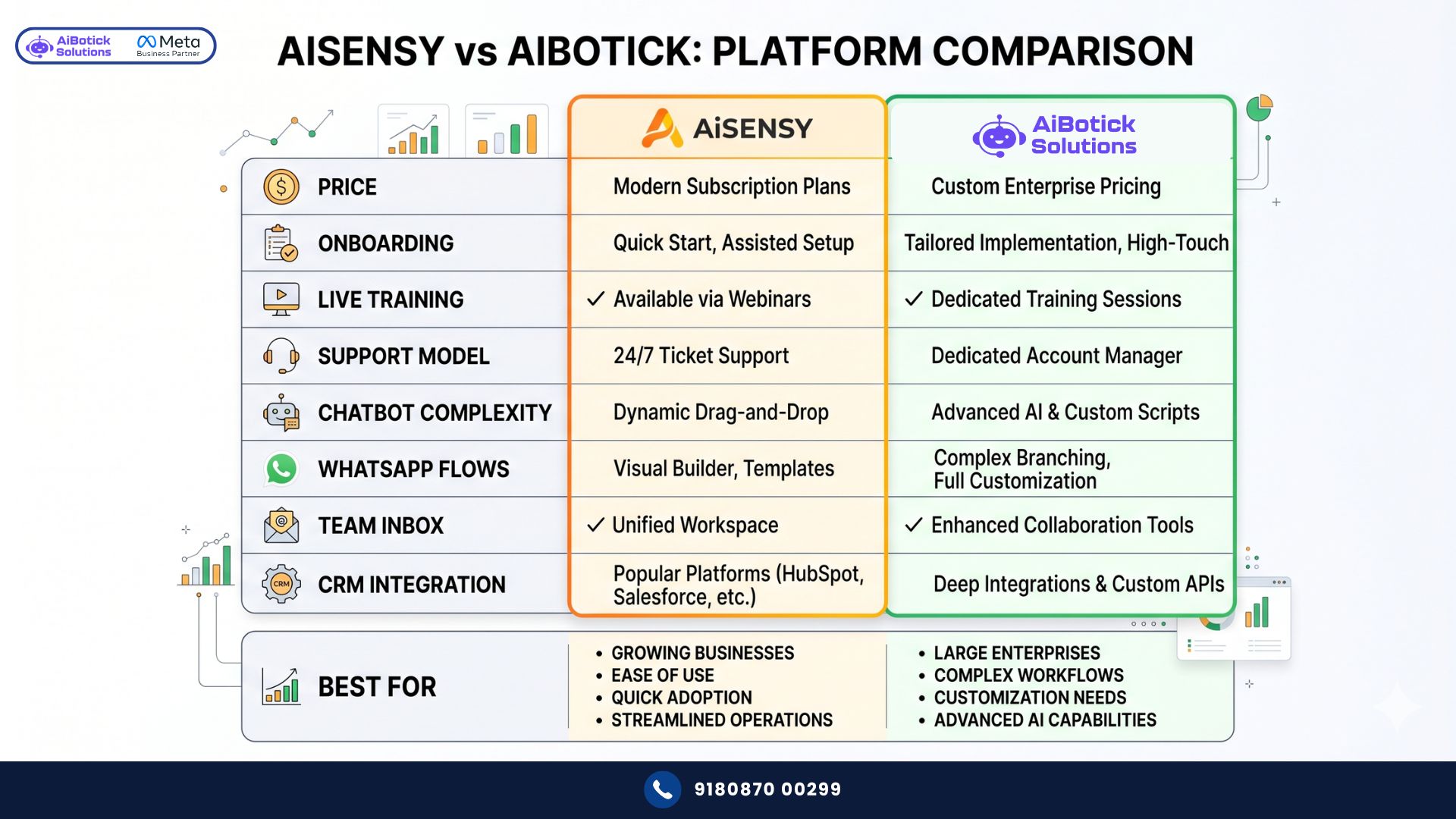
| Feature | AiSensy | AiBotick |
|---|---|---|
| Starting price | Rs.999/month | Rs.15,000/year (Rs.1,250/month equiv) |
| Monthly plan | Yes | Enterprise only |
| Official Meta API | Yes | Yes |
| Broadcast campaigns | Yes | Yes |
| Chatbot flows | Basic (limited) | Advanced (full flow builder) |
| WhatsApp Flows (native forms) | Limited | Full support |
| Team inbox | Yes (limited seats) | Yes (all plans) |
| CRM integration | Yes (higher plans) | Yes |
| Personalised onboarding | No | Yes — every plan |
| Live training | No | Yes — every plan |
| Dedicated support group | No | Yes — every plan |
| Support model | Ticket-based | WhatsApp-first, dedicated group |
| Indian business focus | Yes | Yes |
| Language support | English | English + Hindi support |
The feature comparison is fairly close at the technical level. Both platforms deliver WhatsApp Business API access, broadcasts, chatbots, and team inbox.
The real gap is in the support and onboarding layer — which is where most businesses actually succeed or fail with WhatsApp automation.
What People Get Wrong About This Comparison
Most business owners compare AiSensy vs AiBotick purely on monthly price. AiSensy Rs.999 vs AiBotick Rs.1,250 (annualised Starter). AiSensy wins on paper.
Nope. That’s the wrong comparison. Completely wrong.
The correct comparison is: cost of platform vs value delivered.
Here’s the practical reality: a business that pays Rs.999/month for AiSensy but spends 3 months figuring out setup, building chatbots through trial and error, and getting generic ticket responses — has spent 3 months of Rs.999 (Rs.2,997) plus 3 months of wasted time trying to make it work.
A business that pays Rs.15,000/year for AiBotick but gets personalised onboarding in Week 1, live training for their specific use case in Week 2, and a dedicated WhatsApp support group that answers questions in under 2 hours — goes live in Week 3 and starts generating revenue by Week 4.
The time-to-value gap is where the real cost calculation happens. And time-to-value is where AiBotick’s onboarding model shows its advantage.
I’ve seen this firsthand. One time when I was working with an ecommerce brand in Surat that had tried AiSensy for 4 months. They’d set up basic broadcasts. Their chatbot was functional but not converting. Support tickets were taking 48-72 hours. They were at about 20% of the platform’s potential.
They switched to AiBotick. Personalised onboarding in the first week showed them 3 use cases they hadn’t thought of. Live training on chatbot flows. Dedicated support group responses. Within 6 weeks they were at 80% platform utilisation.
Same WhatsApp API. Dramatically different implementation outcome.
AiSensy vs AiBotick: Which Business Profile Fits Which Platform?
This is the most useful question and the one most comparisons skip.
AiSensy fits well when:
- You’re a solo entrepreneur or very early-stage startup testing WhatsApp for the first time
- Your monthly revenue is below Rs.10-15L and you genuinely can’t commit to annual plans yet
- You have a technically capable person internally who can figure out setup independently
- Your use case is basic: broadcast campaigns + simple FAQ chatbot + order notifications
- You want month-to-month flexibility while you assess whether WhatsApp makes sense for your business
AiBotick fits better when:
- Your business is doing Rs.15L+ monthly revenue (or growing toward it) and you need WhatsApp to actually work, not just exist
- You want personalised guidance on implementation — not generic documentation
- You’re planning to build actual automation flows (lead qualification, drip sequences, appointment booking) — not just broadcasts
- You value fast, dedicated support over ticket queues (especially during campaigns when issues are expensive)
- You’re in an industry that benefits from tailored WhatsApp strategy: real estate, education, healthcare, finance, ecommerce, IT services
- You want a platform partner relationship, not just a SaaS subscription
The Support Model Difference — Why It Actually Matters
Honestly? I think the support model is the single most underrated factor in AiSensy vs AiBotick comparisons. Everyone focuses on features and price. Nobody talks about what happens when things break.
And things break. Always. With any WhatsApp platform.
Template gets rejected by Meta. Chatbot flow has a logic error. Broadcast delivery rate drops. Payment integration stops working. These issues don’t happen on your schedule — they happen at 11 PM the night before your Diwali campaign launch.
AiSensy’s support: ticket-based. Standard response time. Escalation process for critical issues. Adequate for non-urgent issues.
AiBotick’s support: WhatsApp group where your dedicated team is available. Not a generic support team — the same people who onboarded you and know your setup. Response in hours, not days.
For a business running a Rs.8L Diwali campaign and hitting a template rejection at 9 PM the night before — these are two completely different experiences.
The support model isn’t a nice feature. It’s the difference between campaigns that launch on time and revenue that actually arrives.
Real Numbers: What the Platform Cost Looks Like at Different Business Sizes
Small business (Rs.20L monthly revenue):
AiSensy Growth plan: Rs.2,499/month = Rs.29,988/year AiBotick Growth plan: Rs.25,000/year (half-yearly: Rs.14,000; quarterly: Rs.8,000)
AiBotick is slightly cheaper at the annual level and includes personalised onboarding and dedicated support. AiSensy is cheaper monthly if you need flexibility.
Mid-size business (Rs.1Cr+ monthly revenue):
AiSensy’s pricing at this level: Rs.4,999-9,999/month depending on features needed = Rs.60,000-1,20,000/year
AiBotick Scale plan: Rs.45,000/year
At Rs.1Cr+ revenue, AiBotick is significantly more cost-effective at the Scale level. And the personalised support model matters even more when your WhatsApp campaigns are driving Rs.20-30L monthly.
Enterprise (Rs.5Cr+ monthly revenue):
Both platforms have enterprise options. AiBotick Enterprise: Rs.60,000/year with monthly option at Rs.10,000. Custom pricing on both platforms at significant scale.
The cost comparison at this level should include: total cost of ownership (platform + implementation time + support resolution time + revenue impact of downtime). When calculated this way, the cheaper-per-month option rarely wins.
Where AiSensy Has Genuine Strengths
Being fair: AiSensy has built real strengths in certain areas.
Brand recognition: AiSensy has stronger brand recognition among Indian SMEs at the early exploration stage. More likely to be the first platform a small business considers.
Month-to-month flexibility: For businesses not ready to commit annually, Rs.999/month is genuinely accessible.
Ecosystem integrations: AiSensy has invested in integrations with popular Indian ecommerce platforms and CRM tools. Their Shopify and WooCommerce integrations are solid.
Self-serve documentation: If you want to figure things out independently, AiSensy has decent documentation for common use cases.
These are real strengths. Not pretending otherwise. But notice what’s not on this list: personalised support, dedicated onboarding, and live training. Because AiSensy’s model is self-serve by design.
The Question That Decides the Comparison
Here’s the actual question to ask yourself in the AiSensy vs AiBotick decision:
Do I want to figure out WhatsApp automation on my own, or do I want a partner who helps me do it right the first time?
If you’re a technically capable team, enjoy exploring platforms, and have time to invest in learning — AiSensy’s self-serve model works fine. The platform is functional. The features are real.
If you want to go from signup to revenue-generating WhatsApp automation as fast as possible, with someone guiding you specifically for your business type — AiBotick’s partnership model is built for that.
For most Indian businesses doing serious volumes? That platform is AiBotick. 😄
To understand how platform capability translates to actual ROI for your specific business type — and how to make the case internally for investing in proper WhatsApp automation — our WhatsApp automation ROI guide gives you the calculation framework that works across industries and deal sizes.
And for businesses evaluating multiple platforms simultaneously, understanding what to look for beyond price and feature lists — our WhatsApp automation benefits guide covers the business outcomes that platform quality actually drives, which is the right evaluation lens for any vendor comparison. 💯
Want to see AiBotick’s platform in action for your specific business use case?
— Mohit | 15+ years in IT industry | 4+ years in WhatsApp automation | Worked with various MNC brands | Now helping businesses figure out what actually works
Q1: Is AiSensy’s Rs.999/month plan genuinely enough for a growing Indian business?
A1: For initial experimentation — yes, it works. For a business doing Rs.20L+ monthly revenue trying to run actual WhatsApp marketing campaigns, build meaningful chatbot flows, and manage team conversations — no, Rs.999/month plan has limitations that will require upgrading within 60-90 days. The broadcast limits, agent seats, and basic chatbot capabilities at that price point work for simple use cases. The moment you want qualification flows, drip sequences, advanced routing, and CRM integration — you’re looking at AiSensy’s higher tiers (Rs.2,499-4,999/month), at which point the price difference between AiSensy and AiBotick narrows or reverses.
Q2: How long does onboarding take with AiBotick compared to a self-serve platform like AiSensy?
A2: AiBotick’s personalised onboarding typically gets businesses to first live automation in 7-14 days. This includes setting up the API connection, building the first chatbot flow for your specific use case, configuring templates for your industry, and training your team on the platform. With AiSensy’s self-serve model, time-to-first-meaningful-automation averages 4-8 weeks for businesses without prior WhatsApp API experience — because they’re learning the platform, building flows by trial and error, and waiting for ticket responses when they hit issues. The 3-6 week time-to-value difference translates directly into revenue delay: if your WhatsApp campaigns generate Rs.5L monthly, that’s Rs.3.75L-7.5L in delayed revenue from slower implementation.
Q3: Can I switch from AiSensy to AiBotick without losing my WhatsApp number or contact history?
A3: Yes. Your WhatsApp Business phone number is separate from the platform — it’s connected to your Facebook Business Manager, not to AiSensy or AiBotick. Migration involves: disconnecting the number from AiSensy in your Business Manager, connecting it to AiBotick (takes 1-2 business days), and migrating your contact database (exported from AiSensy, imported to AiBotick). Message history from old conversations doesn’t transfer (WhatsApp API doesn’t support conversation history migration), but your contact list, tags, and business profile transfer fully. Most businesses complete the switch in 3-5 days with zero disruption to their WhatsApp number or customer-facing communication.