Free lagta hai. Free hota nahi.
That’s the most expensive lesson I’ve watched Indian businesses learn about free WhatsApp automation. They go in thinking they’re saving money. They come out having lost leads, time, and sometimes their entire WhatsApp number.
Let me break down what free WhatsApp automation actually costs you — in real numbers, real consequences, and real missed revenue.
First — What Does “Free WhatsApp Automation” Even Mean?
When people say free WhatsApp automation, they usually mean one of three things:
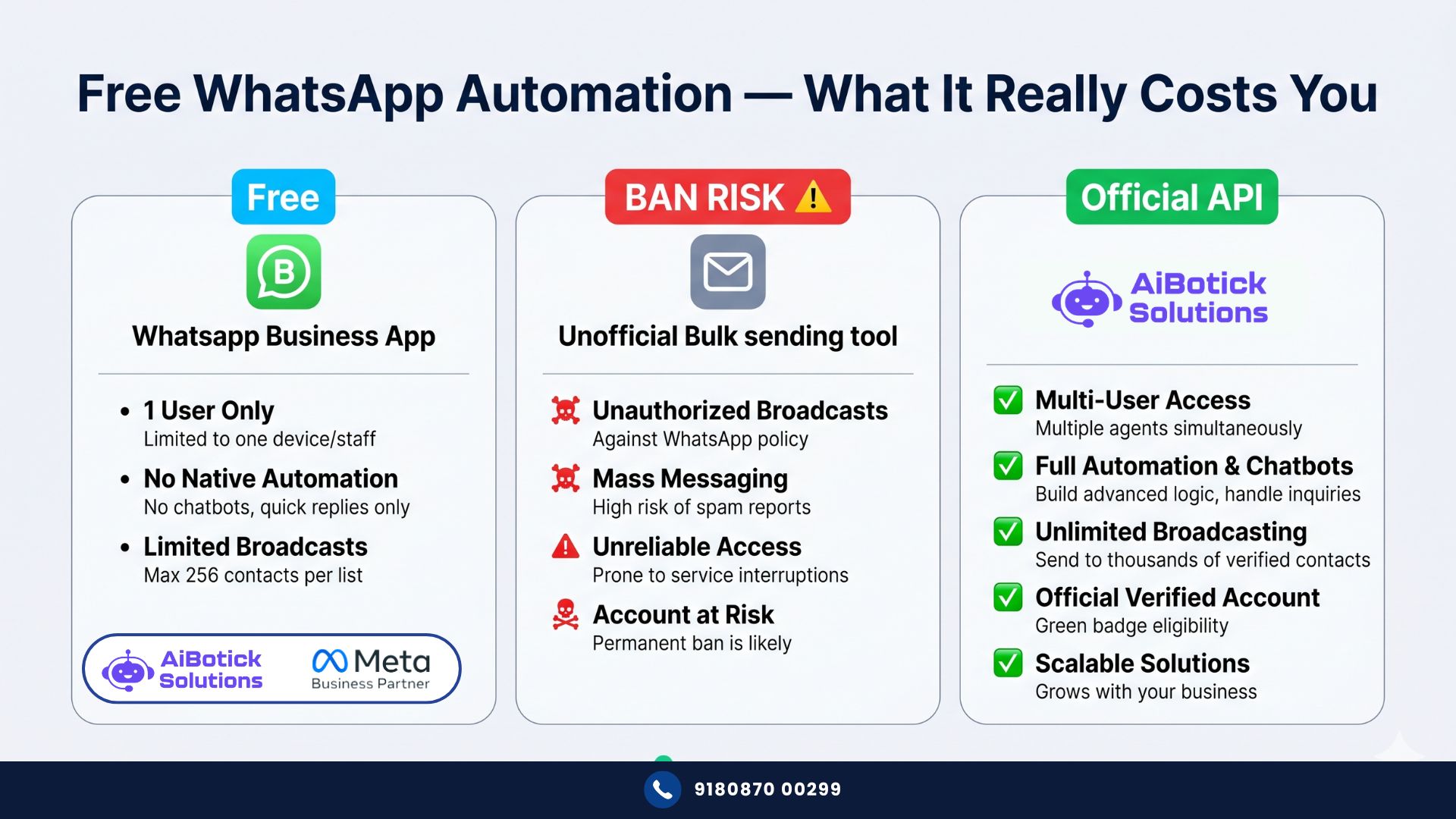
Option 1 — WhatsApp Business App (the free Meta app) The standard WhatsApp Business app you download from Play Store or App Store. Free. Limited. One device, one user, no API, no real automation.
Option 2 — Free tiers of paid platforms Some platforms offer a “forever free” or limited free plan. Typically: very few contacts, very limited features, heavy branding, no support.
Option 3 — Unofficial bulk WhatsApp tools Grey-market software — sometimes APK-based, sometimes web tools — that use unofficial WhatsApp access to send mass messages. Not Meta-approved. Not legal under WhatsApp’s terms.
Each of these has a different risk and cost profile. And none of them are actually free once you calculate what they cost your business in lost capability, lost time, and lost revenue.
Let’s go through each one properly.
The WhatsApp Business App — Free, But at What Cost?
The WhatsApp Business App is genuinely free. Meta built it. It’s legitimate. And for a truly micro-business — a single-person freelancer, a neighbourhood shop — it’s fine.
But the moment your business grows beyond one person handling WhatsApp manually, the free WhatsApp Business App starts costing you.
Here’s what you can’t do on the free app:
- No multiple agents — one phone, one person. Your team can’t all access the same number.
- No automation — no chatbots, no auto-replies beyond a basic away message, no drip campaigns.
- No broadcasting to opted-in lists at scale — broadcast lists are capped at 256 contacts, and recipients must have your number saved.
- No API integrations — can’t connect to your CRM, Shopify, payment gateway, or Google Sheets.
- No shared inbox — no supervisor visibility, no agent assignment, no conversation tracking.
- No analytics — you have no idea what’s working.
So the free WhatsApp Business App is free in price. But it’s also free of features. And those missing features have a real business cost.
Actually wait — let me make this concrete with numbers.
A coaching institute in Nagpur. 3 counsellors. All using their personal WhatsApp accounts to handle admissions enquiries. Average 80 new leads per day during admission season.
What happened with free WhatsApp?
- Leads came in across 3 different numbers — no central visibility
- When a counsellor went on leave, their leads went dark
- No follow-up automation — manual follow-ups happened maybe 40% of the time
- Conversion rate: 8%
They switched to WhatsApp Business API with automation. Same leads. Same counsellors. Same product.
- All leads to one number, assigned automatically to available counsellors
- Automated Day 1 / Day 3 / Day 7 follow-up sequences
- Chatbot handling initial qualification 24/7
- Conversion rate: 19%
The free solution cost them 11 percentage points of conversion on 80 leads a day for 3 months of admission season. At their average admission fee — that’s lakhs in lost revenue. From using a free tool. 😅
Free Tiers of Paid Platforms — The “Freemium” Trap
Some WhatsApp automation platforms offer free plans to get you in the door. Sounds good. Usually isn’t.
Here’s what free tiers typically give you:
- Very limited contacts (often under 100-250)
- No team inbox — just one user
- Platform branding on your messages (“Powered by [Platform Name]”)
- Zero or minimal chatbot capability
- No integrations
- Email-only support, low priority
- Features locked behind paid plans prominently shown as “upgrade to access”
The free tier exists for one reason: to get you to use the platform, get attached to it, and then upgrade. That’s not cynical — it’s just how freemium SaaS works.
The problem is when businesses try to run real WhatsApp communication on a free tier. You hit the contact limit in week 1. You can’t connect your CRM. Your customers see “Powered by [Platform]” on your messages — which looks cheap. And when something breaks, you’re at the bottom of the support queue because free users aren’t a priority.
Real talk — I’ve seen businesses spend 3-4 weeks setting up a free tier account, building flows within the platform’s limited free features, and then discovering that the one thing they actually need — say, Shopify integration or multiple agents — is on the paid plan only. All that setup time? Wasted.
Unofficial Bulk WhatsApp Tools — This Is Where It Gets Dangerous
This is the “free WhatsApp automation” option I want to spend the most time on. Because it’s the most damaging and the most commonly chosen by businesses trying to save money.
Unofficial bulk WhatsApp tools work by accessing WhatsApp through unofficial means — not through Meta’s official API. They typically look like this:
- You upload a list of numbers
- The tool sends messages from a WhatsApp number (usually via a connected phone or browser session)
- Messages go out, looks like it’s working, feels like automation
And for a while, it does work. Until it doesn’t.
What actually happens with unofficial WhatsApp tools:
Meta actively detects and bans accounts using unofficial access. They’ve been cracking down aggressively since 2023 — and the enforcement has only intensified.
When Meta bans your number:
- Your WhatsApp Business number is permanently banned
- All your contacts, chat history, and accumulated trust — gone
- You cannot recover the number or the data
- You start from zero with a new number — and your customers don’t know the new number
I’ve seen this happen to a textile business in Surat. They’d been using an unofficial bulk sender for 8 months. Built up a WhatsApp broadcast list of 12,000 contacts — customers, distributors, agents. Sent product catalogs, new collection launches, price updates. Everything running “smoothly.”
Then one Tuesday morning — number banned. Permanently. 12,000 contacts. 8 months of communication. Business relationships built on that number. All gone overnight.
They called me in a panic. There was nothing I could do. You can’t appeal a Meta ban from an unofficial tool. You start over.
The “free” tool cost them their entire customer communication channel. For context on exactly why unofficial tools are so dangerous and what Meta actually allows — read our detailed breakdown on why unofficial bulk senders get WhatsApp numbers banned. Everything in that article is exactly what I’ve watched happen in practice.
What People Get Wrong About Free WhatsApp Automation
Wrong belief #1: “We’ll start free and upgrade when we need to.”
The problem with this thinking: by the time you realise you need to upgrade, you’ve already built habits, flows, and team processes around the free tool’s limitations. And switching — including migrating data, rebuilding flows, re-training your team — costs significantly more than if you’d started on the right plan.
Start where your actual needs are. Not where your budget anxiety is.
Wrong belief #2: “The free tool is doing the same thing as the paid API.”
It’s not. Free WhatsApp Business App has no API. Unofficial tools are against Meta’s terms. The only legitimate way to run WhatsApp automation at scale is through the official WhatsApp Business API. That costs money. But it’s the only one that doesn’t put your number at risk.
Wrong belief #3: “If it’s working right now, it must be fine.”
Unofficial tools work right up until the moment they don’t. Meta’s bans aren’t gradual — they’re sudden. The number that was working yesterday is permanently banned today. There’s no warning. There’s no grace period.
Wrong belief #4: “Paid WhatsApp API is too expensive for a business our size.”
Let’s actually calculate this. AiBotick’s Growth plan is Rs.25,000 per year. That’s Rs.2,083 per month. For a business doing Rs.50L+ turnover — that’s less than 0.05% of annual revenue. If that investment helps you convert even 5 extra customers per month, it pays for itself many times over.
The question isn’t whether you can afford paid WhatsApp API. The question is whether you can afford not to have it.
The Real Cost Comparison — Free vs Paid WhatsApp Automation
Let me lay this out clearly. Not in marketing language. In actual business terms.
Free WhatsApp Business App
| What You Get | What It Costs Your Business |
|---|---|
| Zero subscription fee | Limited to 1 user — team coordination chaos |
| Basic auto-reply | No real automation — manual everything |
| 256-contact broadcast cap | Can’t scale campaigns |
| No API | No CRM, no Shopify, no payments |
| No analytics | Flying blind |
| Free | Lost conversions, wasted team time, zero scale |
Unofficial Bulk WhatsApp Tool
| What You Get | What It Costs Your Business |
|---|---|
| Low or zero cost | Permanent ban risk — total loss of number |
| Mass messaging | Against Meta ToS — no recourse if banned |
| “Automation” | Fake automation — manually triggered, not API |
| No compliance | All contacts, history lost if banned |
| Feels like it works | Until it catastrophically doesn’t |
Official WhatsApp Business API (Paid)
| What You Pay | What You Actually Get |
|---|---|
| Platform subscription (e.g. Rs.25,000/year) | Multi-agent shared inbox |
| Meta conversation charges | Real chatbot automation |
| CRM, Shopify, payment integrations | |
| Full analytics and reporting | |
| Broadcast at scale to opted-in contacts | |
| Legitimate, Meta-compliant, number protected | |
| Support when things break |
The paid API isn’t an expense. It’s infrastructure. Like your internet connection or your CRM. It’s what enables the rest of your business to function properly on WhatsApp.
When Free WhatsApp Actually Makes Sense
Seedha bolta hoon — I’m not going to tell you free is always wrong.
The free WhatsApp Business App genuinely works for:
- A solo founder handling 10-20 customer conversations a day manually
- A business in its absolute first 30-60 days testing whether WhatsApp is a useful channel at all
- A neighbourhood business where the owner is the only touchpoint
That’s it. If your business is beyond those 3 situations — the free app is costing you more than a paid plan would.
And unofficial bulk tools? Never. Not for any business, at any stage. The risk is categorical. One ban and you’ve lost everything built on that number. No business case justifies that risk.
How to Know You’ve Outgrown Free WhatsApp
Here are the clear signals: 👇
- More than one person needs to handle WhatsApp conversations
- You’re manually following up with more than 20 leads per week
- You want to send broadcasts to more than 256 contacts
- Your customers are asking questions outside business hours that go unanswered until morning
- You want to connect WhatsApp to your CRM, Shopify, or payment gateway
- Your competitors are responding faster on WhatsApp than you are
- You’ve lost a deal because follow-up was slow or inconsistent
If 3 or more of these apply — you needed a paid WhatsApp API yesterday. Not next quarter. Now.
For a full picture of what the switch from free to paid actually delivers in measurable business outcomes, read our breakdown on WhatsApp automation ROI and how to calculate it for your business. The numbers in that article are based on real businesses making exactly this switch.
What the Right Paid Plan Actually Looks Like
You don’t need the most expensive plan. You need the right plan for your stage.
For a business under Rs.1Cr turnover — AiBotick’s Growth plan at Rs.25,000/year covers the fundamentals: multi-agent inbox, chatbot builder, broadcasting, integrations, and onboarding support. That’s Rs.2,083/month.
For Rs.1Cr to Rs.10Cr turnover — Scale plan at Rs.45,000/year. Higher message volumes, advanced automation, priority support.
For Rs.10Cr+ — Enterprise at Rs.60,000/year. Unlimited everything, dedicated account management.
And remember — Meta conversation charges are separate and based on your actual usage. You only pay for the conversations you have. Low volume in month 1? Low Meta charges. Scaling up in month 6? Meta charges scale with your actual business.
No hidden fees. No surprise invoices. Just honest infrastructure pricing for what you actually use.
The Bottom Line on Free WhatsApp Automation
No no, scratch that — let me say this one more time, as simply as possible.
Free WhatsApp automation costs you:
- Your team’s time (manual work that should be automated)
- Your conversions (leads that fall through because follow-up is inconsistent)
- Your number (if you use unofficial tools — this can happen any day)
- Your growth (you can’t scale what you can’t automate)
Paid WhatsApp API costs you:
- Rs.2,083 to Rs.5,000 per month depending on plan
The maths isn’t complicated. 💯
If you’re still on free WhatsApp automation and you’re a growing business — today’s a good day to change that.
Chat with us on WhatsApp and we’ll show you exactly what plan makes sense for your stage, your volume, and your use case. No upsell. Just the right recommendation.
— Mohit Shah | 15+ years in IT industry | 4+ years in WhatsApp automation | Worked with various MNC brands | Now helping businesses figure out what actually works
Q1: Is the free WhatsApp Business App enough for a growing business?
A1: For a solo founder or micro-business handling under 20 conversations a day manually — yes, it works. But the moment you have more than one person needing WhatsApp access, more than 256 contacts to broadcast to, or any need for automation, CRM integration, or chatbots — the free WhatsApp Business App becomes a growth limiter, not an asset. The missing features have a direct business cost in lost conversions and wasted team time that consistently exceeds the cost of a paid WhatsApp Business API plan.
Q2: Can free bulk WhatsApp tools get my number permanently banned?
A2: Yes — and this is not a rare edge case. Meta actively detects accounts using unofficial WhatsApp access and bans them permanently, with no appeal process. When your number is banned, you lose all contacts, chat history, and the trust built on that number. There is no recovery path. Businesses using unofficial bulk WhatsApp tools are trading a low monthly cost for a catastrophic, unpredictable risk. The only safe way to run WhatsApp automation at scale is through the official WhatsApp Business API from a Meta-verified provider.
Q3: How much does official WhatsApp Business API actually cost for a small Indian business?
A3: There are two cost layers. The platform subscription — for example, AiBotick’s Growth plan is Rs.25,000 per year, which works out to Rs.2,083 per month. And Meta’s conversation charges, which are billed separately based on the number and type of conversations you have each month. If your volume is low in month 1, your Meta charges are low. They scale with your actual usage. For a business doing Rs.50L+ turnover, the total cost is typically under 0.5% of revenue — and the ROI on converted leads and saved team hours makes it one of the highest-return technology investments available to Indian SMEs.