Every institute owner knows this conversation.
“Arey sir, bhool gaya tha. Kal pakka bhej deta hoon.”
And then tomorrow becomes next week. Next week becomes next month. Your accounts team is spending 3 hours daily calling parents who don’t pick up, sending emails nobody reads, maintaining messy follow-up spreadsheets that are outdated the moment they’re created.
Meanwhile — outstanding fees are piling up. Cash flow is suffering. And your staff is wasting their most productive hours on the most awkward, most uncomfortable task in education management.
Fee collection. The one thing every institute needs. The one thing nobody wants to chase.
I’ve worked with dozens of education businesses over the last 4+ years in WhatsApp automation. Fee reminder automation on WhatsApp is consistently the fastest implementation win I’ve seen in the education sector. Setup time — one day. Results — visible in week 1.
Let me show you exactly how it works.
Why Fee Collection Is Broken at Most Institutes — And It’s Not the Parents’ Fault
Here’s a perspective most institute owners don’t consider.
Parents aren’t deliberately avoiding fees. Most of the time — they genuinely forgot.
Between work, home, kids’ multiple activities, and 200+ WhatsApp messages daily — your fee due date notification got buried. Or they saw it and thought “I’ll pay this evening” and then didn’t. Or the reminder came via email that they haven’t checked in 4 days.
The problem isn’t parent intent. The problem is channel and timing.
Your reminder is reaching them on the wrong channel, at the wrong time, in a format they’re conditioned to ignore.
Fee reminder automation on WhatsApp — the right channel (where they spend 3+ hours daily), at the right time (scheduled for when they’re most likely to act), in a conversational format that feels personal rather than bureaucratic.
That single shift — channel + timing + format — changes collection rates dramatically.
What Fee Reminder Automation on WhatsApp Actually Looks Like
Let me show you the complete sequence. Not theory. Actual messages.
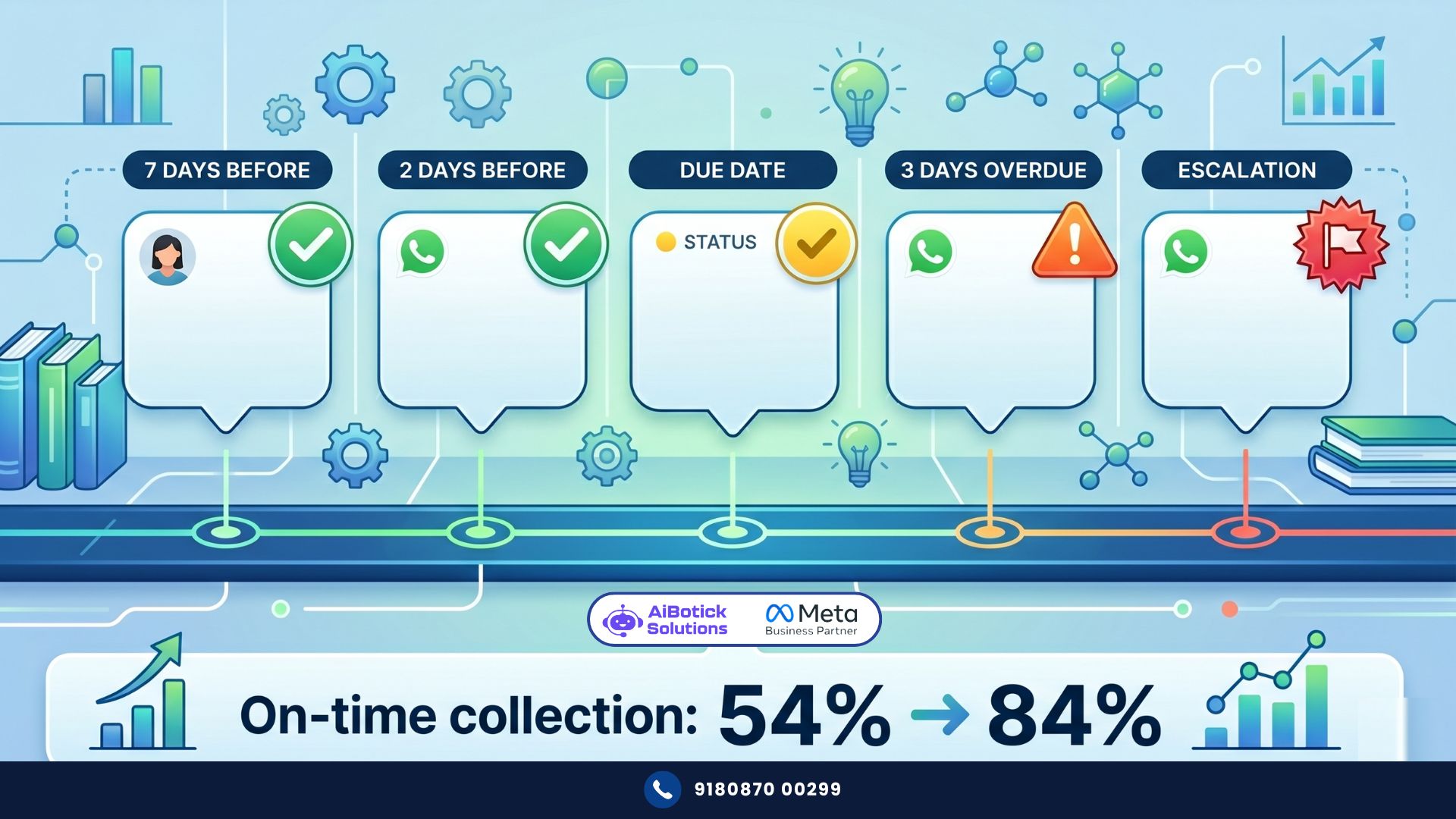
Reminder 1 — 7 days before due date
“Namaste [Parent Name]! 🙏
This is a friendly reminder that [Student Name]’s fees of Rs.[Amount] for [Course/Month] are due on [Date].
Pay conveniently here: [Payment Link]
For any queries, reply to this message or call us at [Number].
Thank you! — [Institute Name]”
Tone: warm, helpful, non-urgent. Like a friendly nudge. Not a demand letter.
Reminder 2 — 2 days before due date
“Hi [Parent Name],
Just a heads up — [Student Name]’s fee of Rs.[Amount] is due in 2 days (by [Date]).
Quick payment options: 💳 Online: [Payment Link] 🏦 Bank transfer: [Account Details] 🏢 In person at the institute
Already paid? Reply ‘PAID’ and we’ll update our records immediately.
— [Institute Name]”
The “Already paid? Reply PAID” line is gold. It immediately resolves the most common frustration — parents who paid by bank transfer but haven’t been updated in the system. Reduces unnecessary follow-up on already-paid fees.
Reminder 3 — Due date
“[Parent Name], today is the last day for [Student Name]’s fees without late charges.
Amount due: Rs.[Amount] Pay now: [Payment Link]
If you’ve already paid or need to discuss a payment plan — reply to this message. We’re here to help. 🙏
— [Institute Name]”
Still warm. Still helpful. Mentions the late charge as a matter of fact — not a threat.
Reminder 4 — 3 days overdue (if still unpaid)
“Hi [Parent Name],
[Student Name]’s fees of Rs.[Amount] are now 3 days overdue. A late fee of Rs.[Late Charge] will be added after [Date].
To avoid additional charges, please pay by [Date]: [Payment Link]
If you’re facing any difficulty, please reply directly — we’re happy to discuss a payment arrangement.
— [Institute Name]”
This message does something important — it opens the door for a conversation about hardship. Parents who genuinely can’t pay right now — they’ll reply. That’s better than them going silent and becoming a collection problem.
Reminder 5 — For genuinely overdue fees (7+ days)
This one escalates to human. Bot flags the account. Accounts manager gets an alert. Personal call or personalised message from institute director.
The bot handles Reminders 1-4 automatically. Only genuinely problematic cases reach a human. That’s the efficiency gain.
The Numbers — Delhi CA Coaching Institute
Real numbers. No rounding up to sound impressive.
CA coaching institute. Delhi. 340 enrolled students. Average fee: Rs.42,000/year, paid quarterly.
Before fee reminder automation on WhatsApp:
- Collection staff: 2 people spending 3 hours/day on fee follow-up
- On-time payment rate (within 7 days of due date): 54%
- Average days to collect after due date: 18 days
- Outstanding fees at any given time: Rs.8.2L
- Bad debt write-offs per year: Rs.1.4L (genuinely uncollectable)
After 90 days of WhatsApp fee reminder automation:
- Collection staff time on fee follow-up: 45 minutes/day (for genuinely escalated cases only)
- On-time payment rate: 84%
- Average days to collect after due date: 4 days
- Outstanding fees at any given time: Rs.1.9L (Rs.6.3L improvement)
- Bad debt write-offs: Rs.31,000 for the same period
Monthly cash flow improvement: Rs.6.3L sitting in the bank instead of outstanding.
Staff time savings: 2.25 hours/day × 2 people × 25 working days = 112.5 hours/month. That’s time redirected to actual student support — not chasing payments.
And the institute director told me something I found genuinely surprising: “Parent relationships actually improved. Because the reminders are polite and helpful — parents stopped feeling guilty and started responding. The awkwardness around fees reduced.”
That’s an unexpected benefit nobody talks about. But it makes sense.
Beyond Basic Reminders — Advanced Fee Automation Possibilities
Fee reminder automation on WhatsApp can go much further than just payment reminders. Here’s what sophisticated institutes are doing.
Installment Plan Management
Parent requested 3-installment payment. Bot automatically sends each installment reminder on the right date. Tracks which installments have been paid. Sends receipt after each payment. No manual tracking. No spreadsheet errors.
Scholarship and Discount Communication
Student qualified for merit scholarship. Automated WhatsApp: “Congratulations [Student Name]! Based on your [Exam Score], you’ve qualified for a Rs.8,000 scholarship. Here’s your revised fee structure: [Details]. Pay now: [Link].”
New Academic Year Fee Announcements
New fee structure for next year — broadcast to all enrolled families simultaneously. Personalised with student name and applicable fee amount. Direct payment link. Done.
Receipt Automation
Payment received via payment gateway — instant WhatsApp receipt to parent. PDF receipt generated and sent. Accounts automatically updated.
No more “I paid but never got a receipt” calls. No more manual receipt generation. Zero.
Fee Defaulter Management
After X days of non-payment — automatic escalation to institute head. Flag in the system. Personalised message from institute director’s name. Converts even stubborn defaulters because it feels like personal attention from leadership.
Actually wait — this last one is interesting. I’ve seen institutes use “message from director” escalation selectively. Not for every defaulter — that would dilute the impact. But for high-value students, long-term families, or cases with genuine hardship potential — a personalised director message converts situations that automated reminders couldn’t.
The bot identifies. The director sends (or the bot sends in director’s name). Conversion happens.
What Institutes Get Wrong About Fee Reminder Automation
One mistake dominates.
Making the messages sound like debt collection notices.
“Your payment of Rs.42,000 is OVERDUE. Immediate payment required to avoid suspension of services.”
This message — I’ve actually seen institutes use language like this — creates resentment, not payment. Parents feel attacked. They dig in emotionally. Even if they intended to pay — now they’re annoyed.
Fee reminder automation on WhatsApp works best when it sounds like a helpful service — not a legal notice.
Compare:
- ❌ “Your account is in arrears. Settle immediately.” — cold, threatening, creates resistance
- ✅ “Hey, just a friendly reminder before the due date!” — warm, helpful, creates cooperation
Same goal. Completely different psychological response.
The tone is not just a nice-to-have. It directly affects payment rates. I’ve seen institutes A/B test tone — same timing, same payment link, different message tone. Warm tone outperforms formal tone by 20-35% on conversion consistently.
Write your reminder messages like you’re texting a friend who happens to owe you money. Not like you’re a bank sending a default notice.
For understanding how WhatsApp automation handles multiple communication types beyond fee reminders — our WhatsApp for coaching institutes guide covers the complete communication stack.
Setting Up Fee Reminder Automation — Exactly What to Do
Simple. Five steps.
Step 1 — Export your fee database Get your student list, fee amounts, due dates, and payment status in a structured format (Google Sheet or CSV works). This becomes the data source for your automation.
Step 2 — Connect data to AiBotick AiBotick’s Google Sheets integration reads your fee data. When a due date approaches — bot automatically pulls the relevant data (parent name, student name, amount, due date) and triggers the right message.
Step 3 — Build your 5-message reminder sequence In AiBotick’s flow builder — create each reminder message. Set timing triggers: 7 days before, 2 days before, due date, 3 days after, 7 days after. Personalise with dynamic variables.
Step 4 — Set up payment gateway integration Every message needs a payment link. Connect Razorpay or your preferred gateway. AiBotick generates unique payment links per student per installment — so every payment is automatically attributed correctly.
Step 5 — Build the escalation alert Define what “overdue” means for your institute. After that threshold — automatic alert to accounts manager. They handle from there.
Test with 10 students first. Verify messages fire correctly. Verify payment links work. Verify escalations trigger. Then roll out to full student base.
Toh yaar — agar aapki accounts team abhi bhi daily 2-3 ghante spend kar rahi hai fee calls pe — aur outstanding amount month-end pe anxiety de raha hai —
Fee reminder automation on WhatsApp fixes this. Not reduces. Fixes.
Rs.6.3L additional cash flow in the bank every month for that Delhi institute. Not from new students. From existing students. From fees that were always owed — just not collected efficiently.
Tap below. 👇 Tell us your enrolled student count and current fee collection challenge — we’ll design your complete WhatsApp fee reminder flow and show you what on-time payment rate improvement looks like for your numbers.
— Mohit Shah | 15+ years in IT industry | 4+ years in WhatsApp automation | Worked with various MNC brands | Now helping businesses figure out what actually works
Q1: How does WhatsApp fee reminder automation improve on-time payment collection for coaching institutes?
A1: WhatsApp fee reminder automation sends a sequence of personalised, timely reminders — 7 days before due date, 2 days before, on due date, 3 days after, and an escalation for genuine defaulters. Because WhatsApp has 95% open rates and messages feel personal rather than bureaucratic, parents respond and pay significantly faster than with email or phone call reminders. A Delhi CA coaching institute improved on-time collection from 54% to 84% within 90 days, freeing Rs.6.3L monthly cash flow.
Q2: What tone should WhatsApp fee reminder messages use for best results?
A2: Warm, helpful, and conversational — not formal or threatening. Reminders that sound like a friendly service message get 20-35% better payment response than reminder messages with formal or legal language. Include easy payment options, acknowledge that parents can reply with questions, and offer to discuss payment arrangements for genuine hardship cases. The goal is cooperation, not confrontation — and tone directly determines which response you get.
Q3: Can WhatsApp fee reminder automation handle installment payment plans for coaching institutes?
A3: Yes — AiBotick’s fee reminder automation handles installment plans completely. Each installment triggers its own reminder sequence automatically based on due dates stored in connected Google Sheets or your student management system. After each payment — an instant WhatsApp receipt is generated and sent. Outstanding installments are tracked automatically. No manual spreadsheet management, no missed installment reminders, no “I paid but got no receipt” support calls.