EdTech mein ek bahut bada jhooth chal raha hai.
“We have 50,000 registered users.”
Ask them how many are active. How many completed even one course. How many renewed. The answer — most EdTech founders already know — is uncomfortable.
Acquisition is easy. Engagement is where EdTech dies.
Students sign up excited. First week — enthusiastic. Second week — “I’ll watch the recorded lectures later.” Third week — the app is three screens deep on their phone. Week 4 — they’ve forgotten the course exists.
And the EdTech company? They’re spending more money acquiring the next batch of students to replace the ones who quietly disappeared.
I’ve spent 4+ years in WhatsApp automation and 15 years in IT. And the EdTech brands I’ve seen actually crack retention — not just acquisition — they have one thing in common. They use WhatsApp for EdTech communication as the engagement layer. Not push notifications that get ignored. Not emails that go unread. WhatsApp — where Indian learners actually live.
Let me show you the complete system.
Why WhatsApp for EdTech Is a Different Problem Than WhatsApp for Coaching Institutes
Quick but important distinction before we go deeper.
Coaching institutes have offline urgency built in — student has to show up physically, batch runs at fixed time, peer pressure exists naturally. Engagement is easier to force.
EdTech — pure online, self-paced — has none of these natural engagement mechanisms. Student can learn “whenever.” Which means they often learn never.
WhatsApp for EdTech has to do something coaching institute WhatsApp doesn’t need to do as much: it has to create artificial urgency, accountability, and community in a self-paced environment.
That’s a harder problem. But it’s solvable. And the brands that solve it — they build LTV that’s 4-5x their competitors who don’t.
Actually wait — let me give you the stark contrast in numbers first.
EdTech brand without WhatsApp engagement: course completion rate 18-22%. 90-day renewal rate 12%.
Same product category EdTech brand with structured WhatsApp for EdTech engagement: course completion rate 54-62%. 90-day renewal rate 34%.
Same content. Same price. Same acquisition channel.
Just a completely different engagement layer.
The 6 Ways WhatsApp for EdTech Creates Engagement That Other Channels Can’t
1. Daily Learning Nudges That Actually Get Read
Push notifications — most learners have turned them off. Email — buried. SMS — ignored.
WhatsApp nudge — opened.
“Good morning [Name]! 🌟 Today’s focus: [Specific Topic]. Estimated time: 18 minutes. Your progress this week: [X]% of module complete. Tap to continue: [Deep Link]”
Personalised. Specific. Has a direct action. Delivers in the channel they’re already in.
The key — it’s not “don’t forget to study!” It’s “here’s exactly what to do next and how long it’ll take.” Removes decision fatigue. Makes starting easier.
2. Progress Milestones That Make Learners Feel Seen
“🎉 [Name], you just completed Module 3 of 8 in [Course Name]! That’s 37% of your full course.
You’ve studied [X] hours this week — you’re in the top 15% of learners in your batch.
Next up: Module 4 starts with [Topic]. Most learners say it’s the most interesting module. See you there! 💯”
Two psychological triggers here. Social comparison (“top 15%”) — healthy competitive motivation. Anticipation building (“most interesting module”) — makes them look forward to the next step.
Completion rates jump dramatically when learners feel their progress is acknowledged. Not at course end — continuously throughout.
3. Peer Learning Accountability Groups
This is underused by most EdTech brands. And it’s powerful.
Create WhatsApp groups of 8-10 learners from the same batch or cohort. Use AiBotick to manage these groups systematically — automated weekly prompts, assignment reminders, peer discussion triggers.
“Hey Batch 47! 👋 Weekly check-in: Who has completed [Assignment Name]? React with ✅ if done, 🔄 if in progress.
[Top performer of week] crushed it this week — 4 modules completed! Share what’s working for you? 👇”
Peer accountability — this changes behavior more than any automated reminder. Learner sees others progressing and feels the pull to not fall behind. Human psychology at its most powerful.
4. Doubt Clearance on WhatsApp — The Engagement Goldmine
Students don’t disengage because content is bad. They disengage because they got stuck on something, felt stupid asking, and quietly gave up.
WhatsApp for EdTech changes this dynamic entirely.
Student stuck on Concept X at 10pm — types “I’m confused about [Concept X]” in the course WhatsApp.
Three possible responses:
- AI bot answers immediately if it’s a common query (trained on course FAQs)
- If complex — AI acknowledges, schedules a doubt session with faculty
- If urgent — human TA picks up within defined SLA
This 24×7 doubt clearance — it’s not just support. It’s retention insurance. Every doubt resolved is a dropout prevented.
5. Assignment and Assessment Reminders With Real Consequences
“[Name], your Module 4 assessment closes in 48 hours. You haven’t attempted it yet.
Quick reminder: assessments unlock the next module. And your [Certificate/Completion Badge] requires all assessments completed.
15 minutes is all it takes. Attempt now: [Link]”
Consequence clarity + time pressure + direct action link. Three conversion drivers in one message.
Assessment completion rates with WhatsApp reminders versus without — consistently 40-60% higher in my experience. Because the reminder arrives when the student is on their phone — which is almost always.
6. Course Completion Celebration + Renewal Trigger
The completion moment — most EdTech brands send a generic “Congratulations!” email. That’s it. Opportunity wasted.
“🏆 [Name], YOU DID IT!
You’ve completed [Course Name] — all [X] modules, all assessments, [X] hours of learning.
Your certificate is ready: [Download Link]
Honestly — completing a course while managing [work/college/family] is genuinely hard. Not everyone does it. You did.
Now — what’s next? The students who saw the best results from [Course Name] typically followed up with [Next Course]. We’ve reserved a seat for you at [Special Price] for the next 72 hours. Interested? Reply YES and we’ll send the details. 🙏”
This message does three things simultaneously. Celebrates genuinely. Provides the certificate immediately (not “check email in 24 hours”). Makes the next course offer at the peak of positive emotion — right when they’re feeling accomplished.
Renewal rate at this moment — 3-4x higher than when the same offer is made 2 weeks later. Strike while the iron is hot. Loha garam hai toh thok do. 😄
Real Numbers — Hyderabad Online Skill Platform
Specific. Verifiable. No exaggeration.
Online professional skill development platform. Hyderabad. Courses in data analytics and digital marketing. Average course price: Rs.8,500. Batch size: 40-80 students.
Before WhatsApp for EdTech engagement:
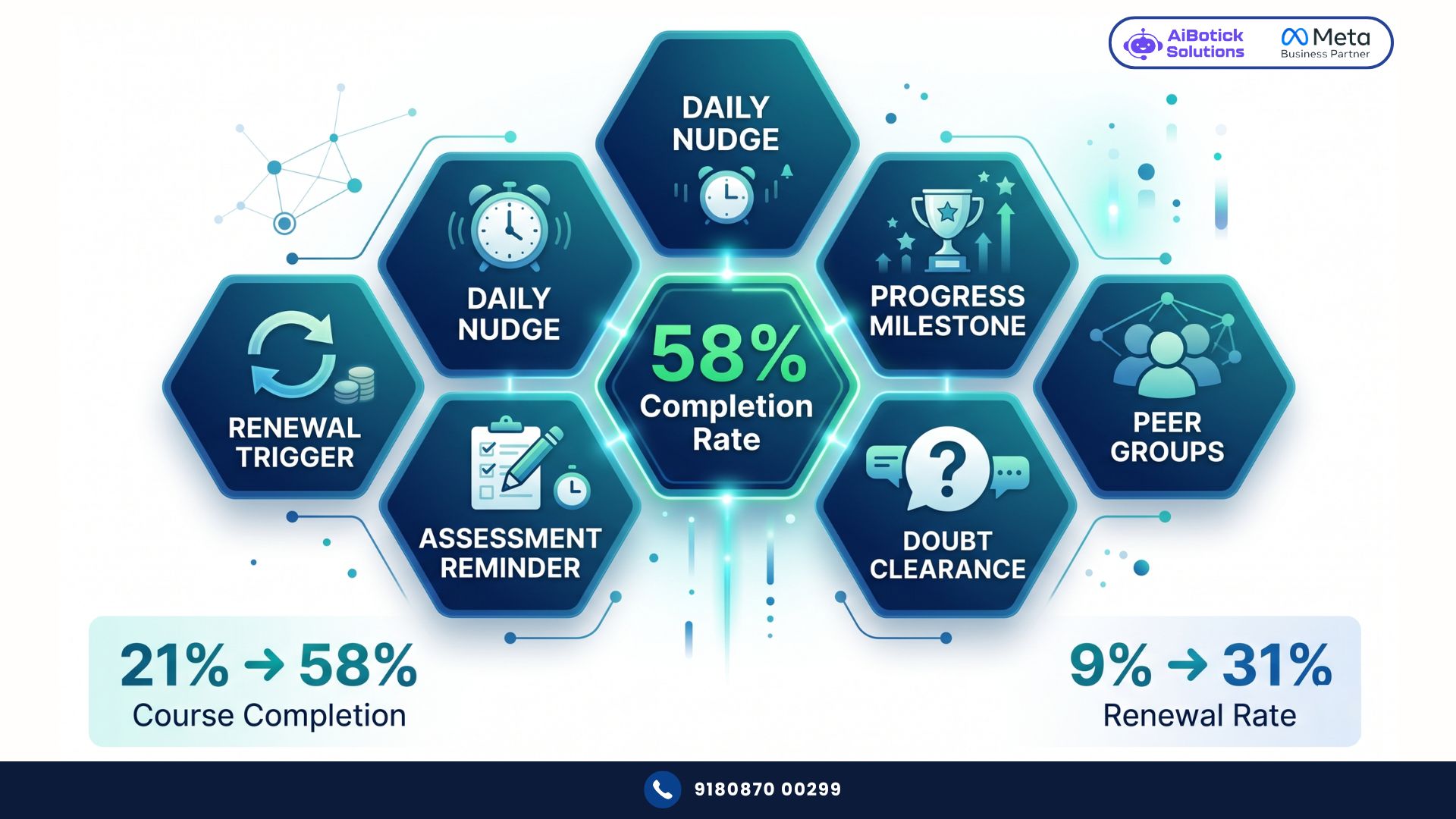
- Course completion rate: 21%
- 90-day renewal rate: 9%
- Average learner NPS: 28
- Monthly active learner rate (logged in at least once in 30 days): 34%
After 6 months of structured WhatsApp for EdTech engagement (daily nudges, milestone messages, doubt clearance, peer groups, assessment reminders, completion + renewal flow):
- Course completion rate: 58% (176% improvement)
- 90-day renewal rate: 31% (244% improvement)
- Average learner NPS: 67
- Monthly active learner rate: 71%
Revenue impact — same acquisition spend, same pricing:
Monthly enrollments stayed roughly the same (400-420/month). But:
- 58% completion vs 21% = 148 more certificates issued per month = 148 more learners eligible for renewal
- 31% renewal vs 9% = 89 additional renewals per month at Rs.8,500 = Rs.7,56,500 additional monthly revenue
Rs.7.5L+ additional monthly revenue. From the same customer base. Just by keeping them engaged.
Annual impact: Rs.90L+ in incremental revenue. From better engagement — not more acquisition.
Platform cost: Rs.45,000/year.
Ek number yaad rakhna — 2000x ROI. Not made up. Calculated from real data.
What EdTech Brands Get Wrong About WhatsApp for EdTech
Honestly? One mistake that costs crores.
They treat WhatsApp as a broadcast channel. Not a conversation channel.
Send → send → send → send. Course update. Assignment reminder. New feature. Sale offer. Send → send → send.
Student stops reading. Mutes the number. Might block.
WhatsApp for EdTech works when it’s two-way. When the student can reply and something useful happens. When the platform asks questions and actually uses the answers.
“How are you finding the pace of [Module 3]?” — student replies “a bit fast.” That reply triggers a human follow-up. Or surfaces supplementary slower-paced content. Or schedules a one-on-one catch-up.
The reply is the signal. The signal drives personalised response. The personalised response creates engagement.
Brands that use WhatsApp as a one-way megaphone — they see declining engagement over time. Brands that build genuine two-way conversation flows — they see engagement increase over time.
The difference in learner lifetime value between these two approaches — I’ve seen 4-5x consistently. Not occasionally. Consistently.
For how to measure the full financial impact of this kind of engagement improvement — our WhatsApp automation ROI guide has a specific section on EdTech lifetime value calculations.
The WhatsApp for EdTech Tech Stack — What You Actually Need
Simple. Four connected pieces.
1. Your LMS / Course Platform Teachable, Thinkific, custom-built, or in-house — whatever your courses run on. This is the source of truth for student progress, completion rates, assessment scores.
2. AiBotick WhatsApp API Platform Handles all WhatsApp communication. Receives data from your LMS via webhooks or API integration. Sends messages. Receives replies. Routes to humans when needed. Manages peer group WhatsApp groups at scale.
3. Your CRM / Student Database Student name, enrollment date, course, progress percentage, last active date. This data drives personalization in every message.
4. Payment Gateway For renewal offers. Razorpay or your existing gateway. Renewal offer message includes direct payment link. One tap → payment → new enrollment confirmed → onboarding sequence restarts.
All four connected — you have a complete WhatsApp for EdTech engagement engine. Any one piece missing — the system underperforms.
For how the student communication journey works from admission through completion — our complete student onboarding guide covers every stage in detail.
Exactly What to Build First — Priority Order for EdTech
Week 1 — Start here: Daily learning nudge (personalised, with deep link, with progress %). This single flow — if done well — improves monthly active learner rate by 30-40% almost immediately.
Week 2: Assessment and assignment reminders. 48-hour reminder + 24-hour reminder + same-day. Completion rates jump within the first assessment cycle.
Week 3: Milestone messages. Every module completion triggers a WhatsApp. Small investment of time, big impact on motivation.
Month 2: Peer accountability groups. Start with one cohort. Test. Refine. Then scale to all new batches.
Month 3: Doubt clearance flow. AI-powered for common queries. Human escalation for complex ones.
Month 4: Completion + renewal flow. This is where the revenue comes back. Don’t skip it.
Build in layers. Each layer pays for the next. By Month 4 — you have a complete WhatsApp for EdTech engagement system running. Largely automated. Driving completion, retention, and renewal simultaneously.
EdTech walon se seedha baat —
Aapke paas content hai. Students hain. Infrastructure hai.
Jo nahi hai woh yeh hai: ek systematic way to stay in the learner’s mind and life — consistently, personally, helpfully — from enrollment to completion to renewal.
WhatsApp for EdTech is that system.
And the brands that build it now — they’re building a competitive moat that’s very hard to replicate. Because you can copy course content. You can copy pricing. You cannot easily copy years of WhatsApp engagement data, refined flows, and learner relationships built on genuine helpful communication.
Tap below. 👇 Tell us your EdTech platform, monthly enrollment numbers, and current completion rate — we’ll design your complete WhatsApp engagement stack and show you what the revenue impact looks like for your specific numbers.
— Mohit Shah | 15+ years in IT industry | 4+ years in WhatsApp automation | Now helping businesses figure out what actually works
Q1: How does WhatsApp for EdTech improve course completion rates for Indian online education platforms?
A1: WhatsApp for EdTech improves completion rates through 6 systematic engagement flows — daily personalised learning nudges with direct course links, progress milestone celebrations, peer accountability groups of 8-10 learners, 24×7 doubt clearance (AI-powered for common queries, human escalation for complex ones), assessment reminders with consequence clarity, and completion celebrations that trigger renewal offers at peak positive emotion. A Hyderabad skill platform improved completion rates from 21% to 58% using these flows, driving Rs.90L in additional annual revenue from the same student base.
Q2: What is the most important WhatsApp engagement flow to build first for an EdTech platform?
A2: Daily learning nudges — personalised with the student’s name, specific next topic, estimated time, and a direct deep link back into the course — deliver the fastest, most measurable impact on monthly active learner rates. This single flow typically improves learner activity by 30-40% within the first month. Start here, then layer assessment reminders, milestone messages, peer groups, doubt clearance, and renewal flows in subsequent months.
Q3: How is WhatsApp for EdTech different from WhatsApp for traditional coaching institutes?
A3: Traditional coaching institutes have built-in engagement mechanisms — fixed class schedules, physical attendance, peer pressure. EdTech is self-paced and fully online, with no natural accountability structures. WhatsApp for EdTech must create artificial urgency, peer accountability, and progress visibility that coaching institutes get automatically. This requires more sophisticated flows — peer groups, progress tracking, dropout prediction, and personalised nudges — compared to the primarily scheduling and reminder-focused flows that work for coaching institutes.