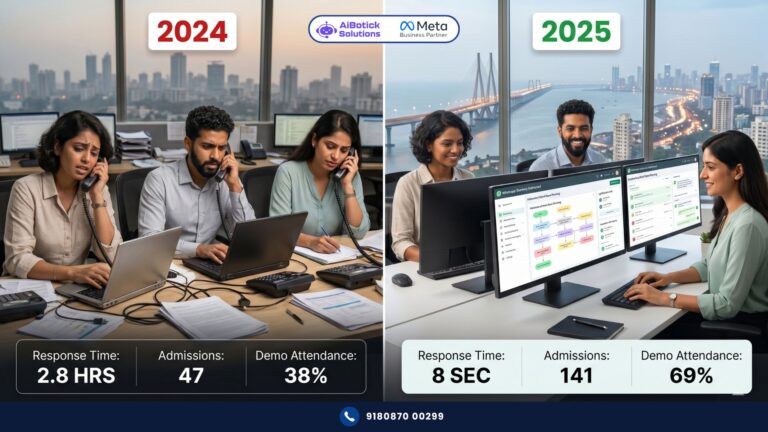
Most coaching institutes have a graveyard.
They just don’t call it that.
It’s the Excel sheet — or the CRM, if they’re slightly more organised — with 400, 600, sometimes 2,000 names. Parents who enquired. Parents who attended a demo. Parents who said “we’ll think about it” and then disappeared.
Followed up once. Maybe twice. No response. Marked as “cold.” Moved to the bottom of the list. Forgotten.
And every admission season — that graveyard grows.
Here’s what nobody tells you: 60-70% of education purchase decisions in India take 2-6 weeks from first enquiry to enrollment. That’s not coldness. That’s process. The Indian education buyer — especially for competitive exam prep — is comparing, discussing with spouse, checking finances, asking friends. They need time.
The institutes that win are not the ones with the best product. They’re the ones who stay consistently, helpfully present throughout that entire 2-6 week decision window.
WhatsApp lead nurturing for education is exactly that — a systematic way to stay in the right parent’s mind, at the right time, with the right message. Without a counsellor making 47 manual follow-up calls.
Why “Follow Up” Is Not the Same as “Nurture” — The Crucial Distinction
This confusion kills more education sales pipelines than anything else.
Follow-up: “Hi, did you decide?” “Just checking in.” “We have seats available.” “Please let us know.”
These messages — they don’t add value. They just remind the parent that you exist. And after 2-3 of them, the parent stops responding because every message is a push for a decision they haven’t made yet.
Nurture: A sequence of messages that progressively builds trust, addresses concerns, and provides genuine value — so by the time the parent is ready to decide, they’ve already made up their mind about you.
The difference in outcome is dramatic. I’ve seen institutes doing pure follow-up get 4-6% conversion on cold leads. Institutes doing structured WhatsApp lead nurturing for education get 18-24% on the same quality of cold leads.
Same leads. Same product. 4-5x better conversion.
Because nurture respects the decision process. Follow-up tries to interrupt it.
The 30-Day WhatsApp Lead Nurturing Sequence — Every Message, Every Day
This is the actual sequence I’ve helped education businesses build. Not a template — a strategic communication arc.
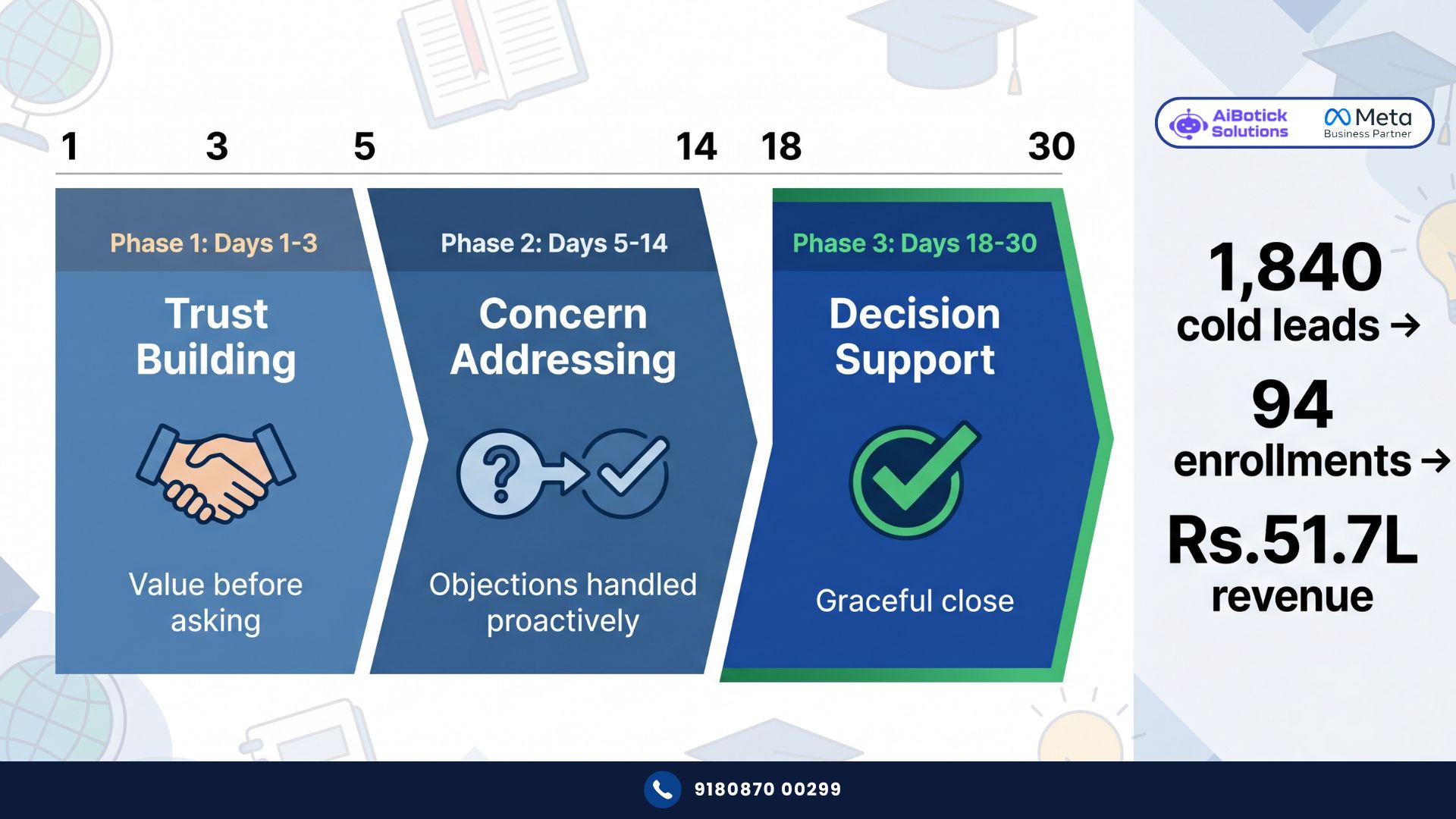
Days 1-3: Trust Building Phase
Day 1 — 2 hours after enquiry (if demo not booked):
“Hi [Parent Name]! 🙏
Thank you for enquiring about [Course Name] at [Institute Name]. I’m [Counsellor Name] and I’ll be your point of contact.
I know you’re probably comparing options right now — completely makes sense for a decision this important. I’m not here to push you.
Instead, I wanted to share one thing that parents often find most useful at this stage: a quick 3-minute video of [Faculty Name] explaining exactly how we approach [Key Topic] differently from other institutes.
[Video Link]
Watch it when you have time. And if [Student Name] wants to experience this teaching style live — our next demo class is [Date]. Happy to reserve a spot. — [Counsellor Name], [Institute Name]”
This message — it’s doing something most follow-up messages don’t. It’s giving before asking. It’s respecting the parent’s timeline. It’s providing genuine value (the video) without demanding a decision.
Day 3 — A specific result story:
“[Parent Name], quick share — something that might be relevant to your decision.
[Student Name], who sat in the same demo class you’re considering, enrolled with us in March 2024. He was scoring around 65% in mock tests when he joined. By December — 91%.
His parent messaged us after the result: ‘[Actual quote from parent — specific, authentic]’
I’m not sharing this to impress. I’m sharing it because you’re considering a significant investment and you deserve to know what’s actually possible. 🙏 — [Counsellor Name]”
Specific. Named (if parent has given permission — otherwise anonymised). Authentic quote. Not “our students achieve great results” generic language.
Days 5-10: Concern Addressing Phase
By Day 5, if the parent hasn’t enrolled, there’s a reason. The WhatsApp lead nurturing sequence now shifts to proactively addressing the most common objections — without the parent having to voice them.
Day 5 — Address the “is it worth the fees” concern:
“[Parent Name], one question I get asked a lot at this stage: ‘Is [Course Name] worth Rs.[Fee]?’
Honest answer: it depends on how it’s used.
Students who attend every class, complete all assignments, and attend doubt sessions — their results are dramatically different from students who don’t. The teaching is the same. The discipline isn’t.
What I can tell you from 4+ years in this industry: the institutes that produce results aren’t always the most expensive. They’re the ones where the student-faculty relationship is built on accountability.
That’s specifically why we do [specific thing your institute does — smaller batches, weekly one-on-ones, parent progress calls, etc.].
Still have questions about fees or EMI options? Just reply here. — [Counsellor Name]”
Day 7 — Faculty credibility deepdive:
“[Parent Name], wanted to introduce you to [Faculty Name] properly — because most parents only see a 2-line bio and don’t realise what they’re getting.
[Faculty Name] has [specific credential — eg: ‘IIT Bombay alumnus, 12 years teaching JEE, personally mentored 3 AIR top-100 students’].
What makes them different: [one specific teaching philosophy or approach that’s genuinely differentiating — not generic ‘student-centric’ language]
[Student Name] will spend 400+ hours with this person over the course. That’s more time than most parents spend with their children in meaningful conversation in a year. The relationship matters. — [Counsellor Name]”
Day 10 — Address the “online vs offline” concern (if relevant):
Customise this based on your institute’s model. If offline — address commute concerns. If online — address engagement concerns. If hybrid — address confusion about which suits the student better.
The point: by Day 10, the parent has received 5 genuinely useful messages. They know your results. They know your faculty. They know your fees are justified. They know you’re not just chasing a sale.
Days 14-21: Decision Support Phase
Day 14 — Peer social proof:
“[Parent Name], something interesting happened in our parent community this week.
[Parent of Student X] posted this in our parent WhatsApp group after [Student X]’s mid-term result: ‘[Authentic, specific quote]’
[Another parent] responded: ‘[Another quote]’
I’m sharing this because these conversations happen naturally in our parent community. When parents are invested in each other’s students’ success — it creates something beyond just coaching. It creates a support system.
Is [Student Name] someone who would thrive in that kind of environment? — [Counsellor Name]”
Day 18 — Seat availability and genuine urgency:
“[Parent Name], I want to be straightforward with you.
[Batch Name] — the one that would suit [Student Name]’s profile — has [X] seats remaining. I check this every week and I’ve watched it go from 25 to [X] in the past 3 weeks.
I’m not saying this to pressure you. You know your timeline better than I do.
But if you’re leaning toward [Institute Name] and the only thing holding you back is timing — this is probably the right moment to know the real seat situation.
Your call entirely. 🙏 — [Counsellor Name]”
Honest urgency — based on real data, communicated transparently. Not “only 3 seats left!” manipulation.
Day 21 — Offer to address any remaining concern directly:
“[Parent Name], this is around the time in the decision process when parents usually have one or two specific concerns they haven’t voiced yet.
Could be about [Student Name]’s current academic level. Could be about the commute. Could be about whether [Course] is the right path given their interests and aptitude.
Whatever it is — I’d rather discuss it honestly than have you make a decision with unanswered questions.
Would you be open to a 15-minute call this week? Or if WhatsApp is easier — just reply with your question. — [Counsellor Name]”
Days 25-30: Final Decision Phase
Day 25 — Last batch reminder with specific closure:
“[Parent Name], I want to respect your time and not keep sending messages indefinitely.
[Batch Name] enrollment closes on [Date]. After that, [Student Name] would need to wait for the next batch — which starts [X months later].
If the timing works — even a 50% fee payment today secures the seat.
If it doesn’t work — genuinely no hard feelings. Some decisions need more time than an admission season allows. We’ll still be here next cycle.
But if you’ve been meaning to decide and just haven’t got around to it — this is probably the nudge you needed. 🙏 — [Counsellor Name]”
Day 30 — The graceful close:
“[Parent Name], this is my last message in this sequence — I promise! 😊
We had a great conversation and I genuinely believe [Institute Name] would be the right environment for [Student Name]. But I also know that’s your call to make, not mine.
If the answer is yes — I’m one message away. If the answer is no right now — please do keep us in mind for next cycle. And if you ever have questions about [Student Name]’s preparation journey, feel free to reach out anytime.
Wishing [Student Name] all the best — whatever path you choose. 🙏 — [Counsellor Name]”
This last message — it closes without pressure. And it does something quietly powerful: it leaves the relationship intact. Parents who don’t enroll in Cycle 1 but receive this kind of graceful closing message — they enroll in Cycle 2 at dramatically higher rates than parents who felt pressured and disengaged.
Real Numbers — Bangalore MBA Entrance Coaching
Specific. Because vague case studies are useless.
MBA entrance coaching institute. Bangalore. CAT, GMAT, XAT preparation. Average fee: Rs.55,000.
Problem: Large cold lead database — 1,840 enquiries from previous 3 seasons that hadn’t converted. Being treated as dead leads. No systematic nurture. Occasional manual follow-up calls with near-zero conversion.
What we built: 30-day WhatsApp lead nurturing for education sequence — deployed to all 1,840 leads simultaneously. Personalised with their name and original enquiry date. Sequenced over 30 days as described above.
Results after one campaign cycle:
- Total leads in campaign: 1,840
- Opted out (replied STOP or blocked): 47 (2.6% — well within acceptable range)
- Engaged (replied, asked questions, requested demo): 312 (17%)
- Demo class attended from this cold list: 189
- Enrolled from this campaign: 94
94 enrollments from leads most institutes would have written off as dead.
At Rs.55,000 per enrollment: Rs.51,70,000 in revenue. From a “dead” list.
Platform cost for the campaign: approximately Rs.8,200 in Meta charges + Rs.3,750 platform fee share.
Total campaign cost: Rs.11,950.
Revenue generated: Rs.51,70,000.
433x return. From leads that were already in the database. Already paid for through past marketing spend.
Actually wait — I want to add context here. This result was particularly strong because the list was large and the nurture sequence was well-crafted. Results vary. But even at 20% of this result — 19 enrollments from a dead list — the ROI is extraordinary. The floor of the return on WhatsApp lead nurturing for education is high, because the input cost is nearly zero.
What Education Institutes Get Wrong About Lead Nurturing
Honestly bhai — two mistakes. Both predictable. Both fatal.
Mistake 1 — Treating all cold leads the same.
Parent who enquired 3 days ago and parent who enquired 8 months ago — very different situations. Different messages, different tone, different urgency level appropriate.
Segment your cold leads by recency:
- 0-30 days old: recent, high-intent, nurture immediately
- 31-90 days old: warm but cooling, re-engagement focus
- 90+ days old: requires stronger re-engagement hook, acknowledge the gap
“Hi [Name], it’s been a while since you first enquired about [Institute Name] — and a lot has changed since then. Here’s what’s new…” — much better opening for a 6-month-old lead than “Just following up!”
Mistake 2 — Stopping the sequence the moment someone shows interest.
Parent responds on Day 7. Counsellor takes over the conversation. The automated sequence stops.
But counsellor is busy. Response takes 3 hours. Momentum lost.
Build the system so that when a lead responds — human takes over immediately (within 30 minutes SLA) AND the automated sequence pauses (to avoid bot and human messaging simultaneously). If human doesn’t respond within SLA — sequence resumes automatically.
This requires process discipline alongside technical setup. But it’s the difference between a nurture system that works and one that creates confusion.
For how the complete admission journey connects — from first enquiry through nurture through enrollment and onboarding — our WhatsApp admission automation case study shows the full integrated system in action.
Setting Up WhatsApp Lead Nurturing for Education — Exactly What to Do
Step 1 — Audit your existing cold lead database How many leads do you have? From when? What information do you have — name, phone, course interest, last interaction date? This determines your starting segmentation.
Step 2 — Write your 10-12 nurture messages Don’t use the exact messages from this article — customise for your institute’s actual results, actual faculty, actual differentiators. Authentic specificity outperforms generic templates every time.
Step 3 — Build the sequence in AiBotick Create the flow with timing delays. Connect to your lead database. Set up triggers for when a lead responds (pause sequence, alert counsellor). Set up re-entry logic for leads who don’t respond.
Step 4 — Get your templates Meta-approved Each message template needs Meta approval. AiBotick helps draft compliant templates. Submit all 10-12 at once — approval within a few hours typically.
Step 5 — Start with a small test segment Run the sequence on 200 leads first. Watch response rates. Identify which messages generate the most replies. Refine. Then scale.
Step 6 — Measure and iterate Track: open rate, reply rate, demo booking rate, enrollment rate per lead cohort. WhatsApp lead nurturing for education gets better over time as you refine based on actual response data.
For understanding the full financial impact of converting cold leads — our WhatsApp automation ROI guide has the exact framework for calculating lead nurturing returns.
Toh ek last question — direct, honest.
Aapke institute ke paas kitne “dead” leads hain right now? Numbers mein socho.
200? 500? 2,000?
WhatsApp lead nurturing for education woh leads wapas lata hai. Not all of them. But enough to change your quarterly numbers significantly.
And the beautiful part — these are leads you already have. Already paid for through past marketing. Already in your database. The cost to nurture them is a fraction of what you spent acquiring them.
Tap below. 👇 Tell us your cold lead database size, how old the leads are, and your current cold lead follow-up process — we’ll design your complete 30-day WhatsApp nurture sequence and show you what realistic conversion looks like for your numbers.
— Mohit Shah | 15+ years in IT industry | 4+ years in WhatsApp automation | Now helping businesses figure out what actually works
Q1: What is WhatsApp lead nurturing for education and how is it different from follow-up calls?
A1: WhatsApp lead nurturing is a structured 30-day sequence of value-adding messages that progressively builds trust, addresses unspoken concerns, and supports the decision process — without demanding a response at each step. Unlike follow-up calls (“have you decided?”), WhatsApp lead nurturing respects the 2-6 week decision timeline typical for Indian education purchases by providing relevant content (faculty credentials, result stories, fee justification, peer testimonials) that helps parents decide in your favour naturally. Institutes using structured WhatsApp lead nurturing consistently see 18-24% conversion on cold leads versus 4-6% from pure follow-up approaches.
Q2: How long should a WhatsApp lead nurturing sequence be for coaching institutes?
A2: 30 days is the optimal length for most education lead nurturing sequences — long enough to cover the complete Indian education purchase decision timeline (typically 2-6 weeks), structured into three phases: trust building (Days 1-3), concern addressing (Days 5-14), and decision support (Days 18-30). Sequences shorter than 14 days miss the later-stage deciders. Sequences longer than 30 days see diminishing returns and increased opt-out rates. The 30-day arc with 10-12 messages at natural intervals delivers the best balance of conversion and relationship preservation.
Q3: What types of messages should a WhatsApp lead nurturing sequence include for education businesses?
A3: An effective WhatsApp lead nurturing sequence for education includes — specific result stories (named students, actual scores, verifiable outcomes), faculty credibility content (credentials, teaching philosophy, student testimonials), honest fee justification (ROI framing, EMI options, value vs cost comparison), peer social proof (authentic parent community quotes), genuine urgency updates (real seat availability, real batch closing dates), and concern-addressing messages that proactively tackle the most common objections without the parent having to voice them. Every message should provide genuine value — information the parent couldn’t easily find elsewhere — rather than simply pushing for a decision.