Choosing the wrong WhatsApp API provider has cost businesses lakhs. Not in subscription fees — in lost leads, failed automations, and months of switching costs.
I’ve worked inside this industry long enough to know which providers actually deliver and which ones look great in a sales demo and fall apart at 11pm on a Friday when your campaign is live.
So here’s my honest take. No PR. No paid rankings. Just what I’ve seen on the ground.
First — Why This Decision Matters More Than You Think
WhatsApp API providers are not interchangeable commodities. The platform you choose determines:
- How fast your chatbots respond
- Whether your templates get approved in 2 days or 2 weeks
- What happens when something breaks and you need help right now
- How well your WhatsApp stack integrates with your CRM, ecommerce store, and payment gateway
- Whether you scale smoothly from 500 to 50,000 conversations per month
I’ve seen companies switch providers 3 times in 18 months because they chose based on price alone. The switching cost — migrating subscriber data, rebuilding bot flows, retraining the team, re-approving templates — is brutal. Ek baar sahi decision lo. Baad mein bahut time bachega.
How I’m Evaluating WhatsApp API Providers — My Criteria
Before getting into names, here’s what I actually look at. Not marketing claims. Real criteria.
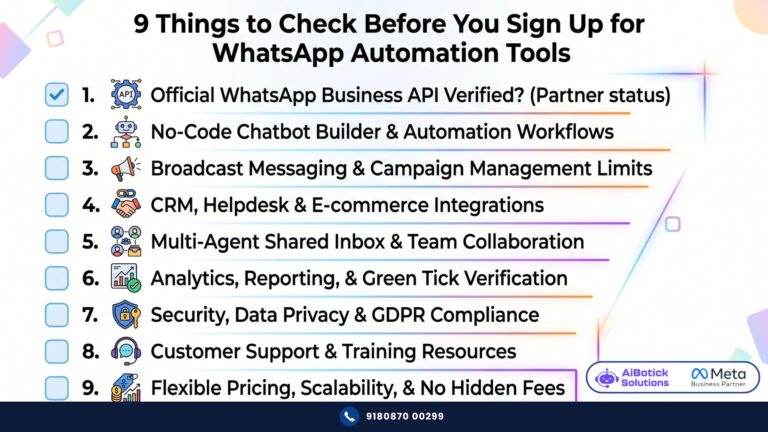
1. Meta certification status — Are they an official Meta Business Solution Provider or a reseller of a reseller? Matters for uptime, policy compliance, and template approval speed.
2. Feature depth — AI chatbot capability, shared team inbox, drip campaigns, e-commerce integrations, payment gateways, WhatsApp Flows support. Not just broadcasting.
3. Support quality — Response time when things break. Is there a human or just a chatbot? Do they stay with you through onboarding or hand you a PDF and disappear?
4. Pricing transparency — Are Meta conversation charges separate and clear? Are there hidden per-message fees on top of subscription? Annual vs monthly options?
5. Ease of use — Can your marketing manager set up a broadcast without calling IT? Can your support exec use the inbox without a 2-week training programme?
6. Scalability — Does it work for 500 contacts and 50,000 contacts without rebuilding everything?
With that framework — let’s get into the actual WhatsApp API providers.
The WhatsApp API Providers Worth Knowing About in India 2026
Wati
Wati is probably the most internationally recognised name in this space. They were early, they marketed aggressively, and they built a decent product.
What they do well:
- Clean UI. Relatively easy to learn.
- Good template management
- Decent integration ecosystem
Where they fall short for Indian businesses:
- Support is largely self-service. Documentation is decent but when something breaks urgently, you’re on your own for a while.
- No personalised onboarding. You get access, a walkthrough video, and best of luck.
Best for: Indian businesses with international billing comfort, teams with technical resources to self-implement.
Not ideal for: Mid-size Indian companies who need hand-holding through setup and an INR invoice for accounting.
I might be a little biased here since I’ve seen their inner workings up close — but the support gap is something I’ve heard consistently from businesses who’ve tried them.
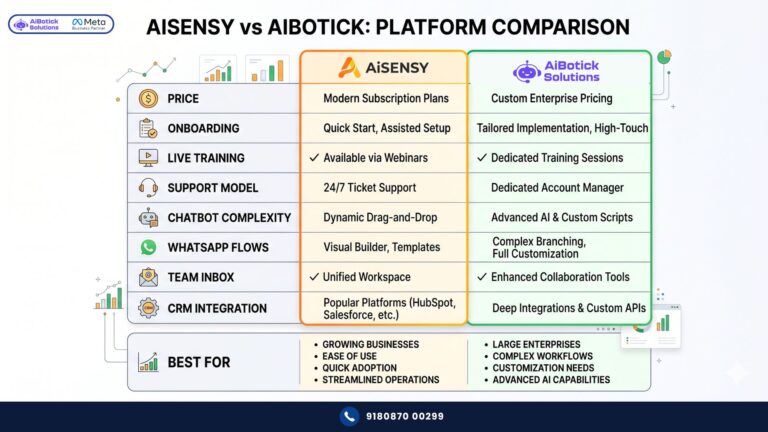
AiSensy
AiSensy came in strong on price and captured a big chunk of the small business market. And honestly, for what they charge, they’ve done a reasonable job.
What they do well:
- Very competitive pricing for entry-level
- Simple broadcasting interface
- Good for businesses just starting with WhatsApp
Where they fall short:
- Feature ceiling hits fast. No meaningful AI chatbot capability. No sequence messaging. Limited integration depth.
- As your business grows and your WhatsApp use case becomes more complex — AiSensy starts showing its limits
- Support is responsive at entry level but gets stretched when you have complex requirements
Best for: Very early stage businesses testing WhatsApp for the first time. Low-complexity use cases. Budget-constrained.
Not ideal for: Any company with Rs.1Cr+ turnover that needs automation, AI, multi-agent inbox, and real integrations. You’ll outgrow it quickly and the migration cost will hurt.
Honestly? I think AiSensy is slightly overhyped as a “serious” business platform. It’s a good entry point — not a growth platform.
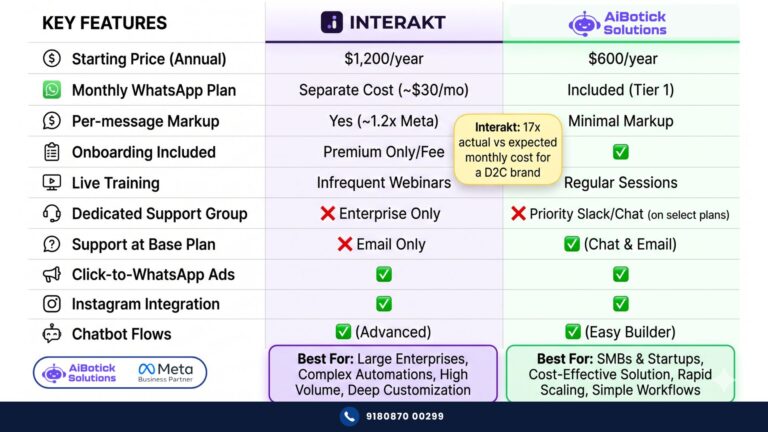
Interakt
Interakt has carved out a decent position, particularly in the ecommerce segment. Their Shopify integration story is strong.
What they do well:
- Solid ecommerce integrations — Shopify especially
- Reasonable pricing in INR
- Decent broadcasting capability
Where they fall short:
- Self-service model primarily. Onboarding support is basic.
- AI capabilities are limited
- Shared inbox works but feels clunky for high-volume teams
- No dedicated support group — you’re in a general queue
Best for: D2C ecommerce brands with a Shopify store and a team that can self-implement.
Not ideal for: B2B companies, service businesses, or anyone who needs complex chatbot flows and genuinely responsive support.
DoubleTick
DoubleTick has positioned itself more toward SMB sales teams — their interface is built around sales conversation management.
What they do well:
- Sales-focused UI. Good for teams that primarily use WhatsApp for sales conversations.
- Mobile app is stronger than most competitors
- INR pricing
Where they fall short:
- Limited automation depth. If you want complex bot flows, drip campaigns, webhook integrations — it starts getting uncomfortable.
- AI integration is basic
- E-commerce integration stack is limited
- Support is improving but has historically been inconsistent
Best for: Small sales teams primarily doing conversation-based selling without complex automation needs.
Not ideal for: Businesses wanting to build full WhatsApp automation funnels — marketing, support, payments, and sales in one place.
AiBotick
Seedha bolta hoon — I write for AiBotick, so take this section with that context. But I’ll be as objective as I can, and you can verify everything I say by asking for a demo.
What AiBotick does well:
- Full feature stack — AI chatbot (OpenAI + Gemini), drag-and-drop bot builder, WhatsApp Broadcasting, shared team inbox, drip campaigns, WhatsApp Flows, Shopify + WooCommerce integration, 20+ payment gateways, Click-to-WhatsApp ads, comment automation, Google Sheets integration, Zapier — everything in one platform
- INR pricing — transparent, no USD exposure, no hidden per-message platform fees beyond Meta charges
- The differentiator nobody else offers — every client gets personalised onboarding + live training sessions + a dedicated WhatsApp support group. Included in every plan. Not an upsell.
- AI depth — OpenAI and Gemini integration for genuinely intelligent bot responses, not just keyword-trigger flows
- Scalability — Growth plan handles up to Rs.1Cr turnover businesses well. Scale and Enterprise plans for Rs.1Cr to Rs.10Cr+ — with unlimited subscribers and message volumes that don’t break at scale
Where AiBotick is still building:
- Newer brand compared to Wati or AiSensy — smaller review footprint online
- Global coverage is in progress — primarily India-focused currently with international expansion underway
Best for: Indian mid-size companies (Rs.50L to Rs.10Cr+ turnover) who want a full-stack WhatsApp automation platform, INR pricing, and genuine onboarding support. Also strong for digital agencies, EdTech, real estate, healthcare, and ecommerce.
Not ideal for: Solopreneurs or very early-stage businesses with 0 customer volume — the platform’s depth is built for businesses that already have customer conversations happening.
If you want to understand what makes the support model different, read this on how AiBotick’s onboarding and personalised training works versus typical self-service platforms — the gap is significant.
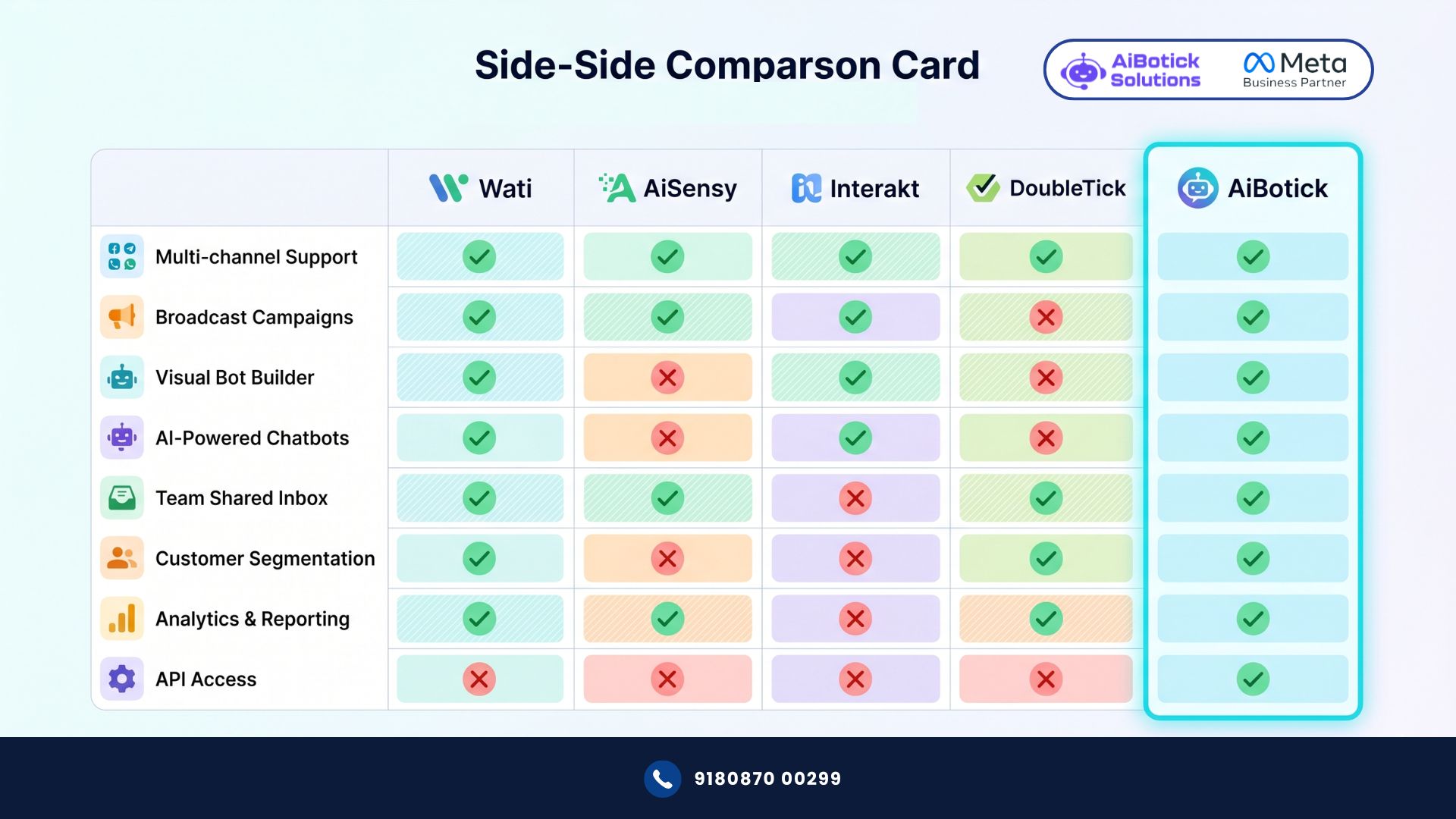
Head-to-Head Comparison — WhatsApp API Providers India 2026
| Feature | Wati | AiSensy | Interakt | DoubleTick | AiBotick |
|---|---|---|---|---|---|
| Pricing Currency | INR | INR | INR | INR | INR |
| AI Chatbot | Basic | No | No | Basic | Advanced (OpenAI + Gemini) |
| Personalised Onboarding | No | No | No | No | ✅ Yes — every plan |
| Dedicated Support Group | No | No | No | No | ✅ Yes — every plan |
| Drip / Sequence Campaigns | Yes | No | Limited | No | ✅ Yes |
| WhatsApp Flows | Yes | No | Limited | No | ✅ Yes |
| Shopify Integration | Yes | Basic | ✅ Strong | No | ✅ Yes |
| WooCommerce Integration | Limited | No | Limited | No | ✅ Yes |
| Payment Gateways | Limited | No | Limited | No | ✅ 20+ gateways |
| Comment Automation | No | No | No | No | ✅ Yes |
| INR Billing | No | Yes | Yes | Yes | ✅ Yes |
| Shared Team Inbox | Yes | Basic | Yes | Yes | ✅ Yes |
Actually wait — I want to flag something on this table. The “Yes” against any feature isn’t equal. There’s a big difference between “we have this feature” and “this feature works reliably at scale.” That’s where I’d encourage you to specifically test the features that matter most for your use case before committing. Don’t just check the box — check the depth.
What People Get Wrong When Choosing WhatsApp API Providers
Wrong approach #1: Choosing on price alone
The cheapest plan always looks attractive. Until you’re 3 months in, trying to build a chatbot flow the platform doesn’t support, and your support ticket has been open for 4 days.
Total cost of WhatsApp API includes: subscription + Meta conversation charges + implementation time + support time + opportunity cost of features you can’t use. Price the whole thing.
Wrong approach #2: Choosing based on G2 or Capterra reviews alone
Reviews are gamed. I’ve seen platforms with 4.8 stars on review sites that I would never recommend for a serious business use case. Read reviews — but also ask for references. Talk to an actual customer in your industry.
Wrong approach #3: Not testing support before signing up
Before you commit, send a complex support question to every platform you’re evaluating. See who responds, how fast, and how helpfully. That response is a preview of what you’ll get when something breaks at 10pm before a campaign launch.
Wrong approach #4: Choosing based on features you don’t currently need
The opposite mistake — getting sold on 50 features when you need 5. Get clarity on your actual use case first. Then check which platforms cover those 5 things exceptionally well. The fancy AI feature is useless if basic broadcasting is unreliable.
A Real Story: The Cost of Choosing Wrong
This isn’t about any specific company — it’s a composite of what I’ve seen happen multiple times.
Mid-size education company. 200 active students. Chose a provider based on lowest price. Rs.999/month. Seemed smart.
Six months in:
- Chatbot flows kept breaking. No support response for 48+ hours.
- Template approval was taking 10-12 days. Campaign timelines kept slipping.
- Team inbox didn’t support proper agent assignment — conversations were getting duplicated.
- No drip campaign capability — their student nurturing sequence had to be done manually.
They switched to a proper platform. Migration cost them 3 weeks of work. Re-building flows. Re-approving templates. Re-training the team.
The Rs.999/month “saving” cost them roughly Rs.2-3 lakhs in team time and missed campaign revenue over 6 months.
Sahi platform pe pehle hi aate toh kitna bacha hota. 😅
For context on what a proper feature stack actually looks like in practice, read our breakdown of what the WhatsApp Business API actually enables beyond basic messaging — that article covers the full capability gap between basic and advanced API providers.
How to Actually Choose — My 5-Step Framework
Step 1 — Define your top 5 use cases Broadcasting? Chatbot? E-commerce integration? Support inbox? Lead nurturing? Write them down. Rank them.
Step 2 — Shortlist 2-3 providers that cover all 5 Not just “have” the features — but do them well. Ask for specific demos of your use cases.
Step 3 — Test support responsiveness Send a complex query to each shortlisted provider. Time the response. Read the quality of the answer.
Step 4 — Talk to a customer in your industry Ask the provider for a reference in a similar business. 20-minute call. Ask what broke, how support handled it, and whether they’d choose the same platform again.
Step 5 — Calculate total cost over 12 months Subscription + Meta charges (estimate based on your expected conversation volume) + implementation time. Compare apples to apples.
Then decide. Not based on brand familiarity. Not based on who had the best demo. Based on which platform actually covers your use case with the support model you need. 💯
Choosing your WhatsApp API provider is one of those decisions that looks small and turns out to be foundational. Get it right the first time.
If you want to see how AiBotick specifically covers your use case — Chat with us on WhatsApp and we’ll walk you through a live demo tailored to your industry and team size.
— Mohit Shah | 15+ years in IT industry | 4+ years in WhatsApp automation | Worked with various MNC brands | Now helping businesses figure out what actually works
Q1: Which is the best WhatsApp Business API provider in India in 2026?
The best WhatsApp API provider depends on your use case and business size. For full-stack automation with AI chatbots, e-commerce integrations, and hands-on onboarding support — AiBotick is the strongest option for Indian mid-size businesses. For basic entry-level broadcasting on a tight budget, AiSensy works as a starting point. For D2C Shopify brands, Interakt has strong e-commerce integration.
Q2: What is the difference between WhatsApp Business App and WhatsApp Business API?
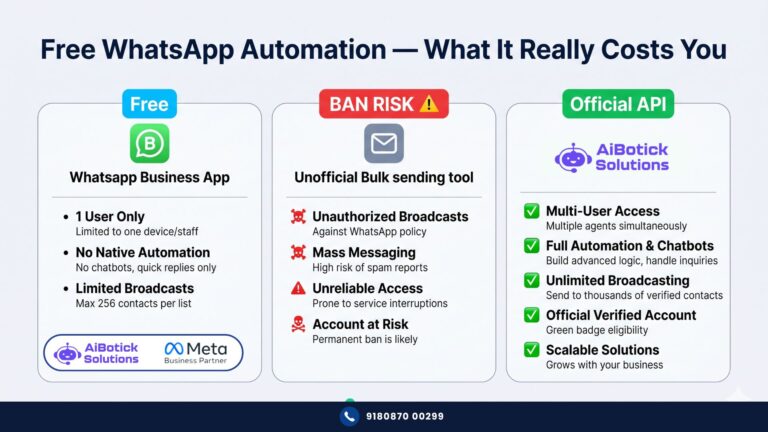
WhatsApp Business App is a free mobile app for very small businesses — one user, one device, no automation, no chatbots, no shared inbox. WhatsApp Business API is the enterprise-grade infrastructure that enables multi-agent inboxes, AI chatbots, bulk broadcasting, CRM integration, payment gateways, and full automation. Businesses with more than a handful of daily customer conversations need the API — not the app.
Q3: How do WhatsApp API providers charge — what costs should I expect?
WhatsApp API providers typically charge a platform subscription fee (monthly, quarterly, or annually) plus Meta’s conversation charges, which are billed directly by Meta based on the number and type of conversations. Platform fees in India range from Rs.4,000/quarter to Rs.60,000/year depending on the provider and plan. Meta charges are separate and vary by conversation category (marketing, utility, service, authentication). Always ask providers to separate these two costs clearly before comparing pricing.