WhatsApp automation benefits — sabse zyada jo cheez Indian businesses miss karti hain, woh yeh hai ki unhe pata hi nahi kitna miss out raha hai.
Okay real talk.
Nobody wakes up one morning and thinks — “aaj main WhatsApp automation khareedunga.”
It doesn’t work like that.
What actually happens is slower. Quieter. More painful.
It starts with one missed lead. Then two. Then your sales guy goes on leave and suddenly nobody’s responding to enquiries for three days. Then a client complains they messaged you at 9pm and heard nothing until next afternoon. Then your support person quits and takes three months of customer conversation history with them on their personal phone.
And somewhere in the middle of all that chaos — you think, “yaar, kuch toh karna padega.”
This article is for that moment.
Not a sales pitch. I’m genuinely not going to tell you to buy anything right now.
I’m going to give you 10 signs — real, specific, honest signs — that your business has outgrown manual WhatsApp. If 3 of these match your situation right now — you need automation. Simple as that.
Let’s go.
Sign #1 — You’ve Missed Leads Because Nobody Was Online
Bhai, this one hurts. Because you never fully know how much it’s costing you.
A lead messages at 8:30pm. Your team logs off at 7. Lead waits. Sees no response. Moves on — finds a competitor who has a bot running, gets an instant reply, books a demo, done.
You wake up next morning, reply at 9am. They politely say “we’ve already gone with someone else.”
This isn’t rare. This happens every single night in businesses across India.
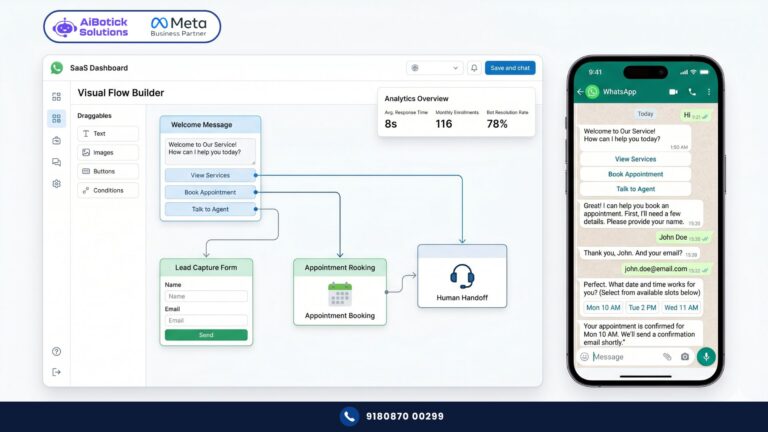
Here’s the brutal truth — the businesses winning on WhatsApp right now aren’t necessarily better than you. They’re just faster. A bot that responds in 8 seconds at 11pm beats your best salesperson responding at 9am. Every time.
If you’ve lost even one lead this way — actually, scratch that. If you’ve even SUSPECTED you’ve lost leads this way — Sign #1 is yours.
Sign #2 — Your Team is Answering the Same 5 Questions. Daily. On Loop.
“What are your timings?” “How much does it cost?” “Do you deliver to [area]?” “What’s the process to get started?” “Can I get a brochure?”
Sound familiar?
Now — I want you to actually calculate something. Take 5 minutes and do this properly.
How many times per day does your team answer these questions? Let’s say 30 times. Each reply takes 3-4 minutes. That’s 90-120 minutes per day. Per person.
Annually — that’s 30-40 working days per person. Just answering the same questions. Over and over. Questions a bot could handle in 8 seconds.
That’s not a people problem. That’s a systems problem.
And it’s not just the time. It’s the energy. The context switching. The mental fatigue of repetitive tasks — which quietly kills your team’s ability to do the high-value work only humans can do. Closing deals. Building relationships. Solving complex problems.
If your team is spending hours every day on questions a bot can answer — Sign #2 is yours.
Sign #3 — Customer Data Lives on Personal Phones
Okay. This one is a slow-burning disaster. And most businesses don’t realise it until it explodes.
Your sales executive has been chatting with 200 customers on his personal WhatsApp for 8 months. Every conversation. Every negotiation. Every promise made to a client. Every complaint received.
He resigns.
Takes his phone. Takes his number. Takes every single one of those 200 conversations with him.
You have no record. No history. No idea what was promised to which client. No way to follow up. No data. Nothing.
I’ve seen this destroy client relationships that took years to build. I’ve seen businesses lose enterprise accounts because the new person had zero context on an ongoing negotiation.
And the worst part? The outgoing employee isn’t even doing anything wrong. It’s their personal phone. Their personal number. You gave them no alternative.
If your business WhatsApp conversations live on personal phones — Sign #3 is yours. And this one isn’t just a growth problem. It’s a serious business risk.
Want to understand what a proper WhatsApp system looks like? Read our plain-English guide to WhatsApp automation.
Sign #4 — Your Response Time is More Than 30 Minutes
Here’s a stat that should make every sales person uncomfortable.
Studies consistently show — and this matches everything I’ve seen in 15 years — that lead conversion probability drops by 80% after the first 5 minutes.
Five minutes.
Not 30. Not an hour. Five minutes.
Now — what’s your current average WhatsApp response time? Be honest. Not your best day. Your average day.
If it’s more than 30 minutes — you’re working with maybe 20% of the conversion potential of every lead that comes in.
That’s not a team problem. Your team is trying. They’re human. They have other tasks, lunch breaks, meetings, bad days.
A bot has none of those. It responds in seconds. At 3am. During Diwali. When your entire team is at the office party.
If leads are waiting more than 30 minutes for a response — Sign #4 is yours.
Sign #5 — You Have No Idea Who Messaged You Last Week
Quick question. No Google Sheets allowed.
How many new enquiries did you get on WhatsApp last Tuesday?
How many were followed up? How many converted? How many went cold?
If you’re staring at the screen right now — Sign #5 is yours.
Manual WhatsApp is a black hole for data. Messages come in. Some get replied to. Some get forgotten. No log. No report. No visibility.
You can’t improve what you can’t measure. And you can’t measure a personal WhatsApp chat history.
This matters more than most founders realise. Because without data — you’re flying blind on your most important customer communication channel. You don’t know your busiest hours. You don’t know your most common enquiry type. You don’t know which campaign generated the most responses.
A proper WhatsApp automation platform gives you all of this. Every conversation logged. Every campaign tracked. Every agent’s response time measured. Clean data. Actionable insights.
Agar aapko pata hi nahi ki WhatsApp pe kya ho raha hai — Sign #5 is 100% yours.
Sign #6 — Your Team Uses Multiple Personal Numbers for Business
Raise your hand if this is you. 🙋
Sales executive 1 — personal number. Sales executive 2 — different personal number. Support person — their own number. Sometimes the founder steps in — fourth number.
Customer messages one number. Gets transferred to another. Explains the problem again. Gets transferred again.
It’s chaos. But it’s such common chaos that most businesses have normalised it.
Here’s what this actually looks like from the customer’s side — they feel like they’re dealing with a disorganised, unprofessional operation. Even if your product is excellent. Even if your team is trying hard.
First impressions on WhatsApp are formed fast. A customer messaging three different numbers trying to get one answer? That impression sticks.
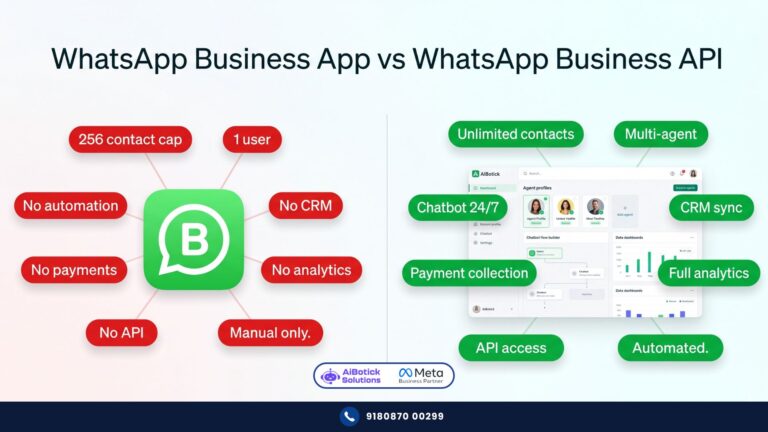
WhatsApp Business API gives your entire team — however many people — one single business number. All chats visible in one shared inbox. Any agent can pick up any conversation. Context travels with the chat. Customer sees one professional identity.
If your business has more than one WhatsApp number floating around — Sign #6 is yours.
Sign #7 — You’re Running Campaigns Manually
Okay. This one is exhausting just to describe.
You have a Diwali sale coming up. 2,000 customers to notify.
What happens in a manual setup?
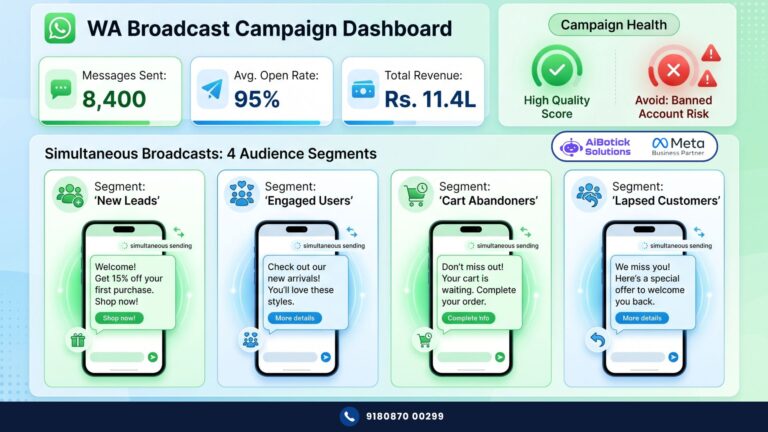
Someone sits down. Opens WhatsApp. Selects contacts one by one — or creates a broadcast list of 256, sends, creates another list of 256, sends, repeat. For hours. While manually checking who already got the message. While accidentally sending duplicates to some people. While completely missing others.
And after all that effort — the broadcast list only reaches people who have your number saved. So maybe 40% of your 2,000 actually get it.
Total time: 3-4 hours minimum. Total reach: 800 people if you’re lucky.
With automation: Upload your list. Write your message. Schedule it. Click send. 2,000 people get a personalised message — “Hi [Name], here’s your exclusive Diwali offer” — in under 10 minutes. While you’re having chai.
If you’re manually managing any kind of broadcast campaign — Sign #7 is yours. And honestly, your team deserves better.
See how WhatsApp open rates make broadcasting a completely different game. Read this.
Sign #8 — Follow-Ups Depend on Someone Remembering to Follow Up
Ek second. I need you to really sit with this one.
How does follow-up work in your business right now?
Someone enquires. Your team replies. Lead says “let me think about it.” Team member makes a mental note — or maybe writes it in a diary, or puts a reminder on their phone — to follow up in 3 days.
3 days later — they’re in back-to-back meetings. Reminder fires. They dismiss it — “I’ll do it after this call.” Forget. Lead goes cold. Deal lost.
This isn’t a discipline problem. This is a human problem. Humans forget. Humans get busy. Humans have bad days.
Automation doesn’t forget. Ever.
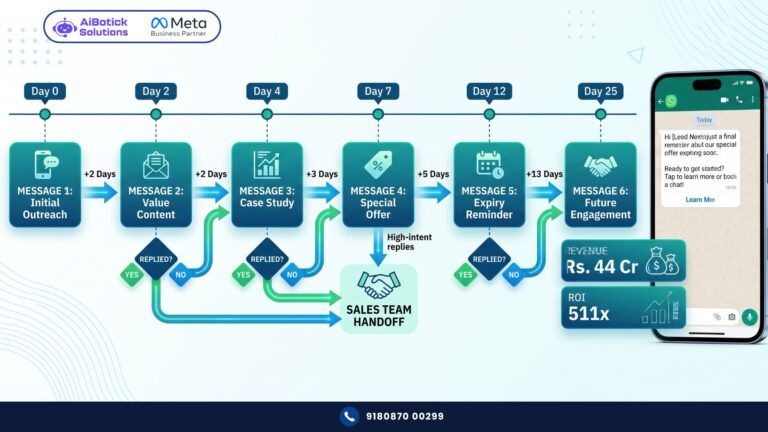
Set up a follow-up sequence once — Day 1 message, Day 3 message, Day 7 message, Day 14 final nudge. The system runs it. For every single lead. Forever. Without anyone remembering to do anything.
I’ve seen businesses recover 20-25% of “dead” leads purely by implementing automated follow-up sequences. Leads their team had given up on. Sitting there in the database. Just needing one more nudge at the right time.
If follow-up in your business depends on someone remembering — Sign #8 is absolutely yours.
Sign #9 — You’ve Had a Client Complaint About Slow Response
Just one. Even one.
Because for every client who actually complained — there are probably 10 who said nothing, quietly got frustrated, and either didn’t renew or didn’t refer anyone.
That’s the dangerous part about slow response complaints. The ones you hear are the tip of the iceberg. The ones you never hear — the silent churns, the referrals that never happened, the upsells that were never attempted because the relationship went cold — those are the real cost.
A 2-hour response time feels okay internally. “We’re a small team, we’re doing our best.”
From the customer’s side — especially a customer paying Rs.50,000+ a year — 2 hours feels like being ignored. Especially when their competitor’s vendor responds in 8 minutes.
If you’ve had even one complaint about response time in the last 6 months — Sign #9 is yours. And it’s worth taking seriously.
Sign #10 — You’re Planning to Hire More Support Staff to Handle WhatsApp Volume
Matlab — your solution to “too many WhatsApp messages” is “hire another person.”
I understand the instinct. It feels like the safe, logical answer. More volume = more people.
But think about what you’re actually signing up for:
Rs.15,000-25,000/month salary. Plus PF. Plus training time. Plus the 3 months before they’re actually productive. Plus the risk they leave in 6 months and you start over.
And that new hire can handle maybe 80-100 chats a day. Works 8 hours. Takes weekends off. Goes on leave. Has bad days.
A WhatsApp automation platform handles 500+ conversations simultaneously. 24×7. 365 days. No salary. No leave. No resignation letter.
The math isn’t even close.
Hiring to handle volume is the right answer when the problem needs human judgment. It’s the wrong answer when the problem is repetitive, predictable, automatable queries.
If your instinct is “we need to hire someone for WhatsApp” — Sign #10 is yours. And before you post that job listing, give automation 30 days first.
So — How Many WhatsApp Automation Benefits Apply to You?
Be honest with yourself.
- 1-2 signs: You’re managing okay. Keep an eye on this as you grow.
- 3-4 signs: You’re leaving money on the table. Not dramatically — but consistently, every day.
- 5-7 signs: Manual WhatsApp is genuinely hurting your business. This needs to change in the next 30-60 days.
- 8-10 signs: Yaar — kab se wait kar rahe ho? Every day of delay is a measurable cost.
One Last Thing
I’ve seen businesses look at this list and think — “haan sab sahi hai, but humara business different hai.”
It’s not. I promise.
In 15 years — across ecommerce, education, real estate, healthcare, travel, finance, manufacturing — the problems are the same. The scale is different. The industry is different. The solution is the same.
If you want to see what fixing even 3 of these signs actually looks like for your specific business — what gets automated, how it’s set up, what it costs, what the realistic ROI looks like — just tap below. 👇
Honest conversation. No scripts. No pressure. Just two people figuring out if this makes sense for you.
— Mohit Shah | 15+ years Learning & Growing | Now helping businesses figure out what actually works
Q1: How do I know if my business needs WhatsApp automation?
A1: If you’re missing leads outside business hours, your team is answering the same questions repeatedly, you have more than 50 customer conversations per day, or your response time is over 30 minutes — you need WhatsApp automation. Any 3 of these signs together means manual WhatsApp is actively costing you money.
Q2: Is WhatsApp automation only for large businesses?
A2: No. Any business with consistent customer enquiries benefits — even a 5-person team. The moment manual replies start slowing you down or causing missed leads, automation pays for itself. Most businesses that automate recover the platform cost within the first month from leads they would’ve otherwise lost.
Q3: What happens if I don’t automate my WhatsApp?
A3: You keep losing leads to faster competitors, burning out your team on repetitive tasks, and leaving revenue on the table every single day. Manual WhatsApp scales with headcount — meaning every new customer requires a new person. Automation breaks that equation entirely.