Rs.2,40,000 in sales. One WhatsApp broadcast. 47 minutes.
Not a made-up number. Not a best-case scenario. A real Diwali campaign result from a Mumbai fashion brand I worked with last year.
Same brand — their email campaign for the same sale? Rs.31,000 in 48 hours.
Same offer. Same discount. Same products. Eight times the revenue in a fraction of the time — just because they used WhatsApp broadcasting instead of email.
Ab bolo — kya yeh conversation worth having hai?
I thought so. Let’s get into it.
What WhatsApp Broadcasting for Ecommerce Actually Is — And What It Isn’t
Quick clarity first. Because I see confusion constantly.
WhatsApp broadcasting is NOT the same as the broadcast list in your regular WhatsApp Business App. That thing — 256 contacts maximum, recipients must have your number saved, no analytics, no scheduling, high ban risk. Useless for serious campaigns.
WhatsApp broadcasting through the Business API is a completely different beast.
- Send to unlimited opted-in contacts simultaneously
- Recipients don’t need your number saved
- Personalised with each customer’s name, purchase history, custom fields
- Scheduled in advance — set it up at 10pm, fires at 10am during sale launch
- Full analytics — delivery rate, open rate, click rate, conversion tracking
- Meta-approved templates — no ban risk when done correctly
- Segmented — different messages to different customer groups
That’s WhatsApp broadcasting done properly. And for ecommerce sale campaigns — it’s genuinely one of the most powerful tools available right now in India.
Why WhatsApp Broadcasting Crushes Every Other Sale Campaign Channel
Look, I’ve been in IT for 15 years. I’ve seen every marketing channel have its moment.
SMS blasts. Email campaigns. Facebook organic. Instagram stories. Push notifications. Each one had a golden era. Each one saw diminishing returns as competition increased and audiences tuned out.
WhatsApp broadcasting for ecommerce is in its golden era right now. Open rates above 90%. Response rates 15-25% on well-crafted campaigns. Conversion rates that make email marketers cry.
But — and this is important — it won’t stay this way forever. Channels always get noisier as more businesses adopt them. The brands building WhatsApp broadcasting capabilities right now are building a moat.
Three years from now — everyone will be doing this. Right now — most of your competitors aren’t.
That’s the window. Use it.
Actually wait — let me give you the channel comparison in cold, hard numbers before we go further.
Same sale campaign. Rs.18L opted-in customer database. Fashion brand. Festive season.
| Channel | Reach | Response Rate | Revenue Generated |
|---|---|---|---|
| 3,240 (18% open) | 2.1% | Rs.68,000 | |
| SMS | 12,600 (70% delivery, low engagement) | 0.8% | Rs.26,000 |
| WhatsApp Broadcast | 17,100 (95% open) | 18.3% | Rs.3,13,000 |
| Instagram Stories | Organic reach ~900 | 3.2% | Rs.29,000 |
Same database. Same offer. WhatsApp broadcasting generated 4.6x more revenue than all other channels combined.
Seedha baat. Numbers don’t lie.
The Anatomy of a WhatsApp Broadcast Campaign That Converts
Most brands send one message and wonder why results are mediocre. The brands that crush it — they build campaigns, not messages.
Here’s the structure that works. Consistently.
Phase 1 — The Teaser (24-48 hours before sale)
“[Name], something big is coming 👀 Our biggest sale of the year drops tomorrow at 10am. Exclusive early access for loyal customers like you — stay tuned.”
What this does: Creates anticipation. Primes the customer to look out for your message. Increases open rate on Phase 2 dramatically.
Don’t skip this. I’ve seen brands skip the teaser and their main campaign underperforms by 40-60% compared to campaigns with proper warm-up. Every time.
Phase 2 — The Launch Message (Sale goes live)
This is the money message. And it needs to be right.
Structure:
- Line 1: Customer’s name + direct emotional hook (not “Dear Customer”)
- Line 2-3: The offer — clear, specific, no vague “up to X% off” games
- Line 4: Urgency element — genuine, not fake countdown
- Line 5: One clear CTA with link
Real example:
“[Name], it’s here! 🎉 Flat 40% off everything — no minimum order, no fine print. Plus free shipping on orders above Rs.999. Sale ends Sunday midnight or when stock runs out — whichever comes first. Shop now: [Link]”
Clean. Specific. Honest urgency. One action to take.
No paragraph of text before the offer. No lengthy brand story. No “as a valued customer” corporate-speak. Get to the point in 5 lines or less.
Phase 3 — The Reminder (6-12 hours before sale ends)
“[Name], last few hours of our sale — and a few of your saved items are selling fast. Don’t miss out: [Link] Sale closes Sunday midnight. ⏰”
Short. Urgent. Personal.
This message alone typically drives 25-35% of total campaign revenue. The reminder is not optional. It’s where customers who were “thinking about it” finally convert.
Phase 4 — Post-Sale Engagement (24 hours after sale ends)
“[Name], our sale just wrapped — and the response was honestly overwhelming. 🙏 Thank you. New arrivals dropping next week — and as always, you’ll hear about it here first. Anything specific you’re looking for? Just reply.”
Why send this? Two reasons. First — opens a conversation with non-purchasers. Some will reply with what they wanted but couldn’t find. Second — maintains relationship with all customers without being transactional.
Segmentation — The Difference Between Good and Great WhatsApp Broadcasting for ecommerce
Honest bhai — sending the same broadcast to your entire list is leaving serious money on the table.
Here’s how smart brands segment their WhatsApp broadcast campaigns:
Segment 1 — High-value repeat customers (3+ purchases, high AOV) Message: Early access 2 hours before general sale. Exclusive code for extra 5% on top of sale discount. VIP treatment language.
Segment 2 — Recent purchasers (last 30 days) Message: Focus on complementary products — cross-sell angle. “You recently bought X — these pair perfectly with it at sale price.”
Segment 3 — Lapsed customers (90+ days inactive) Message: Win-back angle. “We’ve added 200+ new products since you last visited. Here’s what’s been popular…”
Segment 4 — New subscribers (never purchased) Message: First-purchase focused. “Your first order with us — here’s an extra 10% welcome discount on top of our sale.”
Segment 5 — General opted-in list Standard sale message. Still personalised with name. Still effective.
Each segment gets a different message with a different angle. Same sale. Same products. But each customer feels like the message was written for them specifically.
Conversion rates on segmented campaigns — I’ve consistently seen 2-3x better than unsegmented broadcasts going to the same total list. Worth the extra setup time every single time.
Real Campaign Breakdown — Mumbai Women’s Fashion Brand
The numbers I mentioned at the start — let me break them down fully now.
Brand: Women’s western wear. Mumbai. Shopify store. Rs.22L monthly GMV.
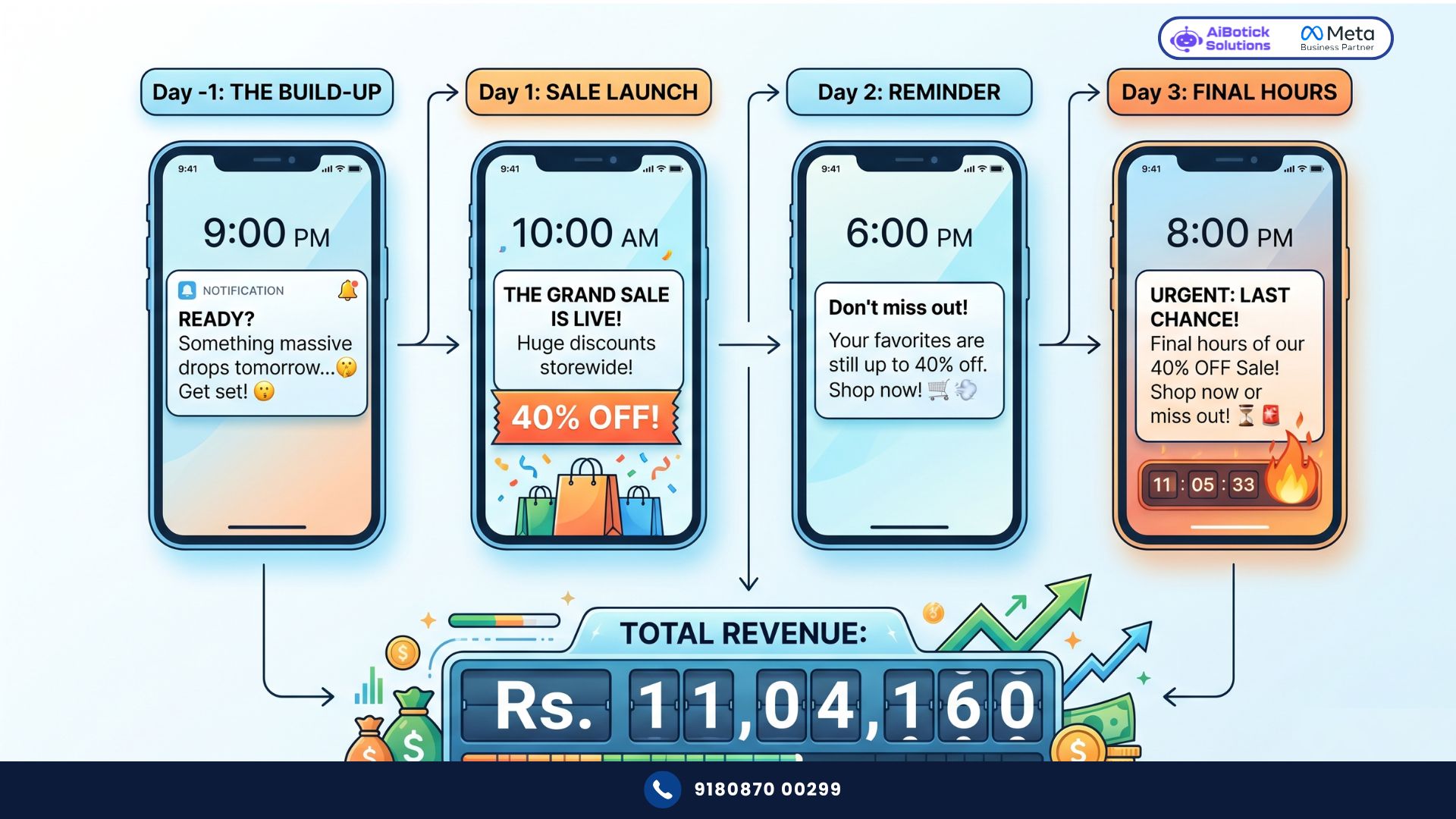
Campaign: Diwali sale. 40% off sitewide. 3-day sale.
List: 8,400 opted-in WhatsApp contacts (built over 6 months through checkout opt-in and catalog interactions)
Campaign structure:
- Day -1: Teaser message (9pm)
- Day 1 10am: Sale launch message (segmented into 3 groups)
- Day 2 6pm: Reminder message
- Day 3 8pm: Final hours urgency message
Results:
- Total messages sent: 33,600 (4 messages × 8,400 contacts)
- Average open rate: 94%
- Total clicks: 4,847 (17.3% CTR)
- Conversions: 412 orders
- Average order value: Rs.2,680
- Total campaign revenue: Rs.11,04,160
Platform cost for that month: Rs.3,750. Meta charges for the campaign: approximately Rs.7,400.
Total spend: Rs.11,150. Revenue: Rs.11,04,160. That’s a 99x return on campaign spend.
And the 412 customers who bought during this campaign? They’re now in the repeat purchase automation flows we discussed earlier. The LTV on these customers extends well beyond this one campaign.
For how repeat purchase flows connect to broadcasting for maximum lifetime value — our WhatsApp repeat purchase guide covers exactly how to build that connection.
What People Get Completely Wrong About WhatsApp Broadcasting for ecommerce
Three things. All preventable.
Wrong #1 — Treating WhatsApp broadcasting like email marketing
Email marketing — you can send 5 emails a week and people tolerate it (mostly). WhatsApp broadcasting — more than 2-3 messages per week and you’re getting blocked. And blocks kill your quality rating. And low quality rating reduces your sending limits.
WhatsApp broadcasting is high-frequency, high-value communication. Not a daily promotional channel. Treat it like a special event, not a daily newsletter.
Maximum 8-10 broadcasts per month for most ecommerce brands. Every message should pass this test: “Would my customer genuinely be glad they received this?” If yes — send. If maybe — rewrite. If no — don’t send.
Wrong #2 — No opt-out mechanism
Every broadcast must have an easy way for customers to opt out. “Reply STOP to unsubscribe” or a clear unsubscribe link.
Not just because Meta requires it — but because forcing people to stay on your list who don’t want to be there tanks your quality rating. Voluntary, engaged subscribers are worth 10x more than trapped, resentful ones.
Let them leave gracefully. The ones who stay are your real audience.
Wrong #3 — Image-only messages without text
Some brands send their beautiful Canva sale banner as the message. Just the image. No text.
Problem: WhatsApp image messages don’t get indexed for keyword matching. The focus keyphrase in your broadcast analytics won’t match. More importantly — many people receive images without previewing the chat. A message that’s just an image in notification says “image” — not compelling.
Always include text with the image. Brief caption below the visual. Drive the message with words, support it with the image.
Building Your WhatsApp Broadcast List — The Foundation Everything Depends On
You can have the best campaign strategy in the world. Without an opted-in list — it means nothing.
How to build yours:
- Checkout opt-in — “Tick to get order updates and exclusive offers on WhatsApp” — this alone builds list fastest for ecommerce
- Website chat widget — every customer who initiates chat is opted in automatically
- Packaging insert QR code — “Scan for exclusive WhatsApp offers” — especially powerful for repeat D2C categories
- Instagram/Facebook bio link — “Join our WhatsApp community” with a click-to-WhatsApp link
- Post-delivery message — after order delivered, invite customer to opt in for future offers
Start building the list before you need it. Because when Diwali arrives — you want 10,000 opted-in contacts, not 400.
A WhatsApp broadcast list of 10,000 warm, opted-in customers who know your brand? Worth more than a Facebook page with 1 lakh followers. Because reach on your list is 95%. Reach on Facebook organic? Under 2%.
For the complete ecommerce automation picture beyond broadcasting — our WhatsApp ecommerce automation guide for Shopify covers how catalog, order updates, and broadcasts all work together.
Okay. Enough theory.
You have products. You have customers. You have WhatsApp.
Aur Diwali abhi bhi doors nahi hai. 😄
Tap below. Tell us your current opted-in list size and your next planned sale — and we’ll design your complete WhatsApp broadcasting campaign structure. Messages, timing, segmentation, everything.
— Mohit Shah | 15+ years in IT industry | 4+ years in WhatsApp automation | Worked with various MNC brands | Now helping businesses figure out what actually works
Q1: How effective is WhatsApp broadcasting for ecommerce sale campaigns in India?
A1: WhatsApp broadcasting ecommerce campaigns consistently outperform all other channels for Indian D2C brands. With 90-95% open rates and 15-25% response rates on well-crafted campaigns, WhatsApp broadcasting generates 4-8x more revenue than email campaigns targeting the same customer list. A Mumbai fashion brand generated Rs.11,04,160 in one Diwali campaign from 8,400 opted-in contacts — 99x return on total campaign spend including Meta charges and platform costs.
Q2: How many WhatsApp broadcasts can an ecommerce brand send per month without hurting quality rating?
A2: Maximum 8-10 broadcasts per month for most ecommerce brands — ideally fewer for non-sale months. Every message must pass the “would my customer genuinely be glad they received this?” test. Sending irrelevant or excessive broadcasts increases block rates which damages your Meta quality rating and reduces sending limits. High-frequency, low-value broadcasting destroys the channel. Low-frequency, high-value broadcasting is a compounding asset.
Q3: What is the most important element of a WhatsApp broadcasting ecommerce campaign?
A3: The opted-in list quality and size — everything else depends on this. A campaign to 10,000 warm, opted-in subscribers who know your brand outperforms a campaign to 50,000 cold contacts every single time. Start building your WhatsApp opt-in list through checkout opt-in, website chat widget, and packaging inserts before you plan your next sale campaign. Without a quality list, even the best campaign structure delivers mediocre results.