India’s D2C boom is real.
Brands built in bedrooms are doing crores. Shopify stores launching every week. Competition brutal. Margins thin. Customer acquisition costs going up every quarter.
And yet — most Shopify store owners are still managing customer communication the same way they did in 2019. Email newsletters. Manual WhatsApp replies from a personal number. Maybe an SMS here and there.
Yaar, I’ve spent 15 years in IT and the last 3 years specifically in WhatsApp automation. And the gap between what Shopify + WhatsApp can do together versus what most Indian D2C brands are actually doing — it’s genuinely shocking.
So let’s fix that today. Everything you need to know about WhatsApp for Shopify — what’s possible, how it works, what it costs, and what results to realistically expect.
Why Shopify + WhatsApp Is Such a Powerful Combination
Shopify is where your products live. WhatsApp is where your customers live.
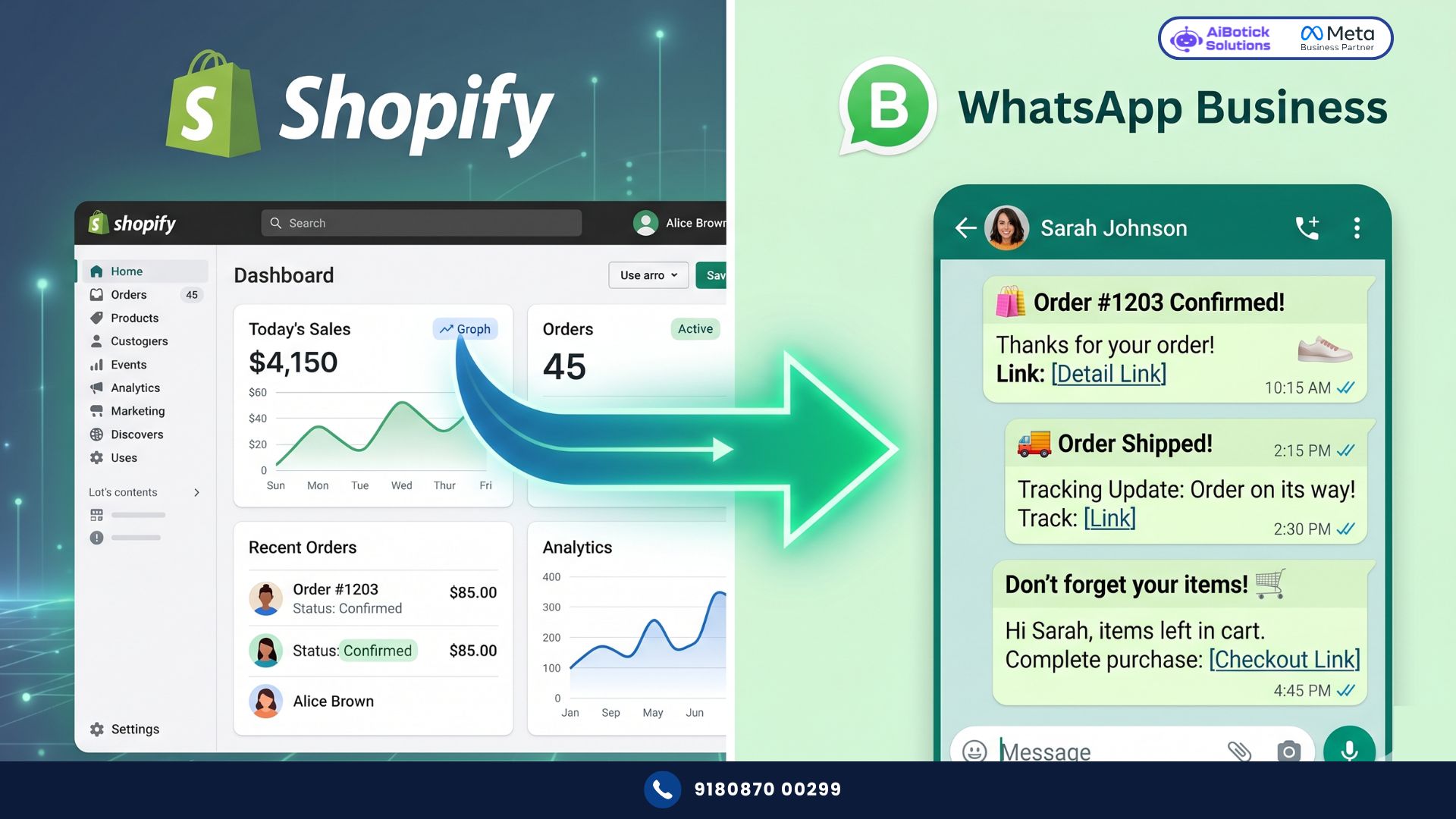
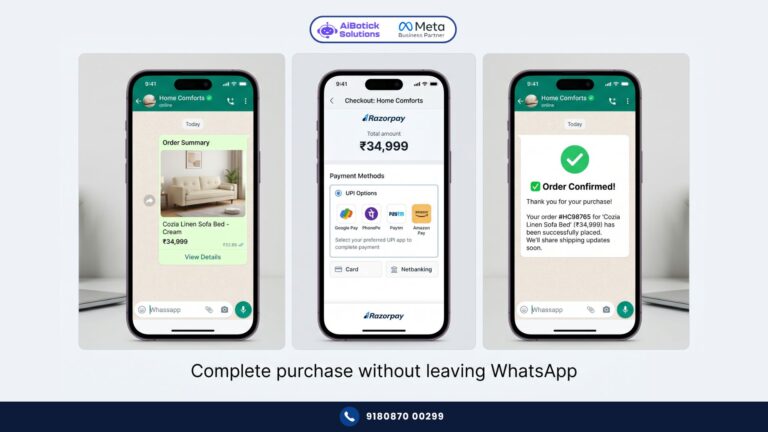
Connecting both means — every significant event in your store automatically triggers a relevant, personalised WhatsApp message to your customer. No manual work. No delays. No missed communication.
Think about every touchpoint in a customer’s journey with your Shopify store:
- Browsing without buying → abandoned cart recovery
- Placing an order → order confirmation
- Order shipped → shipping update with tracking link
- Order delivered → delivery confirmation + review request
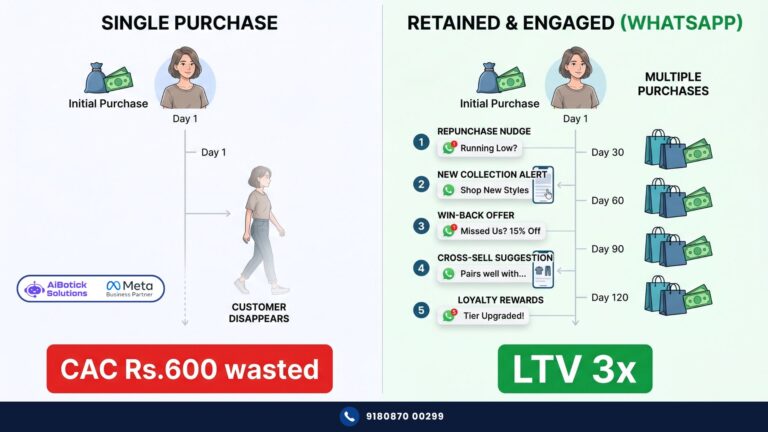
- 30 days later → repurchase nudge
- New collection launch → broadcast to past customers
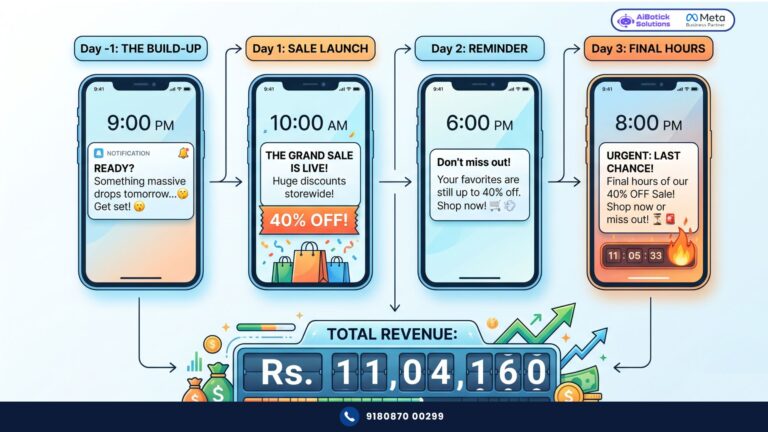
- Flash sale → broadcast to opted-in subscribers
Every single one of these — automated. Running 24×7. Without your team lifting a finger.
That’s WhatsApp for Shopify done right.
What Actually Gets Integrated — The Technical Reality (Simply Explained)
No jargon. Promise.
When you connect your Shopify store to AiBotick’s WhatsApp platform — Shopify’s webhook system sends real-time signals to AiBotick every time something happens in your store. Order placed. Payment received. Shipping updated. Cart abandoned.
AiBotick receives that signal and fires the right WhatsApp message to the right customer at the right time. Automatically.
Your customer gets a WhatsApp — not a generic template, but a personalised message with their name, their order details, their tracking link.
No coding required on your end. AiBotick’s Shopify integration is native — meaning it’s designed to connect in minutes, not days. And our onboarding team walks you through it step by step.
Actually wait — let me give you the full list of what gets connected, because this is where it gets impressive.
Everything WhatsApp for Shopify Can Do — Complete List
Order Management:
- ✅ Instant order confirmation on WhatsApp (replaces or supplements email)
- ✅ Payment confirmation message
- ✅ Order processing update
- ✅ Shipping confirmation with tracking link
- ✅ Out for delivery notification
- ✅ Delivered confirmation + review request
Abandoned Cart Recovery:
- ✅ 3-message recovery sequence (30 min, 24 hrs, 48-72 hrs)
- ✅ Personalised with customer name and product name
- ✅ Direct cart link for one-tap return to checkout
- ✅ Auto-stop when purchase completes
COD Verification:
- ✅ Instant WhatsApp after COD order — “Confirm your order? Reply YES or NO”
- ✅ Dramatically reduces RTO (Return to Origin) rates
- ✅ Saves reverse logistics costs on unconfirmed orders
Customer Support:
- ✅ Shared team inbox — all customer queries in one place
- ✅ Bot handles common questions (order status, return policy, sizing)
- ✅ Human handoff for complex queries
- ✅ 24×7 availability without 24×7 staffing
Marketing Campaigns:
- ✅ Broadcast to opted-in customers — new collection, sale, restock alerts
- ✅ Segmented campaigns — send different messages to different customer groups
- ✅ Personalised offers based on purchase history
- ✅ Festive campaign scheduling — plan Diwali, Holi, EOSS campaigns in advance
Post-Purchase:
- ✅ Review and rating request after delivery
- ✅ Repurchase nudge at right interval (based on product type)
- ✅ Cross-sell and upsell based on what they bought
- ✅ Loyalty and referral programme messages
Real Numbers — What a Shopify Brand Actually Experienced
Mid-size D2C skincare brand. Bangalore. Doing Rs.18L GMV per month on Shopify.
Before WhatsApp integration:
- Cart abandonment rate: 72% — recovering 4% via email = Rs.51,840/month recovered
- COD orders: 45% of total — RTO rate 23% — losing Rs.1.86L/month to RTOs
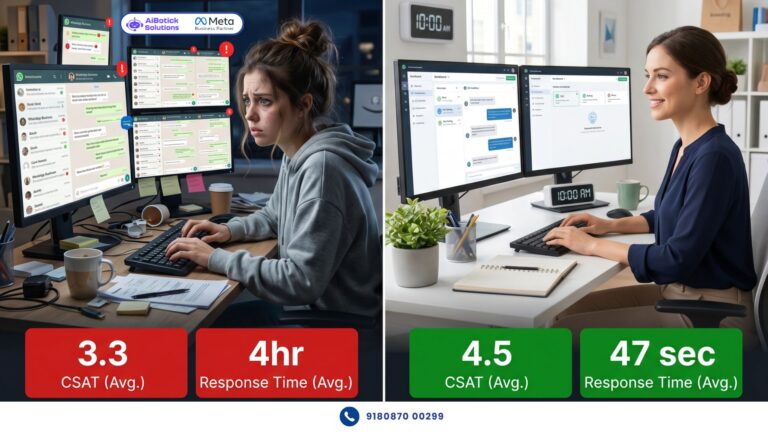
- Customer support: 2 people handling WhatsApp + email manually, 3-4 hour response time
- Repeat purchase rate: 18% within 90 days
After 90 days of WhatsApp for Shopify:
- Cart recovery via WhatsApp: 12% — Rs.1,55,520/month recovered (3x improvement)
- COD RTO rate dropped to 9% after WhatsApp confirmation flow — saving Rs.1.24L/month
- Support response time: under 8 minutes (bot handling 65% of queries)
- Repeat purchase rate: 27% within 90 days (repurchase nudge flow driving this)
Combined monthly impact: Rs.2,79,000+ additional value.
Platform cost: Rs.45,000/year = Rs.3,750/month.
That’s a 74x monthly return. From one integration.
WhatsApp for Shopify vs What You’re Doing Now
Let me be direct here. Because most Shopify store owners fall into one of these three situations:
Situation 1 — Using only Shopify email notifications Shopify’s default email notifications are fine. But 20% open rates. Promotions tab. Ignored. You’re reaching 1 in 5 customers at best with every update.
Situation 2 — Personal WhatsApp number for customer support Someone on your team is handling customer queries from their personal phone. Data living on their device. No visibility for you. No backup when they leave. And they will leave.
Situation 3 — Some third-party bulk WhatsApp tool Already covered this in detail — here’s why bulk WhatsApp senders are a ban waiting to happen. Short version: don’t.
WhatsApp for Shopify via official API solves all three situations. Officially. Legally. Scalably.
What People Get Wrong About WhatsApp Shopify Integration
Honestly? The biggest myth I encounter is this:
“WhatsApp is for support. Email is for marketing. Keep them separate.”
No no, scratch that thinking entirely.
WhatsApp handles both — and handles both better than the alternatives. Your customer doesn’t care about your internal channel strategy. They care about convenience. They care about speed. They care about getting the right information at the right time.
A customer who gets their order update, their tracking link, their delivery confirmation, AND their support queries all resolved — on one WhatsApp thread — that’s a premium experience. Feels like talking to a brand that actually has their act together.
Second myth: “Setting up Shopify + WhatsApp integration requires a developer.”
It doesn’t. AiBotick’s native Shopify integration connects through a simple API key — no custom code, no developer needed. Our onboarding team has done this hundreds of times. Setup takes one session.
The COD Problem — WhatsApp Solves India’s Biggest Ecommerce Headache
Quick detour — because this is too important to skip for Indian ecommerce.
COD is 50-60% of orders for most Indian D2C brands. And COD RTO rates — where customer refuses delivery or is unavailable — are killing margins.
Average RTO cost in India: Rs.150-300 per returned order. Shipping forward + shipping back + restocking. For a brand doing 500 COD orders/month at 20% RTO — that’s 100 returns × Rs.200 = Rs.20,000/month straight to waste.
WhatsApp COD confirmation flow: immediately after order, customer gets “Confirm your order? Reply YES to confirm, NO to cancel.” Customers who would’ve refused delivery — cancel now. You save the forward shipping cost. Your RTO rate drops 40-60%.
That saving alone often covers the entire platform cost.
For the full financial picture on WhatsApp automation ROI — this breakdown shows exactly how to calculate your numbers.
How to Get Started — Exactly What to Do
Simple. Four steps.
Step 1: Get your WhatsApp Business API set up with AiBotick. Number verified, business profile live.
Step 2: Connect your Shopify store — AiBotick provides the integration. One session with our team. Done.
Step 3: Set up your priority flows first — abandoned cart recovery, order confirmation, COD verification. These give fastest ROI.
Step 4: Build your opted-in subscriber list — website chat widget, order confirmation opt-in, QR codes in packaging inserts. This becomes your most valuable marketing asset over time.
Start with these four. Everything else — broadcasts, post-purchase sequences, review requests — you add once the basics are running smoothly. Don’t try to do everything in week 1.
Toh yaar — agar aap Shopify pe ho aur WhatsApp integration abhi tak nahi ki hai — you’re leaving a very specific, very calculable amount of money on the table every single month.
The integration is not complex. The results are not theoretical. The ROI is fast.
Tap below. 👇 Tell us your store’s monthly GMV and we’ll show you exactly what WhatsApp for Shopify can recover and generate for your specific numbers.
— Mohit Shah | 15+ years Learning & Growing | Now helping businesses figure out what actually works
Q1: How does WhatsApp for Shopify integration work for Indian ecommerce brands?
A1: Shopify’s webhook system sends real-time signals to your WhatsApp platform whenever a key event occurs — order placed, payment received, cart abandoned, order shipped. The WhatsApp platform automatically fires personalised messages to the customer with their name, order details, and relevant links. No coding required. Native integrations connect in minutes with proper onboarding support.
Q2: What are the most important WhatsApp flows to set up first for a Shopify store?
A2: Start with three priority flows — abandoned cart recovery (30 min, 24 hr, 72 hr sequence), COD order confirmation (reduces RTO rates 40-60%), and order status updates (confirmation, shipping, delivery). These three generate the fastest ROI and improve customer experience immediately. Add broadcasts, review requests, and repurchase nudges once the basics run smoothly.
Q3: How much does WhatsApp Shopify integration cost for Indian D2C brands?
A3: Two costs — AiBotick platform fee (Scale plan at Rs.45,000/year is recommended for most D2C brands doing Rs.10L+ monthly GMV) plus Meta conversation charges paid directly to Meta (marketing messages ~Rs.0.86/conversation, utility messages ~Rs.0.115/conversation, inbound service conversations free). Most brands recover the full annual platform cost within the first 30-45 days from cart recovery and RTO reduction alone.