Cash on delivery is India ka sabse bada ecommerce paradox.
It’s the reason millions of first-time online shoppers trusted ecommerce at all. “Pay when it arrives” — that safety net built an entire industry.
But for the seller? COD is a nightmare.
High RTO rates. Reverse logistics costs. Inventory tied up in transit. Delivery boys wasting time on addresses where nobody shows up. And the worst — fake orders placed by people who never intended to pay.
I’ve worked with dozens of ecommerce brands over the last 3 years in WhatsApp automation. And COD verification on WhatsApp is consistently — consistently — one of the fastest ROI plays I’ve seen. Faster than abandoned cart recovery. Sometimes faster than any other automation combined.
Because you’re not trying to get a new customer. You’re just confirming the ones you already have.
Let me show you exactly how it works.
The Real Cost of Unverified COD Orders — Do This Math Right Now
Before anything else — calculate your actual COD losses. Most brands haven’t done this properly.
Take your last month’s numbers:
- Total COD orders placed
- RTO rate percentage (orders refused or undeliverable)
- Average forward shipping cost per order
- Average reverse shipping cost per order
- Average restocking / repackaging cost
Formula: (COD orders × RTO rate) × (forward shipping + reverse shipping + restocking) = Monthly COD loss
For a brand doing 600 COD orders/month at 20% RTO with Rs.180 forward + Rs.160 reverse + Rs.40 restocking:
120 returns × Rs.380 = Rs.45,600/month wasted.
Rs.5,47,200/year. Just on RTOs.
And that’s before counting the lost sale itself, the customer experience damage, and the time your team spends managing return logistics.
Ab bolo — is COD verification worth setting up? 😄
What Is COD Verification on WhatsApp — Exactly?
Simple concept. Powerful execution.
The moment a customer places a COD order on your store — within seconds, they get a WhatsApp message:
“Hey [Name]! 🎉 Your order #[Order ID] for [Product] worth Rs.[Amount] is confirmed at [Address].
Quick confirmation — reply YES to confirm delivery or NO to cancel. This helps us ensure smooth delivery for you!”
Customer replies YES — order proceeds to fulfilment. Normal process.
Customer replies NO — order cancelled before it ever reaches the warehouse. No forward shipping cost. No reverse logistics. Nothing wasted.
Customer doesn’t reply within 2-3 hours — optional follow-up message. After that — your team decides whether to call or cancel based on your business policy.
That’s COD verification on WhatsApp. Deceptively simple. Dramatically effective.
Why WhatsApp Works So Much Better Than Call Verification
Most brands doing COD verification are using phone calls. Calling customers to “confirm” the order.
Problems with call verification:
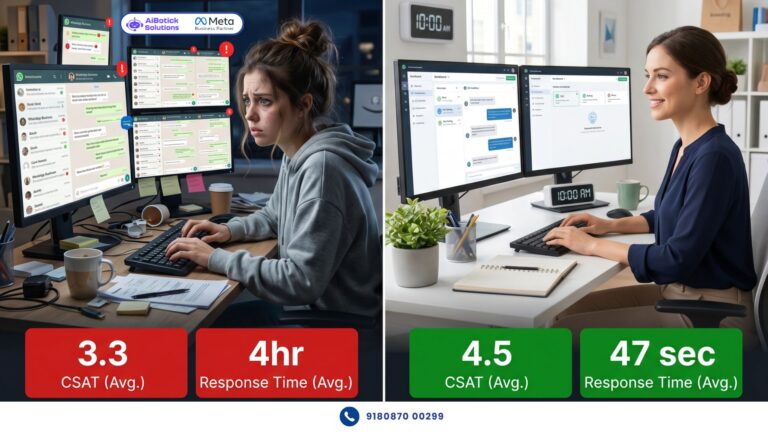
- Low pickup rates — Unknown numbers get ignored. Especially in metros. People don’t pick up calls from numbers they don’t recognise.
- Time intensive — Someone on your team spending 4-6 hours a day just calling customers. That’s a real salary cost for a manually intensive task.
- Customer friction — Being called to “confirm” an order feels intrusive to many customers. Especially within minutes of ordering.
- No record — Call happens, customer says yes, no written confirmation. If dispute arises later — no proof.
- Off-hours problem — Orders placed at 10pm. Nobody calling until next morning. By then customer may have changed their mind or ordered elsewhere.
COD verification on WhatsApp solves every single one of these:
- 95% open rate — WhatsApp message read within 5 minutes. Day or night.
- Fully automated — Zero team involvement until human intervention is actually needed
- Non-intrusive — Customer replies when convenient. Doesn’t feel like an interrogation.
- Written record — Every confirmation saved in your platform. Dispute-proof.
- 24×7 — Order at 11pm, WhatsApp fires at 11pm. Confirmed by midnight.
The Numbers — Ahmedabad Homeware Brand
Real example. No fluff.
Homeware and decor brand. Ahmedabad. WooCommerce store doing Rs.30L GMV/month.
COD orders: 62% of total = Rs.18.6L in COD GMV monthly. Pre-verification RTO rate: 24% = 4,464 units returned per month (approximate).
Actually wait — let me recalculate more accurately.
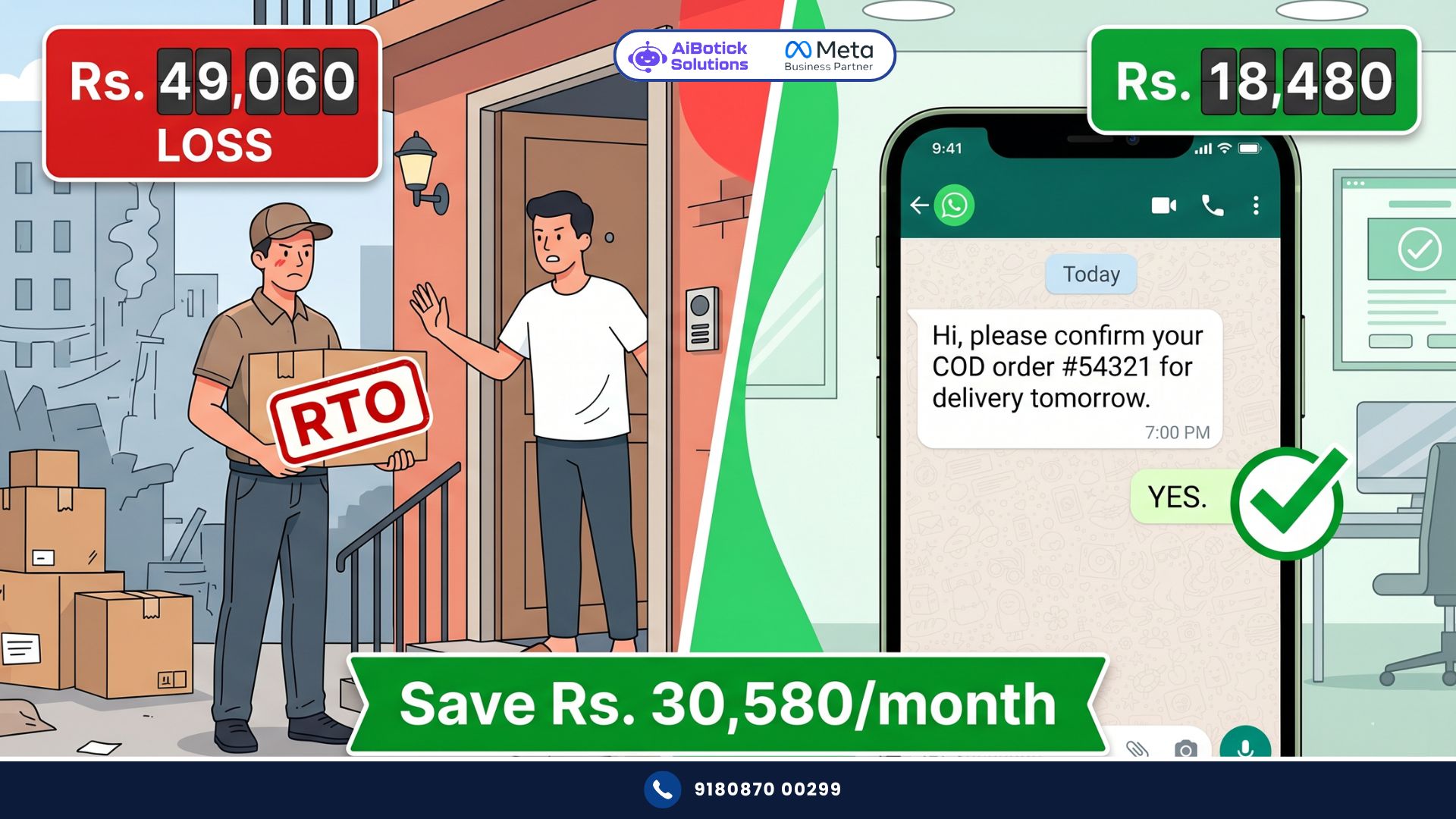
They were doing approximately 930 COD orders/month. RTO rate 24% = 223 returns. Reverse logistics cost average Rs.220/return = Rs.49,060/month in RTO losses.
After implementing COD verification on WhatsApp:
RTO rate dropped to 9% within 60 days. From 223 returns to 84 returns. Monthly RTO loss: Rs.18,480 — down from Rs.49,060.
Monthly saving: Rs.30,580. Annual saving: Rs.3,66,960.
Platform cost for the year: Rs.45,000.
That’s an 8x return just from COD verification alone. Before counting cart recovery, order updates, broadcast campaigns — everything else WhatsApp automation does.
Seedha baat — ek flow ne poora platform cost recover kar liya. 💯
How to Set Up COD Verification on WhatsApp — Step by Step
No developer needed. Here’s exactly what to do:
Step 1 — WhatsApp Business API setup Your number connected officially through AiBotick. Takes 24-48 hours including Meta business verification.
Step 2 — Connect your store WooCommerce or Shopify — both supported. Webhook connection through your store settings. AiBotick onboarding team does this with you.
Step 3 — Create the verification flow
In AiBotick’s flow builder:
- Trigger: COD order placed
- Delay: 0 minutes (fire immediately)
- Message: Personalised verification message with order details
- Response handling: YES → tag order as confirmed, NO → trigger cancellation workflow
Step 4 — Set up response routing
- Customer says YES → confirmation sent, order proceeds
- Customer says NO → cancellation message sent, store order status updated to Cancelled
- Customer says nothing in X hours → optional follow-up or team alert
Step 5 — Create Meta-approved template Your verification message needs Meta approval before sending. AiBotick helps draft and submit. Approval usually within a few hours.
Step 6 — Test with real order Place a test COD order. Watch the WhatsApp fire. Reply YES. Confirm order proceeds correctly. Go live.
Total setup time: one session with AiBotick team. Most brands live within 48 hours.
What People Get Wrong About COD Verification WhatsApp
Honestly? Two big mistakes I see.
Mistake 1 — Making the message sound like an interrogation
“Your order cannot be processed until you confirm. Reply CONFIRM within 1 hour or your order will be automatically cancelled.”
This feels threatening. Customer feels accused of being a fraudster. Even genuine customers get annoyed.
Right tone: helpful, friendly, confirmatory. Like you’re doing them a favour — making sure their order arrives correctly. Not like you’re suspicious of them.
Compare:
- ❌ “Confirm or we cancel” — aggressive
- ✅ “Just confirming your delivery details so everything goes smoothly!” — helpful
Same goal. Completely different customer experience.
Mistake 2 — Not having a cancellation workflow
Customer replies NO. Then what?
If your team has to manually go into the store and cancel the order — you’ve created a new manual process instead of removing one.
Build the full flow — customer replies NO → AiBotick automatically updates order status in WooCommerce/Shopify to Cancelled → customer receives cancellation confirmation on WhatsApp → team notified via dashboard alert.
Full automation. No manual steps. That’s the point.
For the complete picture on what WhatsApp automation does for ecommerce revenue beyond COD — our WhatsApp automation ROI guide breaks down every revenue stream with actual calculations.
COD Verification + Abandoned Cart Recovery — The Combination That Wins
Quick note — because these two flows together are where the real magic happens for Indian ecommerce.
Abandoned cart recovery handles people who almost bought but didn’t.
COD verification handles people who bought but might not actually want it.
Together — you’re recovering revenue from both ends of the leaky bucket. More people converting. Fewer orders returning.
I’ve seen brands implement both flows in the same week. Within 60 days — GMV impact is visible without increasing ad spend by a single rupee. Same traffic. Same products. Just better systems.
If you haven’t set up abandoned cart recovery yet — here’s the exact 3-message sequence that recovers 8-15% of abandoned carts for Indian ecommerce stores.
One Last Thing — International Customers and COD
If any portion of your business ships internationally or to NRIs — COD verification is even more critical.
International COD return costs are brutal. Rs.800-1,500 per returned shipment depending on destination. One bad COD order internationally can cost more than your platform subscription for a month.
WhatsApp verification works internationally too — as long as the customer has WhatsApp (which, globally, most do). Same flow. Same automation. Dramatically higher stakes.
Set this up before you scale internationally. Not after.
Ab seedha baat —
Agar aapka ecommerce store COD orders le raha hai — aur COD verification on WhatsApp abhi tak nahi set up ki — aap literally paise waste kar rahe ho. Every single day.
The math is not complicated. The setup is not complicated. The results are not slow.
Tap below. 👇 Tell us your monthly COD order volume and current RTO rate — we’ll calculate your exact monthly loss and show you what verification on WhatsApp can recover for your specific store.
— Mohit Shah | 15+ years in IT industry | 4+ years in WhatsApp automation | Now helping businesses figure out what actually works
Q1: What is COD verification on WhatsApp and how does it reduce RTO rates?
A1: COD verification on WhatsApp is an automated flow that fires a personalised WhatsApp message immediately after a COD order is placed — asking the customer to reply YES to confirm or NO to cancel. Customers who planned to refuse delivery cancel upfront, saving forward and reverse shipping costs. This single flow typically reduces COD RTO rates by 40-65% within 60 days of implementation.
Q2: How much can COD verification on WhatsApp save for an Indian ecommerce brand?
A2: Savings depend on COD order volume and current RTO rate. A brand doing 930 COD orders/month at 24% RTO was losing Rs.49,060/month in reverse logistics. After WhatsApp verification — RTO dropped to 9%, saving Rs.30,580/month = Rs.3,66,960/year. Most brands recover their entire annual platform cost within 45-60 days from COD verification savings alone.
Q3: Why is WhatsApp better than phone calls for COD order verification?
A3: Phone calls for COD verification have low pickup rates (unknown numbers get ignored), require manual team effort, create customer friction, and don’t work outside business hours. WhatsApp verification is fully automated, fires 24×7 immediately after order placement, gets 95% open rates, feels less intrusive, and creates a written confirmation record. Most customers respond within minutes — day or night.