I’m going to tell you something that’s bad for business.
Most WhatsApp automation projects fail. Not because the technology doesn’t work. Not because WhatsApp is the wrong channel. Not because the business was too small or the team wasn’t smart enough.
They fail because of three specific, entirely avoidable mistakes that I’ve watched businesses make — repeatedly, predictably, almost ritualistically — across four years of working in this space.
And the frustrating part? Every single one of these failures looked like success for the first 30 days.
That’s the dangerous part. WhatsApp automation feels like it’s working early. Open rates are high. A few customers reply. The founder tells the team “great, this is running.” And then 60 days later, opt-out rates are climbing, quality scores are dropping, and someone in the office says “I think WhatsApp isn’t really working for us.”
It wasn’t WhatsApp. It was how they built it.
Ab toh seedha bolta hoon — this article is for anyone who has tried WhatsApp automation and felt underwhelmed. Anyone planning to start and wanting to avoid the landmines. And honestly? Anyone currently running WhatsApp automation who’s never actually audited whether they’re doing it right.
First — What “Failure” Actually Looks Like in WhatsApp Automation
Before we diagnose why WhatsApp automation fails, be precise about what failure looks like. Because it’s not always obvious.
Failure Type 1 — The Slow Death
Business sets up WhatsApp broadcasts. First campaign: 68% open rate, 12% response rate. Founder is excited. Second campaign: 61% open rate, 9% response rate. Third: 54%, 6%. Fourth: 41%, 3%.
Six months in — the list is half the size from opt-outs, Meta has flagged the account for low quality scores, and the team has quietly stopped sending because “nobody responds anymore.”
This is the most common failure. And it happens because the strategy never evolved beyond “send promotional messages to everyone.”
Failure Type 2 — The Setup-and-Abandon
Business hires someone to set up WhatsApp automation. Chatbot goes live. Broadcast list built. Three template messages approved. Founder attends one training session, declares it “done,” and moves on to the next priority.
Three months later: the chatbot is answering wrong questions because nobody updated it. Templates are outdated — still promoting a product that’s out of stock. The broadcast list hasn’t grown because nobody built an opt-in system. Team members don’t know how to use the shared inbox.
The technology is running. The business impact is zero.
Failure Type 3 — The Number Ban
Business uses a bulk WhatsApp sender — not the official API — because it’s cheaper and “does the same thing.” Sends 10,000 messages in one day to a bought contact list. Gets reported by enough recipients. WhatsApp bans the number.
Five years of customer relationships, that phone number on every invoice and business card, every saved contact in every customer’s phone — gone. Permanently.
I’ve seen this happen to businesses that were doing Rs.40-50L a month. The recovery is brutal. Some never fully come back.
The 3 Real Reasons WhatsApp Automation Fails
Reason 1 — They Built a Broadcast Machine, Not a Conversation System
This is the foundational mistake. And it comes from a completely understandable place.
Most business owners discover WhatsApp automation through the broadcast feature. “I can send one message to 10,000 people? Amazing.” And so they build their entire WhatsApp strategy around sending. Promotions. Offers. Announcements. Reminders. More promotions.
What they forget — actually wait, what they never think about in the first place — is that WhatsApp is a two-way medium. It’s a messaging app. People are wired to respond to messages on WhatsApp in a way they never are with email.
When you send a broadcast and someone replies — and they will reply, because WhatsApp response rates are 40-60% — what happens?
In a poorly built system: nobody picks it up. Or a team member sees it 6 hours later and sends a generic response. Or it gets missed entirely because it’s buried in a personal WhatsApp number with 47 other conversations.
That unanswered reply is a broken promise. Multiply it by 200 replies across 1,000 broadcasts over 6 months and you’ve trained your audience that messaging your business on WhatsApp is pointless. Opt-out rates climb. Quality scores drop. The channel dies.
The fix:
Build the conversation infrastructure before you build the broadcast strategy. In this exact order:
- Shared team inbox first — so every reply has someone responsible for it
- Response time SLA — maximum 15 minutes during business hours. Non-negotiable.
- Chatbot for out-of-hours — so replies at 11 PM get an intelligent response, not silence
- Escalation protocol — who handles what, how fast, with what authority to resolve
Only after this is working — then scale your broadcasts.
The businesses that get WhatsApp right treat it the way they’d treat a shop counter. If a customer walks up to the counter and the staff member looks at them and walks away — that’s what an unanswered WhatsApp reply feels like. Build the counter first. Then invite people in.
Reason 2 — They Sent the Wrong Message to the Wrong Person at the Wrong Time
Yaar, I need to tell you about a client situation I witnessed — I won’t name the business, but the category was fashion ecommerce, Mumbai-based, doing reasonable volume.
They had 8,400 WhatsApp contacts. Built over two years. Genuinely opted-in. Good list.
They sent one Diwali broadcast to all 8,400 people. Same message. Same offer. Same creative.
The message was: “🪔 Diwali Dhamaka Sale! Flat 30% off on all women’s ethnic wear. Shop now: [link]”
Results: 71% open rate (WhatsApp, so expected). 4.2% click rate. 1.1% conversion.
They declared it “okay” and moved on.
Here’s what they didn’t see. Their list of 8,400 contained:
- 2,100 women who had purchased ethnic wear before — ideal audience for this offer
- 1,800 women who had only purchased western wear — this offer was irrelevant to them
- 940 men — who bought gifts for wives/girlfriends — needed completely different framing
- 1,200 people who had purchased once, 18+ months ago — needed a re-engagement message before a hard sell
- 2,360 people who had never purchased — leads still in consideration phase
One message to all 8,400. Imagine the conversion rate if each segment got a message written specifically for them.
The women who bought ethnic wear before: “Your favourite category just got better — Diwali exclusive pieces, 30% off, only for our loyal customers.”
The men buying gifts: “Diwali gift sorted? She’ll love our new ethnic collection — 30% off, gift wrapping included, delivered before Diwali.”
The 18-month lapsed customers: “It’s been a while. We’ve added over 200 new styles since you last visited. Diwali feels like the right time to come back 😄”
Same offer. Same budget. Four different messages. Conversion rate would have been 3-4x minimum.
WhatsApp automation fails when businesses treat segmentation as optional. It is not optional. It is the difference between a channel that compounds in value every month and one that burns out in six.
The fix — non-negotiable segmentation:
At minimum, segment by:
- Purchase history (bought vs never bought)
- Recency (last purchase within 90 days vs longer)
- Product category preference
- Funnel stage (lead vs customer vs lapsed customer)
Even this basic segmentation — four buckets, four messages — will outperform one-size-fits-all broadcasting every single time. Without exception. I’ve seen this consistently across every industry, every business size, every geography.
For the complete framework on building proper WhatsApp segments, our WhatsApp audience segmentation guide covers exactly how to structure this — including which data points matter most and how to tag contacts without a complex CRM setup.
Reason 3 — They Optimised for Setup, Not for Outcomes
This is the subtlest failure mode. And the one that kills otherwise well-intentioned WhatsApp automation projects.
Here’s what it looks like:
Business invests properly. Gets on official API. Sets up shared inbox. Builds a chatbot. Gets templates approved. Has a team trained. Goes live. Founder is satisfied — “we’ve done WhatsApp automation.”
Six months later, nobody has looked at:
- What the chatbot’s fallback rate is (how often it says “I didn’t understand” and hands off to a human)
- Whether the opt-out rate has been climbing month on month
- Which broadcast campaigns actually drove revenue vs which ones were just opened and ignored
- Whether the response time SLA is actually being met or just aspirational
- Whether the templates approved 6 months ago still reflect current offers and positioning
WhatsApp automation is not a set-and-forget system. It is a living communication channel that needs the same ongoing attention as your sales team, your ad campaigns, your customer service operation.
The businesses that treat WhatsApp automation as an infrastructure project — “we built it, now it runs” — consistently underperform against businesses that treat it as an ongoing channel to optimise.
No no, let me make that even more concrete.
I know a D2C home décor brand in Bangalore — Rs.18L/month GMV when they started, targeting Rs.40L. They set up WhatsApp properly. Good foundation. And then — they reviewed their WhatsApp metrics every single Monday morning. 45 minutes. Four numbers: open rate, response rate, opt-out rate, revenue attributed to WhatsApp.
Every week, one small change based on what the numbers said. Change a template that had high open but low response. Reduce broadcast frequency for the segment showing rising opt-outs. Add a new chatbot response for a question that was coming up repeatedly in human-handled conversations.
Eighteen months later: Rs.43L/month GMV. WhatsApp attributed for 34% of revenue. Opt-out rate under 0.8%. Quality score consistently green.
Not because they had a better chatbot than everyone else. Because they treated WhatsApp like a channel that needed weekly attention, not monthly prayers.
The fix:
Establish a WhatsApp review cadence before you go live. Weekly for the first 3 months. Bi-weekly after that. Monthly minimum forever.
Four metrics every review:
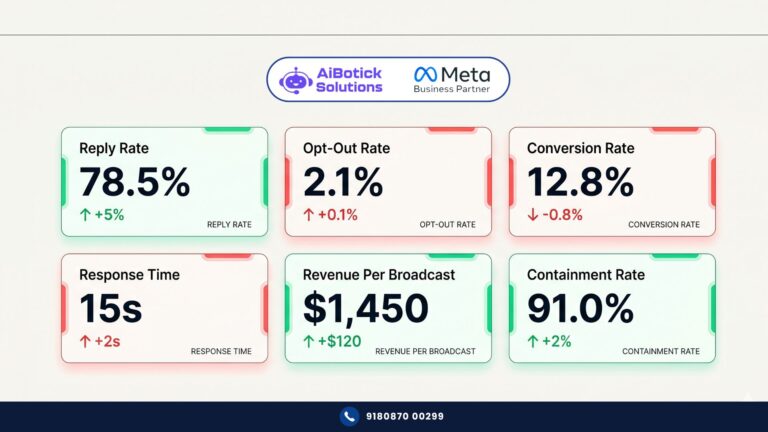
- Opt-out rate (should be under 2% per broadcast, target under 1%)
- Response rate (should be climbing month on month if content quality is improving)
- Chatbot fallback rate (should be falling as you add responses to common questions)
- Revenue or conversion attributed to WhatsApp (your north star metric)
If any of these are moving in the wrong direction — something in your strategy needs changing. Find it. Fix it. Don’t wait for the quarterly review.
What People Get Completely Wrong About Why WhatsApp Automation Fails
Myth-busting. Because the excuses I hear most often are wrong.
“WhatsApp automation failed because our audience isn’t on WhatsApp”
With 500+ million users in India alone? Nope. Your audience is on WhatsApp. The question is whether your opt-in collection was broken — meaning you never actually got the right people into your list in the first place. Fix the opt-in process, not the channel assumption.
“WhatsApp automation failed because it’s too expensive”
Official WhatsApp Business API costs for a business doing 10,000 marketing conversations per month: approximately Rs.8,600 in Meta conversation charges (at Rs.0.8631 per marketing conversation). Add your platform subscription. Total: under Rs.35,000 a month for serious scale.
Compare that to what 10,000 qualified customer touchpoints cost via Google Ads or Meta feed ads. WhatsApp is not expensive. Poorly managed WhatsApp that generates no revenue feels expensive because you’re paying for a channel you’re not converting from.
“WhatsApp automation failed because our team didn’t have time to manage it”
Honestly? This one has some truth in it — but the framing is wrong. WhatsApp automation done right reduces team time. The problem is that most businesses implement automation without designing the human-in-the-loop element properly. They automate the broadcasts but not the response handling. So the volume of incoming messages increases — because broadcasts generate replies — without the infrastructure to handle them.
Automate the responses, not just the outgoing messages. That’s the distinction.
“Our chatbot kept confusing customers so we turned it off”
This is a symptom, not a cause. A chatbot that confuses customers was either built with insufficient flows, launched without testing, or never updated after launch. The solution is not to remove automation — it’s to fix the specific flows that are breaking.
Could be wrong, but I’ve seen this consistently — every WhatsApp chatbot that “failed” and was turned off had never been properly audited for the questions customers were actually asking versus the questions the builder assumed they’d ask. Build from real customer questions. Not from what you think customers will ask.
The 3 Things That Actually Make WhatsApp Automation Work
We’ve covered the failures in depth. Now the other side.
The businesses I’ve watched build genuinely great WhatsApp automation — the ones achieving 35-40% of revenue from the channel, the ones with 89%+ customer retention, the ones whose WhatsApp list keeps growing organically through referrals — they all do three things differently.
Thing 1: They obsess over opt-in quality, not list size
A list of 1,000 highly engaged, recently opted-in customers who genuinely want to hear from you will outperform a list of 10,000 scraped, imported, or cold contacts every single time.
The best WhatsApp lists are built through: post-purchase opt-in (“Want order updates on WhatsApp? ✓”), in-store QR codes, lead forms with explicit WhatsApp consent, referral programs where existing customers share your WhatsApp link.
Every person on your list should be there because they specifically chose to be. Not because someone exported a contact database.
Thing 2: They make every message worth receiving
The businesses with the lowest opt-out rates — consistently under 1% — don’t send fewer messages. They send better messages.
Better means: valuable information the recipient couldn’t easily get elsewhere, personalised to their history and preferences, timed to when they’re most likely to act, written in a tone that feels human and warm rather than promotional and robotic.
A weekly WhatsApp message from a trusted business that’s genuinely useful? People don’t opt out of that. They wait for it.
Thing 3: They treat the first 90 days as a learning phase, not a performance phase
The businesses that get impatient in the first 90 days — expecting immediate revenue attribution, immediate conversion rates, immediate ROI — almost always make the mistake of over-broadcasting to compensate. They send more, more often, to make the numbers move. And they burn the list in the process.
The businesses that win treat the first 90 days as: build the list properly, get the chatbot flows right, understand what content their audience responds to, establish the team habits around response time and conversation quality.
Revenue comes from a well-built system run consistently. Not from an aggressive start that burns your audience in month two.
Before You Go — An Honest Word About Who You Build With
Ab yeh baat important hai.
WhatsApp automation fails. But it fails significantly more often with the wrong partner than the right one.
Wrong partner means: you get software access, a help document, and a support ticket system. When your chatbot breaks at 9 PM on a Friday before a campaign — you’re on your own until Monday.
Right partner means: someone who has seen 50 implementations fail for the exact reasons above and has built their onboarding, training, and support processes specifically to prevent those failures.
At AiBotick, every client gets personalised onboarding — not a video course, a real human who understands your business. Live training sessions for your team. A dedicated WhatsApp support group where you can ask questions and get answers from people who’ve solved the same problem before.
Not because we’re generous. Because we’ve learned — the hard way, watching clients struggle — that technology without proper implementation support produces exactly the failure modes this entire article describes.
We don’t just sell you software. We partner with you until it works.
If you’re ready to build WhatsApp automation that actually works — and you want a partner who will tell you when you’re about to make a mistake before you make it — the conversation starts here. 💯
— Mohit Shah │ 15+ years in IT industry │ 4+ years in WhatsApp automation │ Worked with various MNC brands │ Now helping businesses figure out what actually works
Q1: Why do most WhatsApp automation projects fail in India?
A1: The three root causes are: building a broadcast-only system without the conversation infrastructure to handle replies, sending the same message to every contact regardless of their purchase history or funnel stage, and treating WhatsApp automation as a one-time setup rather than an ongoing channel that requires weekly review and optimisation. Most failures are strategic, not technical — the WhatsApp Business API works reliably. What breaks is the strategy built on top of it.
Q2: How do I know if my WhatsApp automation is failing before it’s too late?
A2: Four early warning signs: opt-out rate climbing above 2% per broadcast, response rate declining month on month despite stable send volume, chatbot fallback rate above 30% (meaning the bot is handing off more than it’s resolving), and zero or unmeasured revenue attribution from the channel. If any two of these are present simultaneously, the strategy needs immediate review — not the technology.
Q3: Can a failed WhatsApp automation project be recovered, or should you start over?
A3: Most failed WhatsApp projects can be recovered without starting from scratch — but recovery requires honest diagnosis first. Audit the opt-in quality of your existing list, review your last six broadcasts for segmentation and tone, check your chatbot’s actual fallback rate, and measure your team’s real response time versus intended SLA. Fix the specific broken element rather than abandoning the channel. The exception is if the WhatsApp number was banned for policy violations — in that case, a fresh start with a new number on official API infrastructure is the only path forward.