Nobody tells you the truth about WhatsApp Growth Playbook Journey.
They show you the destination — the thriving WhatsApp list, the automated revenue, the broadcasts that generate Rs.8L in 48 hours, the chatbot handling 400 queries while the founder sleeps. They show you the screenshot. The graph going up and to the right.
What they don’t show you is month two. When you have 340 contacts, three approved templates, a chatbot that breaks whenever someone types in Hindi, and a team that’s still forwarding customer messages to each other on a personal WhatsApp group because nobody fully understood the shared inbox training.
I’ve seen this movie. Many times. From both sides.
And I want to tell you the version of this story that’s actually true — not the highlight reel. Because the businesses that build genuinely great WhatsApp operations — the ones sitting at 8,000, 12,000, 15,000 opted-in customers with 30%+ of revenue flowing through the channel — they didn’t get there by following a polished framework from a blog post.
They got there by doing unglamorous things, consistently, for longer than felt comfortable.
This is that story. The realistic one.
Before the Playbook — Let’s Agree on What 10,000 Actually Means
Because I’ve seen people misunderstand this target in ways that send them completely off course.
10,000 customers on WhatsApp does not mean:
- 10,000 numbers imported from a database
- 10,000 people who messaged you once and never replied again
- 10,000 contacts blasted with your promotions who’ve opted out but are still in your list because nobody cleaned it
10,000 customers on WhatsApp means 10,000 opted-in, engaged people who have explicitly chosen to receive communication from your business on WhatsApp, who open your messages, who reply occasionally, and from whom you can generate real, measurable revenue.
That’s a fundamentally different target. And achieving it requires a fundamentally different strategy than “collect as many numbers as possible.”
Seedha bolta hoon — a business with 2,000 genuinely engaged WhatsApp contacts will consistently outperform a business with 15,000 scraped, imported, or disengaged contacts. Every metric. Every time. Quality of list is the only metric that matters at the beginning. Size comes later, as a result of quality — not as a shortcut to it.
With that settled — let’s build.
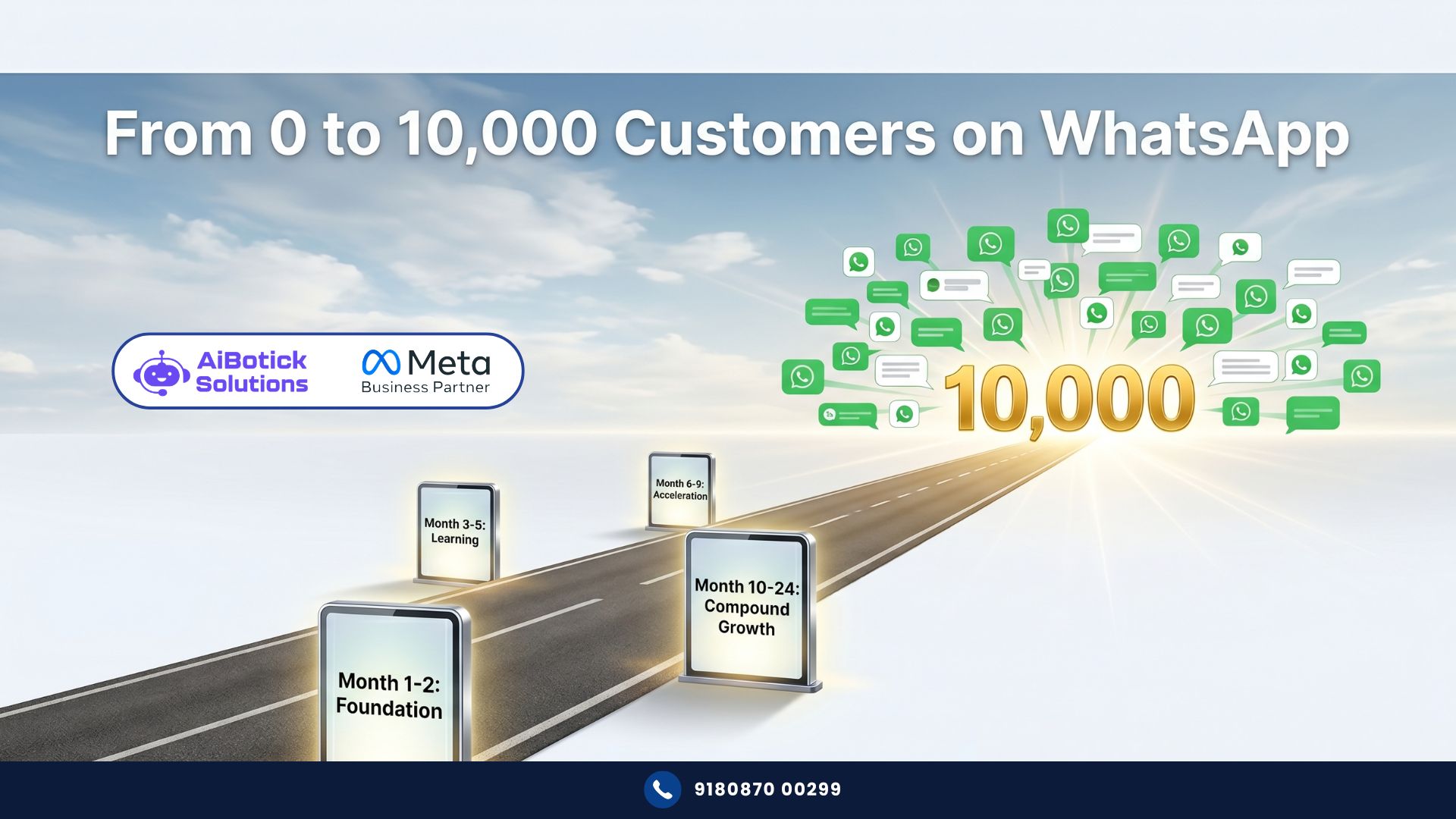
Phase 1 — Foundation (Month 1-2): Build the Infrastructure Before the Audience
Most businesses do this backwards. They focus on growing the list first, then figure out the infrastructure. That’s like inviting 500 guests to a party before you’ve booked the venue, hired the caterers, or confirmed the date.
The first 60 days are not about WhatsApp growth. They are about building something worth growing into.
Get the Technical Foundation Right — Once, Properly
Official WhatsApp Business API — non-negotiable starting point.
Not the WhatsApp Business App. Not a bulk sender. Not a “WhatsApp marketing tool” that sidesteps Meta’s infrastructure. The official API through a verified provider.
Why does this matter so much at the start? Because everything you build — your contact list, your chatbot flows, your team inbox habits, your broadcast audience — sits on top of this foundation. Build on grey-market infrastructure and you risk losing everything when the number gets banned. I’ve seen it happen to businesses five years into their WhatsApp journey. Five years of contact relationships, gone overnight.
Start right. It costs more than a bulk sender. The insurance value is infinite.
Set up your shared team inbox before you send a single broadcast.
Seriously. Before. One message to 50 people will generate 8-12 replies. If those replies land in chaos — split across personal numbers, missed because nobody was assigned — you’ve trained 8-12 people that messaging your business on WhatsApp leads nowhere.
Assign a primary agent. Set response time expectations internally. Build the escalation path (who handles complaints, who handles sales queries, who handles technical issues). Document it. It takes 2 hours. It saves you from months of broken customer experience.
Build your first three chatbot flows — not twenty. Three.
- Welcome flow: for anyone who messages your number for the first time
- FAQ flow: your 5 most common customer questions with proper answers
- Out-of-hours flow: what happens when someone messages at 11 PM
That’s it for Phase 1. Resist the temptation to build 15 flows before you’ve seen how real customers actually interact with your bot. You will build the wrong flows. I promise you. Build the three essentials, go live, watch real conversations, then build what customers actually need.
Get your first five templates approved.
One welcome message. One order/booking confirmation. One follow-up for leads who enquired but didn’t convert. One broadcast template for promotions. One feedback request.
Five templates. Approved. Ready to use. Don’t wait until you need them to get them approved — Meta’s approval process takes 24-48 hours and always happens at the worst possible time if you haven’t prepared.
Build Your First Opt-In System — Multiple Entry Points
The WhatsApp growth playbook lives and dies on opt-in quality. And opt-ins don’t happen by accident. You need specific mechanisms designed to capture them.
Entry Point 1 — Post-purchase WhatsApp opt-in
The moment after a customer buys from you is the highest-trust moment in your relationship. They’ve just given you money. They want the transaction to go well. “Would you like order updates and exclusive offers on WhatsApp? ✓” at checkout or in the confirmation email — conversion rate on this opt-in is 60-75% in my experience. Highest quality leads you’ll ever build.
Entry Point 2 — In-store or in-office QR code
Physical presence is an underused WhatsApp list builder. A QR code at your counter, on your packaging, on your visiting card, on your restaurant table — that routes to a WhatsApp opt-in message pre-filled: “Hi, I’d like to stay updated on [BusinessName]’s offers and news.”
Customer scans. Message pre-fills. They send. They’re on your list. Frictionless.
Entry Point 3 — Website WhatsApp widget
A WhatsApp chat button on your website homepage and product pages. Captures people at the moment of highest interest. Every inbound message through this is a warm lead who has self-identified interest.
Entry Point 4 — Click-to-WhatsApp ads
Paid, but high quality. Meta ads that open directly in WhatsApp rather than routing to a landing page. The opt-in happens as part of the conversation initiation. Lead quality is dramatically higher than a landing page lead because the customer chose WhatsApp — they’re comfortable with the channel and expect to communicate there.
By end of month 2, with these four entry points active: a business doing Rs.15-20L/month revenue should have 300-600 genuinely opted-in WhatsApp contacts. Not 3,000. 300-600. High quality. Engaged. Ready.
That number is not disappointing. That number is the foundation of everything that follows.
Phase 2 — Early Growth (Month 3-5): Learn Before You Scale
Actually wait — this is the phase most playbooks skip entirely. And it’s the most important one.
Month 3 to 5 is not about aggressive WhatsApp growth. It’s about learning what works for your specific audience before you pour fuel on it.
Run Your First Broadcasts — With Obsessive Measurement
By month 3, you should have 400-700 contacts. Send your first broadcast campaign. But send it like a scientist, not a marketer.
Specifically:
Test message tone first. Send the same offer in two different tones to two equal halves of your list. Version A: formal, benefit-focused. “Get 20% off on all orders above Rs.2,000 this weekend.” Version B: conversational, Mohit-style. “Yaar, weekend aa gaya — and we figured it’s a good time to give our WhatsApp family something special. 20% off all weekend, no code needed 😄”
In every test I’ve run or seen run — Version B wins. Not by a little. By 2-3x in response rate. But test it for your audience. Because occasionally there are B2B or premium segments where slightly more formal works. Know your audience before you assume.
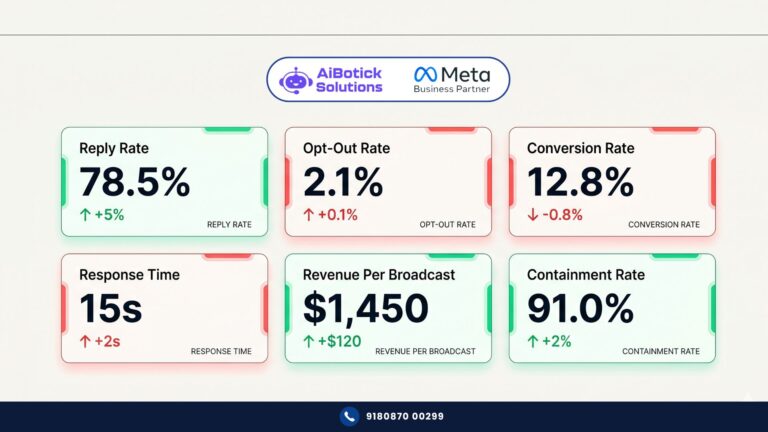
Measure four numbers after every broadcast:
- Open rate (benchmark: above 60% is good, above 80% is excellent)
- Response rate (benchmark: above 8% is good, above 15% is excellent)
- Opt-out rate (red flag: above 2%. Immediate action required.)
- Conversion rate (revenue or bookings generated / total messages sent)
These four numbers tell you everything. Open rate tells you if your timing and first line are working. Response rate tells you if your content is engaging. Opt-out rate tells you if you’re annoying people. Conversion tells you if any of this is actually making money.
Fix Your Chatbot Based on Real Conversations
By month 3, you’ll have real conversation data. Look at every instance where your chatbot said “I didn’t understand that” — those are the flows you need to build next.
I guarantee you: there are 3-5 questions your customers ask repeatedly that you never anticipated when you built the original bot. Find them. Add responses. Your chatbot fallback rate — the percentage of conversations it can’t handle and passes to a human — should be dropping every month.
Month 1 fallback rate: maybe 40-50%. That’s normal and acceptable at the start. Month 3 target: under 25%. Month 6 target: under 15%. Month 12 target: under 10%.
That progression is achievable. It requires weekly attention, not a major rebuild. Add 2-3 new responses per week based on what customers are actually asking.
Build Your First Drip Sequence for New Leads
Not everyone who opts in is ready to buy immediately. Some people are curious, browsing, comparing. A 5-message drip sequence over 14 days — timed and automated — converts these people at rates that justify building it in month 3, not month 6.
Message 1 (Day 1): Warm welcome + your single most compelling value proposition. Not a list of features. One thing.
Message 2 (Day 3): Social proof. A specific customer story — real city, real numbers, real outcome. Not “our customers love us.” A story.
Message 3 (Day 6): Address the most common objection your sales team hears. Directly. “A lot of people ask us whether X is worth it if they’re a smaller business. Here’s the honest answer…”
Message 4 (Day 10): Useful content. Something they can use even if they never buy from you. Builds goodwill and trust. Positions you as an advisor, not just a seller.
Message 5 (Day 14): Soft close. “If you’ve been thinking about it — this is a good week to start. Here’s why.” With a clear, simple next step.
This sequence, once built, runs forever. Every new opt-in enters it automatically. You build it once in month 3. It generates revenue every month for years.
Phase 3 — Acceleration (Month 6-9): Now You Pour Fuel
By month 6, you have something most businesses never build: a proven WhatsApp system. You know what content your audience responds to. You know what broadcast frequency works without spiking opt-outs. Your chatbot handles most common queries. Your team knows the inbox. Your drip sequence is running.
Now you scale.
Scale Your Opt-In Channels Aggressively
Everything that was working at small scale — amplify it.
Click-to-WhatsApp ads that were running at Rs.5,000/month? Increase budget on the campaigns with the lowest cost-per-opt-in. The data from months 3-5 tells you exactly which ad creative and audience targeting produces the highest quality WhatsApp leads. Scale those specifically.
Referral program launch: “Share this WhatsApp link with a friend who’d benefit from [your product/service]. When they make their first purchase, you both get [reward].” WhatsApp is the perfect channel to run a referral program because sharing a WhatsApp link in a family group or friend chat takes literally 3 seconds. Make the ask natural. Make the reward meaningful.
Partner opt-ins: Identify 3-5 complementary businesses — not competitors, adjacent businesses serving the same customer. A bridal jewellery brand partnering with a wedding photographer. A fitness supplement brand partnering with a gym. Cross-promote each other’s WhatsApp channels to your respective lists. Both lists grow. Zero ad spend.
Deepen Segmentation as the List Grows
At 1,000 contacts, basic segmentation is fine — bought vs never bought, recent vs lapsed.
At 3,000+ contacts, you need richer segmentation:
- Product category preference (built from purchase history)
- Engagement tier (high — replies regularly; medium — opens but rarely replies; low — opens occasionally)
- Customer lifetime value bracket
- Geographic segment if relevant (Mumbai vs Delhi vs Bangalore pricing or product differences)
- Acquisition source (did they come from an ad, a referral, in-store, website?)
The acquisition source segment is one most businesses ignore completely. And it’s enormously valuable. Customers who came via referral have different loyalty profiles than customers who came via a paid ad. Customers who found you in-store have different purchase behaviour than customers who found you online.
Communicate with them differently. The personalisation doesn’t need to be complicated — a single different opening line that acknowledges how they found you is enough to dramatically change response rates.
Introduce Your Loyalty Broadcast Cadence
By month 7-8, your WhatsApp list has become a genuine business asset. Protect it by establishing a consistent broadcast rhythm that delivers value — not just promotions.
A model that works: for every 3 broadcasts, maximum 1 is purely promotional. The other 2 deliver something genuinely useful — a tip, an insight, early access to something, a behind-the-scenes story, a customer spotlight.
This 1-in-3 ratio keeps your audience engaged with your brand, not just your offers. It’s the difference between a WhatsApp presence people look forward to versus one they eventually tune out.
Actually wait — here’s the counterintuitive part. The non-promotional broadcasts often outperform the promotional ones in revenue. Because they build the trust and relationship that makes the promotional broadcast land harder when it comes. Jab relationship strong hota hai, toh offer zyada chalti hai. Simple.
Phase 4 — Compound Growth (Month 10-18): The List Grows Itself
By month 10-12, something shifts. And it’s genuinely exciting to watch when it happens.
The WhatsApp list starts growing through channels you didn’t build.
Customers start sharing your WhatsApp number unprompted. In family groups. In office chats. With friends who have the same problem you solve. “Yaar, inhe message kar — bahut acha service hai aur WhatsApp pe hi sab ho jaata hai.”
This is the organic flywheel. It happens when three things are true simultaneously: the opt-in experience is smooth, the communication quality is consistently high, and the service delivered through WhatsApp is genuinely better than alternatives.
You cannot manufacture this flywheel. You can only create the conditions for it. And those conditions are everything this playbook has described — from proper infrastructure in month 1 to communication quality in month 7.
The Compounding Math of a Great WhatsApp List
Let me show you what 10,000 engaged WhatsApp contacts actually means financially — with real numbers from businesses I’ve seen at this stage.
A D2C brand with 10,000 engaged WhatsApp contacts running 2-3 broadcasts per month:
- Average open rate at this scale with good practices: 75-80%
- Average response/click rate on a promotional broadcast: 12-18%
- Average conversion rate from WhatsApp lead to purchase: 8-14%
- Average order value: varies by category, but say Rs.1,200
One broadcast to 10,000 contacts:
- 7,500-8,000 opens
- 900-1,440 click/responses
- 72-200 purchases
- Revenue: Rs.86,000 to Rs.2,40,000 from one broadcast
At Rs.0.86 per marketing conversation, the Meta cost for 10,000 messages: Rs.8,600.
Rs.8,600 in. Rs.86,000 to Rs.2,40,000 out. From one well-crafted broadcast to a well-built list.
That math is why businesses that do this properly don’t ask “is WhatsApp worth the investment?” They ask “how do I get to 20,000 contacts faster?”
For the exact ROI calculation framework applied to your specific business model, our WhatsApp automation ROI guide gives you the full numbers breakdown — including how to factor in Meta conversation costs at different list sizes.
The Realistic Timeline — What Each Milestone Actually Takes
Bhai, I want to be honest about time. Because the “0 to 10,000” framing can make it sound like a 6-month project. It’s not.
| Milestone | Realistic Timeframe | What Unlocks It |
|---|---|---|
| First 500 opted-in contacts | Month 1-3 | Proper opt-in systems live across all touchpoints |
| First Rs.50,000 WhatsApp revenue | Month 2-4 | First broadcast + drip sequence working |
| 1,000 engaged contacts | Month 4-6 | Consistent opt-in WhatsApp growth + zero shortcuts |
| First month where WhatsApp drives 15%+ of revenue | Month 5-7 | Segmented broadcasts + working chatbot |
| 3,000 contacts | Month 7-10 | Referral program + paid opt-ins scaling |
| WhatsApp driving 25%+ of revenue | Month 9-12 | Full automation stack + consistent quality |
| 10,000 engaged contacts | Month 14-24 | Organic flywheel + consistent paid WhatsApp growth |
| WhatsApp driving 30-40% of revenue | Month 18-24 | Compounding list quality + broadcast mastery |
Month 14-24 for 10,000 contacts. Not 6 months. Not a year. 14-24 months of consistent, quality-first work.
The businesses that try to compress this timeline — by buying lists, by sending too frequently, by scaling before the foundation is proven — consistently end up back at zero. Sometimes with a banned number. Sometimes just with a dead list and a disillusioned team.
The businesses that respect the timeline? They hit 10,000 and keep going. Because by then, the system runs itself.
What People Get Wrong About the WhatsApp Growth Playbook
One final myth-busting section. Because even with the best intentions, people come to this playbook with wrong assumptions.
“I need a big list before I can start seeing results”
Wrong. A D2C fashion brand in Jaipur with 280 WhatsApp contacts generated Rs.1.1L in their first broadcast campaign. 280 contacts. Hyper-engaged, perfectly targeted, beautifully written message. Size doesn’t create results. Quality and targeting do.
“The chatbot will handle everything — I don’t need to staff the inbox”
Nope. Even the best AI-powered WhatsApp chatbot in 2026 needs human oversight. Complex queries, emotional complaints, negotiation, relationship moments — humans handle these better. Every time. The chatbot exists to handle volume so humans can focus on conversations that actually need human judgment. Remove the humans entirely and you’ll know about it through your opt-out rate within 30 days.
“Once we hit 10,000 contacts, we can relax the quality standards”
This is exactly backwards. The larger your list, the more consequential every broadcast decision is. A poorly written, mis-timed broadcast to 500 people costs you 10 opt-outs. The same mistake to 10,000 people costs you 200 opt-outs and potentially a quality score flag from Meta.
Scale amplifies both good and bad practices. It does not forgive shortcuts that were invisible at small scale.
“This playbook works for big businesses — we’re too small to start”
Could be wrong, but I’ve seen this consistently — the businesses that benefit most dramatically from the WhatsApp growth playbook are not the large ones. Large businesses already have CRM infrastructure, dedicated marketing teams, and multiple customer touchpoints.
The small business — 5 employees, Rs.8-15L/month revenue, founder still answering customer calls personally — this playbook is transformative for them. Because WhatsApp becomes their CRM, their marketing team, their customer support system, and their loyalty program simultaneously. At a cost that’s a fraction of building those functions separately.
The Last Thing I Want to Say — After 100 Articles
Ab toh — yaar, 100 articles mein bahut kuch cover kiya humne.
Ecommerce. Healthcare. Real Estate. Education. Travel. Finance. Manufacturing. Legal firms. HR agencies. Restaurants. IT companies. Digital marketing agencies. SaaS. Hotels. Tour operators. UAE. Malaysia. Indonesia. UK. Global sales. AI chatbots. The future of commerce. Why things fail.
Every article pointed at the same truth from a different angle.
WhatsApp is not a marketing channel. It’s not a chatbot platform. It’s not an automation tool.
It’s the closest thing to a direct line between a business and its customers that has ever existed at scale. No algorithm filtering your message. No promotional tab burying your email. No voicemail nobody checks. A message, delivered, read, responded to — between a business and a human who chose to be there.
That’s the opportunity. And it’s available right now, to every business reading this, regardless of size, industry, or geography.
The only question is whether you build it right.
10,000 customers on WhatsApp is not a fantasy. It’s a 14-24 month commitment to quality-first growth, consistent communication, and genuine respect for the attention your customers give you when they opt in.
Make that commitment. Build it properly. And when the flywheel starts spinning — when your list grows on its own and your broadcasts pay for themselves 20x over — you’ll know exactly where it came from.
Not from a shortcut. From the work.
If you want to start that work with a team that has done this 50+ times, across 50+ businesses, across every industry covered in these 100 articles — the conversation is one WhatsApp message away. 🙏
— Mohit Shah │ 15+ years in IT industry │ 4+ years in WhatsApp automation │ Worked with various MNC brands │ Now helping businesses figure out what actually works
Q1: How long does it realistically take to build 10,000 WhatsApp customers for a business in India?
A1: For a business doing Rs.10-30L per month revenue with proper opt-in systems, official WhatsApp Business API infrastructure, and consistent quality-first communication — reaching 10,000 genuinely engaged opted-in contacts takes 14 to 24 months. Businesses that try to compress this timeline through bought lists, grey-market tools, or high-frequency low-quality broadcasting consistently fail to sustain list quality at scale. The timeline is non-negotiable — but the revenue generated along the way more than justifies it.
Q2: What is the minimum number of WhatsApp contacts needed before running broadcast campaigns?
A2: There is no minimum. A business with 280 well-targeted, opted-in WhatsApp contacts running a precisely crafted broadcast can generate meaningful revenue from day one. What matters is not list size but list quality and message relevance. Starting broadcasts early — even with a small list — builds the measurement data and content instincts needed to scale effectively when the list grows.
Q3: What are the four phases of the WhatsApp growth playbook?
A3: Phase 1 (Month 1-2) is Foundation — building API infrastructure, shared inbox, first chatbot flows, and opt-in systems before growing the list. Phase 2 (Month 3-5) is Early Growth — running first broadcasts with obsessive measurement and learning what content works for your specific audience. Phase 3 (Month 6-9) is Acceleration — scaling opt-in channels, deepening segmentation, and establishing a consistent broadcast cadence. Phase 4 (Month 10-24) is Compound Growth — where a well-built list begins growing organically through referrals and community sharing, with 30-40% of business revenue flowing through the WhatsApp channel.