Sending the same WhatsApp message to 5,000 contacts is not marketing. It’s hoping.
And hoping — at Rs.0.86 per conversation — adds up to an expensive prayer. A D2C brand in Jaipur burned Rs.43,000 on a broadcast campaign that generated Rs.12,000 in revenue because they sent one message to their entire list. Same offer. Same words. To a new lead, a loyal customer of 3 years, and someone who hadn’t bought in 8 months.
WhatsApp audience segmentation is the skill that separates businesses with 3x ROAS from businesses wondering why WhatsApp “doesn’t work.” Here’s the complete guide.
Why Unsegmented WhatsApp Campaigns Are Actively Hurting Your Business
Dekho, unsegmented broadcasting doesn’t just underperform. It actively damages your WhatsApp marketing capability.
Here’s the chain reaction:
Irrelevant message sent to wrong audience → higher block rate → phone quality score drops → Meta reduces your messaging limits → your next campaign reaches fewer people → even lower ROI → number eventually flagged.
I’ve watched this exact spiral happen at a Mumbai coaching institute that sent 8,000 messages without segmentation — a mix of students in the middle of their course, students who had completed, fresh inquiries, and cold leads who’d never paid them a rupee. Same “Enroll Now” message to everyone.
Block rate: 6.8%. (Danger threshold is 2%.) Quality score: Red within 72 hours. Messaging limit: Reduced by 80%. Recovery time: 6 weeks of careful messaging before limits restored.
WhatsApp audience segmentation isn’t a nice-to-have feature. It’s what keeps your number healthy, your campaigns effective, and your customers from feeling spammed.
What People Get Wrong About WhatsApp Segmentation
Most marketing managers think WhatsApp audience segmentation means separating contacts into “customers” and “leads.”
Two segments. Done.
Nope. That’s not segmentation. That’s a directory.
Real WhatsApp audience segmentation is dynamic — contacts move between segments based on behaviour, not just status. It’s multi-dimensional — a contact is tagged by multiple attributes simultaneously. And it’s actionable — each segment triggers specific messages, not just the removal of contacts from wrong lists.
Here’s the difference between directory thinking and segmentation thinking:
Directory thinking: “These are my customers and these are my leads.”
Segmentation thinking: “Among my customers, who bought in the last 30 days vs 60-90 days vs 90+ days? Who spent above Rs.5,000 vs below? Who bought Product A vs Product B? Who has referred someone vs not? Who engaged with my last 3 messages vs went silent?”
Each of those sub-groups needs a different message. Because they’re at different places in their relationship with you. And relevance — the match between message and recipient’s current situation — is the only thing that determines whether your WhatsApp message delights or annoys.
The 6 Segmentation Dimensions That Matter for Indian Businesses
Dimension 1: Lifecycle Stage
Where is this contact in their relationship with your business?
- New lead (0-7 days, first contact): Needs education and trust-building. Not ready for promotions.
- Warm lead (engaged, not purchased): Actively considering. Needs social proof and objection handling.
- Recent customer (0-90 days post-purchase): Needs onboarding, value reinforcement, and upsell.
- Loyal customer (90+ days, 2+ purchases): Needs loyalty recognition, early access, referral ask.
- At-risk customer (90+ days since last purchase): Needs re-engagement with value-led message.
- Churned (6+ months, no engagement): Needs win-back with significantly different offer.
Dimension 2: Purchase Behaviour
What have they actually bought and how much?
- First-time buyer (different from repeat buyer — treat them differently)
- High-value buyer (top 20% by spend) vs low-value buyer
- Category-specific (bought Product A — relevant for Product A upsells/accessories)
- Frequency (buys every month vs once every 6 months)
Dimension 3: Engagement Level
How actively are they engaging with your WhatsApp communication?
- High engagers (opens + replies to most messages)
- Medium engagers (opens but rarely replies)
- Low engagers (opens drop, no replies)
- Silent (messages delivered, never opened in last 30 days)
Dimension 4: Demographics/Profile
What do you know about them as a person?
- Age group (where known — young professionals vs families vs seniors)
- Location (city-tier matters hugely in India — Tier 1 vs Tier 2 vs Tier 3)
- Profession (working professional vs student vs business owner vs homemaker)
- Lead source (Facebook ad vs organic WhatsApp vs referral vs website)
Dimension 5: Intent Signals
What has their recent behaviour told you about their current intent?
- Clicked product link 2+ times (high purchase intent)
- Asked about pricing recently (very high intent)
- Visited website cart but didn’t complete (abandoned cart)
- Viewed your catalog (browsing intent)
- Hasn’t responded to last 3 messages (declining intent)
Dimension 6: Product/Service Interest
What are they specifically interested in?
- Course A inquirers vs Course B inquirers (education)
- Budget property seekers vs premium seekers (real estate)
- Skincare category vs haircare category (D2C)
- Feature X users vs Feature Y users (SaaS)
Your contacts are tagged across multiple dimensions simultaneously. A contact might be: Warm lead + Tier 2 city + Facebook ad source + visited pricing page twice + interested in Product B. That combination of tags determines exactly which message they should receive.
Real Case Study: Bengaluru D2C Skincare Brand — Segmentation Took ROAS From 3x to 28x
The Situation:
- Skincare D2C brand in Bengaluru
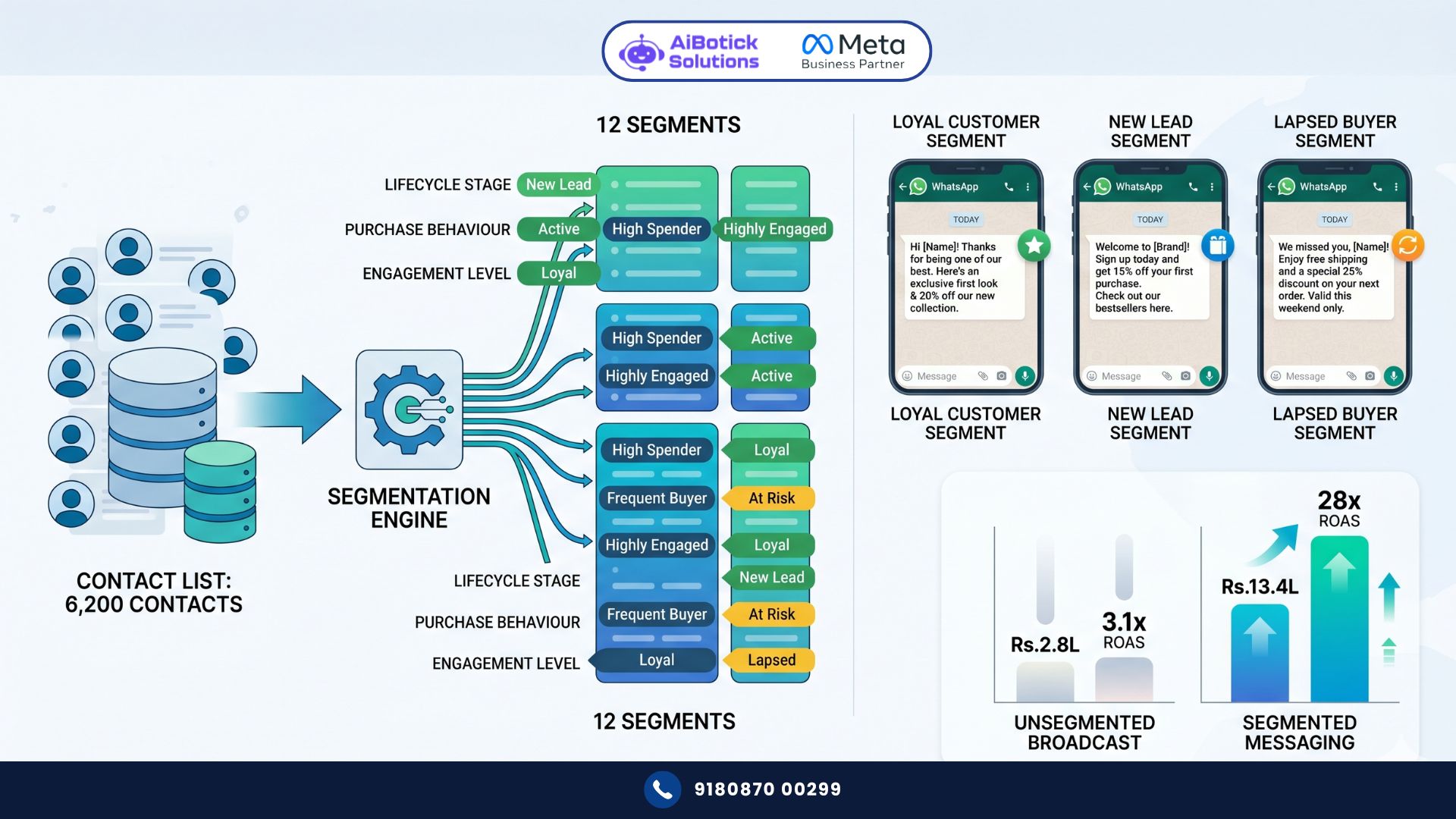
- 6,200 WhatsApp contacts
- Running monthly broadcast campaigns to entire list
- Average campaign ROAS: 3.1x
- Block rate per campaign: 3.2% (above danger threshold)
- Number quality: Yellow (struggling)
The Problem: Their contact list was a complete mix: people who’d bought 3 times, people who’d never bought, people in the middle of a purchase decision, people who’d returned products. Same message to all.
What They Implemented:
They rebuilt their contact tagging system from scratch. Every contact got tagged across 4 dimensions:
Purchase status: New lead / First buyer / Repeat buyer / Lapsed (90+ days) Category interest: Cleanser / Moisturiser / Serum / SPF / Kit (from browsing/purchase history) Spend tier: Below Rs.1,500 / Rs.1,500-5,000 / Above Rs.5,000 Engagement: Active (opened last 3 campaigns) / Passive (opened 1-2) / Silent (opened none)
From 6,200 contacts, they identified 12 primary segments (not 4 — because combinations matter).
They created 12 different campaign messages for a Diwali sale — same sale, different angle, different product emphasis, different tone.
Examples of how the message changed by segment:
Segment: Repeat buyers, serum interest, high spend, active “[Name], Diwali exclusive — you’ve tried our Vitamin C Serum. Now meet its partner: the Glow Booster we just launched. 40% off this Diwali — reserved for our loyal customers first. Tap to see: [link]”
Segment: First buyers, moisturiser interest, low spend, passive “Hi [Name]! Diwali’s coming and we wanted to say thank you for your first order with us 😄. Here’s a little gift — 25% off your next moisturiser order. Valid until [date]: [link]”
Segment: New leads (never purchased), any interest, active “[Name], this Diwali is the perfect time to try us for the first time. Our starter kit (Rs.999 instead of Rs.1,799) has our 3 bestsellers. 1,400+ women in Bengaluru use it daily: [link]”
Segment: Lapsed customers, any interest, silent “It’s been a while, [Name]. We’ve added 6 new products since you last shopped with us — including a Niacinamide Serum that’s gotten 340+ 5-star reviews. No push, just thought you’d want to know: [link]”
Same Diwali sale. 12 different messages. 12 different relevant angles.
The Results (one Diwali campaign):
| Metric | Before Segmentation | After Segmentation | Change |
|---|---|---|---|
| Contacts messaged | 6,200 (all) | 6,200 (all, different messages) | 0% |
| Block rate | 3.2% | 0.4% | -88% |
| Open rate | 68% | 91% | +34% |
| Click-through rate | 8% | 22% | +175% |
| Orders generated | 186 | 892 | +380% |
| Revenue | Rs.2.8L | Rs.13.4L | +379% |
| Campaign cost | Rs.5,332 | Rs.5,332 | 0% |
| ROAS | 3.1x | 28x | +803% |
Same list. Same spend. Same sale. 9x more revenue from segmentation alone.
And the number quality went from Yellow back to Green within 2 campaigns. Block rate dropped from 3.2% to 0.4% because relevant messages don’t get blocked.
How to Build Your WhatsApp Segmentation System: Step by Step
Step 1: Audit Your Current Contact List
Before building segments, understand what data you actually have. Go through your contacts and note what you know:
- Name (most have this)
- What they purchased (do you have this tagged?)
- When they last purchased (do you track this?)
- What pages/products they browsed (do you know this?)
- Their response to your last 3 messages (do you track this?)
- How they first came to you (source tag?)
For most businesses, they have name and “whether they purchased” — and nothing else. That’s the starting point. Build from here.
Step 2: Define Your Core Segments
For most Indian businesses, start with these 6 and expand from there:
- Hot leads — Messaged in last 7 days, engaged with at least one reply, haven’t purchased
- Warm leads — Messaged 7-30 days ago, at least one reply, haven’t purchased
- Cold leads — Messaged 30+ days ago, little or no engagement, haven’t purchased
- New customers — First purchase in last 30 days
- Active customers — 2+ purchases in last 90 days
- Lapsed customers — No purchase in 90+ days
Six segments. Simple. Actionable. Start here.
Step 3: Set Up Tagging in Your WhatsApp Platform
In AiBotick’s platform, tags are applied to contacts manually, automatically (based on actions), or via CRM sync.
Tag types to configure:
Automatic tags (applied when action happens):
- “New Lead” → applied when contact first messages
- “Purchased” → applied when payment confirmed (via Razorpay webhook or manual)
- “Engaged Last 30 Days” → applied when contact opens or replies to a message
- “Browsed Catalog” → applied when contact views your WhatsApp catalog
Manual tags (applied by team):
- “Hot Lead” → sales team applies when lead is clearly ready to buy
- “High Value” → applied when purchase crosses threshold
- “Referral Source” → applied when customer refers someone
- “Complaint Filed” → applied when support issue is raised
CRM-synced tags (pulled from your CRM or sheet):
- Purchase history tags
- Category interest tags
- Geographic tags
Step 4: Create Segment-Specific Message Templates
For each segment, create:
- 1 standard campaign template (for broadcast campaigns)
- 1 re-engagement template (for contacts going quiet)
- 1 conversion push template (for moving them to next stage)
That’s 3 templates × 6 segments = 18 templates minimum. Build these before your first segmented campaign.
Step 5: Run Segmented Campaigns
When sending a campaign:
Never broadcast to your full list. Always select a segment.
For each segment, select the relevant template. Verify it’s appropriate for that audience (would a loyal 3-year customer be glad to receive this?). Send.
After campaign, review block rate by segment. High block rate in one segment = message not relevant for that group. Investigate and fix.
Step 6: Build Dynamic Segmentation Rules
Static segmentation (contact is permanently in Segment A) becomes outdated fast. Build dynamic rules:
- Contact moved from “Lapsed” to “Active Customer” when new purchase recorded
- Contact moved from “Hot Lead” to “Cold Lead” when 14 days pass without reply
- Contact gets “High Value” tag when cumulative spend crosses Rs.10,000
- Contact gets “At-Risk” tag when 60 days pass since last purchase
Dynamic rules ensure your segments are always current. Your campaigns are always relevant.
WhatsApp Segmentation for Different Business Types
For Ecommerce/D2C: Primary segments: First buyer, Repeat buyer, Lapsed buyer, Cart abandoner, High-value buyer, Category-specific (by product interest).
The cart abandoner segment alone — people who browsed your WhatsApp catalog or clicked product links but didn’t buy — typically converts at 18-24% when you send a targeted message within 2 hours of the browse session. Generic broadcast to the same audience? 4-6%.
For Education/Coaching: Primary segments: Fresh inquiry (0-7 days), Demo attended (not enrolled), Enrolled current student, Completed student, Lapsed inquiry (30+ days, no enrollment).
The “demo attended, not enrolled” segment is where most coaching institutes leave the most money. Targeted follow-up to this segment at the right time — not the same message as fresh inquiries — converts 3-4x better.
For Real Estate: Primary segments: Fresh inquiry, Site visit done (not booked), Ready to buy (shown purchase signals), Passive interest (browsing, not serious), Budget segments (under 50L, 50L-1Cr, above 1Cr).
A developer in Pune created a “Site Visit + No Booking + 14+ Days” segment — people who visited and liked but hadn’t committed. Targeted message to this segment with a personalised “We noticed you were interested in [Unit Type]” produced 23% booking rate vs 4% from general campaigns.
For Financial Services: Primary segments: Insurance inquirer, Investment inquirer, Loan inquirer, Existing client by product type, Renewal due within 30 days.
The “Renewal due within 30 days” segment is critical and specific. These contacts need proactive renewal conversation — not promotional messages about new products. Sending them a new product campaign instead of a renewal nudge actively costs you renewal revenue.
For B2B: Primary segments: Decision maker, Influencer, Technical evaluator, Existing client, Former client, Competitor’s customer (from your research).
Segmenting B2B contacts by role dramatically improves message relevance. A CTO cares about API capabilities and security. A marketing director cares about campaign ROI. Sending the CTO a message about marketing ROI wastes everyone’s time.
The WhatsApp Segmentation Metrics to Track
After implementing WhatsApp audience segmentation, track these per segment:
- Open rate (should be 85%+ for relevant segments)
- Response rate (benchmark varies by segment — leads should be higher than customers)
- Block rate (must stay below 1% per segment per campaign)
- Conversion rate (key business metric — what % take the desired action)
- Revenue per contact messaged (ultimate segmentation effectiveness metric)
When one segment’s block rate spikes above 1%, investigate immediately. Usually means: message isn’t relevant, frequency too high, or segment definition is wrong (wrong people in the segment).
And to understand how WhatsApp audience segmentation connects to your broader broadcast strategy — specifically how segments determine which template to use and how to structure campaigns for maximum relevance — our WhatsApp broadcasting guide covers the full campaign architecture that segmentation powers. 😄
Common Segmentation Mistakes Indian Businesses Make
Mistake 1: Too many segments too early Building 40 micro-segments before you have the data or team to manage them. Start with 6. Add complexity as you learn.
Mistake 2: Static segmentation that never updates Contact bought once 8 months ago. Still in “Active Customer” segment. They get loyalty messages. They’re confused. Dynamic rules prevent this.
Mistake 3: Segmenting by demographics instead of behaviour “All contacts from Delhi” is a demographic segment. Useful sometimes. But “All contacts from Delhi who browsed apartment listings above Rs.1Cr in the last 30 days” is a behavioural segment. Dramatically more actionable.
Mistake 4: Same message frequency for all segments Hot leads might tolerate 3 messages per week (they’re actively deciding). Lapsed customers should get maximum 1 message per month (they’ve already showed disengagement). Same frequency for all = annoying the disengaged while under-serving the engaged.
Mistake 5: Not tagging lead source WhatsApp contacts from Facebook ads behave differently than contacts from referrals or organic Instagram. Source tagging lets you understand which acquisition channels produce your best contacts.
Mistake 6: Segmenting broadcast campaigns but not drip sequences You segment your campaigns but all leads go through the same onboarding drip. A Rs.50,000 high-ticket product lead and a Rs.999 introductory product lead need completely different drip sequences. Segment your automation too, not just your one-time campaigns.
Why WhatsApp Audience Segmentation Is the Highest-Leverage Marketing Skill in 2026
Honestly bhai, I think most businesses are sitting on gold they can’t access because their contact list is undifferentiated.
The Bengaluru skincare brand had 6,200 contacts generating Rs.2.8L from campaigns. Same 6,200 contacts — properly segmented — generated Rs.13.4L. No new contacts. No new products. No increased ad spend.
That’s the power of WhatsApp audience segmentation. Not new audience, new relevance. Not bigger campaigns, smarter ones.
And here’s what makes this especially powerful on WhatsApp vs other channels: WhatsApp’s quality score system punishes irrelevance in real-time. Block rate spikes → quality drops → limits reduce. The platform literally rewards good segmentation and penalises bad segmentation by restricting your reach.
Which means businesses that master WhatsApp audience segmentation get an expanding capability (better quality = higher messaging limits) while businesses that ignore it face a shrinking capability (poor quality = lower limits).
Segmentation is both the revenue strategy and the channel health strategy. That’s a rare combination. Use it.
And if you want to see how segmentation connects to the complete lifecycle of lead-to-loyal-customer, our WhatsApp sales funnel guide shows how each funnel stage creates natural segment boundaries — and how segment transitions drive the automation that runs your sales process 24×7. 💯
Ready to build a proper WhatsApp segmentation system for your business?
— Mohit Shah | 15+ years in IT industry | 4+ years in WhatsApp automation | Worked with various MNC brands | Now helping businesses figure out what actually works
Q1: How many segments is too many for WhatsApp audience segmentation for an SME?
A1: For a business with under 5,000 contacts: 6-8 segments is optimal. For 5,000-20,000 contacts: 10-15 segments. For 20,000+ contacts: 15-25 segments with sub-segments for key categories. Beyond 25 segments, the management overhead exceeds the marginal benefit for most teams. The Bengaluru skincare brand’s 12 segments was right for 6,200 contacts. Start with 6 and add segments only when you have clear evidence that a sub-group is receiving irrelevant messages (high block rate, low conversion). Complexity for its own sake creates management burden without proportional revenue improvement.
Q2: How do you collect the data needed for WhatsApp audience segmentation without lengthy onboarding forms?
A2: Four low-friction methods. First, use qualification questions in your welcome chatbot flow — 3-4 quick questions (which product, timeline, budget range) capture the most important segmentation data at the moment of first contact. Second, track behaviour passively — what links they click, what catalog items they browse, what messages they reply to — all of these create segmentation data without asking anything. Third, purchase data is automatic — every transaction should automatically tag the contact with product, category, and spend tier. Fourth, lead source tagging is automatic — your chatbot knows whether someone came from a Facebook ad, a referral link, or your website widget. These four methods build multi-dimensional segmentation data without ever asking the customer to “fill a form.”
Q3: Can WhatsApp audience segmentation work for businesses with fewer than 500 contacts?
A3: Yes, and it’s especially important at small scale. With 500 contacts, you can’t afford to annoy anyone — every blocked contact is 0.2% of your entire list. With fewer contacts, manual segmentation is practical (your team can personally tag each contact based on conversation history). Build 4-5 segments: Active buyer, Warm lead, Cold lead, Lapsed buyer, VIP. Even this basic segmentation dramatically improves relevance. One educational consultant with 340 WhatsApp contacts improved their enrollment conversion from 12% to 34% after splitting into just 4 segments and sending different messages to each. Small list, big impact from basic segmentation.