A parent enquires on Monday at 11am.
By Tuesday evening — they’ve received course details, fee structure, demo class confirmation, batch allocation, welcome kit, and their first study schedule update. All on WhatsApp. All automated. All personalised with their child’s name.
They feel taken care of. They feel organised. They feel like they made the right choice.
And your admission team? They didn’t manually send a single one of those messages.
That’s WhatsApp student onboarding done right. And I’ll be honest — when institutes first see this working, the reaction is always the same. Half disbelief, half excitement. “Yeh sab automatic ho raha hai?”
Haan bhai. Sab automatic.
I’ve built and watched these flows work across coaching institutes, EdTech platforms, skill development centres, and school tuition franchises over the last 4+ years. The difference between institutes with a structured WhatsApp student onboarding system and those without — it’s not just operational. It shows in student experience, dropout rates, fee payment behavior, and word-of-mouth referrals.
Let me walk you through the complete system.
Why Student Onboarding Is the Most Underinvested Stage in Education
Every institute obsesses over admission marketing. Fair enough — you need enquiries.
Some invest in demo class experience. Smart — first impression matters.
But the 48 hours between “I want to enroll” and “I’m officially started and engaged” — this stage gets almost no attention. And it’s where some of the most expensive damage happens.
Think about it from the newly enrolled student’s perspective.
They paid Rs.60,000-80,000. Or their parents did. Big decision. Emotional investment. And then — silence. Or worse, scattered communication. “Someone will call you.” “Check your email for the schedule.” “WhatsApp us if you have questions.”
That silence — that disorganisation — creates doubt. “Did I make the right choice? Is this institute actually good?” The doubt doesn’t always turn into dropout immediately. But it erodes confidence. It makes the student less engaged. Less likely to refer friends. Less likely to renew for the next level.
WhatsApp student onboarding eliminates that silence permanently. From the moment enrollment is confirmed — the student and parent are in a structured, warm, organised communication journey. Every question answered before it’s asked. Every next step communicated clearly.
First impressions don’t just happen at the demo. They happen in the first 48 hours after enrollment too.
The Complete WhatsApp Student Onboarding Journey — Every Stage, Every Message
Let me map this out completely. Because “send some messages” isn’t a system. This is a system.
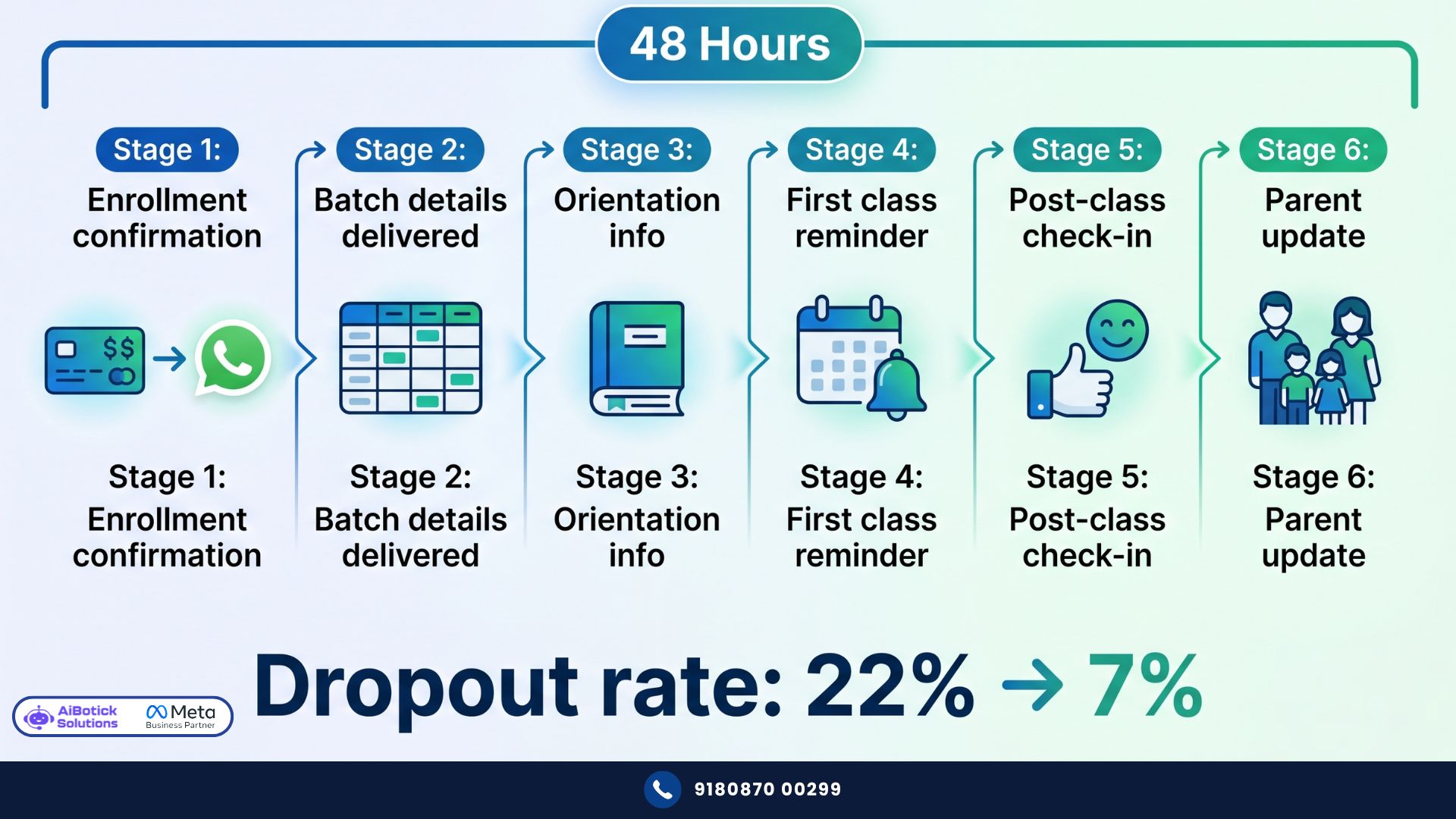
Stage 1 — Enrollment Confirmation (Fires Immediately After Payment)
“🎉 Welcome to [Institute Name], [Student Name]!
Your enrollment is confirmed for [Course Name] — Batch [Batch Code/Name].
Here’s what happens next: 📋 Your batch details and schedule: arriving in the next message 📚 Study material pickup/delivery: [Details] 👨🏫 Meet your faculty: [Brief intro] 📅 Your first class: [Date, Time, Venue/Link]
You’ve made a great decision. We’re genuinely excited to have you in the batch. 🙏 — [Institute Name] Team”
This message — warm, organised, forward-looking — immediately reassures. The parent who just transferred Rs.65,000 sees this within seconds and thinks: “Good. They’re professional. We made the right call.”
Stage 2 — Batch Details and Schedule (Fires 2 Minutes After Stage 1)
“[Student Name]’s Batch Details 📋
📚 Course: [Course Name] 🏫 Batch: [Batch Name] 📅 Schedule: [Days — eg: Mon/Wed/Fri] ⏰ Timings: [Time] 👨🏫 Faculty: [Faculty Name] — [Brief credential] 📍 Classroom: [Room number/Floor/Building] 💻 Online link (if hybrid): [Link]
Save this message — you’ll need these details regularly. First class starts: [Date]. See you there! 😊”
Structured. Complete. Saveable. Parent screenshots this and has everything they need in one place.
Stage 3 — Welcome and Orientation Information (Day 1)
“Good morning [Student Name]! 🌟
A few important things before your first class:
📖 Study materials: [How to access — pickup/download/delivery timeline] 📱 Student portal login: [Link + How to register] 📞 Doubt support: [WhatsApp number or timing for doubt clearance] 📋 Important rules: [Link to student handbook or brief key rules]
Pro tip from your faculty: [Genuine, specific tip for the exam — not generic motivation]
Any questions? Just reply here. We’re with you all the way. 🙏”
The “pro tip from your faculty” element — this is where you differentiate. Generic onboarding sends administrative information. Great onboarding sends value before the first class even starts.
Stage 4 — First Class Reminder (24 Hours Before)
Same structure as demo class reminders — but now it’s for the actual first class.
“[Student Name], your first [Course Name] class is tomorrow!
⏰ [Time], [Date] 📍 [Location/Link]
What to bring: ✅ Notebook and pen (yes, still relevant even with digital notes 😄) ✅ [Any specific requirement] ✅ Your questions — [Faculty Name] specifically encourages questions in the first class
Any last-minute concerns? Reply here. See you tomorrow! 🙏”
Stage 5 — Post First Class Check-in (Same Evening)
“Hi [Student Name]! How was your first class today? 😊
[Faculty Name] mentioned the batch has a great energy. Hope you felt it too!
Quick check: ✅ Got your study material? ✅ Access to student portal working? ✅ Batch schedule clear?
Anything confusing or missing — just reply and we’ll sort it within the hour. — [Institute Name]”
This message does something most institutes never do — it follows up after the first class. Parent and student feel seen. Issues get flagged immediately before they fester.
Stage 6 — Parent Engagement Message (Day 3)
This one is for the parent specifically — not the student.
“Namaste [Parent Name]! 🙏
[Student Name] has completed their first 2 days at [Institute Name]. Here’s a quick update:
✅ Attendance: Present and engaged ✅ Batch status: On schedule 📊 First assessment: [Date — eg: “in 3 weeks”]
As parents, you can always reach us here on WhatsApp for any concern — big or small. We believe the student-parent-institute triangle only works when all three stay connected.
Thank you for trusting us with [Student Name]’s preparation. 🙏 — [Director Name / Faculty Name], [Institute Name]”
This message builds trust with parents at a deeper level. They feel like partners — not customers. That feeling translates directly into long-term retention, fee payment behavior, and referrals.
The Dropout Prevention WhatsApp Flow — Often Worth More Than the Onboarding Itself
Here’s something most institutes don’t think about until it’s too late.
The highest dropout risk window — Week 2 to Week 6 of enrollment.
The initial excitement wears off. First assignment is harder than expected. Student misses a class, falls behind, feels embarrassed to ask. Silently disengages. Stops coming. Fee for next installment gets “delayed.” You lose them.
WhatsApp student onboarding automation includes a dropout prevention layer.
Week 2 — Engagement check: “Hi [Student Name]! Week 2 done 💪 How are you finding the pace so far? Be honest — it helps us help you better. Reply with: 😊 Going great / 😐 Managing okay / 😕 Finding it tough”
Students who reply “finding it tough” — immediately flagged. Counsellor reaches out personally. Issue addressed before it becomes a dropout.
Week 4 — Progress acknowledgment: “[Student Name], 1 month in! 🎉 You’ve attended [X] classes and covered [Y] topics. That’s real progress.
Upcoming: [First major test/assessment] on [Date]. Start your preparation with: [Specific resource or topic focus].”
Specific progress data makes students feel accountable and seen. Not a generic “keep it up” message.
If student misses 3 consecutive classes — automated alert: Bot detects absence from attendance data. Fires: “Hi [Parent Name], we noticed [Student Name] hasn’t been able to attend the last 3 classes. Is everything okay? We’d love to help them catch up — reply here and we’ll arrange a catch-up session.”
This intervention — at the right moment — saves enrollments that would otherwise have silently fallen off.
Real Numbers — Lucknow Skill Development Centre
Concrete. Because this is where it gets real.
Professional skill development centre. Lucknow. Courses ranging from Rs.15,000 to Rs.45,000. Average batch size: 25 students.
Before WhatsApp student onboarding automation:
- Dropout rate in first 60 days: 22%
- Average parent complaint about communication: 8-10/month
- Course completion rate: 68%
- Referral rate (students referring friends): 11%
After implementing full WhatsApp student onboarding flow (120 days):
- Dropout rate in first 60 days: 7% (68% reduction)
- Parent complaints about communication: 0-1/month
- Course completion rate: 84%
- Referral rate: 29%
Actually wait — that referral rate jump deserves attention. From 11% to 29%. Nearly 3x.
Why? Because students who feel supported, organised, and valued — they talk about it. “Yaar, is institute ka WhatsApp support bahut achha hai.” Word of mouth from genuine experience. Not from a referral incentive programme — just from delivering a great onboarding experience.
At 25 students per batch × 12 batches per year — 22% dropout vs 7% dropout = 45 additional students completing annually. At average Rs.30,000 per course = Rs.13,50,000 in additional revenue from retention alone.
That’s not new customer acquisition money. That’s money you already had — just keeping it instead of losing it.
For how these retention improvements connect to your full WhatsApp automation ROI — our ROI guide breaks down dropout prevention economics with actual numbers.
What Education Institutes Get Wrong About Student Onboarding
One assumption. Kills every onboarding system before it starts.
“Our staff will handle onboarding personally. It’s better than automation.”
No no, let me push back on this directly.
Personal attention is valuable. At specific moments — the demo class, the first one-on-one doubt session, the result announcement call. Human touch at those moments matters enormously.
But personal attention for routine information delivery? “Here’s your batch schedule.” “Here’s your login.” “Here’s tomorrow’s reminder.” These messages don’t get better when a human sends them. They just get slower and less consistent.
Your staff sends 30 onboarding messages manually today. Forget one student. Send wrong batch timing to another. Schedule confusion for a third. These errors — under-resourced humans doing high-volume work — they erode trust.
Automation sends 300 onboarding messages with perfect accuracy. Every student gets the same quality. Every detail correct. Every timing right.
Reserve your staff’s attention for moments that actually require human judgment. Automate everything that doesn’t.
The Lucknow institute — their counsellors went from spending 4 hours daily on routine onboarding communication to 45 minutes. Those 3+ hours redirected to actual student relationship building — doubt clearance, parent calls, result reviews. Quality of human interaction improved because automation handled the routine.
For how WhatsApp handles the broader student communication journey beyond onboarding — our coaching institute guide covers the complete year-round communication system.
Setting Up WhatsApp Student Onboarding — Exactly What to Do First
Day 1 — Build the enrollment confirmation flow: Payment received → immediate WhatsApp confirmation → batch details in 2 minutes. This alone transforms the post-enrollment experience. Do this first.
Day 2-3 — Build the first-class journey: Orientation message → first class reminder (24hrs before) → post first class check-in. Three messages. Powerful impact.
Week 2 — Build parent communication: Day 3 parent update message. Dropout risk check at Week 2.
Month 2 — Build dropout prevention: Absence detection alert. Progress acknowledgment at Week 4. These require attendance data integration — slightly more technical but worth every minute.
Month 3 — Build referral trigger: Course completion WhatsApp + referral programme invitation. Capitalise on the positive completion experience.
Build in this order. Each stage delivers value before you build the next. Don’t wait until the entire system is perfect before going live. Start with enrollment confirmation. The improvement is immediate and visible.
Toh yaar — ek real sawaal.
Aapke institute mein abhi ek student enroll karta hai. Unhe next 48 ghante mein kya experience milta hai?
If the honest answer is “not great” — or “depends on which counsellor is on duty” — WhatsApp student onboarding automation solves that. Permanently. Consistently. Without depending on which staff member happens to be available.
Every student. Same quality. Every time.
Tap below. 👇 Tell us your institute type, batch size, and current onboarding process — we’ll map out your complete WhatsApp student onboarding flow and show you what dropout reduction looks like for your numbers.
— Mohit Shah | 15+ years in IT industry | Now helping businesses figure out what actually works
Q1: What does a complete WhatsApp student onboarding flow include for coaching institutes?
A1: A complete WhatsApp student onboarding flow includes 6 stages — immediate enrollment confirmation after payment, batch details and schedule delivery within 2 minutes, orientation information on Day 1, first class reminder 24 hours before, post-first-class check-in the same evening, and a parent engagement message on Day 3. Beyond these 6 stages, advanced implementations include dropout prevention sequences — Week 2 engagement checks, Week 4 progress updates, and automated alerts when students miss consecutive classes.
Q2: How does WhatsApp student onboarding automation reduce dropout rates?
A2: WhatsApp student onboarding automation reduces dropouts by catching disengagement early — before it becomes a dropout. Automated attendance monitoring triggers alerts when students miss 3+ consecutive classes. Week 2 engagement surveys identify struggling students proactively. Progress acknowledgment messages maintain motivation and accountability. A Lucknow skill development centre reduced first-60-day dropout rates from 22% to 7% using these flows, saving Rs.13.5L annually in revenue that would have otherwise been lost to early dropouts.
Q3: Should coaching institutes use WhatsApp automation or personal staff for student onboarding?
A3: Both — but for different purposes. Automation handles routine information delivery perfectly: batch schedules, login details, reminders, progress updates. These messages don’t improve when a human sends them — they just become slower and inconsistent. Personal staff attention should be reserved for high-judgment moments: doubt clearance, struggling student intervention, parent concern calls, result discussions. Automation frees staff from 3-4 hours of daily routine communication so they can invest that time in the human interactions that actually build loyalty and drive referrals.