Most Indian businesses treat WhatsApp like a broadcast tool. Send an offer. Hope someone buys. Repeat next month.
That’s not a strategy. That’s desperation dressed up as marketing.
A proper WhatsApp marketing strategy is a system — one that acquires leads, nurtures them, converts them, retains them, and turns them into referral sources. All on one platform. All largely automated. Here’s the complete playbook — built from 4+ years of implementing this across Indian businesses of every size and sector.
Why WhatsApp Marketing Is Different From Every Other Channel You’ve Used
Seedha bolta hoon — WhatsApp marketing doesn’t work like email marketing, social media marketing, or SMS marketing. It’s fundamentally different. And businesses that treat it like those other channels fail.
Here’s why it’s different:
It’s personal by default. WhatsApp is where your customers talk to family and friends. When you enter that space, you’re not an advertiser — you’re a participant in their personal communication environment. Treat it accordingly.
95% open rate isn’t guaranteed — it’s conditional. People open WhatsApp messages because they trust the sender. The moment you betray that trust (spam, irrelevant messages, too frequent contact), open rates drop to 30% and block rates spike. The 95% belongs to businesses that have earned it.
Two-way conversation is the product. Unlike email where “reply” is rare, WhatsApp expects replies. A WhatsApp marketing strategy that doesn’t plan for and leverage two-way conversation is a WhatsApp broadcast strategy — not a marketing strategy.
Opt-out is permanent. On email, people unsubscribe and can resubscribe. On WhatsApp, if someone blocks you, they’re gone. Forever. And if your block rate climbs above 2%, Meta starts restricting your number. The irreversibility makes every message decision high-stakes.
Understanding these differences is what separates businesses that consistently generate crores from WhatsApp from businesses that “tried WhatsApp marketing and it didn’t work.”
The 5-Layer WhatsApp Marketing Strategy Framework
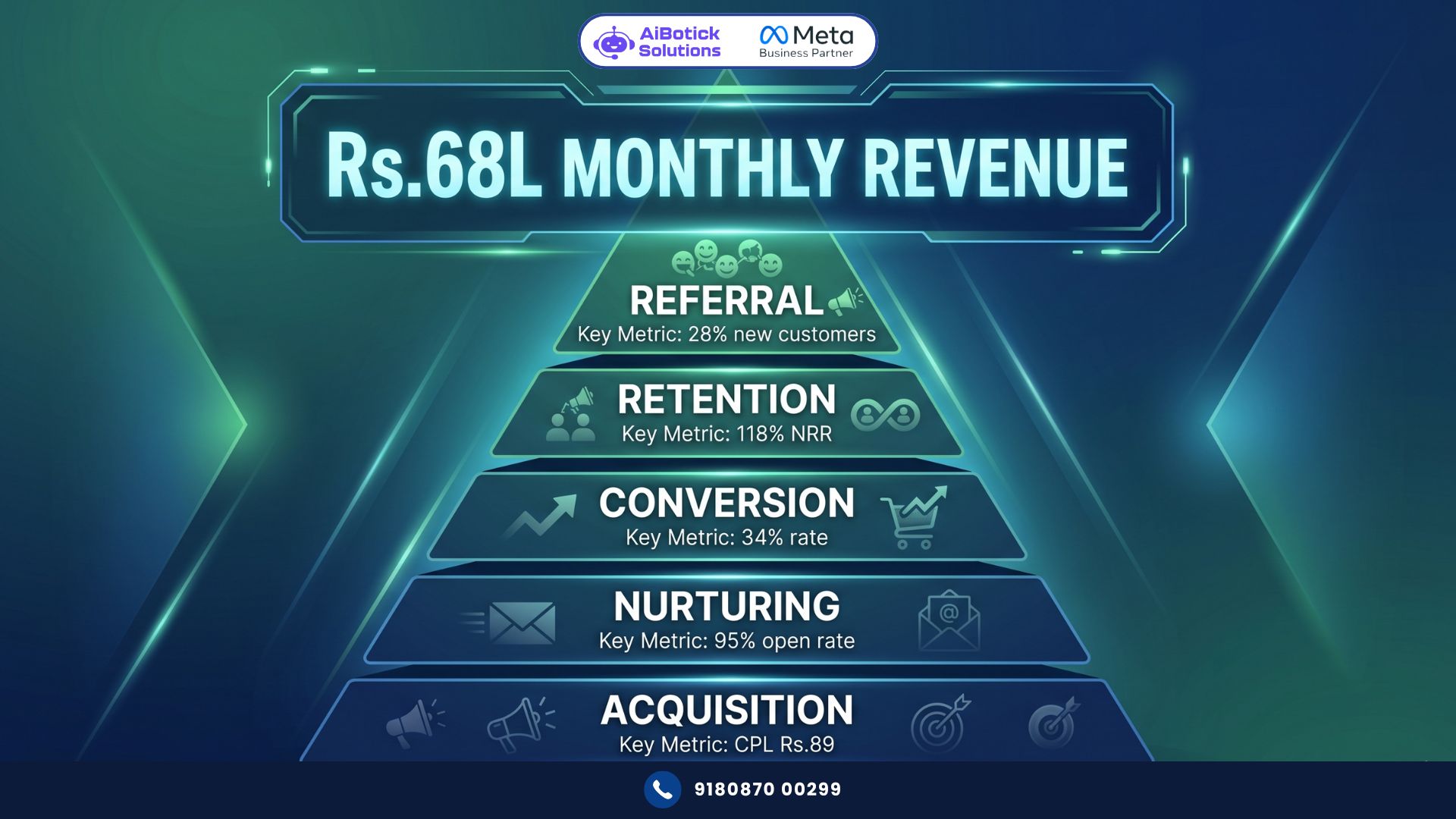
A complete WhatsApp marketing strategy operates across 5 distinct layers. Most businesses only implement 1-2. The ones generating serious revenue implement all 5.
Layer 1: Acquisition — Getting people into your WhatsApp ecosystem Layer 2: Nurturing — Building relationship and moving leads toward purchase Layer 3: Conversion — Turning warm leads into paying customers Layer 4: Retention — Keeping customers coming back Layer 5: Referral — Turning customers into growth engines
Let’s build each layer.
Layer 1: WhatsApp Lead Acquisition Strategy
You can’t market to people who aren’t in your WhatsApp ecosystem. Building your opted-in contact database is the foundation of your entire WhatsApp marketing strategy.
What People Get Wrong About WhatsApp Acquisition
Most businesses run Facebook ads, collect leads in a form, and then start messaging those leads on WhatsApp.
Wrong order. Wrong approach.
When a lead fills a form and you WhatsApp them, they didn’t opt into WhatsApp communication. They filled a form. Different thing. Block rate on this approach: 15-25%. Number quality goes Red. Campaigns shut down.
The right approach: the WhatsApp channel itself is the opt-in mechanism. Leads come INTO WhatsApp. They initiated. That’s consent.
The 7 Best WhatsApp Acquisition Methods for Indian Businesses:
1. Click-to-WhatsApp Ads (Facebook/Instagram) Ad → WhatsApp opens → conversation starts. Lead came to you. Highest intent. Lowest block rate. CPL 60-75% lower than landing page forms. Already covered in detail in our complete click-to-WhatsApp ads guide — this is your primary paid acquisition channel for a serious WhatsApp marketing strategy.
2. Comment Automation (Instagram/Facebook) Customer comments on your post → automatic DM with WhatsApp link → they tap → WhatsApp conversation starts. Social media engagement converted to WhatsApp lead. High intent (they already engaged with your content).
3. WhatsApp Link in Bio and Profile Every social media profile. Every email signature. Every business card. Every invoice. Consistent exposure = steady organic flow of people into your WhatsApp ecosystem.
4. QR Code at Physical Touchpoints Restaurant table. Product packaging. Store entrance. Invoice. QR code scanned → WhatsApp opens with pre-filled message → lead captured. Works exceptionally well for businesses with physical presence or product that reaches customers physically.
5. “WhatsApp Exclusive” Offers “Get 20% off — only for our WhatsApp members.” People opt in for the benefit. You build a list of people motivated to engage. Works for D2C, restaurants, retail, services.
6. Lead Magnet via WhatsApp “Send ‘GUIDE’ to [WhatsApp number] for our free [relevant resource].” Mention in social media, blog posts, email. People initiate conversation to get the resource. Opt-in + initial engagement in one step.
7. Existing Customer Migration Your current customers across email, SMS, calls — invite them to communicate via WhatsApp. “For faster support and exclusive updates, connect with us on WhatsApp: [link].” Typically 30-40% migrate in the first month.
Acquisition Target: For every Rs.1L you spend on paid acquisition, you should be building 500-1,500 opted-in WhatsApp contacts (depending on industry CPL). Organic methods should add 100-300 contacts per month for a business with active social media presence.
Layer 2: WhatsApp Nurturing Strategy
Most leads aren’t ready to buy when they first contact you. They need information, trust-building, and the right moment.
WhatsApp nurturing is how you stay present without being annoying.
The Golden Rule of WhatsApp Nurturing:
Every message must earn its place. Ask yourself: “Would my customer be glad they received this?” If the answer is “probably not” — don’t send it.
Nurturing Message Types That Work:
Educational content: “3 things most people don’t know about [relevant topic in your industry]” — teaches something useful, positions you as expert, no selling.
Case studies with specific numbers: “A client similar to you [specific situation] achieved [specific result] in [specific timeframe].” Specific beats generic every time.
Relevant market updates: Industry news, regulation changes, market trends — things that affect your customers whether they buy from you or not.
Personal insights: “I’ve been seeing a pattern with [client type] businesses lately — [observation]. Worth being aware of.” Feels like advice from a knowledgeable contact, not marketing.
Behind-the-scenes: How your product is made. A day in your operation. Your team’s expertise. Builds familiarity and trust.
Nurturing Frequency:
- New leads (0-30 days): 2-3 messages per week maximum
- Warm leads (engaged but not purchased): 1-2 messages per week
- Older leads (30-90 days, lower engagement): 1 message per week or less
Drop below these limits by 20% and you lose momentum. Exceed them by 50% and you increase block rate. Stay in range.
The Drip Architecture:
Your nurturing must be structured, not random. Build 6-8 message sequences for different lead types — new lead, product-specific inquiry lead, service inquiry lead, re-engagement lead. Each sequence tells a coherent story that moves the lead toward a decision.
Layer 3: WhatsApp Conversion Strategy
Nurturing creates readiness. Conversion creates revenue.
Most businesses wait too long to ask for the sale. They nurture for 3 months and never actually close. Or they ask too early — first message is an offer and they get blocked.
The Conversion Trigger Framework:
Don’t convert on a schedule — convert on signals.
High-intent signals that should trigger conversion conversation:
- Lead clicks a product link 2-3 times
- Lead asks a specific pricing question
- Lead asks about delivery or timeline
- Lead compares two specific options
- Lead asks “how do I get started?”
- Lead mentions a deadline (“I need this before Diwali”)
When these signals appear, your team should initiate the conversion conversation. Not wait for more nurturing.
The WhatsApp Conversion Conversation:
Don’t pitch. Ask and solve.
“Hi [Name], noticed you were looking at [specific product/service] — had a couple of people in similar situations last week who went with [option X] because of [reason]. Are you looking for [specific use case] or something different?”
This response shows you noticed, you understand their situation, and you’re going to help them pick — not sell them something.
Conversion Tools to Deploy:
- WhatsApp Flows for structured data collection (need, budget, timeline)
- Payment link (Razorpay integration) sent immediately when customer says yes
- Limited-time offers with genuine expiry (not fake urgency)
- Social proof at the moment of decision (“48 businesses in your sector started last month”)
Conversion Timeline Target:
B2C: Lead should convert within 7-21 days of first WhatsApp contact. B2B: Lead should convert within 21-60 days depending on deal size.
If a lead is past these windows without converting, their status changes from “active lead” to “nurturing” — continue the relationship but stop prioritising for manual conversion effort.
Layer 4: WhatsApp Retention Strategy
This is where most businesses leave the biggest money on the table.
A customer who has already bought from you is 5-7x more likely to buy again than a new lead. Your WhatsApp marketing strategy must prioritise retention as aggressively as acquisition.
Actually wait — let me correct myself. Not “as aggressively.” More aggressively. Because your existing customers are:
- Cheaper to reach (no ad spend)
- More trusting (existing relationship)
- More likely to buy (proven purchase behaviour)
- More likely to refer (satisfied customers do this)
The 4 WhatsApp Retention Pillars:
1. Post-purchase onboarding sequence The moment payment is received, a 5-7 message sequence begins over 2-3 weeks:
- Day 0: Welcome + what to expect next
- Day 3: “How’s everything going?” check-in
- Day 7: Tip/resource to get maximum value
- Day 14: Milestone celebration or usage check
- Day 21: Feature/benefit they might have missed
- Day 30: Satisfaction check + soft referral ask
2. Regular value delivery Monthly or fortnightly message that gives customers something useful — tip, tool, insight, update — related to your product/service. Not promotional. Pure value. Keeps relationship alive between purchases.
3. Re-engagement sequences Customer hasn’t purchased in 60-90 days? Automated re-engagement: “Hi [Name], it’s been a while! We’ve added [new thing] since your last [purchase/engagement]. Thought you’d want to know. And here’s a [loyalty offer] for being a valued customer.”
4. Birthday/anniversary triggers Customer’s birthday → personalised WhatsApp message with birthday offer. Purchase anniversary → “One year since you joined us — here’s what you’ve achieved/received.” Personal moments create emotional connection that drives loyalty.
I’ve tracked retention metrics across a Pune-based SaaS company that implemented this framework. Their NRR (Net Revenue Retention) went from 81% to 114% in 6 months. Existing customers were generating more revenue than they were losing to churn. That’s the power of systematic retention on WhatsApp.
Layer 5: WhatsApp Referral Strategy
The most underutilised layer. And the highest-ROI layer.
A customer who refers someone to you is doing three things simultaneously:
- Endorsing your business (highest trust signal possible)
- Pre-qualifying the lead (referred leads convert 4x better)
- Marketing at zero cost
Your WhatsApp marketing strategy must build a systematic referral engine.
The WhatsApp Referral System:
Step 1: Identify the right moment Ask for referrals when satisfaction is peak — immediately after a great outcome, after a positive CSAT response, after a milestone achieved.
Never ask for referrals when the customer is mid-problem or at the end of a support interaction.
Step 2: Make it embarrassingly easy Don’t ask “Do you know anyone who might benefit?” That’s vague and creates work.
Instead: “Hi [Name], you mentioned [positive outcome] last week — thrilled to hear it! If you have a colleague in [similar situation] who’d benefit from the same, I can reach out to them directly. Just share their WhatsApp number here and I’ll take care of the rest.”
One step. Share a number. Done.
Step 3: Reward it Cash referral bonus. Discount on next purchase. Service upgrade. Free month. The reward should be meaningful relative to your product’s value.
For a Rs.50,000/year SaaS: a Rs.5,000 referral bonus is reasonable. For a Rs.2,000 D2C product: a 20% discount on next order.
Step 4: Close the loop When the referred contact converts, WhatsApp the referrer: “Great news — [Referred name] just joined! Your referral bonus of [reward] is on its way. Thank you!”
This creates the referral loop — referrer feels valued, likely to refer again.
Referral Target: A mature WhatsApp marketing strategy should see 20-30% of new customers coming from referrals within 12 months. Businesses I’ve tracked hit this number consistently when the referral system is properly built and maintained.
The WhatsApp Marketing Calendar: How to Plan a Month
Without a calendar, your WhatsApp marketing strategy becomes reactive. Random. Ineffective.
Here’s a sample monthly WhatsApp marketing calendar for a B2C business:
Week 1:
- Day 1: Value message (tip/insight) to all active contacts
- Day 3: Drip message to new leads (automated)
- Day 5: Feature spotlight on a product most haven’t tried
Week 2:
- Day 8: Case study or success story
- Day 10: Mid-month promotional offer (segmented — only to customers who haven’t purchased this month)
- Day 12: Re-engagement message to dormant contacts (90+ days inactive)
Week 3:
- Day 15: Educational content
- Day 17: Drip follow-up sequence (automated)
- Day 19: Referral ask (to customers who gave positive feedback in Month 1)
Week 4:
- Day 22: Product/service update or new launch announcement
- Day 25: Monthly loyalty recognition (“You’ve been with us X months — thank you”)
- Day 28: Month-end offer (genuine — not fake urgency)
That’s 10-12 touchpoints per month across different purposes. No single contact receives all of them — segmentation ensures each person gets what’s relevant to them.
Segmentation: The Skill That Separates Good WhatsApp Marketers From Great Ones
Sending the same message to all 3,000 contacts is the most common WhatsApp marketing strategy failure mode.
Your customer who just purchased doesn’t need a promotional offer. Your customer who hasn’t engaged in 60 days needs a re-engagement message. Your customer who asked about Product A needs content about Product A — not Product B.
Minimum segmentation for any serious WhatsApp marketing:
- New leads (0-30 days): Nurturing sequence focused on education and trust building
- Warm leads (engaged, not purchased): Conversion-focused content, social proof, objection handling
- Recent customers (0-90 days post-purchase): Onboarding, value delivery, upsell opportunity
- Loyal customers (90+ days, multiple purchases): Retention, referral asks, loyalty rewards
- Dormant contacts (90+ days, no engagement): Re-engagement with low-commitment value offer
- Churned customers: Win-back sequence (maximum 3 messages, then archive)
The more granular your segmentation, the higher your relevance, the lower your block rate, the higher your conversion. This is non-negotiable in a mature WhatsApp marketing strategy.
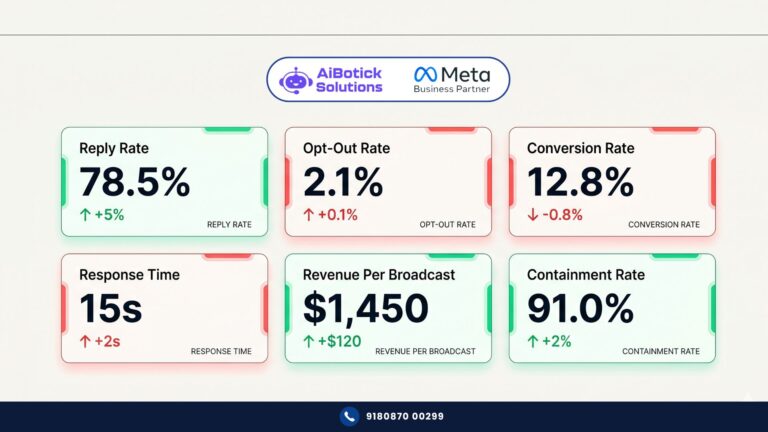
Measuring Your WhatsApp Marketing Strategy
What you don’t measure, you can’t improve. Track these weekly:
Acquisition metrics:
- New WhatsApp contacts added (by source)
- Cost per WhatsApp contact (paid channels)
- Opt-in rate from website/social traffic
Engagement metrics:
- Message open rate by campaign type
- Response rate (% of recipients who reply)
- Block rate (target: under 1% per campaign)
- Number quality rating (should stay Green)
Conversion metrics:
- Lead-to-customer conversion rate by source
- Average days from first WhatsApp contact to purchase
- Revenue attributed to WhatsApp by month
Retention metrics:
- Repeat purchase rate from WhatsApp customers vs other channels
- NRR (Net Revenue Retention) from WhatsApp-acquired customers
- Lifetime value of WhatsApp customers vs other acquisition channels
Referral metrics:
- Referral requests sent monthly
- Referral conversion rate
- % of new customers from referral
A complete WhatsApp marketing strategy dashboard tracks all of these. Monthly review. Quarterly strategy adjustment.
What a Successful WhatsApp Marketing Strategy Looks Like at Scale
Let me show you what this looks like fully implemented, with real numbers from a composite of businesses I’ve tracked.
Business: B2C coaching and courses company, Mumbai. Rs.1.8Cr monthly revenue.
WhatsApp marketing contributions (after 12 months of strategy implementation):
- WhatsApp-acquired customers: 34% of total new customers
- WhatsApp-retained customers: NRR 118% (retention revenue exceeds churn)
- WhatsApp referral customers: 28% of new customers
- WhatsApp broadcast revenue (monthly campaign): Rs.38L/month from 12,000 contacts
- WhatsApp drip campaign revenue: Rs.22L/month
- Total WhatsApp marketing contribution: Rs.68L/month (38% of total revenue)
What they spent to generate this:
- WhatsApp platform: Rs.25,000/month
- Content and strategy management: Rs.40,000/month
- Meta conversation charges: Rs.52,000/month
Total spend: Rs.1,17,000/month Revenue generated: Rs.68L/month ROI: 58x
This is achievable. Not overnight. 12 months of building, iterating, and scaling. But it’s achievable. And it’s happening at Indian businesses right now.
Ab toh puri picture clear hai — a WhatsApp marketing strategy isn’t just sending messages. It’s a complete customer acquisition and retention system built on India’s most personal communication channel.
Jo businesses yeh samajh gaye — woh market mein hai. Jo nahi samjhe — woh competitors ke liye leads generate kar rahe hain. 💯
Ready to build a complete WhatsApp marketing strategy for your business?
— Mohit Shah | 15+ years in IT industry | 4+ years in WhatsApp automation | Worked with various MNC brands | Now helping businesses figure out what actually works
Q1: How long does it take for a WhatsApp marketing strategy to start showing measurable results?
A1: Layer 1 (acquisition) and Layer 3 (conversion) show results within 30-60 days of proper implementation — you’ll see leads entering and converting faster than your current methods. Layer 4 (retention) shows measurable improvement in repeat purchase rates within 60-90 days. Layer 5 (referral) takes 90-120 days to generate consistent referral volume. A complete WhatsApp marketing strategy shows compounding results — each month better than the last — with the 6-month mark typically showing a clear revenue step-change. The Mumbai coaching company hit Rs.68L monthly at month 12. At month 3, they were at Rs.22L monthly. The trajectory is steep once all 5 layers are running simultaneously.
Q2: What’s the minimum database size needed before a WhatsApp marketing strategy becomes worth investing in?
A2: With 200 opted-in contacts you can start seeing meaningful results from a WhatsApp marketing strategy — particularly from conversion nurturing (warm leads) and retention (existing customers). With 500+ contacts, all 5 layers start contributing meaningfully. With 2,000+ contacts, the broadcast campaign layer alone justifies full platform investment. Don’t wait for a “large enough” database — start building the strategy with whatever contacts you have now. The database grows as a byproduct of the acquisition layer being active. Businesses that wait for a big database before starting strategy implementation never build the big database.
Q3: How do you prevent a WhatsApp marketing strategy from becoming spammy and getting your number banned?
A3: Three non-negotiable rules: only message opted-in contacts (people who initiated WhatsApp contact with you), respect message frequency limits (maximum 3-4 promotional messages per month per contact), and deliver genuine value in every message (ask “would my customer be glad to receive this?” before sending). Monitor your block rate weekly — if it exceeds 1% on any campaign, pause and diagnose before sending more. Use separate WhatsApp numbers for high-frequency campaigns vs premium customer communication. And always use Meta-approved templates for outbound messages — this is both a policy requirement and a quality filter that forces you to think before sending.