Ek second ruko.
Before I say anything else — I want you to do something.
Open your email right now. Go to your Promotions tab.
How many unread emails are sitting there?
Hundreds? Thousands?
Now think about your WhatsApp. When was the last time you had more than 10 unread messages that you hadn’t at least glanced at?
Yeah. Exactly.
And yet — most Indian businesses are still sending their most important communication, their best offers, their follow-ups, their reminders — via email.
To an inbox that looks like that.
Yaar, I’ve been in this industry 15 years. And this one thing — this single channel mismatch — is probably the most expensive mistake I see businesses make. Not the biggest. Not the flashiest. But quietly, consistently, the most expensive.
Let me show you why.
WhatsApp Open Rate — Where Does the 95% Number Actually Come From?
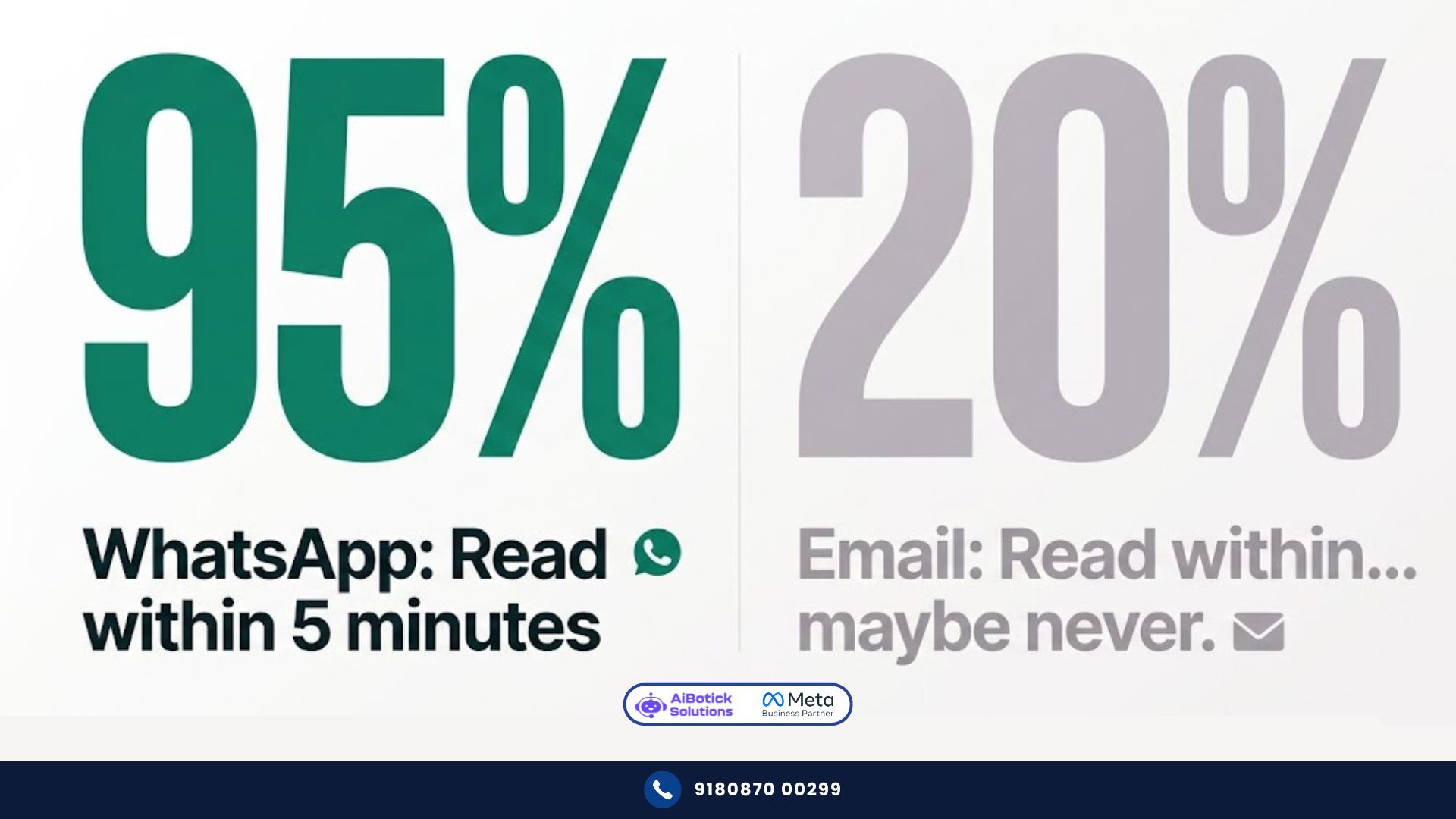
95% WhatsApp open rate. 20% email open rate.
I’ve said it. Everyone says it. But let me be honest with you for a second — where do these numbers come from? Are they real?
Yes. And no. Let me explain.
The 95% figure comes from multiple industry studies — Twilio, Meta’s own data, various marketing research firms. It’s been quoted so many times it’s become almost cliché. But here’s the thing — in my own experience across hundreds of business deployments? It holds up.
Actually, sometimes it’s higher.
I’ve seen WhatsApp broadcast campaigns hit 97-98% delivery AND open rates for businesses with warm, opted-in lists. Businesses whose customers actually want to hear from them.
The 20% email figure? That’s the global average. India is often lower — 12-18% for most B2C businesses. And here’s something nobody tells you — “open” in email tracking means the tracking pixel fired. Which means the email loaded. Which means… the person might have seen the subject line, decided it was junk, and deleted it without reading a single word.
So the real gap? Might be even bigger than 95 vs 20.
Want to understand the full picture of WhatsApp vs email for Indian businesses? We broke it down in detail here.
Okay But What Does This Actually MEAN for My Business?
Numbers are nice. Real money is better.
Let me do the math for you. And I want you to actually sit with this — not just skim past it.
Say you’re an education company. Coaching institute. 2,000 leads in your database — people who enquired at some point but didn’t join yet.
You run a “new batch starting” campaign.
Via Email:
- Open rate 18% = 360 people see it
- Click rate ~3% of opens = ~11 people click
- Enquiries generated = maybe 4-6
Same campaign. Same 2,000 people. Via WhatsApp:
- Open rate 92% = 1,840 people see it
- Response rate 15% = 276 people respond or click
- Enquiries generated = 80-120
Same list. Same offer. Same day.
One gives you 4-6 enquiries. Other gives you 80-120.
Bhai — agar ek admission ka value Rs.15,000 hai — we’re talking Rs.60,000-90,000 revenue vs Rs.12-18 lakh revenue.
From the same database. The same afternoon.
I’m not guessing here. I’ve watched this exact scenario play out — not once, not twice — dozens of times across different industries. The numbers shift slightly by industry and list quality. But the direction never changes. WhatsApp wins. Every time.
The Reason Nobody Talks About — Indian Psychology
Okay. This part. This is the part I find genuinely fascinating.
And I don’t think I’ve seen anyone explain it properly. So let me try.
Email was built for a certain kind of user. Someone who sits at a desk. Opens a laptop. Has a structured workday. Processes communication in batches.
That’s not most Indians.
India’s internet story is mobile-first. Smartphone-first. Our habits formed around apps — not browsers, not email clients. WhatsApp arrived early, spread fast, went deep. Into every layer of Indian society. Rickshaw drivers. Kirana owners. CAs. CEOs. Housewives. Students. Everyone.
WhatsApp isn’t an app for most Indians. It’s how they communicate. Full stop.
So when a business sends a WhatsApp — even from an unknown number — there’s a reflex. The notification pops. The thumb moves. The message opens. It’s almost unconscious.
Email? The brain has learned to filter it. Promotions tab exists for a reason — because humans trained Gmail to put that stuff away where they don’t have to deal with it.
You’re not fighting email open rates. You’re fighting 20 years of inbox conditioning.
WhatsApp sidesteps that entirely.
WhatsApp Open Rate vs Email — The Time Factor That Actually Hurt
Open rate is one thing. When the message gets opened — that’s another thing entirely.
Average time to open a WhatsApp message in India: 3-5 minutes.
Average time to open a business email in India: 6.4 hours. On a good day. Weekends — forget it. Could be Monday before they see it.
Now think about what happens in sales when you follow up with a lead.
They filled your form at 2pm on a Tuesday. They’re interested right now — in this moment. That interest has a half-life. Every hour that passes, it drops. By the time your email follow-up lands in their inbox and they actually see it — 6 hours later — they’ve moved on. Spoken to a competitor. Forgotten why they even filled the form.
WhatsApp follow-up hits them in 3 minutes. While they’re still thinking about it. While the problem they were trying to solve is still fresh.
Dekho — I’ll say it plainly. In sales, speed is a superpower. WhatsApp gives you that superpower. Email takes it away.
“But People Find WhatsApp Messages Intrusive”
I hear this one a lot. Usually from someone who’s received a spammy bulk WhatsApp from some random business and hated it. Fair.
But here’s the distinction that matters — and it’s huge:
Spam WhatsApp = Unsolicited. Random. Irrelevant. Sent to people who never asked to hear from you. Yes — intrusive. Annoying. Gets you blocked AND reported to Meta.
Proper WhatsApp communication = Sent to people who opted in. Who gave you their number because they’re interested. Who actually want updates about your product, their order, their course, their appointment.
That second type? Customers love it.
I’ve seen NPS scores go UP after businesses switched to WhatsApp for customer communication. Because suddenly — support is fast. Updates are instant. Reminders actually arrive. The experience feels personal.
One time — actually, this is a good story. A travel agency I worked with was terrified of WhatsApp broadcasts. “Our clients are premium. They’ll find it cheap.”
We convinced them to try one campaign. A Diwali offer. Sent to 800 opted-in past clients.
Within 2 hours — 47 replies. 12 booking inquiries. 3 confirmed bookings worth Rs.4.5 lakh.
Their most successful email campaign ever? 6 replies from the same list size.
After that — no more arguments about WhatsApp being “intrusive.”
The Open Rate is Just the Beginning
Here’s what most articles miss when they talk about WhatsApp vs email open rates.
Open rate is the entry point. What happens after the open is where it really gets interesting.
Email after open: Customer reads. Maybe clicks a link. Goes to a landing page. Fills a form. Waits for a callback. Somewhere in that chain — most people drop off.
WhatsApp after open: Customer reads. Replies directly in the same chat. Conversation starts. Your team — or your bot — responds instantly. Questions get answered. Objection gets handled. Booking happens. Payment link sent. Payment done.
All. In. One. Chat.
No landing page. No form. No callback. No drop-off points.
The entire sales journey compressed into a single WhatsApp conversation.
And this — not just the open rate — is why the revenue impact is so dramatic.
Email opens a door. WhatsApp walks you through it, sits you down, and closes the deal.
Fine. But What About Deliverability? Email Is More Reliable, Right?
Hmm. Is it though?
Let’s be honest about email deliverability in 2026.
- Gmail’s Promotions tab filters most business emails automatically
- Spam filters are getting more aggressive every year
- Domain reputation issues can get your emails silently dropped — customer never even knows it arrived
- Unsubscribe rates are climbing as people clean up their inboxes
- Apple Mail Privacy Protection has basically broken email open tracking for iOS users
“But WhatsApp messages also get blocked.”
Yes — if you’re sending spam. If you have low quality ratings. If customers are reporting you.
But if you’re sending wanted, opted-in messages through an official API provider? Deliverability is near-perfect. 99%+. No promotions tab. No spam filter. No “your domain has been flagged.”
The message arrives. It gets seen. Simple.
One More Thing Before I Wrap Up
The 95% open rate — it’s powerful. But it’s also a responsibility.
Because if 95% of your customers are going to see your message — you better make sure it’s worth seeing.
Bad WhatsApp campaign = 95% of your customers see something annoying or irrelevant = mass blocks = Meta reduces your sending limits = your channel is damaged.
Good WhatsApp campaign = 95% of your customers see something genuinely useful = replies, conversions, goodwill = Meta sees high engagement = your channel gets stronger over time.
The number works for you or against you depending on what you send.
So — relevant messages. Opted-in audience. Right timing. Genuine value.
Do that — and 95% open rate becomes your biggest business asset.
Don’t do that — and it becomes your biggest liability.
Seedha baat. No sugarcoating.
Ready to see what WhatsApp automation looks like for your business? Start here — our plain-English guide to WhatsApp automation.
So What Now?
If you’ve read this far — you already know the answer.
WhatsApp isn’t the future of business communication in India. It’s the present. Right now. Today.
The businesses that figured this out 2 years ago have a head start. The ones figuring it out now are still early. The ones waiting — well. Math doesn’t wait.
If you want to see what a proper WhatsApp communication system looks like for your business — what you’d send, to whom, when, and what kind of results to realistically expect — just tap below. 👇
No forms. No hour-long sales calls. Just an honest conversation on WhatsApp — which is kind of the point.
— Mohit | 15 years in WhatsApp automation | Worked with Wati, AiSensy, DoubleTick, Interakt | Now helping businesses figure out what actually works
Q1: What is the open rate of WhatsApp messages compared to email in India?
A1: WhatsApp messages in India have an average open rate of 90-95%. Emails average 15-20% — and that’s being generous. Most promotional emails in India see 10-12% open rates. The gap is massive, and it directly impacts how many leads you convert, how many campaigns succeed, and how much revenue you generate from your existing customer base.
Q2: Why does WhatsApp have such a high open rate compared to email?
A2: Simple — Indians live on WhatsApp. The average Indian checks WhatsApp 25-30 times a day. Email? Once or twice, if that. WhatsApp notifications feel personal and urgent. Email notifications get batched, ignored, or filtered into promotions tabs never to be seen again. The channel matches Indian communication behaviour. Email doesn’t.
Q3: Does a higher open rate on WhatsApp actually translate to more sales?
A3: Yes — consistently. Higher open rate means more people see your message. More people seeing your message means more clicks, more replies, more conversions. Businesses switching from email campaigns to WhatsApp broadcasts typically see 3-5x better response rates on the same offer, same list, same day.