Your sales team works 9 to 6. Leads come in at 11 PM.
By morning, those leads have either moved on, forgotten they enquired, or worse — bought from your competitor who responded at 11:05 PM with an automated system.
A WhatsApp sales funnel doesn’t sleep. Doesn’t take weekends. Doesn’t get frustrated with unresponsive leads. It qualifies, nurtures, converts, and hands off to your human team only when a lead is genuinely ready to buy.
Here’s how to build one from scratch.
Why Traditional Sales Funnels Break on WhatsApp
Dekho, most businesses try to copy their existing sales funnel onto WhatsApp. They had an email funnel — welcome email, nurture sequence, promotional emails — so they replicate the same structure on WhatsApp.
Same logic. Different messages. Same order.
And it fails. Every time.
Here’s why: email funnels are designed for asynchronous, low-engagement communication. WhatsApp is synchronous, high-engagement, conversational. The medium changes everything.
An email funnel sends information and hopes the reader processes it passively. A WhatsApp sales funnel creates dialogue — asks questions, receives answers, adapts based on responses, and moves leads through stages based on actual signals rather than time elapsed.
The difference in mechanics:
Email funnel: Message 1 → wait 3 days → Message 2 → wait 5 days → Message 3 → sales call WhatsApp sales funnel: Lead messages → instant qualification → personalised response based on answers → next step triggered by their reply → sale or handoff
One is a broadcast. The other is a conversation. The conversation wins. Every single time in the Indian market.
I’ve seen this play out across real estate, education, finance, D2C, SaaS, and services. Businesses with identical products and marketing spends — the one with the WhatsApp sales funnel consistently outconverts the one with an email funnel by 4-7x.
What a WhatsApp Sales Funnel Actually Looks Like
Let me map this out precisely because “funnel” means different things to different people.
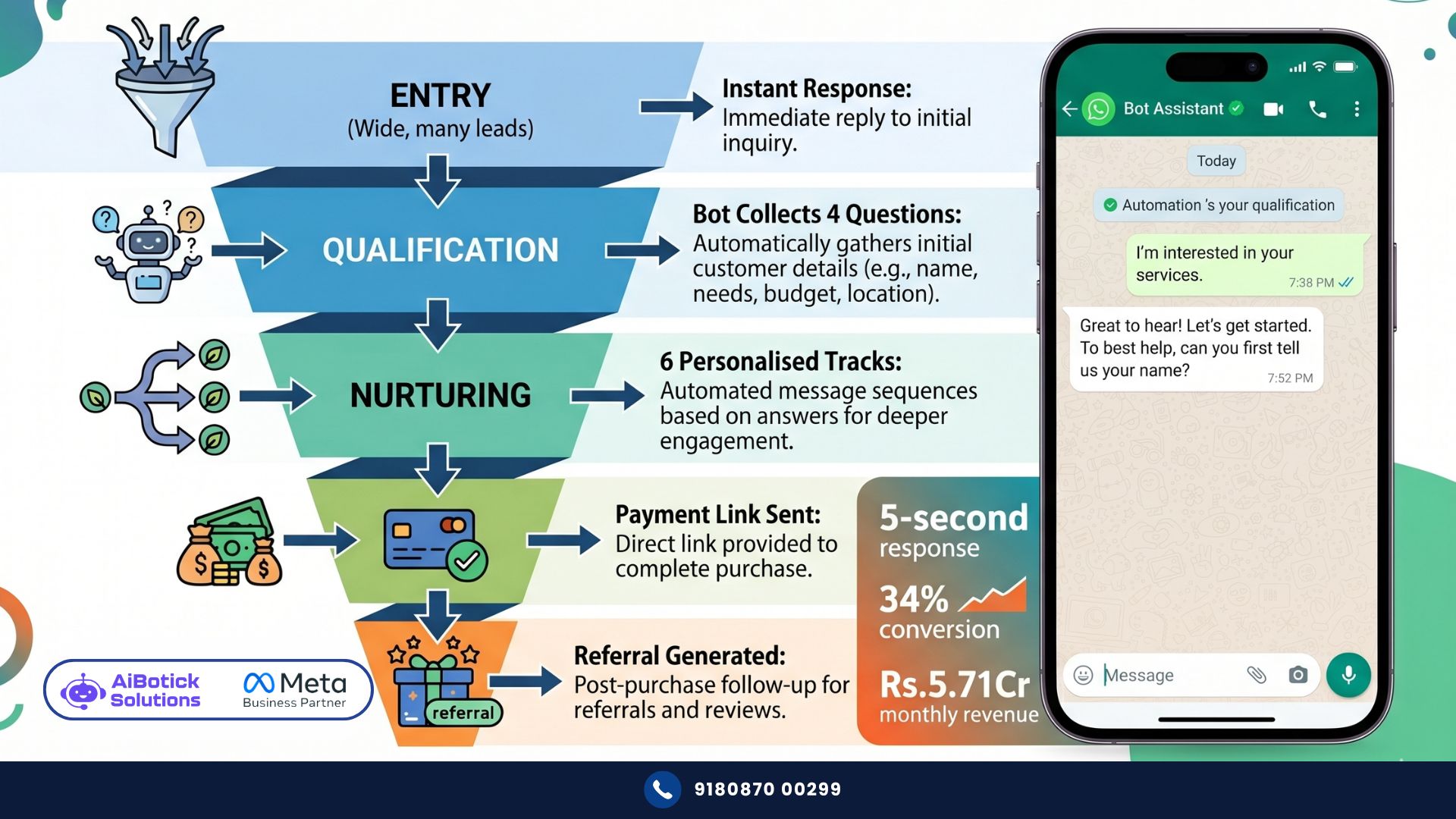
A WhatsApp sales funnel has 5 distinct stages. Each stage has a specific job. Each stage triggers the next automatically.
Stage 1: Entry Lead initiates WhatsApp contact. Could be from: ad click, QR code scan, comment automation DM, website widget, social media bio link, word of mouth.
Job: Capture the lead. Acknowledge instantly. Begin qualification.
Stage 2: Qualification Bot or automated flow collects structured data about the lead’s need, budget, timeline, and fit.
Job: Determine if this lead is worth your team’s time. Route to right person or sequence.
Stage 3: Nurturing Based on qualification data, personalised content sequence begins. Educational. Trust-building. Objection-handling.
Job: Move lead from “interested” to “ready to buy.”
Stage 4: Conversion Lead signals readiness (asks pricing, asks how to get started, expresses urgency). Human team engages or bot triggers payment/booking flow.
Job: Close the sale.
Stage 5: Post-Sale Automated onboarding, follow-up, upsell, and referral sequences trigger.
Job: Maximise lifetime value and generate referrals.
That’s the complete WhatsApp sales funnel. Simple in structure. Powerful in execution. Here’s how to build each stage.
What People Get Wrong About WhatsApp Sales Funnels
Most people build a WhatsApp sales funnel that’s actually just a WhatsApp broadcast sequence with a form at the end.
Nope. That’s not a funnel. That’s a newsletter with extra steps.
A real WhatsApp sales funnel is adaptive. The path a lead takes through the funnel changes based on what they say and do.
Actually wait — let me show you the difference concretely.
Fake funnel (linear, not adaptive): Message 1 → Message 2 → Message 3 → Message 4 → “Buy now” link Same for every lead regardless of their responses.
Real WhatsApp sales funnel (adaptive): Lead replies “budget is tight” → funnel branches to affordable option messages + payment plan info Lead replies “I need this urgently” → funnel fast-tracks to conversion conversation immediately Lead doesn’t reply for 2 days → funnel sends a different re-engagement message than if they’d replied enthusiastically
The funnel responds to the person. Not the schedule.
This adaptability is what makes a WhatsApp sales funnel so powerful — and why it requires more upfront thinking than a simple message sequence.
Real Case Study: Hyderabad EdTech — 8,400 Monthly Leads, 24×7 Funnel, 34% Conversion
The Situation:
- Online MBA entrance coaching platform in Hyderabad
- Monthly Facebook/Instagram ad spend: Rs.4.2L
- Monthly leads generated: 8,400
- Previous setup: leads went to Google Form → added to email sequence → sales team called → 8% conversion
- Challenge: 8,400 calls per month impossible for 12-person sales team. Leads going cold.
What They Built:
A complete WhatsApp sales funnel that ran 24×7 without sales team involvement until Stage 4.
Stage 1 — Entry (Click-to-WhatsApp Ads): All Facebook/Instagram ads changed to click-to-WhatsApp. Lead taps ad → WhatsApp opens → pre-filled message: “Hi, I’m interested in MBA entrance coaching.”
Immediate auto-response (within 5 seconds): “Welcome! 😄 I’ll help you find the perfect MBA prep plan. Quick question — which exam are you targeting? 1️⃣ CAT 2️⃣ XAT / SNAP / NMAT 3️⃣ GMAT 4️⃣ More than one”
Stage 2 — Qualification Flow:
Based on exam reply, next questions: “Great! When are you planning to appear for the exam? A. This year (Nov/Dec 2026) B. Next year C. Just exploring for now”
Then: current preparation level, work status, budget range (Rs.10,000-20,000 / Rs.20,000-40,000 / above Rs.40,000 / not decided).
4 qualification questions. 4 replies. 2-3 minutes total. System now knows: exam target, timeline, experience level, budget.
Stage 3 — Personalised Nurture Sequence:
Based on qualification data, lead gets assigned to one of 6 nurture tracks:
Track A (CAT, this year, budget 20-40K): Day 0: Detailed CAT prep guide PDF Day 1: Success story — “Rahul scored 98.4 percentile working full-time” Day 2: “The 3 mistakes most CAT aspirants make in Month 1” Day 3: Batch comparison — Online live vs Self-paced vs Classroom Day 4: Faculty profile + placement record Day 5: Objection handler — “Is [platform] worth the fee?” Day 6: Application to close — “Your free counselling session — 30 minutes with our CAT expert”
Each day, one WhatsApp message. Each message builds on the previous. Each message references what they said in qualification.
Track B (Just exploring, budget not decided): Softer, longer sequence. 12 messages over 21 days. Education-first. Lower frequency. Price introduced only at Day 10.
Stage 4 — Conversion Trigger:
Multiple triggers activate conversion conversation:
- Lead says “yes” to counselling session offer → immediate calendar booking on WhatsApp
- Lead asks “what’s the exact fee?” → instant fee breakdown sent + payment link option
- Lead asks “how do I enroll?” → enrollment flow triggered
- Lead clicks the course link 3 times without enrolling → human team gets alert to call
Stage 5 — Post-Sale:
Payment received → automated sequence:
- Immediate: Welcome + login credentials + “Your mentor will call within 2 hours”
- Day 3: “How’s your first week going?”
- Day 7: Study schedule WhatsApp message
- Day 14: Referral ask: “Know anyone preparing for CAT? We have a referral bonus…”
- Day 30: Progress check + upsell to test series add-on
The Results (90 days after full funnel launch):
| Metric | Before | After | Change |
|---|---|---|---|
| Monthly leads | 8,400 | 8,400 | 0% |
| Lead response time | 4-6 hours (manual) | 5 seconds (auto) | -99.9% |
| Sales team calls needed | 8,400/month | 1,470/month | -83% |
| Conversion rate | 8% | 34% | +325% |
| Monthly enrollments | 672 | 2,856 | +325% |
| Revenue/month from same ad spend | Rs.1.34Cr | Rs.5.71Cr | +326% |
| Sales team capacity freed | 0% | 83% of calls eliminated | — |
| 24×7 lead response | No | Yes | — |
Rs.1.34Cr to Rs.5.71Cr monthly revenue. Same ad spend. Same sales team. Same courses. Just a WhatsApp sales funnel running between the ad and the salesperson.
Building Your WhatsApp Sales Funnel: Stage by Stage
Stage 1: Design Your Entry Points
Every channel where leads discover you should have a clear path into your WhatsApp sales funnel.
Paid traffic: Click-to-WhatsApp ads (Facebook/Instagram). Pre-filled opening message aligned with the specific ad they clicked.
Organic social: Comment automation → DM with WhatsApp link → WhatsApp conversation starts.
Website: WhatsApp widget or “Chat with us” button → WhatsApp opens → funnel begins.
Physical touchpoints: QR code → WhatsApp → funnel begins.
Referrals: “Have a friend WhatsApp us and mention your name” → referred lead enters funnel with referral tag.
Each entry point should have a specific opening message that the lead sends (or that auto-populates). This opening message tells your funnel which sub-track to begin.
Stage 2: Build Your Qualification Flow
Your qualification flow is the most important part of your WhatsApp sales funnel. Get this right and everything downstream becomes dramatically easier.
Design principles:
- Maximum 4-5 questions. More than this and completion rate drops below 50%.
- Use buttons/quick replies where possible — not open text. “Reply 1, 2, or 3” beats “Tell us what you’re looking for.”
- Ask about need, timeline, and budget in that order. Need first (easiest), budget last (most sensitive).
- Every question should filter leads — each answer should tell you something that changes what happens next.
What to qualify for:
For B2C: product/service interest (which specific one), timeline (urgency), budget range, decision-making status (deciding alone or with family/partner).
For B2B: company size, role/title, specific use case, current solution they’re replacing, decision timeline, budget authority.
After qualification: Every lead gets a tag or label. These tags determine which nurture track they enter. This is where the adaptive magic happens.
Stage 3: Create Your Nurture Tracks
Based on qualification combinations, you’ll have 4-8 different nurture tracks. Each is a curated sequence of messages designed for that specific lead profile.
Rules for effective WhatsApp nurturing in a sales funnel:
- Day 0 message must deliver immediate value (not just “thanks for connecting”)
- No two consecutive messages should be promotional
- Each message should be under 150 words
- Every message should end with either a question or a single clear action
- Sequence should run 7-21 days depending on your sales cycle length
- Build toward the conversion ask — don’t jump to it in Day 2
Content that works in WhatsApp nurturing:
- Specific case study with numbers (Day 2-3)
- “Most common mistake” content (Day 4-5)
- Comparison/vs content (Day 6-7)
- Objection handling story (Day 8-10)
- Social proof — testimonial or review (Day 10-12)
- Soft conversion ask (Day 14+)
Stage 4: Design Your Conversion Triggers
Don’t wait for nurturing to “finish” before trying to convert. Watch for signals and act on them.
Behavioural triggers that should immediately activate conversion:
- Lead uses words: “interested,” “how do I start,” “what’s the price,” “can I book,” “ready”
- Lead clicks your product/pricing link 2+ times
- Lead asks a specific implementation question (“do you support X integration?”)
- Lead mentions a specific deadline (“I need this before March”)
- Lead compares two of your specific offerings
When trigger fires:
Option A (Bot-handled): Conversation branches to payment/booking flow immediately. No human needed.
Option B (Human-handled): Sales team receives immediate WhatsApp alert: “🔥 HOT LEAD: [Name], [qualification summary], just asked [trigger question]. Conversation thread: [link].” Team engages within 10 minutes.
Option C (Hybrid): Bot captures additional info, schedules call/meeting, team takes over.
Which option depends on your product complexity and ticket size. Under Rs.10,000: usually bot-handled works. Rs.10,000-Rs.1L: hybrid. Above Rs.1L: human-handled with bot assisting.
Stage 5: Build Your Post-Sale Automation
The sale isn’t the end of your WhatsApp sales funnel — it’s the beginning of the retention and referral loop.
Immediate post-sale (Day 0-7):
- Purchase confirmation with all details
- Access/delivery information
- First value delivery (how to get started)
- Introduce next contact (who they’ll be working with)
- “Any questions?” check-in at Day 3
Short-term retention (Day 8-30):
- Usage/adoption nudges (if product/service)
- Value reinforcement (“You’ve already achieved X”)
- Related product/service introduction (upsell)
- Review request at peak satisfaction moment
Long-term relationship (Day 31+):
- Monthly value touchpoint
- Referral request (timed to satisfaction peaks)
- Renewal/re-engagement communication
The Technology Stack for a WhatsApp Sales Funnel
To run a proper WhatsApp sales funnel, you need:
1. WhatsApp Business API (core infrastructure) This is non-negotiable. Personal WhatsApp cannot run automated funnels. API is required for automation, templates, and scale.
2. Automation platform (like AiBotick) This is where you build your chatbot flows, drip sequences, qualification logic, and routing rules. The brain of the funnel.
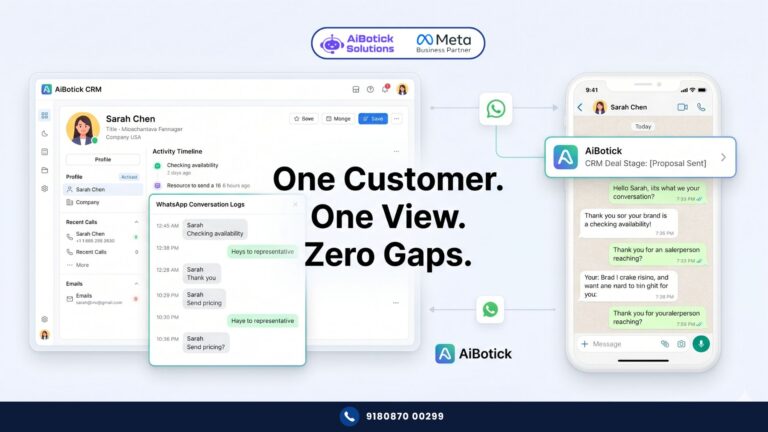
3. CRM or lead tracking system Every lead who enters the funnel should be tracked — what stage they’re at, what they said in qualification, what track they’re on, what actions they’ve taken.
4. Payment integration (for e-commerce/direct sales) Razorpay or similar — so Stage 4 conversion can happen fully automated with payment collection inside WhatsApp.
5. Shared team inbox For Stage 4 human handoffs — your sales team needs to see conversations with full context, handle assigned leads, and collaborate without duplication.
You don’t need all five on Day 1. Start with 1 + 2. Add others as you scale.
Measuring Your WhatsApp Sales Funnel Performance
A WhatsApp sales funnel without measurement is a machine running blind.
Track these metrics weekly:
Entry metrics:
- Total leads entering funnel per week (by source)
- Qualification completion rate (% who answer all 4-5 questions)
- Cost per qualified lead
Funnel progression metrics:
- % moving from Stage 1 to Stage 2 (should be 80%+)
- % moving from Stage 2 to Stage 3 (should be 70%+)
- % moving from Stage 3 to Stage 4 (reaching conversion point — varies by industry, typically 20-40%)
- % converting in Stage 4 (closing rate — varies by industry)
Drop-off analysis: Which message in your nurture sequence has the highest drop-off? That message needs rewriting. It’s a specific, fixable problem.
Conversion metrics:
- Overall funnel conversion rate (entries to sales)
- Revenue generated per lead entering funnel
- Time from entry to conversion (average)
Post-sale metrics:
- Upsell conversion rate
- Referral rate
- Customer lifetime value from WhatsApp-funnel-acquired customers
Review these weekly for the first 3 months. Monthly after that. The data tells you exactly where to improve.
Common WhatsApp Sales Funnel Failures and How to Fix Them
Failure 1: 60% of leads don’t complete qualification Fix: Reduce questions to 3. Change from text responses to button/quick replies. Make Question 1 simpler (easier to answer = more complete the flow).
Failure 2: Leads complete qualification but don’t engage with nurture Fix: Day 0 message isn’t delivering enough immediate value. Add a genuinely useful resource or insight in the very first nurture message. Something they’d forward to a colleague.
Failure 3: High engagement in nurture but low conversion Fix: Conversion ask is too late, too weak, or wrong format. Review Days 12-14 of your sequence. Is the ask clear? Is there urgency? Is the next step frictionless (one tap, not multi-step)?
Failure 4: Leads going cold between Stage 3 and Stage 4 Fix: Your nurture sequence is too long (>21 days for most B2C, >30 days for most B2B). Compress it. Move the conversion trigger earlier. Also check — are you missing buying signals because you’re looking for specific words and missing variations?
Failure 5: Sales team ignoring Stage 4 alerts Fix: Alerts aren’t compelling enough or going to the wrong channel. Make alerts include lead quality score, conversation summary, and urgency level. Send to team WhatsApp group AND individual salesperson simultaneously.
Why Your WhatsApp Sales Funnel Is Your Biggest Growth Lever in 2026
Honestly? I’ve stopped being surprised by the numbers a well-built WhatsApp sales funnel produces. But I still get excited when I show them to business owners seeing it for the first time.
The Hyderabad EdTech going from Rs.1.34Cr to Rs.5.71Cr monthly from the same Rs.4.2L ad spend? That’s not magic. That’s a system doing what systems do — working consistently, tirelessly, without human error or fatigue.
Your sales team is expensive. They need sleep. They have good days and bad days. They leave and take their relationships with them.
A WhatsApp sales funnel doesn’t do any of those things. It responds in 5 seconds at 3 AM on a Sunday. It delivers the same quality message to lead 1 and lead 8,400. It never forgets to follow up. It never has a bad day.
And when the lead is genuinely ready — really ready, not just “maybe interested” — it hands them to your team with full context. Your salesperson gets on a call knowing everything: what the lead wants, what their budget is, what objections they’ve already seen addressed, how long they’ve been in the funnel.
That’s not just automation. That’s your sales team working at 10x effectiveness. And to see how this WhatsApp sales funnel structure connects with your broader WhatsApp marketing strategy — how the funnel sits inside a larger customer acquisition and retention system — our complete WhatsApp marketing strategy guide shows exactly how these pieces fit together into a cohesive revenue engine. 😄
Ab toh ek cheez clear hai — if you’re still running a manual sales process on WhatsApp while your competitors have funnels running 24×7, you’re not competing anymore. You’re just hoping. 💯
Want to build a WhatsApp sales funnel that converts leads 24×7?
— Mohit Shah | 15+ years in IT industry | 4+ years in WhatsApp automation | Worked with various MNC brands | Now helping businesses figure out what actually works
Q1: How long does it take to build a fully automated WhatsApp sales funnel from scratch?
A1: A basic WhatsApp sales funnel — entry, qualification (4 questions), one nurture track (7 messages), and a conversion trigger — takes 2-3 days to build and test. A complete funnel with multiple nurture tracks (6-8 for different lead profiles), conversion triggers, payment integration, and post-sale sequences takes 2-3 weeks. The bottleneck is usually content — writing effective qualification questions, nurture messages, and conversion copy takes more time than the technical setup. Most businesses go live with a 70% complete funnel in Week 1 and add sophistication over the following 4-6 weeks as they see real lead behaviour.
Q2: Can a WhatsApp sales funnel replace the sales team entirely, or does it still need humans?
A2: For products under Rs.5,000-10,000 with straightforward buying decisions, a WhatsApp sales funnel can handle the entire process — qualification, nurturing, conversion, and payment collection — without any human involvement. For products Rs.10,000-Rs.1L, the funnel handles 80-85% of the work and hands qualified, ready-to-buy leads to humans for final closing. For high-ticket products above Rs.1L (real estate, enterprise software, premium services), the funnel is a pre-qualification and nurturing machine that makes human sales conversations dramatically more efficient. In the Hyderabad EdTech case, the funnel eliminated 83% of calls — the remaining 17% were calls where the team had full context and the lead was already educated and interested.
Q3: How do you prevent a WhatsApp sales funnel from feeling robotic or impersonal to leads?
A3: Three techniques that keep a WhatsApp sales funnel feeling human. First, use conversational language in all messages — short sentences, occasional Hindi, first-person voice, specific details rather than generic claims. Second, build in response-adaptive branching — leads who express urgency get a different message than leads who express price sensitivity, and this personalisation feels like the funnel “understands” them. Third, introduce human touchpoints at peak engagement moments — when a lead has responded enthusiastically to 3-4 messages, a personalised “Hi [Name], saw you’ve been going through our materials — any specific questions?” from a named team member (even if templated) breaks the automation pattern. The goal is not to hide that there’s automation — it’s to make the automation so relevant and helpful that leads don’t care.