Two support executives. 340 WhatsApp queries yesterday. Both offline by 7pm.
That was the situation at a Mumbai homeware brand when they first called me. The founder was personally handling overflow queries at 11pm — copy-pasting tracking links, answering “what’s your return policy” for the 40th time that week, trying to manage a growing business while drowning in repetitive customer messages.
“Mohit bhai, I need to hire 4 more people,” he told me.
I said — “Give me 30 days before you post that job listing.”
30 days later — same 2 support executives. Query volume had grown to 420/day. Response time dropped from 4 hours to 11 minutes. Customer satisfaction score went from 3.1 to 4.6.
Zero new hires.
That’s WhatsApp customer support automation done right. And that’s what this article is about.
Why Ecommerce Customer Support Is Broken — And Why It’s Not Your Team’s Fault
Here’s the uncomfortable truth most founders don’t want to hear.
Your support team isn’t underperforming. They’re under-tooled.
Ask any ecommerce support executive what their day looks like — 60-70% of queries are the same 8-10 questions. Every. Single. Day.
- Where is my order?
- What’s your return policy?
- Can I change my delivery address?
- I got the wrong product — what do I do?
- When will you restock [product]?
- Is COD available for my pincode?
- Can I exchange for a different size?
- How long does delivery take?
Same questions. 40-50 times a day. Per person.
This is not a human problem. This is a systems problem. And human solutions — hiring more people — only paper over a systems failure temporarily. Until query volume grows again. Until you hire again. Until margins get squeezed again.
WhatsApp customer support automation breaks this cycle permanently.
What WhatsApp Customer Support Automation Actually Looks Like
No no, scratch that — let me show you through a real conversation first. Because abstract explanations miss the point.
Customer messages at 11:43pm: “Hi, I ordered 3 days ago but haven’t received any update. Order #ORD4821”
Bot response (8 seconds later): “Hey Priya! Let me check that for you right away 😊
Your order #ORD4821 was shipped on [Date] via Delhivery. Current status: In Transit — expected delivery tomorrow by 8pm.
Track your order live here: [Tracking Link]
Need anything else? Tap below: 1️⃣ Change delivery instructions 2️⃣ Report a problem with my order 3️⃣ Talk to a support agent”
Priya taps “1️⃣ Change delivery instructions.” Bot collects the new instructions and routes to the courier partner integration.
Zero humans involved. 11:43pm. Query resolved.
That’s WhatsApp customer support automation for ecommerce. Not a rigid FAQ bot that says “I don’t understand your query.” An actual helpful system that resolves real problems.
The WhatsApp Customer Support Stack — Every Layer You Need
Build this in order. Each layer adds capability.
Layer 1 — Instant Response (Day 1 Priority)
The moment a customer messages — any time of day or night — they get an immediate acknowledgment.
Not “Thank you for contacting us. We’ll respond within 24 hours.” That’s not a response. That’s an autoresponder from 2005.
A real instant response:
“Hey [Name]! Got your message 👋 I’m on it — what can I help you with today?
1️⃣ Track my order 2️⃣ Return or exchange 3️⃣ Product question 4️⃣ Something else”
Customer chooses. Bot routes. Query resolution begins immediately — with or without human involvement.
This single change — instant response with a menu — drops customer anxiety dramatically. Most support escalations happen not because the problem is unsolvable, but because customers feel ignored while waiting.
Layer 2 — Order Status Bot (Eliminates 40% of Queries)
As we covered in our WhatsApp order tracking guide — proactive order updates eliminate most WISMO queries before they arrive.
But some still come in. Customer didn’t see the update. New phone. Different number.
WhatsApp customer support bot handles these reactively too — customer types “where is my order” or their order number — bot fetches real-time status from your WooCommerce/Shopify integration — delivers status and tracking link in seconds.
Human involvement: zero. Query resolution time: under 10 seconds.
Layer 3 — FAQ Resolution Bot (Eliminates 30% of Queries)
Return policy. Exchange process. Delivery timelines. Pincode availability. Product care instructions. Payment methods accepted.
Every business has 8-12 questions that account for 30-40% of total support volume. Map them. Build a knowledge base. Bot handles them.
Customer asks “what’s your return policy?” — bot delivers your exact return policy, with the link to initiate a return if needed.
Done. No human required.
Layer 4 — Smart Escalation to Human Agent
Some queries need a human. Complex complaints. Refund disputes. Situations requiring judgment.
The bot’s job — recognise when it’s out of its depth and escalate gracefully. Not dump the customer. Not say “I don’t understand.” Transfer — with full context — to a live agent.
The agent receives: customer name, order history, the conversation so far, the specific issue flagged. They pick up exactly where the bot left off.
No “can you please repeat your issue?” No starting from zero. Clean handoff.
Layer 5 — Post-Resolution Feedback
After every resolved query:
“Happy to help 😊 Quick question — how would you rate this support experience? ⭐ Poor | ⭐⭐ Okay | ⭐⭐⭐ Good | ⭐⭐⭐⭐ Great | ⭐⭐⭐⭐⭐ Excellent”
Customer taps a rating. Logged automatically. If they tap ⭐ or ⭐⭐ — immediate escalation alert to supervisor. Issue gets proactively followed up before it becomes a public negative review.
This feedback loop — underrated massively. It surfaces problems before they become crises.
The Numbers That Should Make Every Ecommerce Founder Stop and Think
Let me put real math in front of you. Not estimates. Numbers from brands I’ve worked with.
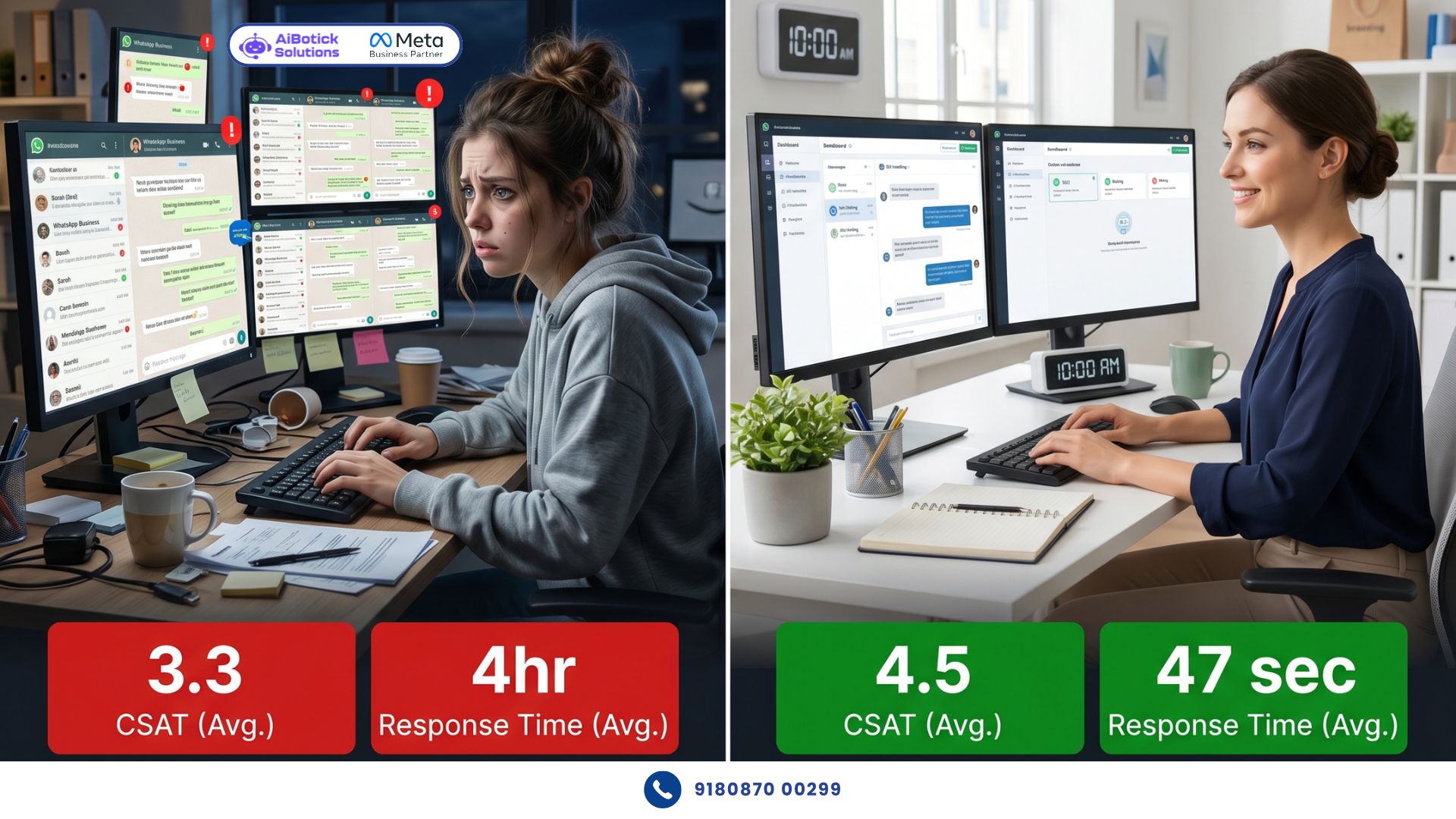
Before WhatsApp customer support automation:
- Support team: 3 people
- Daily queries: 280
- Queries per person per day: 93
- Average handling time: 6.5 minutes per query
- Daily hours spent on support: 18.5 hours across team
- Queries resolved same day: 71%
- Average first response time: 3.8 hours
- Customer satisfaction score: 3.3/5
After WhatsApp customer support automation (60 days):
- Support team: 3 people (same)
- Daily queries: 380 (volume grew 36%)
- Bot handles without human: 68% = 258 queries
- Human handles: 122 queries
- Average handling time for human queries: 4.2 minutes (context already available)
- Daily human hours spent on support: 8.5 hours (down from 18.5)
- Queries resolved same day: 96%
- Average first response time: 47 seconds
- Customer satisfaction score: 4.5/5
Volume grew 36%. Team stayed the same. Human hours halved. Resolution rate jumped 25 percentage points. CSAT went from 3.3 to 4.5.
That’s not automation reducing quality. That’s automation enabling quality.
What People Get Completely Wrong About WhatsApp Customer Support Automation
Honestly bhai — one assumption ruins more implementations than anything else.
“Customers hate talking to bots. They always want a human.”
I’ve heard this so many times. From founders who haven’t tested it. From support managers protecting their team’s scope. From people who had one bad chatbot experience in 2018 and generalised it forever.
Reality — customers don’t hate bots. Customers hate:
- Waiting 4 hours for a response
- Repeating themselves to three different agents
- Getting wrong information
- Being told “we’ll escalate this” and never hearing back
A bot that responds in 8 seconds with the correct information about their order? Customers love it. Genuinely. I’ve seen CSAT scores go UP after implementing bot-first support.
The key word is “correct information.” A bot with wrong or outdated data is worse than no bot. Build it right. Keep the knowledge base updated. Test regularly.
And always — always — have a human escalation path that’s easy to access. Don’t make customers fight to reach a human when they genuinely need one.
WhatsApp Customer Support vs Traditional Support Channels
Let me kill another assumption quickly.
“We have email support. We have a toll-free number. Why do we need WhatsApp?”
Because your customers are on WhatsApp — not checking email for support replies, not wanting to navigate IVR menus on phone calls.
Actually wait — let me give you the numbers on channel preference for Indian ecommerce customers in 2026.
Preferred support channel: WhatsApp — 67%. Phone call — 18%. Email — 11%. Live website chat — 4%.
Two-thirds of your customers would rather WhatsApp you than call or email. And most brands are still investing heavily in phone and email support infrastructure — serving the 29% while frustrating the 67%.
The channel mismatch is a customer experience problem hiding behind an operational problem.
Specific Flows to Build for Ecommerce WhatsApp Customer Support
Concrete. Copy this list. Build in this order.
Week 1 — Must haves:
- Order status lookup (customer provides order ID → bot fetches and delivers status)
- Return initiation flow (customer selects item, reason, pickup date preference → logged in system)
- Wrong product received flow (customer describes issue, uploads photo → escalated with photo to human agent with urgency flag)
Week 2 — High value:
- Exchange request flow
- COD order rescheduling
- Delivery address change (pre-dispatch)
- FAQ responses (return policy, delivery timelines, payment methods)
Week 3 — Advanced:
- Refund status tracking
- Product availability inquiry
- Pincode delivery check
- Back-in-stock notification signup
Ongoing:
- Post-resolution CSAT collection
- Negative rating escalation alerts
- Weekly support analytics review
Each flow built properly — it handles hundreds of queries per month. Automatically. Permanently.
For the complete picture on how WhatsApp customer support fits into your overall ecommerce automation strategy — our WhatsApp automation ROI guide shows exactly how to calculate the team cost savings.
Back to the Mumbai Story — What Actually Happened at 30 Days
Remember the founder answering queries at 11pm?
At 30 days post-implementation — here’s what changed.
Bot handling 71% of all incoming queries automatically. Human team down from handling 340 queries/day to 99. Response time average — 43 seconds. The 2 support executives — now handling only complex cases, escalations, and angry customers needing human empathy.
At 60 days — the founder stopped checking WhatsApp support at night entirely. First time in 2 years.
He told me: “Mohit bhai, lagta hai maine ek full-time support manager hire kar liya — but without the salary, the leave requests, and the ‘I quit’ messages.”
That’s the best way I’ve ever heard anyone describe WhatsApp customer support automation. 😄
Toh seedha question —
Aapka support team abhi kitne queries manually handle kar raha hai per day? Aur unme se kitne same 8-10 questions hain?
Calculate that number. Then decide whether automation makes sense.
I’ll bet — for most ecommerce brands reading this — the math is overwhelming obvious.
Tap below. 👇 Share your daily query volume and top 5 support questions — we’ll map out exactly which flows to build first and what your team’s load looks like 60 days after implementation.
— Mohit Shah | 15+ years in IT industry | 4+ years in WhatsApp automation | Worked with various MNC brands | Now helping businesses figure out what actually works
Q1: How does WhatsApp customer support automation work for ecommerce brands?
A1: WhatsApp customer support automation uses a layered bot system — instant response with menu options, order status lookup integrated with your store, FAQ resolution for common queries, smart escalation to human agents for complex issues, and post-resolution feedback collection. The bot handles 60-75% of queries automatically; humans handle only the cases requiring judgment or empathy. Most ecommerce brands see first response time drop from hours to under 60 seconds within 30 days of implementation.
Q2: Won’t customers be frustrated talking to a WhatsApp bot instead of a human?
A2: Customers aren’t frustrated by bots — they’re frustrated by slow responses, repeated explanations, and unresolved issues. A WhatsApp customer support bot that responds in 8 seconds with accurate order information outperforms a human who takes 4 hours every time. Research consistently shows CSAT scores improve after bot implementation when the bot is built correctly with accurate information and easy human escalation. The key is building proper escalation paths so customers who need a human can always reach one.
Q3: What percentage of ecommerce support queries can WhatsApp automation handle without human involvement?
A3: For most Indian ecommerce brands, 60-75% of support queries can be fully resolved by WhatsApp customer support automation — order status, return initiation, FAQ responses, exchange requests, COD rescheduling, and delivery queries. The remaining 25-40% involve complex complaints, refund disputes, or situations requiring human judgment. Automation doesn’t replace your team — it removes the repetitive load so they focus on cases where human empathy and judgment actually matter.