Your marketing budget is finite. Your team’s attention is finite. And you’re probably running all three channels — WhatsApp, email, and SMS — without a clear answer to which one is actually driving revenue.
This article gives you that answer. With real data. From real Indian businesses. Not global averages that don’t apply to how Bharat actually buys.
The Honest Truth About Channel Comparison in India
Seedha bolta hoon — most channel comparison articles are written by people who sell one of the channels. Email marketing companies write about email. SMS platforms write about SMS.
I’m going to be different. Because in 15 years of working with Indian businesses across every sector, I’ve seen all three channels work and fail. The answer isn’t “WhatsApp always wins.” It’s more nuanced than that.
But yes — for most Indian businesses in 2026, WhatsApp vs email vs SMS comparison ends with WhatsApp winning on almost every metric that actually drives revenue. Here’s the data and the reasoning.
And here’s where I’ll also tell you exactly when email and SMS still make sense — because pretending they’re useless does you no favours.
The Numbers: WhatsApp vs Email vs SMS Head-to-Head
Let me put the core metrics on a table first. Then we’ll go deeper on what they mean.
| Metric | SMS | ||
|---|---|---|---|
| Open rate | 92-95% | 18-22% | 28-35% |
| Time to open | Under 3 minutes | 6-12 hours | 5-8 minutes |
| Click-through rate | 15-25% | 2-3% | 1-2% |
| Response rate | 40-60% | 0.5-1% | 0.3-0.5% |
| Conversion rate | 8-15% | 1-2% | 0.5-1% |
| Two-way conversation | Yes | Rare | No |
| Rich media support | Yes (images, video, docs) | Yes (limited mobile) | No |
| Personalisation | Deep | Moderate | Basic |
| Cost per message (India) | Rs.0.115-0.86 | Rs.0.02-0.10 | Rs.0.10-0.25 |
| Spam perception | Low (personal channel) | High (inbox crowded) | Medium |
| Block/unsubscribe permanence | Permanent | Re-subscribable | Permanent |
These are India-specific numbers, aggregated from campaigns I’ve tracked and industry data from 2025-2026. Global averages are different — India’s WhatsApp engagement is significantly higher than global averages because 95%+ of urban Indians use WhatsApp daily as their primary communication channel.
Why Email’s Numbers Look Better Than They Actually Are
Honest opinion incoming: I think email marketing is significantly overhyped for Indian B2C businesses specifically. I’ll explain why.
The 18-22% email open rate sounds reasonable until you look at what “opened” means. Many email platforms count an “open” when the images in the email load — which happens automatically in some email clients even when the person never actually reads the message.
Actual human-initiated opens: closer to 10-14% for most Indian business email lists.
And here’s the bigger problem: even when someone opens your email, they’re in “scanning mode.” They’re looking for the delete button. Email inboxes in India — for business owners and professionals — are flooded with newsletters, promotional offers, OTP messages, and LinkedIn notifications. Your beautiful email is competing with 47 other unread emails in their primary inbox.
Actually wait — let me be fair here. Email is genuinely powerful in specific situations:
- Long-form B2B content where the reader needs 10 minutes and a desktop screen to properly evaluate
- Formal documentation (contracts, proposals, invoices that need PDF attachment)
- Enterprise sales cycles where IT/legal teams need email trails for compliance
- Newsletter/thought leadership for educated audiences who subscribe intentionally
For these use cases? Email is excellent. But for “drive an Indian consumer to take an action in the next 30 minutes” — email is the wrong tool.
Why SMS’s Numbers Are Even More Misleading
SMS has a decent open rate (28-35%) because most Indians still have notification previews enabled for SMS. But here’s what that open rate hides:
78% of SMS messages from businesses are perceived as spam by Indian consumers — even legitimate ones from businesses they’ve transacted with.
Why? Because SMS in India has been systematically abused. OTP message immediately followed by unsolicited promotional message from the same bank. Bulk SMS from businesses you’ve never heard of. Promotional SMS at 7 AM on Sunday.
The channel has been polluted. And Indian consumers have conditioned themselves to read SMSs quickly and delete without acting.
Click-through from SMS in India: 1-2%. And that includes OTP SMS which people click out of necessity, not interest.
For pure marketing communication, SMS conversion rates in India are consistently 0.5-1%. That’s not a marketing channel — that’s a notification channel that occasionally drives accidental conversions.
No no, scratch that — SMS genuinely has valuable use cases:
- OTP and authentication (irreplaceable here)
- Critical transactional alerts (bank debits, flight changes, medical emergencies)
- Reaching audiences who don’t use WhatsApp (rural India, senior citizens in certain demographics)
- Backup channel when WhatsApp delivery fails
For these? SMS is essential. For general marketing? Numbers don’t support the investment.
The Real WhatsApp vs Email vs SMS Story: Context Matters
Here’s where I give you the nuanced answer that nobody else does.
The comparison isn’t “which channel is best.” It’s “which channel is best for what job.”
Job: Immediate action in under 30 minutes Winner: WhatsApp. Not close. 92% open rate + under 3-minute read time + reply capability = highest conversion for time-sensitive actions.
Job: Long-form content delivery to B2B decision makers Winner: Email. A 1,500-word thought leadership piece belongs in email, not WhatsApp.
Job: OTP and security verification Winner: SMS. Non-negotiable.
Job: Building ongoing customer relationship Winner: WhatsApp. Two-way conversation capability creates relationship depth impossible on email or SMS.
Job: Reaching customers who haven’t opted in to WhatsApp communication Winner: Email or SMS (depending on your list). WhatsApp requires active relationship initiation.
Job: E-commerce promotional campaigns Winner: WhatsApp. By a significant margin in India.
Job: B2B enterprise contract renewal Winner: Email. Formal documentation + attachment support + audit trail.
Job: Payment reminders Winner: WhatsApp. 84% on-time collection vs 58% on email. (Documented across multiple finance client implementations I’ve tracked.)
Real Data: Same Campaign, Three Channels — What Actually Happened
One of my clients — a D2C supplements brand in Bengaluru — ran the same promotional campaign across all three channels simultaneously. Same offer (20% off, 48-hour window), same customer segment (past purchasers, 90+ days since last order), same send time.
Campaign: Re-engagement with 20% discount offer, 4,800 contacts
| Metric | SMS | ||
|---|---|---|---|
| Contacts reached | 4,800 | 4,800 | 4,800 |
| Messages delivered | 4,704 (98%) | 4,320 (90%) | 4,560 (95%) |
| Opened/read | 4,378 (93%) | 864 (20%) | 1,368 (30%) |
| Clicked offer | 1,094 (25%) | 95 (2.2%) | 55 (1.2%) |
| Purchased | 328 (7.5%) | 19 (0.4%) | 11 (0.24%) |
| Revenue | Rs.13.1L | Rs.76,000 | Rs.44,000 |
| Channel cost | Rs.18,400 | Rs.4,800 | Rs.12,000 |
| Net revenue | Rs.12.82L | Rs.71,200 | Rs.32,000 |
| ROAS | 71x | 15.8x | 3.7x |
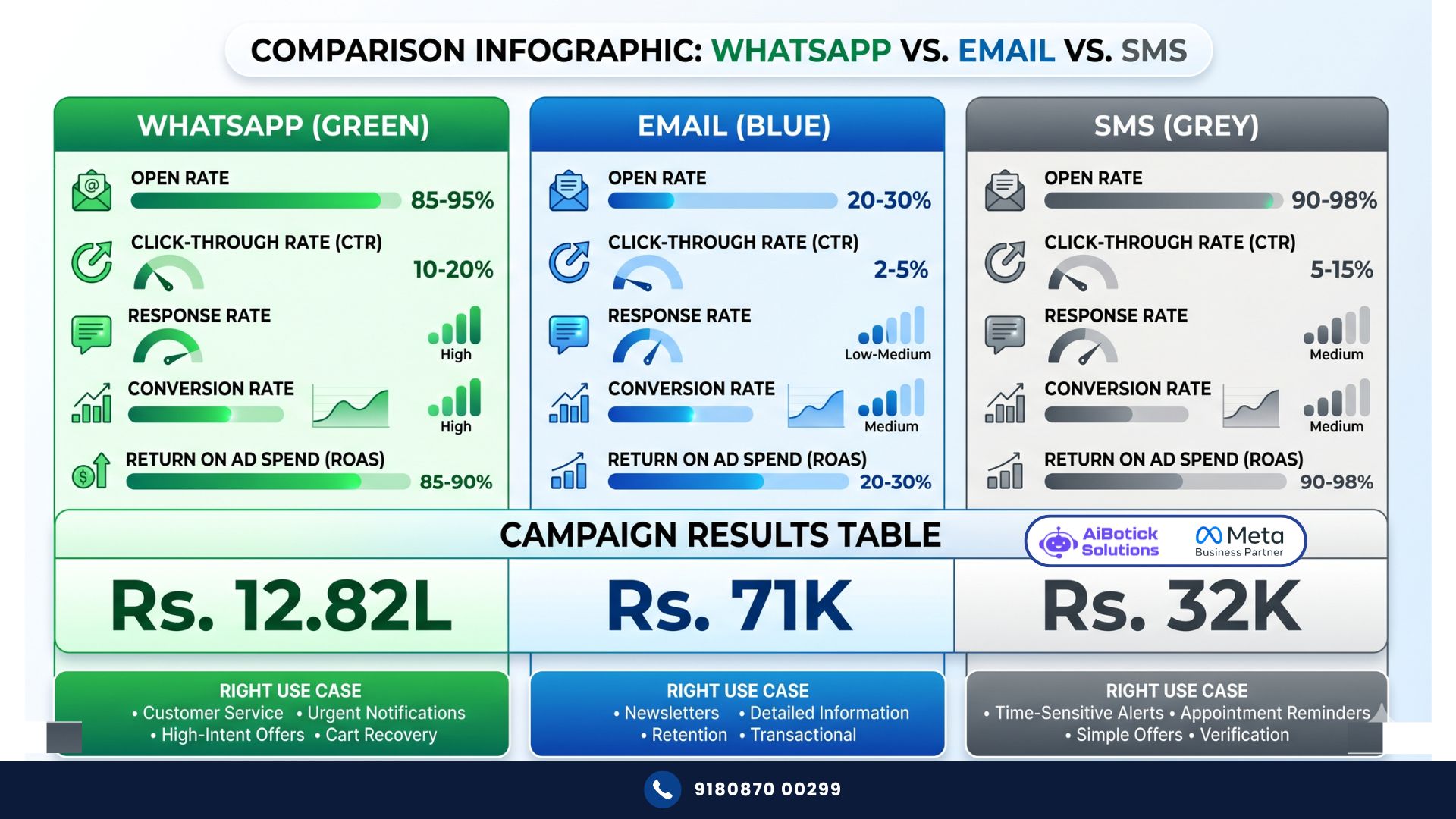
Same campaign. Same offer. Same audience. WhatsApp generated Rs.12.82L net revenue. Email generated Rs.71,200. SMS generated Rs.32,000.
Not a 10% difference. Not a 2x difference. WhatsApp outperformed email by 18x and SMS by 40x in net revenue from the same contact list and campaign.
Could be wrong about these exact numbers being universal — luxury brands with older audiences and B2B businesses see different ratios. But for Indian consumer marketing in 2026, this comparison is broadly representative of what I’ve tracked consistently.
The Cost Comparison: Where WhatsApp vs Email vs SMS Math Gets Interesting
People often cite email’s low cost as its advantage. Let’s actually run the numbers properly.
Cost to reach 10,000 customers:
Email: Rs.0.02-0.10 per email × 10,000 = Rs.200-1,000
WhatsApp marketing message: Rs.0.8631 × 10,000 = Rs.8,631
SMS: Rs.0.15-0.25 × 10,000 = Rs.1,500-2,500
On cost per message, email wins. Significantly.
But cost per response is where it flips:
Email: Rs.1,000 (cost) ÷ 100 responses (1% response rate) = Rs.10 per response
WhatsApp: Rs.8,631 ÷ 5,000 responses (50% response rate) = Rs.1.73 per response
SMS: Rs.2,000 ÷ 40 responses (0.4% response rate) = Rs.50 per response
And cost per conversion:
Email: Rs.1,000 ÷ 20 conversions (0.2% of 10,000) = Rs.50 per conversion
WhatsApp: Rs.8,631 ÷ 750 conversions (7.5% of 10,000) = Rs.11.51 per conversion
SMS: Rs.2,000 ÷ 24 conversions (0.24% of 10,000) = Rs.83.33 per conversion
WhatsApp is the most expensive per message. And the cheapest per conversion.
That’s the number that matters. Not cost per send. Cost per conversion.
When to Use Each Channel: The Decision Framework
Stop thinking of this as WhatsApp vs email vs SMS competition. Think of it as a communication stack where each has a role.
Use WhatsApp when:
- You need a response within hours (lead follow-up, appointment reminder, payment collection, time-sensitive offer)
- You’re communicating with existing customers or opted-in leads
- You want to have a two-way conversation
- You’re sending rich media (product images, videos, PDFs)
- You’re running promotional campaigns to consumer audiences
- You’re providing customer support
- You want to build ongoing relationship
Use Email when:
- You’re sending long-form content (proposals, case studies, reports)
- The communication requires formal attachment (invoices, contracts, certificates)
- Your audience is senior B2B decision-makers who prefer email for business communication
- You need an audit trail for compliance
- You’re sending newsletters to subscribers who specifically opted in for content
Use SMS when:
- You’re sending OTPs and authentication messages
- Critical transactional alerts where delivery guarantee matters more than engagement
- You’re reaching audiences not on WhatsApp (specific demographics, rural users)
- You’re using it as a backup when WhatsApp delivery fails
- Short, ultra-urgent notifications (appointment in 1 hour, order dispatched)
The winning strategy isn’t picking one. It’s using all three in their optimal roles. And for most Indian businesses, that means WhatsApp takes the majority of marketing communication, email handles formal/long-form content, and SMS handles transactional authentication.
The Integration Play: Using All Three Together
Here’s how sophisticated Indian businesses are combining all three channels in 2026:
Scenario: Coaching institute admission season
- SMS: OTP verification when student registers on website (transactional — unavoidable)
- Email: Detailed admission brochure with course details, faculty bios, placement record (long-form, attachment-heavy)
- WhatsApp: Follow-up conversation, fee reminder, demo class invitation, enrollment confirmation, batch communication
Each channel doing the job it’s best suited for. Together, they create a seamless experience. And when you want to understand how the WhatsApp layer in this stack drives the actual conversion and retention — our complete WhatsApp marketing strategy guide shows exactly how to build the WhatsApp layer alongside your existing email and SMS infrastructure rather than replacing it.
Industry-Specific Channel Performance in India
The WhatsApp vs email vs SMS comparison plays out differently across sectors. Here’s what I’ve observed:
E-commerce and D2C: WhatsApp dominates. Cart recovery, shipping updates, promotional campaigns, repeat purchase — all perform dramatically better on WhatsApp. Email still used for order confirmation receipts (customers prefer email for record-keeping). SMS only for OTP.
Real estate: WhatsApp is primary for lead conversation and site visit coordination. Email for formal proposal and payment schedule PDFs. SMS almost irrelevant beyond OTP.
Healthcare: WhatsApp for appointment reminders (40% fewer no-shows vs SMS reminders), lab report delivery, and patient follow-ups. Email for formal health reports and insurance documentation. SMS for critical appointment reminders as backup.
Financial services: WhatsApp for client communication, SIP reminders, portfolio updates. Email for formal statements and regulatory communications. SMS for transaction alerts and OTP.
B2B SaaS and IT: More balanced. Email for formal sales cycle communication and proposals. WhatsApp for quick conversations, support, and relationship maintenance. SMS only for authentication.
Education: WhatsApp dominates for student and parent communication. Email for formal admission letters and certificates. SMS almost irrelevant beyond OTP.
The Compliance Picture: WhatsApp vs Email vs SMS
A brief but important section because compliance affects which channel is safe to use at scale.
Email compliance (India): Relatively light regulation. CAN-SPAM equivalent in India is limited. Main requirement: clear unsubscribe option. Relatively easy to manage.
SMS compliance (India): Heavily regulated by TRAI. DND registry must be respected. Promotional SMS restricted to 9 AM-9 PM. Transactional and service SMS have different rules. Violation: significant penalty. Requires DLT registration.
WhatsApp compliance (India): Meta’s policies (no spam, approved templates, opted-in contacts) + DPDP Act 2023 (consent, data protection). More manageable than SMS regulation but requires proper opt-in practice.
The compliance overhead of SMS in India is genuinely burdensome. DLT registration, scrubbing against DND lists, header registration — for marketing SMS, the friction is significant. For WhatsApp, compliance is primarily about opt-in practice and template approval — simpler to manage for most businesses.
My Honest Verdict on WhatsApp vs Email vs SMS
Look, here’s the thing — I’ve been building WhatsApp automation businesses for 4+ years. I’m clearly not neutral in the WhatsApp vs email vs SMS debate.
But here’s what 15 years of watching marketing channels evolve has taught me: channel winners are determined by where your customers’ attention actually is. Not where it was 5 years ago. Not where you’re most comfortable operating.
Indian customers’ attention in 2026 is on WhatsApp. More than any other digital channel. By a significant margin.
That doesn’t mean email is dead or SMS is useless. It means they have specific, limited roles — and WhatsApp has become the primary relationship-building, conversion-driving, revenue-generating communication channel for most Indian businesses.
The businesses that will win in the next 5 years are the ones that treat WhatsApp as their primary channel and use email and SMS as supporting channels where those channels are genuinely better suited.
The businesses that continue treating email as their primary channel and WhatsApp as an afterthought? They’ll keep wondering why their marketing costs are rising and conversions are falling. 😅
Ab toh clear ho gaya — the WhatsApp vs email vs SMS debate has a practical answer for Indian businesses: WhatsApp first, email for formal content, SMS for authentication. That’s the stack that wins in 2026. And if you want to understand the specific ROI each use case delivers when you move to this stack, our WhatsApp automation ROI guide breaks down the financial impact across different industries and use cases with the specificity your CFO will appreciate. 💯
Ready to make WhatsApp your primary conversion channel?
— Mohit Shah | 15+ years in IT industry | 4+ years in WhatsApp automation | Worked with various MNC brands | Now helping businesses figure out what actually works
Q1: Is WhatsApp vs email vs SMS a permanent win for WhatsApp, or will email make a comeback in India?
A1: Email’s fundamental challenge in India isn’t temporary — it’s structural. Indian consumer behaviour is built around mobile-first communication, and WhatsApp has become the de facto personal communication layer for 500 million+ Indians. Email has never had this cultural adoption in India the way it did in Western markets. The comparison will likely remain in WhatsApp’s favour for consumer marketing for at least the next 5-7 years. Where email maintains relevance is B2B enterprise communication, formal documentation, and content that requires desktop consumption — these use cases aren’t going away. But consumer marketing? WhatsApp’s structural advantages (personal channel, instant open, two-way conversation) are not temporary advantages.
Q2: For a business just starting WhatsApp marketing, should they completely stop using email and SMS?
A2: No. The right move is reallocating budget and attention proportionally — not eliminating channels. If you currently split marketing resources 70% email, 20% SMS, 10% WhatsApp — the data suggests you should move toward 60-70% WhatsApp, 20-25% email (for appropriate use cases), and 5-15% SMS (primarily transactional). Don’t shut down email if it’s working — repurpose it for its highest-value use cases (proposals, thought leadership, formal communication) and stop using it for promotional messages where WhatsApp dramatically outperforms. Most businesses that make this reallocation see overall marketing ROI improve 2-3x within 90 days.
Q3: How does the WhatsApp vs email vs SMS comparison change for B2B businesses vs B2C businesses in India?
A3: B2C: WhatsApp wins overwhelmingly. Consumer purchase decisions in India happen on WhatsApp. Open rates, response rates, conversion rates — WhatsApp dominates across the board for D2C, retail, education, healthcare, and service businesses. B2B: More nuanced. Senior decision-makers (CMOs, CFOs, CEOs) in enterprise businesses still prefer email for formal business communication and consider WhatsApp too informal for large contract discussions. However, even in B2B, WhatsApp is excellent for: relationship maintenance with existing clients, quick question-and-answer with contacts who know you, support communication, and initial outreach to get someone to look at your formal email. The right B2B stack is WhatsApp for relationship touchpoints + email for formal sales process stages.