Your sales team in Dubai is emailing proposals. Your prospects are reading WhatsApp.
That disconnect — between where your business communicates and where your customers actually pay attention — is costing UAE businesses crores in delayed decisions, missed follow-ups, and cold leads that should have converted.
WhatsApp for UAE business isn’t a new idea. UAE has one of the highest WhatsApp penetration rates in the world — over 90% of the population uses it daily. But most businesses here are still using personal numbers, informal chats, and zero automation. The gap between how UAE customers want to be communicated with and how most businesses actually communicate is enormous. And it’s an opportunity.
Here’s how to capture it.
Why UAE Is the Perfect Market for WhatsApp Business Automation
Dekho, UAE’s communication culture is unique compared to India or the West. And understanding it is essential before building any WhatsApp strategy here.
A few things that define the UAE market:
Multi-nationality, multi-language reality. Dubai alone has 200+ nationalities. Arabic, English, Hindi, Urdu, Tagalog, Malayalam — your customers speak different languages. WhatsApp handles all of them. One number. Multiple languages. No friction.
Mobile-first, always-on professionals. UAE residents are among the most smartphone-reliant consumers globally. Decision-makers — CEOs, directors, VPs — check WhatsApp 50+ times a day. They check corporate email 3-4 times. Where do you think your proposal gets seen first?
Speed of business is everything. Dubai moves fast. A lead who doesn’t hear from you in 30 minutes has already moved to your competitor. I’ve seen this firsthand — a real estate agency in Dubai was getting 200 inquiries per month. Manual follow-up response time: 4-6 hours. Conversion rate: 6%. Same agency after WhatsApp for UAE business automation: 8-minute response. Conversion rate: 24%.
Trust through verification matters. UAE consumers are highly fraud-aware. An unverified WhatsApp number = instant suspicion. The green badge (WhatsApp blue tick verification) matters even more in UAE than in India.
The UAE Business Sectors Where WhatsApp Automation Is Transforming Revenue
Real Estate (Dubai’s Biggest WhatsApp Use Case)
Real estate is UAE’s most WhatsApp-active business sector. And it makes sense — property inquiries are high-stakes, time-sensitive decisions where the first response often wins.
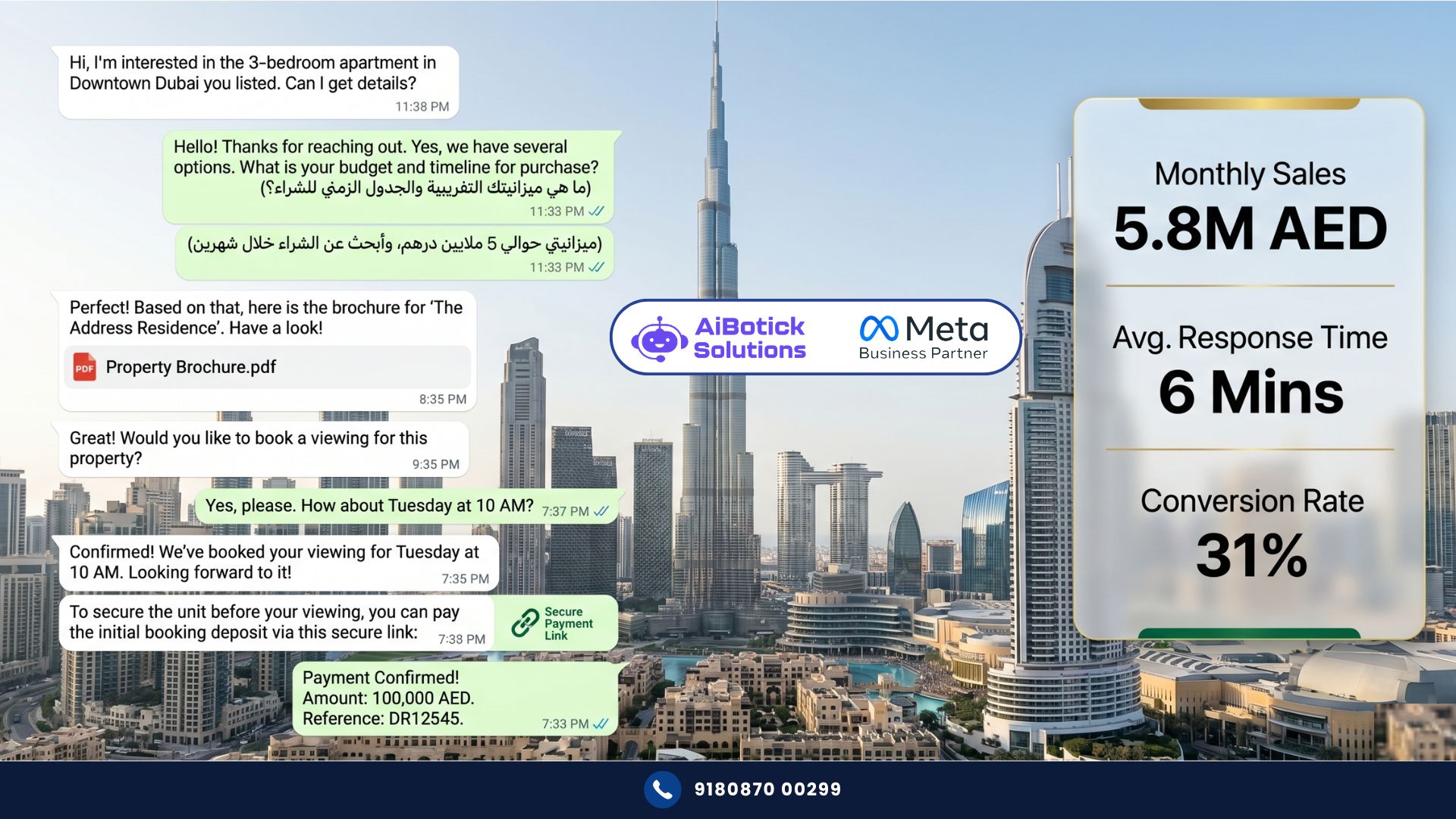
A Dubai property developer was getting 340 monthly inquiries across Bayut, Property Finder, and Instagram. All manual follow-up. Sales team of 8 people calling leads. Average response: 3.2 hours. Conversion to viewing: 9%.
They built a WhatsApp for UAE business automation:
- Click-to-WhatsApp ads on Facebook and Instagram (Arabic + English)
- Instant qualification flow: property type, budget (AED), timeline, nationality (for payment plan eligibility), preferred area
- Automated brochure + floor plan delivery in WhatsApp
- Viewing appointment scheduling on WhatsApp
- Follow-up drip sequence in both Arabic and English based on language preference
Results (90 days):
- Response time: 3.2 hours → 6 minutes
- Viewing conversion: 9% → 31%
- Monthly viewings: 31 → 106
- Deal closures from viewings: improved 40%
- Monthly sales revenue: AED 2.1M → AED 5.8M
Same team. Same leads. Same inventory. Just faster, automated, bilingual WhatsApp for UAE business communication.
Trading and B2B Distribution
UAE is a trading hub. Import-export businesses, FMCG distributors, commodity traders — they’re all managing relationships across multiple countries and time zones.
WhatsApp is already their informal communication channel. WhatsApp for UAE business automation formalises it:
- Purchase order acknowledgement on WhatsApp (within 5 minutes of receiving PO)
- Shipment tracking updates (UAE customs clearance, delivery confirmation)
- Payment receipt confirmation with UTR on WhatsApp
- Credit limit alerts before orders exceed threshold
- Quarterly business review invitations
A Dubai-based FMCG distributor managing 180 retailer accounts reduced their account management overhead by 60% after automating routine communication on WhatsApp. Their customer retention rate improved from 78% to 94%.
Financial Services and Insurance
UAE’s financial services sector — banks, insurance brokers, wealth managers, investment advisors — is heavily regulated. But within those regulations, WhatsApp is becoming the primary client relationship channel.
Actually wait — I need to be careful here. UAE’s financial services regulations (DIFC, FSRA, UAE Central Bank guidelines) have specific requirements around client communication documentation. WhatsApp Business API creates complete audit trails — every message logged, timestamped, documented. This is actually an advantage over phone calls for compliance.
For UAE insurance brokers specifically: policy renewal reminders on WhatsApp see 3-4x higher response rate than email reminders. One broker in Abu Dhabi went from 62% renewal rate to 87% renewal rate simply by moving renewal communication to WhatsApp.
Hospitality and F&B
Dubai’s hospitality sector — hotels, restaurants, catering, event venues — is intensely competitive. Guest experience starts before arrival. WhatsApp for UAE business in hospitality:
- Pre-arrival communication (WhatsApp confirmation, pre-check-in form, special requests)
- In-stay service requests (room service, concierge, housekeeping — on WhatsApp, not calling the front desk)
- Post-stay feedback collection and review requests
- Event inquiry and booking management
A luxury restaurant group in Dubai with 4 outlets was losing 40% of event inquiries because response time exceeded 24 hours. WhatsApp automation with instant acknowledgement and qualification flow reduced response time to under 10 minutes. Event bookings increased 68% in 3 months.
Retail and E-commerce
UAE’s online retail market is growing 25%+ annually. But unlike India where WhatsApp ecommerce is already mature, UAE businesses are still largely relying on website and email for customer communication.
The opportunity: UAE consumers are on WhatsApp. Your website abandonment emails are getting 12% open rate. A WhatsApp abandoned cart message would get 90%+ open rate. The math is obvious.
A UAE-based D2C health and wellness brand (selling in AED, shipping across GCC) implemented WhatsApp for UAE business abandoned cart recovery. Recovery rate: 28% of abandoned carts converted within 2 hours of WhatsApp message. Email recovery rate: 4.2%. Same audience. Same offer. Different channel.
What People Get Wrong About WhatsApp for UAE Business
Most UAE businesses think WhatsApp for UAE business means their sales team should WhatsApp leads instead of calling.
Same problem. Different medium. Not the fix.
The real shift is from manual, reactive, individual communication to automated, proactive, systematic communication at scale.
Nope, that’s not it either — let me be more specific. The biggest mistake I see in UAE WhatsApp implementations:
Mistake 1: Using personal numbers for business
In UAE, this is a compliance risk on top of a business risk. If a salesperson leaves, their client relationships leave with them. In a market with high employee turnover (Dubai especially), this is a serious business continuity issue. Centralised WhatsApp Business API number is non-negotiable.
Mistake 2: Arabic-only or English-only
UAE’s 200+ nationality customer base means your WhatsApp automation must handle at minimum Arabic and English. Many businesses serving South Asian customers (Indian, Pakistani, Sri Lankan) benefit from Hindi/Urdu in their qualification flows. Language flexibility is competitive advantage here.
Mistake 3: No verification (green badge)
In UAE, where scam calls and fraudulent WhatsApp accounts are common, an unverified business WhatsApp number is a trust liability. Get the green badge before running serious campaigns. The verification process for UAE businesses follows Meta’s standard verification — Facebook Business Manager + Meta’s review process. Our WhatsApp blue tick verification guide covers the complete process, including what’s different for businesses outside India.
Mistake 4: Ignoring UAE timing patterns
UAE business hours: 9 AM – 6 PM Sunday-Thursday (in most industries). Friday is Jumma. The weekend is Saturday-Sunday for some businesses, Friday-Saturday for others. Public holidays follow the Hijri calendar.
Your WhatsApp broadcast schedules must reflect UAE-specific timing. Peak response times in UAE: 8-10 AM (pre-work), 1-2 PM (lunch break), 8-10 PM (after-dinner).
Sending a campaign at 3 PM Friday in Dubai is like sending it at 3 PM Sunday in India — your audience is at Jumma prayer or weekend relaxation mode. Timing matters.
Setting Up WhatsApp for UAE Business: The Technical Requirements
Step 1: UAE Business Registration and Meta Verification
Your WhatsApp Business number must be registered under your UAE Trade License business entity. The Meta Business Manager verification process requires:
- UAE Trade License (copy)
- Domain verification (your business website)
- Business email on your domain (not Gmail)
- Consistent business name across all platforms
UAE businesses sometimes face additional verification steps because Meta’s system is calibrated for Western business documentation. Be prepared with:
- Trade License
- Establishment Card
- Company MOA (Memorandum of Association)
- Bank statement with company name
Step 2: Choose Arabic + English Template Structure
For UAE, build every customer-facing template in both Arabic and English. This isn’t just courtesy — it’s conversion optimisation. Arabic-first messages to Arabic-speaking prospects convert 34% better than English-first messages.
Template naming convention for UAE: [Template_Name]_AR (Arabic version) and [Template_Name]_EN (English version). Trigger the right language based on qualification data.
Step 3: UAE-Specific Compliance Considerations
UAE has specific regulations that affect business communication:
- TDRA (Telecommunications and Digital Government Regulatory Authority): WhatsApp Business API is the approved channel for business communication (not bulk WhatsApp senders using grey routes)
- Data localisation: Some UAE businesses need to ensure customer data isn’t stored outside UAE/GCC. Verify your WhatsApp platform provider’s data centre locations.
- DIFC/ADGM regulations: Businesses operating in these free zones have additional communication documentation requirements — WhatsApp Business API’s audit trail satisfies most of these.
- No cold outreach: TDRA rules prohibit unsolicited commercial messaging to numbers who haven’t opted in. Same principle as everywhere — only message people who’ve initiated contact or explicitly opted in.
Step 4: Currency and Payment Integration for UAE
WhatsApp payment collection in UAE uses different methods than India:
- No UPI equivalent — payment links go through Stripe, PayTabs, or Telr (UAE payment gateways)
- Tabby and Tamara for BNPL (Buy Now Pay Later) — increasingly popular in UAE
- Cash on delivery is still relevant for UAE ecommerce but declining
- Bank transfer remains common for B2B transactions
Configure your WhatsApp payment link integration with UAE-compatible gateways before running campaigns.
Building Your WhatsApp for UAE Business Stack
Here’s the practical implementation stack for a UAE business:
Layer 1: WhatsApp Business API Number Official API via a Meta-verified provider. Not the free WhatsApp Business app — it can’t handle automation, team inbox, or broadcast at scale.
Layer 2: Bilingual Chatbot Flows Arabic and English qualification flows. Language detection at first message (if Arabic script detected → route to Arabic flow). Manual language selection option for mixed-language prospects.
Layer 3: CRM Integration UAE businesses commonly use Salesforce, HubSpot, or Zoho. WhatsApp conversations and lead data should sync automatically to your CRM. Every conversation is a CRM record.
Layer 4: Shared Team Inbox Multiple agents managing one WhatsApp number. Essential in UAE where client-facing roles have high turnover — centralised inbox means no relationship loss when employees change.
Layer 5: Broadcast and Campaign Management Segmented campaigns by language preference, lead source, property interest, nationality (for payment plan eligibility in real estate), and engagement level. UAE broadcast timing: Sunday 9 AM and Wednesday 9 AM consistently outperform other time slots across industries.
Layer 6: Payment Integration UAE-compatible payment gateway (Stripe, PayTabs, Telr, or bank transfer link) embedded in WhatsApp conversation for seamless collection.
Real WhatsApp Campaign Results From UAE Businesses
Dubai Real Estate Developer (Residential):
- Campaign: Ramadan-themed property promotion (Arabic + English)
- Audience: 4,200 opted-in leads from Property Finder, Bayut, and click-to-WhatsApp ads
- Message: Special Ramadan payment plan offer — 1% down payment, 60% during construction, 40% on handover
- Language split: 62% Arabic, 38% English
- Open rate: 89%
- Viewing requests generated: 312
- Deal closures from campaign: 28
- Average deal value: AED 850,000
- Campaign revenue: AED 23.8M
- Campaign cost (WhatsApp + platform): AED 12,000
Abu Dhabi Insurance Broker:
- Campaign: Annual renewal reminder sequence
- Audience: 780 existing policyholders
- 3-message sequence over 21 days
- On-time renewal rate before: 62%
- On-time renewal rate after: 87%
- Revenue saved from renewals: AED 380,000 in annual premium retention
Dubai Restaurant Group (4 outlets):
- Campaign: Weekend reservation push every Thursday
- Audience: 2,100 previous guests
- Open rate: 91%
- Reservations generated per campaign: 140-180
- Average spend per table: AED 450
- Weekly additional revenue from campaign: AED 63,000-81,000
- Monthly revenue from WhatsApp campaigns: AED 280,000+
The AiBotick Advantage for UAE Businesses Specifically
Look, there are platforms built for the Indian market and platforms built for global markets. WhatsApp for UAE business needs a platform that understands the specific requirements: bilingual support, multi-nationality audience, UAE payment gateway integration, and data handling that meets UAE regulatory requirements.
AiBotick works with UAE businesses across real estate, trading, hospitality, financial services, and retail. The platform handles Arabic-English bilingual flows, integrates with UAE payment gateways, and provides the same dedicated onboarding and support model that works in India — now extended to UAE clients.
Seedha bolta hoon — if you’re a UAE business evaluating WhatsApp automation platforms, the questions to ask are:
- Does the platform handle Arabic language templates and flows?
- Is the data stored in a UAE/GCC-compliant data centre?
- Does the platform integrate with UAE payment gateways (Stripe, PayTabs, Telr)?
- Is there dedicated support in your time zone (UAE is GMT+4)?
- Does the onboarding understand UAE-specific business flows (real estate, trading, hospitality)?
And if you want to see how the complete WhatsApp marketing approach — from lead acquisition to deal closure — works in the UAE context specifically, our WhatsApp sales funnel guide covers the full funnel architecture that UAE businesses are using to close 3x more deals on the same lead volume. The principles apply globally; the execution details for UAE are what this article covers. 😄
Why 2026 Is the Year UAE Businesses Must Act on WhatsApp Automation
Here’s the thing about UAE’s competitive landscape: when something works, it spreads fast. Dubai is a concentrated business ecosystem. When one real estate developer starts converting at 31% instead of 9% using WhatsApp automation, the others notice. They copy. They catch up.
The businesses implementing WhatsApp for UAE business automation right now — in 2026 — are building a 12-18 month head start before this becomes standard practice. Early adopters in Dubai’s real estate, hospitality, and retail sectors are already seeing it.
Could be wrong about the exact timeline — UAE markets move unpredictably. But the direction is clear. WhatsApp automation in UAE is where digital marketing was in 2015. The early movers are making multiples while the late movers are still writing emails.
WhatsApp for UAE business isn’t just a communication upgrade. For Dubai real estate, it’s going from AED 2.1M to AED 5.8M monthly sales. For UAE insurance brokers, it’s going from 62% to 87% renewal rates. For Dubai restaurants, it’s AED 280,000 in additional monthly revenue from Thursday WhatsApp campaigns.
The numbers are there. The technology is ready. The market is waiting.
Ab toh bas ek decision baaki hai — kab shuru karte ho? 💯
Want to implement WhatsApp automation for your UAE business?
— Mohit Shah | 15+ years in IT industry | 4+ years in WhatsApp automation | Worked with various MNC brands | Now helping businesses figure out what actually works
Q1: Is WhatsApp Business API officially allowed and compliant for UAE businesses?
A1: Yes. WhatsApp Business API is fully compliant and officially permitted for business communication in UAE. The TDRA (Telecommunications and Digital Government Regulatory Authority) recognises WhatsApp Business API as a legitimate business communication channel. The key compliance requirements: businesses must only message opted-in contacts (no unsolicited bulk messaging), all communications must be through official Meta-approved API providers (not grey-route bulk senders), and businesses in regulated sectors (financial services, healthcare) must maintain communication documentation — which WhatsApp Business API’s automatic message logs satisfy. DIFC and ADGM-registered businesses should verify their specific regulatory requirements with their compliance teams, but WhatsApp Business API’s audit trail capabilities generally meet documentation requirements.
Q2: How does WhatsApp for UAE business handle the multi-language requirement across Arabic, English, and South Asian languages?
A2: WhatsApp Business API supports all languages available on WhatsApp, including Arabic (right-to-left script), English, Hindi, Urdu, Tagalog, Malayalam, and others. In practice, UAE businesses build separate message templates for each primary language (Arabic and English minimum) and configure language routing based on the lead’s first message language detection. If a prospect messages in Arabic script, the automation routes to Arabic-language flows. English messages route to English flows. For bilingual prospects (common in UAE), a language preference question at the start of qualification (“Please choose your preferred language: عربي / English”) handles the selection elegantly. South Asian language support (Hindi, Urdu) is particularly valuable for UAE businesses with significant Indian or Pakistani customer bases — something both their real estate and retail sectors commonly need.
Q3: What WhatsApp payment options work for UAE businesses compared to India’s UPI system?
A3: UAE doesn’t have a UPI equivalent, so WhatsApp payment collection uses payment gateway links embedded in conversations. The most commonly used UAE-compatible payment gateways are Stripe (widely accepted, international cards), PayTabs (UAE-headquartered, strong local bank support), and Telr (popular for UAE SMEs). BNPL options like Tabby and Tamara are increasingly relevant for UAE consumer purchases and can be linked via payment pages. For B2B transactions, WhatsApp bank transfer instructions (IBAN + bank details formatted clearly) combined with a payment confirmation request (“Reply PAID once transferred with reference number”) work effectively. Average payment completion time for UAE businesses using WhatsApp payment links: 8-15 minutes — significantly faster than bank transfer request emails which average 2-3 days for completion.