Singapore’s business culture is legendarily efficient.
If you’ve ever dealt with a Singaporean company — the response times, the documentation, the follow-through — it’s almost unsettling by Indian standards. Everything works. Everything is on time. Everything is tracked.
And yet. I sat with a Singapore-based Indian entrepreneur last year who was running a B2B distribution business across Singapore, Malaysia, and Indonesia. Sophisticated guy. Harvard MBA. 200-person operation.
His customer follow-up system? A shared Gmail inbox and a WhatsApp group where sales reps posted updates manually. In 2025.
Bhai, I didn’t laugh. But it was close. 😅
The gap between the operational sophistication of Southeast Asian businesses and their WhatsApp communication infrastructure is genuinely enormous. And for businesses that figure this out — Indian companies expanding into SEA, Southeast Asian businesses scaling across the region, Singapore-headquartered operations managing multi-country teams — the opportunity is as large as any market in the world right now.
Let me show you exactly what’s happening and what to do about it.
Why Southeast Asia Is a WhatsApp Automation Goldmine — The Numbers First
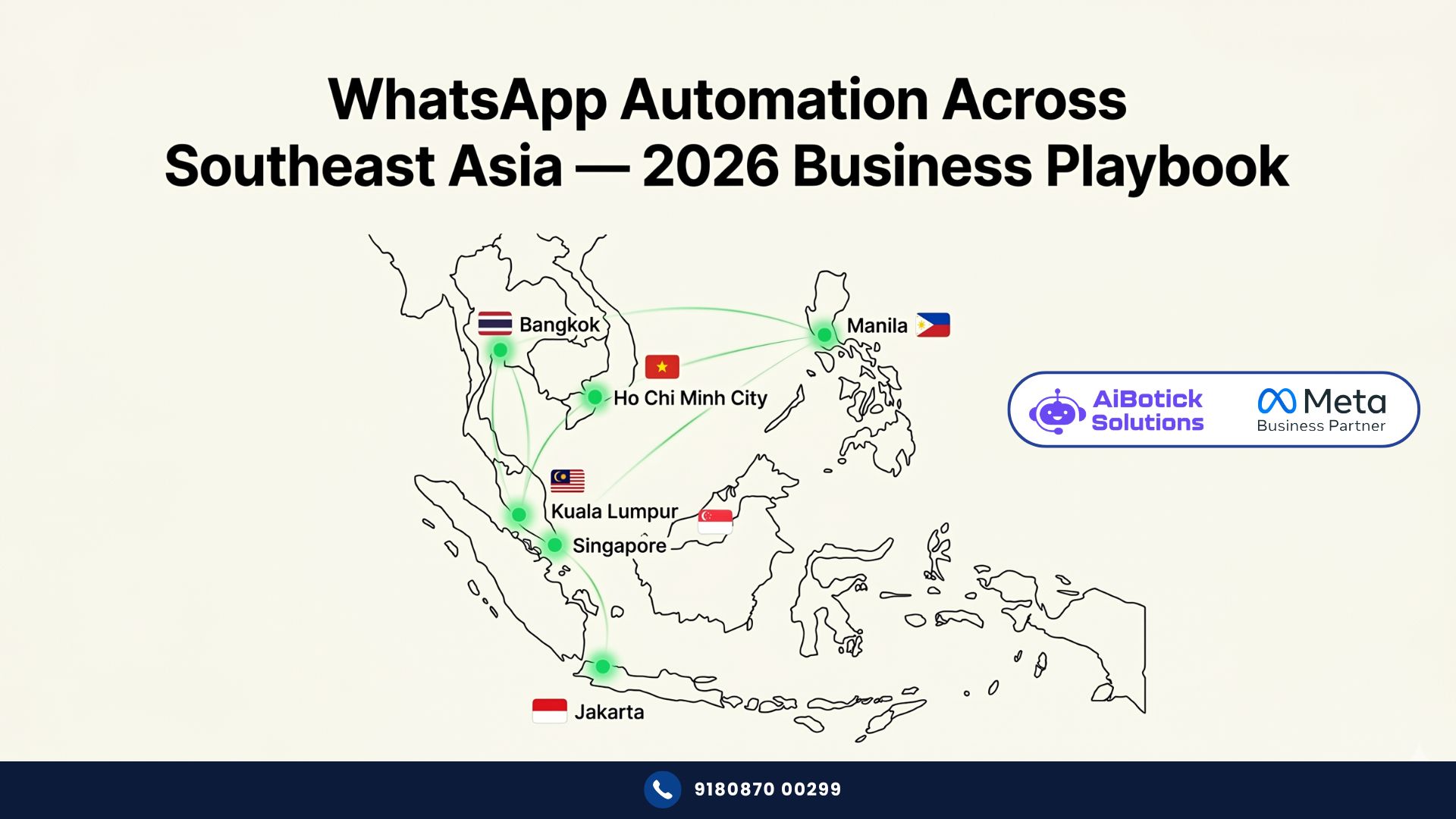
Before strategy, understand the market reality. Because Southeast Asia WhatsApp isn’t one market — it’s seven distinct markets that happen to share a common communication platform.
Singapore: 5.9 million people. 83% WhatsApp penetration. Highest GDP per capita in Southeast Asia. English-primary business communication. WhatsApp used for both personal and professional communication at very high rates.
Malaysia: 33 million people. 85%+ WhatsApp penetration. Multi-racial market — Malay, Chinese, Indian communities each with distinct communication preferences. Bahasa Malaysia and English both essential.
Indonesia: 277 million people. 2nd largest WhatsApp user base in the world after India. 68%+ penetration but growing fast. Bahasa Indonesia primary. Massive SME ecosystem — 64 million SMEs, most of them WhatsApp-native in their customer communication.
Philippines: 115 million people. WhatsApp growing rapidly alongside Facebook Messenger. English-proficient market — one of the highest in Asia. Large BPO sector heavily WhatsApp-dependent.
Thailand: 71 million people. LINE is dominant but WhatsApp growing fast in business-to-business and tourism contexts. English for business, Thai for consumer.
Vietnam: 97 million people. Zalo is local dominant but WhatsApp penetration accelerating, especially in export-oriented business communication.
Cambodia, Myanmar, Laos: Smaller markets but growing WhatsApp business adoption, particularly in cross-border trade contexts.
The common thread across all seven: WhatsApp Southeast Asia business communication is exploding. And formal automation infrastructure is dramatically behind adoption.
That gap — between how much businesses are using WhatsApp and how well they’re using it — is the opportunity.
The Three Types of Businesses This Article Is For
Let me be specific about who benefits most from WhatsApp Southeast Asia automation — because the strategy differs meaningfully by business type.
Type 1 — Indian businesses expanding into SEA Indian entrepreneurs and Indian companies opening offices in Singapore, Malaysia, or Indonesia. They understand WhatsApp deeply from India. They’re entering markets where WhatsApp is equally dominant. They have a natural advantage — and usually don’t realise it.
Type 2 — Southeast Asian businesses scaling across the region A Singapore company expanding into Malaysia and Indonesia. A Malaysian brand entering the Philippines. Multi-country operations where customer communication needs to work across languages, time zones, and cultural contexts simultaneously.
Type 3 — Global businesses using Southeast Asia as a hub Companies with Singapore headquarters managing Asia-Pacific operations. Professional services firms, tech companies, trading houses — where WhatsApp is the de facto client communication channel but nobody has built proper infrastructure around it.
All three types share the same core problem: WhatsApp usage is high, WhatsApp infrastructure is low, and the gap is costing them money daily.
What Makes Southeast Asia Fundamentally Different From India and UAE
This is the section most articles skip. Don’t skip it.
The Language Complexity Is Genuinely Unprecedented
India has many languages but WhatsApp automation in India works primarily in Hindi and English — broadly covering 80%+ of business communication needs.
UAE has Arabic and English as the essential pair, with Hindi as a significant third.
Southeast Asia? Let me list just the business-essential languages for a company operating across the region:
English (Singapore, Philippines, Malaysia business tier), Bahasa Malaysia, Bahasa Indonesia (similar to Malaysian but distinct enough to matter), Tagalog (Philippines consumer), Thai, Vietnamese, Mandarin (Singapore Chinese community — 74% of population), Tamil (Singapore Indian community — 9% of population).
A company operating across Singapore, Malaysia, Indonesia, and Philippines needs to potentially communicate competently in 5-6 languages. Simultaneously. Across a single WhatsApp Business API setup.
This isn’t a future problem. It’s a today problem for any business with genuine regional ambitions.
The Cultural Communication Styles Diverge Sharply
Singaporean business communication: Direct, efficient, documentation-heavy, formal initially, fast-moving.
Malaysian business communication: Relationship-first, slightly more formal, multilingual switching is natural, pace is warm rather than rushed.
Indonesian business communication: Highly relationship-oriented, hierarchy matters, patience is expected and demonstrated, Bapak/Ibu address forms matter in formal contexts.
Filipino business communication: Warm, English-fluent, high-context, relationship and emotion play strongly in purchase decisions.
The same WhatsApp message — even in the right language — landing differently across these cultures is a real phenomenon. What reads as efficient in Singapore reads as cold in Indonesia. What reads as warm in Philippines reads as unprofessional in Singapore.
Building WhatsApp Southeast Asia automation without accounting for this is like building a restaurant that serves exactly the same menu in all seven countries and wondering why it works in Singapore but not in Jakarta.
Payment and Commerce Integration Differs By Market
India has UPI deeply embedded in WhatsApp commerce flows. UAE has specific payment gateway requirements.
Southeast Asia is fragmented:
- Singapore: PayNow, Stripe, traditional bank transfer
- Malaysia: FPX, Touch ‘n Go, Maybank2u
- Indonesia: GoPay, OVO, DANA, bank transfer (BCA, Mandiri)
- Philippines: GCash, PayMaya, bank transfer
Your WhatsApp commerce flows — catalog, payment collection, order confirmation — need to connect to the right payment infrastructure in each market. A Singapore payment flow won’t work for an Indonesian customer and vice versa.
This matters at the infrastructure selection stage. Your WhatsApp API provider needs to support the integration flexibility to connect different payment systems by market.
Regulatory Environments Vary — Significantly
Singapore has PDPA (Personal Data Protection Act) — strict, well-enforced, serious penalties.
Indonesia has UU PDP — enacted 2022, enforcement ramping up significantly.
Malaysia has PDPA 2010 — established framework, active enforcement.
Philippines has Data Privacy Act 2012 — robust framework, NPC actively investigates complaints.
Each market has distinct requirements for consent collection, data storage location, opt-out mechanisms, and cross-border data transfer. An Indian company expanding across SEA and treating WhatsApp contact data the same way they treat their India database is creating compliance exposure in multiple jurisdictions simultaneously.
This is not theoretical risk. It’s practical exposure that’s increasing as regulators in each market mature their enforcement capability.
The WhatsApp Southeast Asia Playbook — By Business Type
For Indian Businesses Entering SEA — Your Unfair Advantage
Seedha bolta hoon — Indian entrepreneurs entering Southeast Asia have a WhatsApp automation advantage that most local businesses don’t recognise and most Indian entrepreneurs waste.
You already understand WhatsApp as a business tool at an intuitive level that takes non-Indian businesses years to develop. You’ve automated, broadcast, built flows, managed customer groups — this is in your muscle memory.
The SEA market is hungry for this sophistication. Local businesses are largely running WhatsApp manually. International businesses are running email-first with WhatsApp as an afterthought. You walk in with 4+ years of WhatsApp business experience and a market that’s ready for exactly what you know.
The specific plays:
Singapore market entry: Singapore’s business community is small, interconnected, and referral-heavy. A WhatsApp referral activation flow — similar to what we covered in the Gulf article — works exceptionally well here. The Singaporean Chinese business community specifically operates on referral trust networks that WhatsApp is ideally suited to systematise.
Your first 90 days in Singapore: Build your WhatsApp opt-in at every touchpoint. Get 200-300 high-quality contacts. Run value-first sequences — useful content, market insights, relevant introductions — before any sales communication. The patience pays in a market where trust precedes transaction more than almost anywhere else.
Malaysia market: Malaysia’s multi-racial business environment — Malay, Chinese, Indian — means language sensitivity matters acutely. A Malay business owner receiving your WhatsApp message in Bahasa Malaysia feels seen in a way that an English message doesn’t achieve. A Malaysian Indian receiving your message in Tamil or Hindi creates an immediate warmth.
The language investment in Malaysia is low (translation cost) and the return is disproportionately high. Do it.
Indonesia market: Indonesia requires the most patience and the most relationship infrastructure. Don’t try to automate the relationship stage — automate everything that comes after the relationship is established.
In Indonesia, WhatsApp automation works brilliantly for: order processing, payment follow-up, delivery updates, customer support, reorder reminders. It works poorly if used to initiate business relationships — that part still needs human warmth and proper relationship building first.
Actually wait — let me give you the specific example that made this click for me.
An Indian pharmaceutical trading company entered Indonesia from Singapore. Tried to automate their distributor outreach — WhatsApp sequences, broadcast campaigns, the works. Got almost zero traction for 4 months. Frustrated.
Then they shifted strategy: Their team visited 40 distributors in person over 6 weeks. Built relationships. Then — and only then — activated WhatsApp automation for order management, payment reminders, and product update broadcasts.
Adoption was near-instant. Because the relationship was already there. The automation made an existing relationship more efficient — it didn’t try to replace the relationship-building stage.
Revenue from Indonesian distributors: Went from zero to Rs.1.2 crore/month within 6 months of the WhatsApp automation going live post-relationship phase.
This is the Indonesia lesson. Relationship first. Automation after. Non-negotiable.
For Businesses Scaling Across Multiple SEA Markets
This is where the complexity compounds — and where getting the infrastructure right from day one matters most.
The central command model:
One WhatsApp Business API account. Multiple phone numbers — one per market if needed. Centralised team inbox with market-based routing. Country tags on every contact. Language tags. Purchase history tags. Market-specific flow libraries.
Every customer in every market experiences localised communication — their language, their cultural register, their local payment options. Behind the scenes, one team manages everything from a single platform.
This sounds complex. It’s not — if your provider supports it. It’s impossible — if your provider doesn’t.
Before choosing any WhatsApp automation platform for multi-market SEA operations: ask explicitly whether they support multiple numbers on one account, country-based routing, and multi-language flow management. These are non-negotiable for genuine regional operations.
The market-specific broadcast calendar:
Beyond language, your broadcast calendar needs to reflect market-specific occasions.
Singapore: Chinese New Year (massive), National Day (August 9), Deepavali (for Indian community), Christmas, New Year.
Malaysia: Hari Raya Aidilfitri (biggest), Hari Raya Aidiladha, Chinese New Year, Deepavali, National Day (August 31).
Indonesia: Lebaran/Eid Al Fitr (the single biggest consumer moment in Indonesia — larger than Christmas anywhere), Batik Day, National Day (August 17).
Philippines: Christmas (Filipinos start celebrating in September — genuinely), New Year, Valentine’s Day, All Saints Day.
A regional business that maps these occasions across all four markets and builds WhatsApp campaigns accordingly has 25-30 distinct, culturally resonant moments to communicate meaningfully with customers every year.
Compare that to a generic “quarterly promotion” approach. No comparison.
For Singapore-Headquartered Regional Operations
Singapore as a hub means dealing with sophisticated clients, high compliance standards, and teams spread across multiple countries.
The B2B WhatsApp flow for Singapore operations:
Singapore B2B runs on trust, speed, and documentation. Your WhatsApp automation needs to reflect all three.
Lead comes in → instant response with company credentials, relevant case studies, and a clear next step → qualification sequence → if qualified, automated calendar booking for video call with human → post-meeting WhatsApp follow-up with meeting summary and proposed next steps → document collection flow if proceeding → onboarding sequence
The whole flow is professional, fast, and documented. Every touchpoint tracked. Every response within minutes.
For Singapore B2B specifically — the post-meeting WhatsApp summary is a particularly underused tactic. Within 30 minutes of a meeting, a WhatsApp message summarising key discussion points, agreed actions, and timeline creates an impression of professionalism that most competitors aren’t matching. It’s 5 minutes of work if automated correctly. It’s the difference between “impressive team” and “just another vendor.”
A Singapore-based Indian IT services company implemented this post-meeting follow-up flow. Within 90 days, their proposal acceptance rate went from 31% to 49%. Same proposals. Same pricing. Just dramatically better follow-through communication.
For a full breakdown of how to measure what each of these flows is worth financially, our WhatsApp automation ROI guide gives you the exact framework — adaptable to any currency and any deal size.
The Compliance Architecture — Building It Right Across Seven Markets
No no, scratch that — let me reframe this. Compliance isn’t a constraint on your WhatsApp Southeast Asia strategy. It’s the foundation that makes the strategy sustainable.
Here’s the non-negotiable architecture for multi-market SEA WhatsApp compliance:
Explicit, documented opt-in — every market, every contact. Not implied consent. Not “they gave us their number so they consented.” Explicit, recorded, timestamped opt-in. The language of the opt-in should match the language of communication — you can’t consent someone in English and then communicate in Bahasa Indonesia.
Market-specific consent records. Different markets have different consent requirements. Singapore PDPA requires records of what the individual consented to and when. Indonesia UU PDP similarly. Keep these records in a format that can be produced during a regulatory inquiry — because as enforcement matures across the region, this will eventually be requested.
Opt-out honoured immediately and permanently. When someone opts out in any market — they are off every list in every market instantly. No “we’ll process in 3 business days.” No “they opted out of marketing but we can still send transactional.” If they said stop — stop.
Data localisation awareness. Indonesia has specific data localisation requirements for certain data types. Malaysia has cross-border transfer restrictions. Singapore allows more flexibility but requires contractual safeguards. Know what applies in each market before you build your data infrastructure.
Template compliance by market. WhatsApp template approval is global — but content sensitivity varies by market. Templates involving financial products, healthcare, or political content face different scrutiny in different jurisdictions. Build templates with the most restrictive market in mind, then adapt for markets with more flexibility.
This isn’t designed to scare you. It’s designed to make sure you build something that compounds in value over 3-5 years rather than creating liability that blows up at year 2.
What People Get Completely Wrong About WhatsApp in Southeast Asia
Wrong belief 1: “Singapore is the model — what works there works everywhere in SEA.”
Singapore is the exception, not the rule. It’s the most Westernised, most English-fluent, most operationally efficient market in Southeast Asia. What works there — direct, fast, documentation-heavy communication — can actively hurt you in Indonesia or even Malaysia. Treat each market as distinct. Because it is.
Wrong belief 2: “WhatsApp is WhatsApp — the automation is the same everywhere.”
The platform is the same. The cultural deployment is completely different. A broadcast campaign that generates 65% open rates in Singapore generates 28% open rates in Indonesia if you send the same message at the same time in the same format. The localisation isn’t optional — it’s the entire game.
Wrong belief 3: “We’ll do SEA expansion after we’ve perfected India.”
For Indian businesses specifically — the WhatsApp muscle you’ve already built in India is directly transferable to SEA. You don’t need to perfect India first. You need to enter SEA while the market is still in early adoption. The window is open now. It will narrow.
Wrong belief 4: “LINE and Zalo mean WhatsApp doesn’t matter in Thailand and Vietnam.”
For consumer communication in Thailand, LINE is dominant. True. But for B2B communication, cross-border trade, and professional contexts — WhatsApp is increasingly essential even in LINE-dominant markets. And in Vietnam, WhatsApp penetration in business contexts is growing fast enough that ignoring it is a strategic mistake for any internationally-oriented business.
For a detailed understanding of how WhatsApp compares to other communication channels across different business contexts, our WhatsApp vs email vs SMS guide covers the channel comparison with actual data on where each performs best.
The Infrastructure Decision — What to Get Right Before You Start
I’ve seen Indian businesses enter Southeast Asia, get excited about WhatsApp automation, and make an infrastructure decision in 45 minutes based on a demo call. Then spend 8 months regretting it.
Here’s what to evaluate carefully before choosing your WhatsApp Southeast Asia platform:
Multi-number support. Can you manage Singapore, Malaysia, and Indonesia numbers from one platform? Critical for regional operations.
Language flexibility. Right-to-left Arabic support matters for UAE. For SEA, you need Mandarin, Bahasa, Tagalog, Thai rendering — all without workarounds or display issues.
Payment gateway integrations. Singapore PayNow, Indonesian GoPay, Malaysian FPX — does the platform support or allow custom integration with these?
Timezone management. Can you schedule broadcasts in market-local time zones rather than a single global timezone?
Compliance tooling. Does the platform provide opt-in recording, consent management, and opt-out automation that meets PDPA and regional equivalents?
Support coverage. If your Indonesia operations have an issue at 9am WIB (Jakarta time) — that’s 11am Singapore time, 8:30am IST. Does your provider’s support cover that window meaningfully?
At AiBotick, we’ve supported businesses operating across multiple markets with these exact requirements. The personalised onboarding we provide isn’t a generic walkthrough — it’s built around your specific market mix, your language requirements, and your compliance needs. Every client gets live training with their actual team and a dedicated support group that operates across the time zones that matter for their business. 💯
Not an upsell. Not enterprise-only. The way we operate. Because we’ve seen what happens when regional businesses get generic support designed for single-market deployments. It doesn’t work.
The Realistic Timeline — What to Expect and When
Dekho — Southeast Asia expansion through WhatsApp automation isn’t a 30-day project. Here’s the honest timeline for a business entering 2-3 SEA markets simultaneously.
Month 1 — Foundation: WhatsApp Business API setup. Number registration per market. Opt-in flows built in English plus primary local language per market. First post-purchase or post-enquiry sequence live in Singapore (fastest approval environment).
Month 2 — Language expansion: Add Bahasa Indonesia and Bahasa Malaysia flows. Build festival broadcast calendar for next 6 months across all markets. Get compliance documentation in order per market.
Month 3 — Automation depth: Qualification sequences live. Lead routing by market. Team inbox configured with country and language tagging. First broadcast campaigns running in market-local time zones.
Month 4-6 — Optimise and scale: Review open rates, response rates, opt-out rates by market. Kill what isn’t working. Double down on what is. Add payment integration where relevant. Build referral flows in markets where they perform (Singapore especially).
Month 6+ — Compound: By month 6, a business that has built correctly has a functioning WhatsApp customer communication system across 2-3 SEA markets. Clean database. Optimised flows. Compliance architecture in place. And the compounding begins — every new customer enters a system that nurtures them systematically, every referral is captured and activated, every festival moment is leveraged.
The businesses that start this in 2026 will have 2-3 years of compounded customer relationships by the time the SEA WhatsApp automation market matures fully. The ones who wait until the market matures will be starting from zero against competitors who have years of head start.
Ab toh you know what to do.
Let’s Build Your Southeast Asia WhatsApp Infrastructure
Chat with us on WhatsApp — tell us which SEA markets you’re operating in or entering, what your current WhatsApp setup looks like, and what the single biggest communication problem is in your regional operations. We’ll give you an honest assessment of what to build first and what realistic results look like across your specific market mix.
We’ve done this across India and the Gulf. The Southeast Asia expansion playbook is the next chapter — and we’re building it with clients who are ready to move now. 💯
— Mohit Shah | 15+ years in IT industry | 4+ years in WhatsApp automation | Worked with various MNC brands | Now helping businesses figure out what actually works
Q1: Does WhatsApp automation work for businesses operating across multiple Southeast Asian countries simultaneously?
Yes — with the right infrastructure. A WhatsApp Business API setup with multiple country-specific numbers, centralised team inbox, language-based routing, and market-specific contact tagging allows businesses to manage Singapore, Malaysia, Indonesia, and Philippines operations from a single platform while delivering localised communication in each market. The key is choosing a provider that explicitly supports multi-number management and multi-language flow configuration before committing to any platform.
Q2: What are the biggest compliance requirements for WhatsApp marketing in Southeast Asia?
Each major SEA market has its own data protection framework: Singapore’s PDPA, Indonesia’s UU PDP, Malaysia’s PDPA 2010, and the Philippines’ Data Privacy Act 2012. All require explicit opt-in consent before sending WhatsApp marketing messages, immediate and permanent opt-out honouring, and documented consent records. Indonesia additionally has data localisation requirements for certain categories of data. Businesses operating across multiple SEA markets should build their consent architecture to meet the most stringent requirement in their market mix and apply it consistently across all markets.
Q3: How should Indian businesses adapt their WhatsApp automation strategy when entering Southeast Asian markets?
Indian businesses have a natural advantage in SEA — deep WhatsApp familiarity that most local and international competitors lack. The adaptation required is cultural and linguistic rather than technical. Singapore operations can run similar to India in terms of pace and directness. Malaysia requires Bahasa Malaysia language investment and relationship-first sequencing. Indonesia requires significant relationship building before automation is introduced — automation works for transaction management after relationships are established, not for initiating them. Philippines operations benefit from warm, English-fluent communication with strong emotional resonance. The technical infrastructure is identical to India; the deployment philosophy differs meaningfully by market.