Here’s a number that should stop you mid-scroll.
WhatsApp processed over 100 billion messages per day in 2025. More than SMS. More than iMessage. More than email. Combined.
And yet — most businesses are still treating WhatsApp like a customer support afterthought. A place to answer complaints. A channel you hand to your most junior team member because “it’s just WhatsApp.”
Dekho, the companies that figured this out 18 months ago? They’re not going back. WhatsApp global sales is no longer a trend. It’s the infrastructure serious businesses are building their entire revenue engine on. And if you’re still debating whether to “try it” — you’re already behind.
Let me show you exactly what this looks like in practice. Real businesses. Real numbers. Real outcomes.
Why WhatsApp Global Sales Is a Different Beast From Everything Else
Before we get into the how, I want to make sure we’re aligned on why this works at a level that email, SMS, and even Instagram DMs simply don’t match.
Three reasons. That’s it.
Reason 1 — Intimacy at scale
WhatsApp sits in the same app as your customer’s family conversations. Their mum’s messages. Their best friend’s voice notes. When your business message lands there — and it lands well — it carries a completely different psychological weight than an email in a promotional tab that nobody opens.
You’re not competing with 200 other newsletters. You’re sitting next to people they love.
Reason 2 — Response behaviour is fundamentally different
Email average open rate globally: 21%. Response rate: 2-3%. WhatsApp average open rate: 95-98%. Response rate: 40-60% for well-crafted messages.
That gap is not marginal. That gap is the difference between a campaign that pays for itself and one that doesn’t.
Reason 3 — The entire sales conversation happens in one thread
Think about a traditional sales cycle. Lead comes in on a form. Email confirmation goes out. Sales rep calls. Prospect doesn’t pick up. Follow-up email. WhatsApp message. Back to email. Three weeks later — deal either happened or died somewhere in that chaos.
With WhatsApp global sales done properly? The lead comes in, gets an immediate automated response, qualifies itself through a chatbot flow, books a call or demo, gets reminders, closes — and the entire conversation history lives in one thread that any team member can see.
No dropped leads. No “I thought you were handling it.” No lost context.
What Global WhatsApp Sales Actually Looks Like — By Business Type
I want to get specific here because “global businesses use WhatsApp” means nothing without examples.
D2C and Ecommerce Brands Going Cross-Border
A Mumbai-based premium dry fruits and gifting brand — Diwali, Rakhi, corporate gifting market — started selling to UAE, UK, and Singapore in 2024. Their entire international sales process runs on WhatsApp.
Here’s the flow:
- Instagram ad with a click-to-WhatsApp button (UAE-targeted, English + Arabic copy)
- Customer clicks → immediately receives automated greeting with product catalogue link
- Chatbot asks: gift for whom? Budget range? Delivery date?
- Based on answers, sends 3 curated product recommendations with images and prices
- Human sales agent takes over only when customer says “I want to order”
- Order confirmation, payment link, shipping update, delivery confirmation — all WhatsApp
- 7 days after delivery: “Did they love it? We’d love a photo 😄” — feeds UGC pipeline
In 8 months of running this for UAE and UK markets: international revenue went from zero to Rs.34L per month. Customer acquisition cost from WhatsApp: 60% lower than Meta feed ads to a landing page.
The key insight? They removed every step that required the customer to leave WhatsApp. No website navigation. No cart abandonment. No checkout friction. The sale happened inside the conversation.
B2B Companies Using WhatsApp Global Sales to Shorten Deal Cycles
Actually wait — this is the one most B2B founders haven’t fully thought through yet.
In global B2B sales, the traditional cycle is painful. Cold email → LinkedIn → discovery call → proposal → follow-ups → negotiation → close. Anywhere from 4 weeks to 6 months depending on deal size.
WhatsApp doesn’t replace that process. But it dramatically accelerates it.
Here’s what I’ve consistently seen work:
- After an initial intro call or email, move the conversation to WhatsApp immediately. “Should I send the proposal on WhatsApp? Easier to track.” Almost everyone says yes.
- Once you’re in their WhatsApp — you’re no longer competing with 200 unread emails. Your follow-up message gets seen within minutes, not days.
- Contract questions, scope clarifications, pricing negotiations — all handled over WhatsApp voice notes and messages. Faster than scheduling another call. More personal than email.
- Proposal reminder: a WhatsApp message 3 days after sending (“Any questions on the proposal? Happy to jump on a quick call”) converts at 3x the rate of an email follow-up
A Bangalore-based SaaS company selling HR software to mid-size companies in Singapore and Malaysia shifted their entire post-discovery communication to WhatsApp in early 2025. Average deal cycle went from 67 days to 29 days. Same product. Same pricing. Just a different communication channel for the follow-up stages.
29 days versus 67 days. Think about what that does to your quarterly revenue.
Service Businesses — Agencies, Consultants, Coaches
This is where WhatsApp global sales gets almost unfairly easy.
A digital marketing agency in Hyderabad — 12 people, serving clients in UAE, UK, Australia, and India — runs their entire client communication on WhatsApp Business API.
Not personal WhatsApp. API. With a shared team inbox.
What that means practically:
- Every client has one dedicated WhatsApp thread — the client talks to one number, but 3 different team members can see and respond
- Monthly report delivered as a PDF directly on WhatsApp, with a voice note summary from the account manager
- Client approval flows — “Here are 5 posts for next week. React with 👍 to approve or reply with changes” — average approval time dropped from 3 days to 4 hours
- Retainer renewal reminders automated — 30 days before expiry, 15 days, 7 days — conversion rate on renewals went from 71% to 89%
The agency’s NPS score? 74. Their industry average? 31.
Why? Because clients feel heard. They feel responded to. They feel like the agency actually cares — because every message gets a response within the hour, even if it’s just “Got it, we’re on it 🙏”
That feeling of being cared for? That’s what WhatsApp global sales actually sells. Not the product. The relationship.
The WhatsApp Global Sales Stack — What You Actually Need
No no, scratch that approach. Instead of listing features abstractly, let me tell you what a properly built WhatsApp sales operation actually consists of. In order of importance.
Layer 1 — Official WhatsApp Business API (Non-Negotiable)
Not WhatsApp Business App. Not a bulk sender. Not some grey-area tool that’ll get your number banned in 3 months.
Official API through a Meta-verified provider. This is the foundation. Without this, you cannot do template broadcasts, you cannot have a shared inbox, you cannot run chatbot flows at scale, you cannot integrate with your CRM.
Everything else sits on top of this layer.
Layer 2 — Shared Team Inbox
The moment your WhatsApp volume grows beyond 50 conversations a day — one person managing it is a bottleneck. You need multiple agents, full conversation history, assignment capability, and internal notes.
This is what converts WhatsApp from a personal messaging tool into a business sales infrastructure.
Layer 3 — Chatbot Qualification Flows
Your first-response chatbot should do three things:
- Welcome the lead instantly (within seconds — not minutes)
- Ask 2-3 qualifying questions
- Route to the right human or automated sequence based on answers
This is not about replacing humans. It’s about making sure humans spend their time on qualified, ready-to-buy conversations — not on explaining basic product information to everyone who enquires.
For a detailed breakdown of how to build these flows properly, our WhatsApp Sales Funnel guide covers the exact architecture — from first touch to closed deal.
Layer 4 — Broadcast and Drip Sequences
For your existing customer base and opted-in leads — segmented broadcasts for promotions, re-engagement sequences for cold leads, post-purchase sequences to drive repeats.
This layer is where the compounding revenue lives. Your hottest asset is your WhatsApp contact list of opted-in, engaged customers. Most businesses underuse it completely.
Layer 5 — CRM Integration
At serious scale — connecting your WhatsApp conversations to your CRM means every lead is tracked, every follow-up is logged, and no deal falls through because someone forgot to follow up.
Our WhatsApp CRM integration guide walks through exactly how this works for businesses at different stages of growth.
What People Get Wrong About WhatsApp Global Sales
Myth-busting. Let’s go.
Myth: “WhatsApp is too informal for enterprise sales”
Honestly? I think this objection is completely outdated. In 2026.
I’ve watched enterprise procurement managers share RFP documents over WhatsApp voice notes. I’ve seen CFOs approve six-figure deals with a thumbs-up emoji on WhatsApp after a detailed thread. The formality of a communication channel matters far less than the trust and speed it enables.
The businesses clinging to “email is more professional” are the ones losing deals to competitors who respond in 90 seconds on WhatsApp while they’re still drafting their “Dear Sir/Madam” follow-up email.
Myth: “WhatsApp doesn’t scale — it’s too personal”
This is exactly backwards. WhatsApp scales because it feels personal. That’s the product.
A broadcast to 10,000 people that feels like a personal message from a trusted advisor? That’s not a limitation — that’s the most powerful sales tool available right now. No email newsletter comes close.
Myth: “Our customers are in X country — WhatsApp won’t work there”
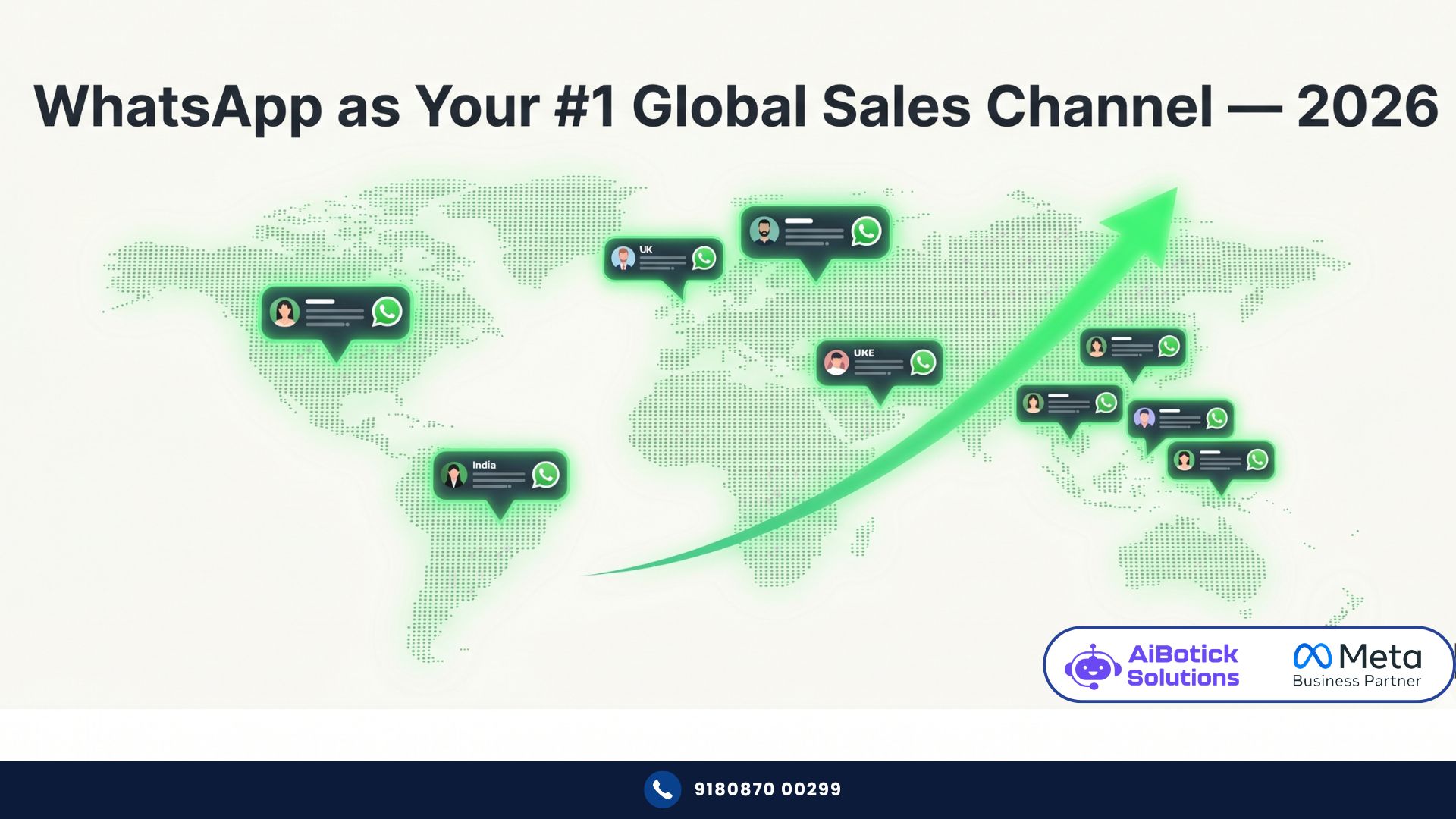
Could be wrong, but I’ve seen this consistently — WhatsApp is the dominant messaging platform in India, Brazil, Indonesia, Malaysia, UAE, UK, Germany, Italy, South Africa, Mexico, Argentina, and dozens of other major markets. The only significant market where WhatsApp is genuinely weak is the United States, where iMessage and SMS dominate.
If your customers are anywhere other than the US? WhatsApp global sales is almost certainly viable. Run the numbers before you dismiss it.
The Honest Truth About What Makes WhatsApp Global Sales Work Long-Term
Ab toh, main seedha point pe aata hoon.
Every business I’ve seen succeed with WhatsApp global sales has one thing in common. It’s not the chatbot sophistication. It’s not the CRM integration. It’s not even the broadcast strategy.
It’s response quality and speed.
WhatsApp creates an expectation of immediacy. If someone messages your business on WhatsApp and waits 6 hours for a reply — you’ve not just lost that sale. You’ve actively damaged trust. Because in their head, it’s like texting a friend and getting a reply the next morning. Something feels off.
The businesses that win? They’re responding within minutes for inbound leads. Automated instantly, human within 15 minutes for anything complex.
And when humans respond — they respond like humans. Warm. Direct. Helpful. Not copy-pasting the same generic script.
Honestly bhai — the technology is the easy part. AiBotick can set up your entire WhatsApp global sales infrastructure in days. The cultural shift — training your team to treat WhatsApp conversations with the same urgency and warmth as an in-person customer walking through your door — that’s what separates the businesses that see 40% conversion lifts from the ones that try WhatsApp for 3 months and say “it didn’t work.”
It works. It works everywhere. For every business type we’ve covered in this article. The variable is how seriously you treat it.
How to Start Building Your WhatsApp Global Sales Engine — This Week
Not next quarter. Not after your next planning cycle. This week.
Day 1-2: Get on WhatsApp Business API with a verified provider. If you’re on a personal number or WhatsApp Business App — migrate. This is the foundation.
Day 3-4: Set up your first chatbot flow for inbound leads. Even a basic one. Welcome message → 2 qualifying questions → route to human. That’s it. Launch it.
Day 5: Build your first broadcast list from existing customers who’ve opted in. Send one warm, non-salesy message. See what happens.
Week 2: Look at your response time data. Where are leads waiting more than 30 minutes? Fix that first. Speed beats sophistication every time.
Week 3-4: Add your drip sequence for leads who enquired but didn’t convert. A 4-message sequence over 10 days — warm, helpful, not desperate — will recover a percentage of those leads that would otherwise have gone cold forever.
That’s your 30-day WhatsApp global sales launch. Not complicated. Not expensive. Just consistent.
If you want AiBotick to build this with you — not just for you, with you — the conversation starts on WhatsApp. Appropriately. 😄
— Mohit Shah │ 15+ years in IT industry │ 4+ years in WhatsApp automation │ Worked with various MNC brands │ Now helping businesses figure out what actually works
Q1: Can any business use WhatsApp as their primary sales channel globally?
A1: Yes — with one significant exception. WhatsApp is the dominant messaging platform across India, UAE, Southeast Asia, UK, Europe, Latin America, and Africa. The only major market where WhatsApp has weak penetration is the United States, where iMessage and SMS dominate. For businesses selling anywhere outside the US, WhatsApp global sales is a viable and often superior primary sales channel.
Q2: What is the difference between WhatsApp Business App and WhatsApp Business API for global sales?
A2: WhatsApp Business App is a single-device tool with no broadcast capability beyond 256 contacts, no chatbot integration, no shared team inbox, and no CRM connectivity. WhatsApp Business API is enterprise-grade infrastructure — unlimited broadcast reach to opted-in contacts, full automation, multiple agents on one number, and integration with any CRM or business tool. For serious global sales operations, the API is non-negotiable.
Q3: How quickly can a business set up WhatsApp as a global sales channel?
A3: With an official API provider like AiBotick handling the setup, the technical infrastructure — API connection, shared inbox, basic chatbot flow — can be live within 3 to 5 business days. The first broadcast to existing opted-in customers can go out in week one. A fully operational WhatsApp sales engine with drip sequences, CRM integration, and segmented broadcasts typically takes 3 to 4 weeks to build and calibrate properly.