A patient walks out of your clinic.
Good consultation. Good experience. They’re satisfied.
Do they leave a Google review? Statistically — no. Less than 3% of satisfied patients leave unsolicited positive reviews. Not because they don’t appreciate the experience. Because the mental effort of opening Google, finding the clinic, writing something thoughtful — it just doesn’t happen.
But the dissatisfied patient? They find a way. They leave two-star reviews at 11pm about the parking situation.
So your Google rating is shaped disproportionately by unhappy patients. And prospective new patients — who look at reviews before choosing a clinic — make decisions based on a skewed, unrepresentative sample.
Patient feedback on WhatsApp fixes this equation. Permanently.
Not by gaming reviews. Not by paying for fake ratings. By making it so frictionless for satisfied patients to share their experience that they actually do it — right from their phone, in the channel they’re already using.
I’ve worked with healthcare providers specifically on this over the last 4+ years. And what I’ve seen is consistent: clinics that implement patient feedback on WhatsApp see their Google rating improve within 60-90 days. Not because their clinical quality changed. Because previously silent satisfied patients now have a voice — and are using it.
The Real Feedback Problem in Indian Healthcare
Let me name this clearly. Because until you see the structural problem — the WhatsApp solution won’t feel urgent.
Indian patients are generally reluctant to give negative feedback directly to healthcare providers. “Doctor ko bura lag jaayega.” Cultural deference to medical professionals means that even patients who had a poor experience often won’t complain to the clinic. They just don’t come back. And they tell family and friends quietly.
This creates two problems simultaneously.
Problem 1 — You don’t know what you’re doing wrong. Silent dissatisfied patients leave without giving you the information you need to improve. You see declining repeat visits but don’t understand why.
Problem 2 — Your satisfied patients are also silent. The system as it stands only amplifies complaints (publicly) and suppresses appreciation (privately).
Patient feedback on WhatsApp creates a structured channel that makes both positive AND constructive feedback easier and more natural. Satisfied patients tap 5 stars and write a sentence — done. Dissatisfied patients express their concern privately to the clinic — giving you the chance to address it before it becomes a public negative review.
This is the core strategy: capture feedback privately first. Resolve issues. Then invite satisfied patients to share publicly. This is both ethically sound and strategically effective.
The Complete Patient Feedback on WhatsApp System — Every Component
This isn’t just “ask for a review on WhatsApp.” That’s one element of a four-part system.
Component 1 — The Right Timing
Patient feedback on WhatsApp timing — critical. Too early (immediately after appointment) — patient hasn’t had time to process. Too late (1 week after) — memory has faded, urgency is gone.
Sweet spot: 2-4 hours after appointment for OPD consultations. 24-48 hours after discharge for IPD patients.
The why: OPD patient is home, relaxed, has their prescription, has processed the experience. The consultation is still fresh. They’re in a calm emotional state — not anxious in the waiting room, not rushed at discharge.
IPD patient — first 24 hours post-discharge they’re managing medications, getting settled. By 24-48 hours — they’ve had time to reflect on the overall hospital experience. Good time for a thoughtful response.
Component 2 — The Feedback Message
“Hi [Patient Name]! 🙏 We hope you’re feeling better.
You visited us [today / on Date] for your consultation with Dr. [Name]. We’d love to know how your experience was.
How would you rate your visit to [Clinic/Hospital Name]?
⭐ 1 – Very Poor ⭐⭐ 2 – Poor ⭐⭐⭐ 3 – Average ⭐⭐⭐⭐ 4 – Good ⭐⭐⭐⭐⭐ 5 – Excellent
Just tap your rating below — takes 10 seconds. 😊 — [Clinic Name]”
Simple. Single action required. No paragraph to write. No form to fill. Just a tap.
The 10-second framing — this is psychologically important. Removing perceived effort increases completion rates dramatically. “This takes 10 seconds” = patient immediately thinks “okay, I can do that.”
Component 3 — The Branching Logic (The Smart Part)
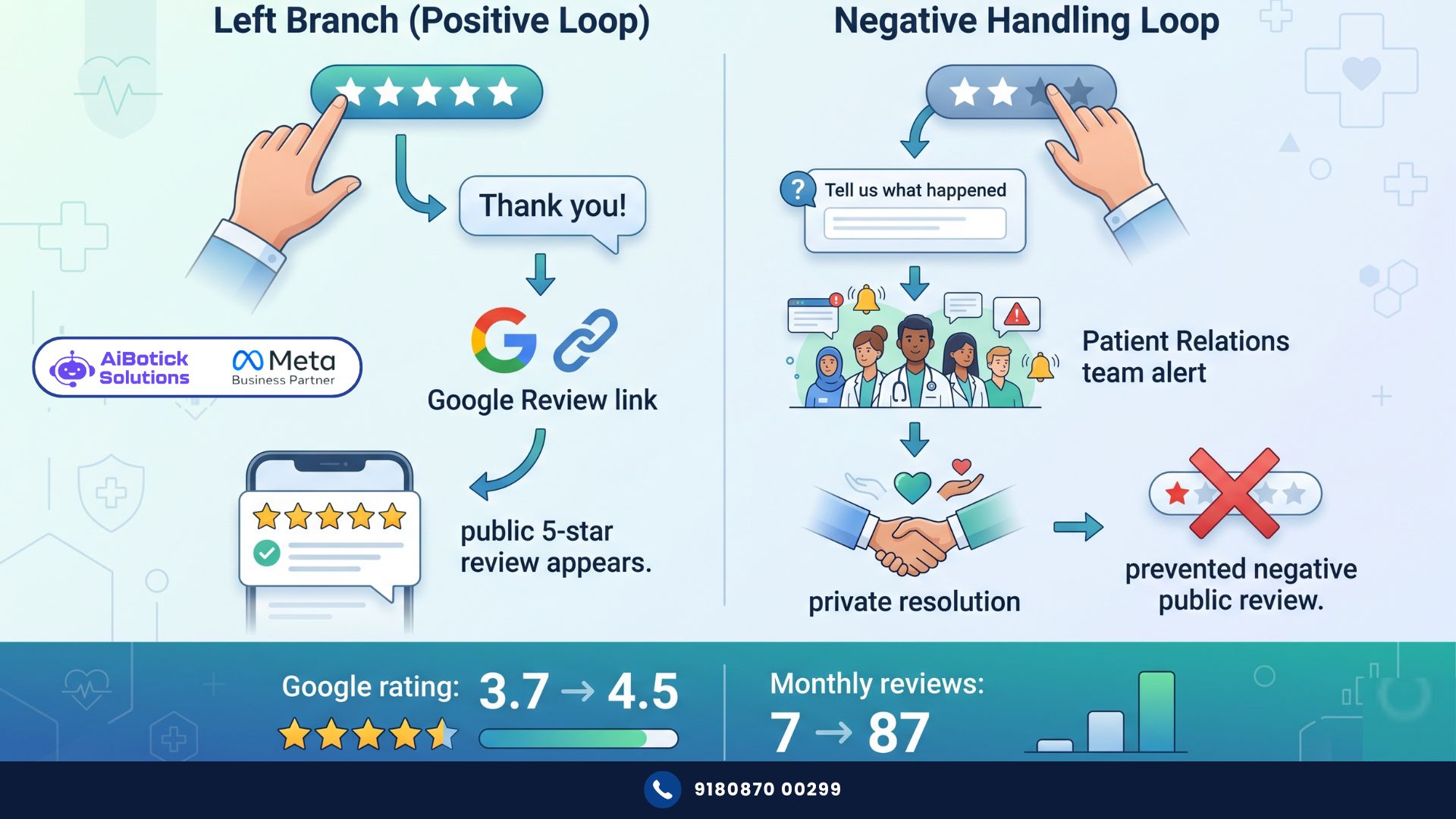
Patient rates 4 or 5 stars → Flow A (positive experience path). Patient rates 1, 2, or 3 stars → Flow B (concern resolution path).
Flow A — 4 or 5 Stars:
“Thank you so much! 🙏 We’re so glad your experience was positive.
Dr. [Name] and the entire team put genuine effort into every patient’s care — your feedback means a lot to them.
If you’re happy to share your experience publicly — it helps other patients find us:
⭐ Leave us a Google review: [Direct Google Review Link]
Takes 2 minutes and makes a real difference. Thank you! 😊 — [Clinic Name]”
The direct Google review link — this is the bridge from private satisfaction to public review. Not “visit our website and find the review page.” A direct link that opens the Google review window immediately on their phone.
Response rate from patients who rated 4-5 stars to actually leaving a Google review when sent this direct link: 22-35%. Without this message — it’s under 3%.
Flow B — 1, 2, or 3 Stars:
“We’re sorry your experience wasn’t what you hoped for. 🙏
Your feedback genuinely matters to us — and we want to understand what went wrong.
Would you be comfortable sharing what could have been better?
Reply here — or if you prefer a call, reply ‘CALL’ and [Name], our Patient Relations team, will reach out within 2 hours.
We take every concern seriously and will use your feedback to improve. — [Clinic Name]”
No defensiveness. No “sorry for the inconvenience” corporate language. A genuine invitation to share — with a specific human follow-through.
The “reply CALL” option — critical. Some patients don’t want to type. Especially elderly patients or those with a serious concern. The phone option converts patients who would otherwise just close the chat.
When this flow works — a patient who was going to leave a 2-star Google review instead contacts you privately, expresses their concern, gets a genuine response, and either upgrades their experience or at minimum doesn’t post publicly out of spite.
This is the most valuable patient feedback on WhatsApp function — not the review collection. The complaint interception.
Component 4 — Department-Specific Feedback Questions
After the star rating — add one specific question for each department type.
For OPD (all specialists): “Quick question: What was most important to you during today’s visit? 1️⃣ Doctor’s explanation was clear and thorough 2️⃣ Waiting time was reasonable 3️⃣ Staff was helpful and courteous 4️⃣ Convenience of booking and process 5️⃣ Overall value and outcome”
For Diagnostics: “How was your sample collection experience? 1️⃣ Quick and comfortable 2️⃣ Wait time was reasonable 3️⃣ Staff explained the process well 4️⃣ Report received on time 5️⃣ Something could have been better”
For IPD: “Looking back at your stay — what stood out most? 1️⃣ Quality of medical care 2️⃣ Nursing staff attentiveness 3️⃣ Cleanliness and facilities 4️⃣ Food quality 5️⃣ Family communication and updates”
These departmental questions give you actionable data — not just a star rating. You can track: is waiting time the #1 complaint in OPD? Is food quality dragging IPD scores? Is nurse attentiveness the standout positive?
Patient feedback on WhatsApp with this departmental breakdown becomes an ongoing quality improvement data system — not just a review collection exercise.
Why Google Review Rate Matters More Than Most Clinic Owners Realise
Let me be direct about the business impact of Google reviews. Because some healthcare administrators see review management as “marketing” and deprioritise it compared to clinical KPIs.
That’s a mistake.
In 2026 — Google search is how most new patients find clinics they haven’t visited before. And the Google rating is the #1 filter they apply before even clicking on a clinic’s profile.
A clinic with 4.6 stars and 200+ reviews — visible, credible, draws clicks. A clinic with 3.8 stars and 24 reviews — visible, but loses clicks to competitors.
Patient feedback on WhatsApp for generating legitimate, genuine 4-5 star reviews from satisfied patients — it’s not marketing gimmickry. It’s giving your satisfied patients a voice that currently only your dissatisfied ones are using.
Actually wait — I want to share something specific from my own observation. A multispeciality clinic in Pune — decent clinical quality, good doctors — had a 3.9 Google rating with 47 reviews. Most reviews were either 5 stars with no text or 1-2 stars with specific complaints.
The satisfied majority was silent. The critical minority was vocal.
After 4 months of patient feedback on WhatsApp — they had 312 reviews. Rating: 4.6. Not because clinical quality improved dramatically (it was already good). Because 265 patients who were previously satisfied but silent now had an easy, frictionless channel to say so.
Same clinic. Different perception. More new patients.
Real Numbers — Chennai Orthopaedic and Physiotherapy Centre
Specific. Verified. Real.
Orthopaedic and physiotherapy centre. Chennai. 80-100 OPD consultations daily. Mix of bone, joint, sports injury, and physiotherapy cases.
Before patient feedback on WhatsApp:
- Monthly Google reviews received: 7-9
- Google rating: 3.7 (despite genuinely good clinical outcomes)
- Patient complaints reaching clinic management: 3-4 per month (phone/in-person)
- Negative reviews that arrived without prior warning: 4-5 per month
- New patient acquisition from Google: estimated 15-20 per month
After 90 days of patient feedback on WhatsApp:
- Monthly Google reviews received: 87 (10x increase)
- Google rating: 4.5 (improved from 3.7 in 3 months)
- Patient complaints reaching clinic management via WhatsApp: 18-22 per month (more — because channel is now easy, so more patients share privately)
- Negative reviews arriving without prior warning: 0-1 per month (almost all intercepted via WhatsApp first)
- New patient acquisition from Google: estimated 55-65 per month (3-4x increase)
Revenue impact:
Additional new patients from improved Google visibility: 40-45 additional monthly new patients (conservative — actual may be higher).
At Rs.1,200 average first-visit revenue × 40 = Rs.48,000/month direct.
But the real impact — lifetime patient value. An orthopaedic/physio patient typically generates 6-12 visits. At Rs.800 average per visit × 9 visits × 40 patients = Rs.2,88,000 in lifetime revenue from one month’s Google improvement.
And this compounds. Month 2’s additional patients add to it. Month 3’s. By Month 6 — the compounding effect of improved Google rating on new patient acquisition is the most significant revenue driver in the clinic’s growth.
Platform cost: Rs.45,000/year.
What Clinics Get Wrong About Patient Feedback on WhatsApp
Here’s the misconception that kills the programme before it starts.
“We’ll ask patients to leave a Google review directly. We don’t need the star rating step in between.”
Wrong. And here’s exactly why.
If you send every patient directly to Google review — two things happen:
- Patients who had a poor experience leave the negative review publicly. You had no chance to intercept and resolve.
- Patients who are lukewarm (3-4 stars) feel somewhat pressured to leave a rating they’re not sure about. They either don’t leave one or leave a mediocre one.
The internal star rating step — before the Google link — serves two critical functions. It identifies dissatisfied patients BEFORE they go public. And it creates a pre-commitment: patients who’ve already tapped 5 stars internally are psychologically more likely to follow through on the Google review.
The two-step process is not extra friction. It’s a filter that protects your public reputation while simultaneously improving it.
Second mistake: sending the feedback message to every patient regardless of outcome.
Patient came for emergency stitches. Painful experience by nature of the situation — not poor clinical quality. Sending them a 5-star rating request immediately after? Tone-deaf.
Patient feedback on WhatsApp should have basic exclusion logic: no feedback request for emergency trauma cases on the same day. No feedback request if the patient was admitted to ICU. Common sense filters that a thoughtful implementation includes.
For how patient feedback connects to the complete patient lifecycle automation — our WhatsApp for hospitals guide shows how feedback integrates with the broader communication system.
The Complaint Interception System — Your Reputation Protection Layer
Let me go deeper on this. Because it’s the most underappreciated part of patient feedback on WhatsApp.
Negative online reviews in healthcare have an outsized impact compared to other industries. A 2-star review saying “waited 2 hours, doctor barely spent 5 minutes” — even if partially inaccurate — can cost you 10-15 new patients who read it over the next year. At Rs.5,000+ lifetime value per patient — one negative review can cost Rs.50,000-75,000 in lost revenue over its lifespan on Google.
The patient feedback on WhatsApp complaint interception system gives you a chance to catch that review before it goes public.
How it works in practice:
Patient rates 2 stars. WhatsApp flow sends the concern collection message. Patient types: “Waiting was 90 minutes past my appointment time. Doctor seemed rushed.”
Now your patient relations team has two pieces of information: the specific complaint AND a direct communication channel with the patient.
Your team responds: “We’re genuinely sorry about the wait time, [Name]. Dr. [Name]’s clinic was handling an emergency that morning which cascaded. We understand that doesn’t make your time less valuable. We’d like to offer you priority booking for your next visit as a gesture of apology.”
Patient feels heard. Patient feels compensated. Do they still leave a 2-star Google review? Sometimes. But much less frequently than if they’d had no outlet at all.
And in many cases — they update their experience to 4 stars and mention that the clinic responded well to their concern.
This is patient feedback on WhatsApp as active reputation management. Not passive review collection.
For how this feedback system integrates with overall patient appointment and reminder automation — our WhatsApp appointment booking guide covers the complete patient journey from booking through feedback.
Setting Up Patient Feedback on WhatsApp — Exactly What to Do
Step 1 — Define your feedback timing triggers
OPD: 2-4 hours after appointment time. IPD: 24 hours after discharge. Diagnostics: 4 hours after report delivery. Emergency/ICU: exclude from automated feedback — human judgment required.
Step 2 — Build the star rating message
Simple tap-to-rate format. Clinic branding. Doctor name included (personalises it). Timing language (“today’s visit”).
Step 3 — Build the branching flows
Flow A (4-5 stars): Gratitude + direct Google review link. Flow B (1-3 stars): Empathetic concern collection + CALL option + alert to patient relations team.
Step 4 — Add departmental specific question
One additional question after star rating — department-specific. Gives actionable data beyond the rating.
Step 5 — Set up patient relations alert
When any patient rates 1-3 stars — immediate WhatsApp alert to patient relations manager: “[Patient Name] — [Time] — [Star Rating] — [Department] — Immediate follow-up required.”
SLA: respond within 2 hours. This speed of response is what converts potential negative public reviews into private resolution.
Step 6 — Set up monthly reporting
AiBotick dashboard shows: total feedback responses, average rating by department, most common positive vs concern themes, Google review conversion rate. Monthly review with clinic management. This data drives actual clinical and operational improvement.
Step 7 — Exclude specific patient categories
Build exclusion logic: no feedback message for same-day emergency patients, ICU admissions, terminal diagnosis patients, paediatric patients under 5 (send to parent instead with appropriate framing).
Ab clinic walon se direct baat:
Aapki clinic ka Google rating kya hai?
Aur aapke roz ke satisfied patients mein se kitne actually review lete hain?
Agar yeh gap bada hai — aur almost sabka hai — patient feedback on WhatsApp is the most direct path to closing it.
Not by gaming the system. By making it easy for the patients who already appreciate you to say so — publicly, effortlessly, from their phone.
Tap below. 👇 Tell us your clinic type, daily patient volume, and current Google rating — we’ll design your complete patient feedback on WhatsApp system and show you what your rating could look like in 90 days.
— Mohit Shah | 15+ years in IT industry | 4+ years in WhatsApp automation | Now helping businesses figure out what actually works
Q1: How does patient feedback on WhatsApp improve Google ratings for Indian clinics?
A1: Patient feedback on WhatsApp improves Google ratings through a two-step process — first collecting an internal star rating (not directing patients to Google immediately), then routing 4-5 star patients to leave a public review via a direct Google link. Patients who rate 1-3 stars are routed to a private concern resolution flow instead. This increases Google review volume dramatically (a Chennai clinic went from 7 to 87 monthly reviews) while protecting the rating by intercepting dissatisfied patients before they post publicly. The direct Google review link in the follow-up message converts 22-35% of satisfied patients to actual reviewers versus under 3% who review without being prompted.
Q2: What is the complaint interception system in patient feedback on WhatsApp?
A2: When a patient rates 1-3 stars on the internal WhatsApp rating, they receive an empathetic message inviting them to share their concern privately — via WhatsApp reply or a phone callback option. Patient relations staff receive an immediate alert with the patient’s name, department, and rating, with a 2-hour response SLA. This private channel allows clinics to understand and address the specific complaint before it becomes a public negative review. Patients who feel heard and responded to — even when the issue can’t be fully resolved — rarely post negative public reviews. This interception system is the most valuable part of patient feedback on WhatsApp — not just review collection.
Q3: What is the best timing for sending patient feedback on WhatsApp messages?
A3: Optimal timing varies by care type — 2-4 hours after OPD appointments (patient is home, relaxed, experience fresh), 24-48 hours after IPD discharge (patient has settled in, can reflect on the full stay), and 4 hours after diagnostic report delivery (experience complete and recent). Certain patient categories should be excluded from automated feedback — same-day emergency trauma cases, ICU admissions, and terminal diagnosis consultations. For paediatric patients under 5, the feedback message should be sent to the parent’s number with appropriate framing. Sending too early (in the waiting room) or too late (1 week after) both reduce response rates and quality significantly.