Monday morning. 9:02am.
Your clinic receptionist picks up the phone. It’s already ringing before she’s even had chai.
Call 1: “Appointment chahiye Dr. Sharma ke liye.” — which slot? what date? patient name? which department? existing patient or new? — 4-minute call.
Call 2: Patient calling to confirm if their 11am appointment is still on. — 2-minute call.
Call 3: Patient calling to reschedule — their 3pm doesn’t work anymore, they want 4:30pm. — 3-minute call.
Call 4: New patient asking about fees, what to bring, parking instructions. — 5-minute call.
By 10am — she’s handled 22 calls. Hasn’t touched the actual patient registration queue. Three patients are waiting. One is complaining.
This is every clinic’s Monday. Every week. 52 weeks a year.
And the thing that frustrates me most — having worked with healthcare clients over the last 4+ years in WhatsApp automation — is that 80% of those calls are completely automatable. Not complicated. Not nuanced. Standard, predictable, repeatable queries that a WhatsApp appointment booking system handles in 30 seconds.
The phone shouldn’t be ringing that much. Not in 2026.
The Real Cost of Manual Appointment Management — Beyond Just Receptionist Time
Let me make this financial, not just operational.
A clinic with 60-80 appointments per day — small to mid-size, typical multispeciality in a Tier-1 Indian city.
Receptionist salary: Rs.18,000-25,000/month. But here’s what the salary doesn’t capture:
No-show rate without reminders: 22-28% on average. For a clinic seeing 70 patients/day — that’s 15-20 empty slots per day. Revenue lost on each slot: Rs.500-2,000 depending on specialist. Conservatively Rs.750/slot × 17 no-shows × 26 working days = Rs.3,31,500/month in lost revenue from no-shows alone.
After-hours calls going unanswered: Patients trying to book at 8pm, 9pm, Sunday morning. No callback system. They call the next clinic. Lost patient. Average patient lifetime value in a clinic — Rs.15,000-25,000 across consultations, tests, follow-ups over 2-3 years. Each after-hours unanswered call = potential loss of that entire LTV.
Booking errors: Wrong slot. Wrong doctor. Wrong date. Patient arrives, slot isn’t theirs. Doctor’s schedule disrupted. Patient upset. 2-3 such errors per week × 52 weeks = 104-156 angry patient interactions annually.
WhatsApp appointment booking automation addresses all three simultaneously. No-shows dramatically reduced through automated reminders. After-hours bookings captured 24×7. Booking errors near-zero because confirmation is in writing, patient confirms all details.
What WhatsApp Appointment Booking Actually Looks Like — The Full Patient Journey
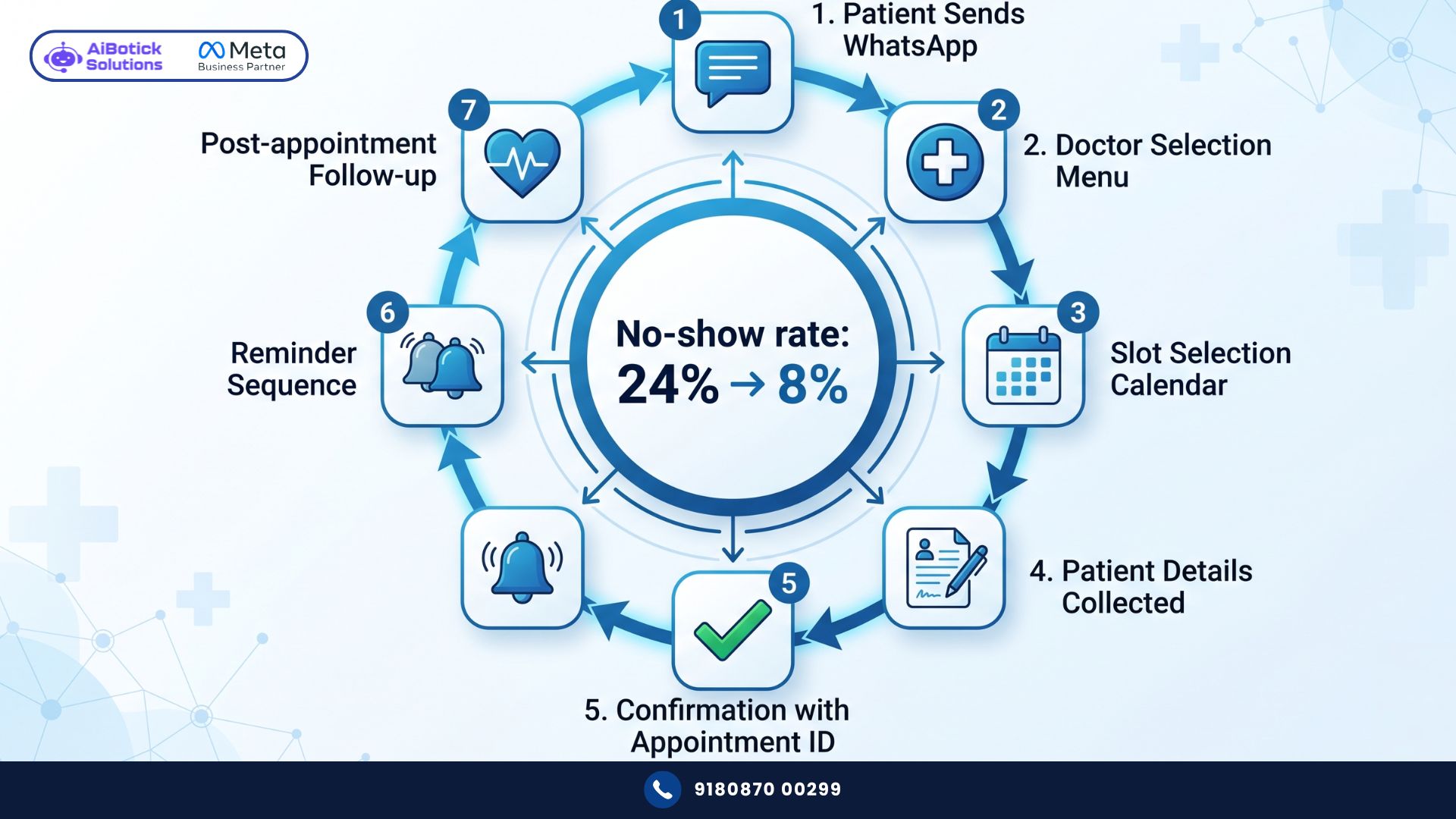
Let me walk you through the complete flow. From first message to post-appointment follow-up.
Step 1 — Patient Initiates on WhatsApp
Patient messages at any time — 7am, 11pm, Sunday, holiday.
Instant response:
“Namaste! 🙏 Welcome to [Clinic/Hospital Name].
How can I help you today? 1️⃣ Book a new appointment 2️⃣ Confirm or reschedule existing appointment 3️⃣ Get directions and parking information 4️⃣ Fees and insurance queries 5️⃣ Speak to our team“*
Patient selects 1️⃣. WhatsApp appointment booking journey begins.
Step 2 — Doctor/Department Selection
“Which specialty are you looking for?
1️⃣ General Physician 2️⃣ Cardiologist — Dr. [Name] 3️⃣ Orthopaedics — Dr. [Name] 4️⃣ Gynaecology — Dr. [Name] 5️⃣ Paediatrics — Dr. [Name] 6️⃣ Other / Not sure — I’ll guide you 😊”
Option 6 is important. Not every patient knows which specialist they need. The “I’ll guide you” option leads to a symptom-based routing flow — patient describes their concern, bot routes to the appropriate department.
This is how WhatsApp appointment booking serves patients who don’t know the medical system well. Accessible healthcare starts with accessible navigation.
Step 3 — Slot Selection
Doctor selected. Bot shows available slots:
“Dr. [Name] — [Specialty]
Available slots this week: 📅 [Day, Date]: [Time 1] | [Time 2] | [Time 3] 📅 [Day, Date]: [Time 1] | [Time 2] 📅 [Day, Date]: [Time 1] | [Time 2] | [Time 3]
Which works best for you?
For urgent consultation — reply ‘URGENT’ and I’ll prioritise accordingly.“*
The URGENT keyword trigger — routes to human immediately. Medical contexts need this escape hatch. A patient with chest pain doesn’t need a slot selection menu. They need a human.
Step 4 — Patient Information Collection
Slot selected. Bot collects essentials:
“Perfect! Just a few details to confirm your appointment:
1. Your full name:“
Patient replies. Bot:
“2. Your mobile number (for appointment confirmation and reminders):”
Patient replies. Bot:
“3. New patient or returning patient? 1️⃣ New patient 2️⃣ Returning patient (I have records here)”
If returning — bot can pull existing patient ID from the system if integrated. If new — basic details collected for registration.
Step 5 — Appointment Confirmation
All details collected. Confirmation fires:
“✅ Appointment Confirmed!
👨⚕️ Doctor: Dr. [Name] ([Specialty]) 📅 Date: [Day], [Date] ⏰ Time: [Time] 📍 [Clinic Name] — [Full Address] 🗺️ Google Maps: [Pin Link] 🅿️ Parking: [Specific instruction]
What to bring: ✅ Valid government ID ✅ Previous prescriptions (if any) ✅ Insurance card (if applicable) ✅ Arrive 10 minutes early for registration
Your appointment ID: [Auto-generated ID]
Need to cancel or reschedule? Reply ‘RESCHEDULE’ anytime — no calls needed.
See you on [Day]! 🙏 — [Clinic Name]”
The appointment ID — this is operational gold. Every confirmation gets a unique ID. Patient has this on their phone. Receptionist has it in the system. No “I have an appointment but I don’t know with which doctor at what time.” Zero confusion.
Step 6 — The Reminder Sequence
This is where no-show rates change dramatically.
24 hours before:
“Hi [Patient Name]! 🌟 Reminder — your appointment is tomorrow.
👨⚕️ Dr. [Name] | 📅 [Date] at [Time] 📍 [Clinic Name] — [Address with Maps link]
Quick preparation tip for your consultation: [Specific tip based on specialty — e.g., for cardiology: “If you have any recent reports or ECGs, please bring them. This helps Dr. [Name] give you a more complete assessment.”]
To reschedule — reply ‘RESCHEDULE’. To confirm — reply ‘CONFIRM’.
See you tomorrow! 😊”
The “reply CONFIRM” option — when patients actively confirm, show-up rates go up further. Because the act of replying creates commitment. Same psychology we saw in real estate site visits.
Morning of appointment (3 hours before):
“Good morning [Patient Name]! Your appointment is in [X hours].
📍 [Address] — [Maps link] 🅿️ Parking: [Instruction] ⏰ Please arrive 10 minutes early
Need directions or have a question? Just reply here.“*
If patient doesn’t confirm and doesn’t arrive (30 minutes after slot):
“Hi [Patient Name], we noticed you weren’t able to make your appointment today. Hope everything is okay. 🙏
Would you like to reschedule? Our next available slots with Dr. [Name] are: [3 options]
Reply with your preference and we’ll confirm immediately.“*
Step 7 — Post-Appointment Follow-Up
This is what differentiates clinics that build patient loyalty from those that don’t.
24 hours after appointment:
“Hi [Patient Name], hope you’re feeling better after your consultation with Dr. [Name] yesterday! 😊
Quick follow-up: 💊 Are you comfortable with the prescribed medication/treatment? ❓ Any questions about Dr. [Name]’s instructions?
Reply here if you need any clarification — our team will respond within a few hours.“*
For chronic condition patients — 7 days after:
“Hi [Patient Name], checking in from [Clinic Name]. 🙏
It’s been a week since your consultation with Dr. [Name]. How are you feeling?
A reminder about your follow-up appointment: Dr. [Name] recommended a review in [X weeks]. Shall I book that now?
1️⃣ Yes, book follow-up 2️⃣ Will call to book 3️⃣ Not needed right now”
That follow-up booking trigger — this is where WhatsApp appointment booking compounds into lifetime patient value. Instead of the patient forgetting their follow-up, waiting until they’re symptomatic again, and potentially going to a different clinic — they’re reminded, offered a frictionless booking option, and retained.
The No-Show Problem — India-Specific and Very Real
Let me address this specifically. Because Indian healthcare no-shows have a unique dimension.
In Western markets — no-shows are primarily about forgetfulness. In India — they’re also about last-minute alternatives (doctor near office, home visit, telemedicine) and family decision dynamics (patient booked, family decided on something different, patient doesn’t cancel).
WhatsApp appointment booking reduces no-shows through three mechanisms:
Mechanism 1 — Active confirmation creates commitment. Patient who taps “CONFIRM” has psychologically committed more than one who passively received a confirmation message. This one change — asking for active confirmation — reduces no-shows by 15-20% alone.
Mechanism 2 — Rescheduling friction removal reduces last-minute cancellations. When rescheduling requires a phone call during clinic hours — patients often don’t bother. They just don’t show. When rescheduling is one WhatsApp reply — patients reschedule instead of disappearing. You get a rescheduled appointment instead of an empty slot.
Mechanism 3 — Morning-of reminder hits at the right moment. By 3 hours before the appointment — patient has made their transportation and schedule arrangement. The reminder at this point isn’t interrupting a decision — it’s confirming one already made. Show-up rate from patients who see the 3-hour reminder: consistently above 90%.
Real Numbers — Bangalore Multi-Speciality Clinic Chain
Specific. Documented. Real.
Multi-speciality clinic chain. Bangalore. 3 locations. Combined 140-160 appointments per day across all locations.
Before WhatsApp appointment booking:
- No-show rate: 24%
- Appointment booking calls handled per day: 180-220 (across all reception staff)
- After-hours booking requests missed: approximately 35-40 per day
- Booking errors (wrong slot, wrong doctor): 8-10 per week
- Patient feedback on booking experience: 3.1/5
After 90 days with WhatsApp appointment booking automation:
- No-show rate: 8% (67% reduction)
- Appointment booking calls handled per day: 42-60 (remaining are complex cases, insurance queries, complaints — stuff that genuinely needs a human)
- After-hours booking requests captured: near 100% (bot runs 24×7)
- Booking errors: under 1 per week (written confirmation with patient verifying all details before confirmation)
- Patient feedback on booking experience: 4.6/5
Financial impact:
No-show reduction alone: from 24% to 8% on 150 daily appointments = 24 additional appointments filled per day.
At Rs.700 average consultation fee × 24 additional appointments × 26 working days = Rs.4,36,800 additional monthly revenue from no-show reduction alone.
Plus: After-hours bookings captured (35-40 per day × 26 days = ~910 per month) at Rs.700 average = Rs.6,37,000 in bookings that were previously lost.
Total monthly revenue impact: approximately Rs.10-11L per month.
Platform cost: Rs.45,000/year = Rs.3,750/month.
2,800x monthly ROI.
And the receptionist team — 3 people across 3 locations who were each handling 60-70 calls per day — now handling 14-20 each. Stress levels visibly dropped. Patient interaction quality improved because staff weren’t burned out from call volume by 11am.
What Clinics Get Wrong About WhatsApp Appointment Booking
Honestly? One dangerous assumption.
“Patients won’t trust a bot with medical appointments. They’ll want to speak to a human.”
Yaar, I’ve heard this from clinic owners, hospital administrators, even doctors themselves. “Healthcare is different. It’s personal. It needs the human touch.”
And I understand where it comes from. But it’s based on a false premise.
Patients don’t want to speak to a human for appointment booking. They want to speak to a human for medical advice. For emotional reassurance during a health scare. For explaining a complicated diagnosis.
For scheduling a Tuesday 11am appointment with Dr. Sharma — they’d much rather do it on WhatsApp at 9:30pm without being put on hold, without navigating an IVR, without waiting for clinic opening hours.
The confusion between “medical consultation needs human care” and “appointment logistics need human involvement” — this is what holds healthcare providers back from implementing something that would genuinely improve the patient experience.
Patients don’t love the current booking process at most Indian clinics. They tolerate it. WhatsApp appointment booking gives them something dramatically better. And they appreciate it.
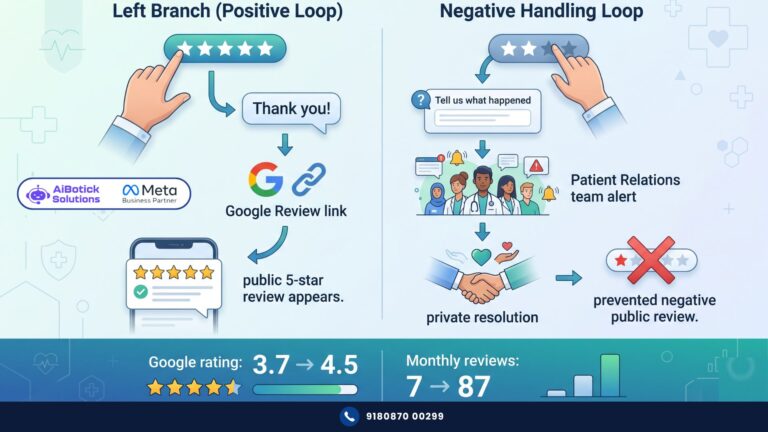
Actually wait — let me share something specific. The Bangalore clinic chain I mentioned earlier — after implementation, their Google reviews started mentioning the booking experience specifically. “Doctor is excellent, and the WhatsApp appointment system is so convenient.” Three separate reviews in the first month used the phrase “convenient booking.”
Nobody ever wrote a Google review praising how good the phone-booking process was. Think about that.
For how WhatsApp automation ROI compounds across healthcare beyond just appointment booking — our WhatsApp automation ROI guide shows the complete financial framework.
Special Considerations for WhatsApp Appointment Booking in Healthcare
Healthcare has specific requirements that general business automation doesn’t need to worry about. Let me address these directly.
Patient data privacy:
WhatsApp Business API data goes through Meta’s servers. For healthcare — be thoughtful about what patient information is collected and stored in the bot. Name, phone, appointment type: fine. Detailed medical history, diagnosis, prescription details: use a separate secure system.
Best practice: WhatsApp handles the scheduling layer. Patient medical records stay in your clinic management system. The two connect at the appointment level (appointment ID) without sharing sensitive medical data through WhatsApp.
Emergency handling:
Any WhatsApp appointment booking flow for healthcare needs a clear, highly visible emergency escalation. “In case of emergency — call [number] immediately or visit our emergency department at [address].” This should appear in the welcome message and be triggerable anytime by keywords like “emergency,” “chest pain,” “breathing problem,” “unconscious.”
Non-negotiable. Build this before anything else.
MCI and regulatory compliance:
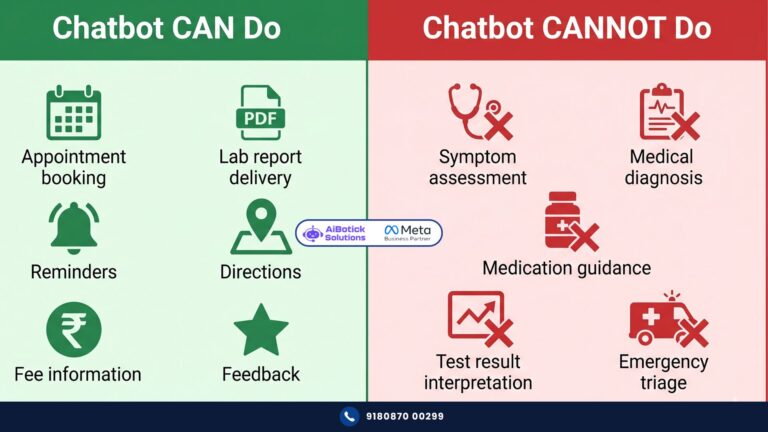
WhatsApp automation doesn’t give medical advice. The bot books appointments. The bot provides operational information. It does not diagnose. It does not suggest treatments. It does not interpret reports.
Any symptom-based routing is for department navigation only — not for clinical assessment. “Your symptoms suggest you might benefit from seeing our cardiologist” is acceptable. “Based on your symptoms you might have X condition” is not.
Build these guardrails into the flow design from Day 1.
Setting Up WhatsApp Appointment Booking — Exactly What to Do
Step 1 — Map your appointment types
List every type of appointment your clinic offers. New patient, returning patient, each specialist, each diagnostic service, teleconsultation. This becomes the menu structure.
Step 2 — Define slot availability logic
How are slots managed? Fixed daily slots per doctor? Rolling 7-day availability? Emergency slots reserved? Define this before building — it determines the technical architecture.
Step 3 — Build the bot flow in AiBotick
Create the complete booking journey: welcome → service selection → doctor/department selection → slot selection → patient details → confirmation. Add emergency escalation at every stage.
Step 4 — Build the reminder sequence
24-hour reminder with active confirmation request. 3-hour morning reminder. No-show recovery at 30 minutes post-slot. Post-appointment follow-up at 24 hours. For chronic patients — 7-day follow-up with re-booking offer.
Step 5 — Integrate with your clinic management system
AiBotick connects to your HMS (Hospital Management System) or appointment calendar via API or webhook. Booked appointment appears in your system automatically. Cancellation or reschedule updates your system automatically. No manual sync.
Step 6 — Train your front desk team
Their job changes — not disappears. They now handle: complex cases that the bot escalates, insurance and billing queries, in-person patient assistance, quality monitoring of bot interactions. Train them specifically on these higher-value tasks.
For how the patient communication system connects to broader WhatsApp automation — our WhatsApp chatbot guide explains how the underlying bot architecture works for healthcare and other industries.
Toh yaar — meri baat seedha:
Aapke clinic mein aaj jitne no-shows hain, jitne after-hours calls miss hote hain, jitne patients frustrate hote hain hold pe wait karke — yeh sab avoidable hai. Completely. In 2026.
WhatsApp appointment booking ke baad — patients book at 10pm, get confirmation instantly, get reminded automatically, show up reliably, and leave Google reviews about your convenient booking process.
Your staff handles patients — not phone logistics.
Tap below. 👇 Tell us your clinic type, daily appointment volume, and current no-show rate — we’ll calculate your revenue impact from no-show reduction and design your complete WhatsApp appointment booking system.
— Mohit Shah | 15+ years in IT industry | 4+ years in WhatsApp automation | Worked with various MNC brands | Now helping businesses figure out what actually works
Q1: How does WhatsApp appointment booking reduce no-shows for Indian clinics?
A1: WhatsApp appointment booking reduces no-shows through three mechanisms — active confirmation requests (patients who tap CONFIRM show up at significantly higher rates than passive recipients), frictionless rescheduling (patients reschedule via WhatsApp reply instead of ghosting when plans change), and a timed reminder sequence (24-hour reminder, 3-hour morning reminder, and no-show recovery message). A Bangalore multi-speciality clinic chain reduced no-show rates from 24% to 8% using this three-mechanism approach, recovering Rs.4.36L monthly from previously lost appointment slots.
Q2: Can WhatsApp appointment booking work for after-hours patient requests?
A2: Yes — this is one of its most significant advantages for Indian healthcare providers. The bot runs 24×7, capturing appointment requests at 9pm, Sunday mornings, and public holidays when staff aren’t available. A Bangalore clinic chain was missing 35-40 appointment booking requests daily outside clinic hours — worth approximately Rs.6.37L monthly in lost bookings. WhatsApp appointment booking automation captured near 100% of these after-hours requests, firing instant confirmation and adding them to the next available slot automatically.
Q3: Are there special considerations for WhatsApp appointment booking in healthcare versus other industries?
A3: Yes — three critical healthcare-specific requirements. First, patient data privacy: WhatsApp handles scheduling and operational data only; detailed medical records stay in secure clinic management systems. Second, emergency escalation: every WhatsApp appointment booking flow must include visible, always-accessible emergency contact information and keyword triggers (URGENT, EMERGENCY) that immediately connect to humans — no bot should handle medical emergencies. Third, no clinical advice from bot: symptom routing is for department navigation only, never clinical assessment or diagnosis — regulatory compliance requires this clear boundary.