Do you know what the most expensive empty space in Indian healthcare is?
Not an unused ICU bed. Not an idle MRI machine at Rs.3Cr.
It’s an empty consultation chair for 15 minutes.
Doctor sitting. Staff standing by. Air conditioning running. Time passing. Revenue gone. Forever.
And why is that chair empty? Because a patient booked an appointment, forgot about it, and didn’t bother cancelling. Something came up. Or nothing came up — they just forgot. Because nobody reminded them.
I’ve worked with healthcare providers across India over the last 4+ years specifically in WhatsApp automation. And patient reminders — the simple, mundane, unglamorous act of reminding a patient they have an appointment — is probably the single highest-ROI automation any clinic can implement.
Not the AI chatbot. Not the fancy digital health integration.
Patient reminders on WhatsApp. Consistently, reliably, 24×7.
Because a patient who shows up — versus a patient who no-shows — is the difference between Rs.700 revenue and Rs.0 revenue. For the same time slot. For the same doctor. For the same overhead.
Let me show you exactly how to set this up.
The No-Show Economics Nobody Calculates Properly
Here’s a financial exercise most clinic owners have never done.
Take your clinic’s current no-show rate. If you haven’t measured it — estimate. Most Indian clinics without reminder systems run 20-28% no-show rates.
Now:
Daily appointments × no-show rate × average consultation fee = daily revenue lost to no-shows.
For a clinic seeing 60 patients/day at 25% no-show rate and Rs.600 average fee:
60 × 0.25 × Rs.600 = Rs.9,000 per day. Lost.
Per month: Rs.9,000 × 26 working days = Rs.2,34,000 per month.
Per year: Rs.28,08,000 per year.
Rs.28 lakh. Lost. To patients who forgot to show up or forgot to cancel.
Not bad leads. Not unsatisfied patients. Just forgotten appointments.
Patient reminders on WhatsApp — if they cut your no-show rate from 25% to 10% — recovers Rs.16,38,000 annually. From one change. That costs Rs.45,000/year in platform fees.
The math is — as they say — dhansoo. 😄
Why Phone Call Reminders Are Not Working Anymore
Most clinics that have some reminder system — it’s phone calls. Either staff calling manually, or an IVR blasting pre-recorded reminders.
And both are failing. Here’s why.
Manual staff calls:
- Staff time: 3-4 minutes per call × 60 patients/day = 3-4 hours daily just on reminder calls
- Pickup rate: 40-55% (patients don’t pick up unknown numbers during work hours)
- Scalability: tied directly to staff availability and hours
- Cost: included in receptionist salary, but the opportunity cost is enormous — staff doing calls can’t do patient service
IVR automated calls:
- Pickup rate: even lower — 25-35%
- Patient experience: poor — nobody likes IVR calls
- No two-way interaction — patient can’t reschedule or confirm easily
- Increasingly blocked as spam by patients’ phones
WhatsApp patient reminders:
- Open rate: 90-95% (same as all WhatsApp messages)
- Two-way: patient can confirm, reschedule, or ask questions in the same thread
- No staff time required after initial setup
- Works 24×7 at any time clinic chooses to send
- Feels personal, not robotic
- Patient saves the message — has appointment details accessible anytime
This isn’t even a close comparison. Patient reminders on WhatsApp win on every dimension.
The Complete Patient Reminder Sequence — Every Message, Every Timing
Here’s what works. Based on what I’ve seen reduce no-show rates most effectively across clinic types.
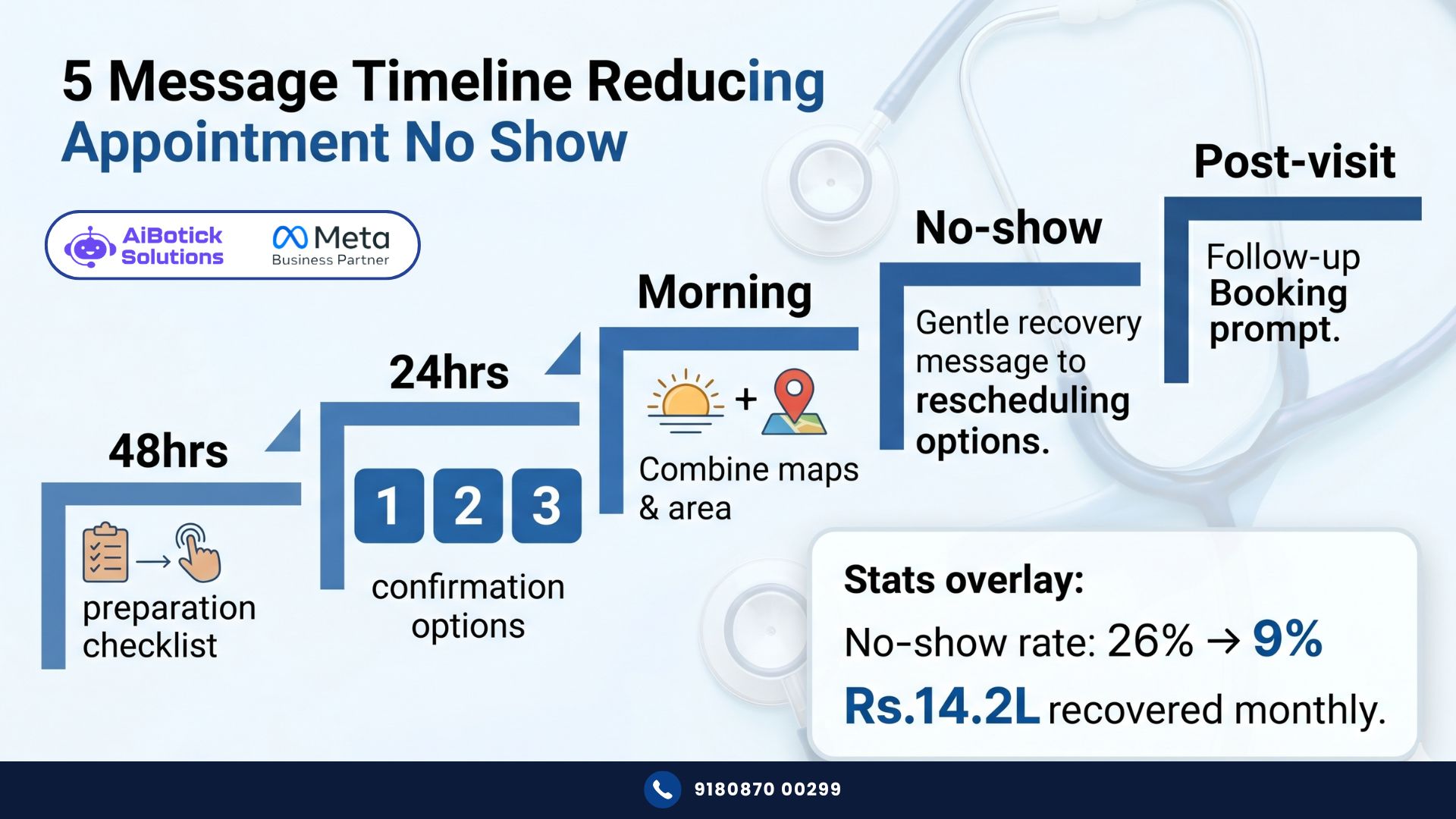
Reminder 1 — 48 Hours Before (The Preparation Reminder)
“Namaste [Patient Name]! 🙏
This is a friendly reminder from [Clinic Name]. You have an appointment coming up:
👨⚕️ Doctor: Dr. [Name] ([Specialty]) 📅 Date: [Day], [Date] ⏰ Time: [Time] 📍 [Clinic Name] — [Address] 🗺️ Directions: [Google Maps link]
Please bring: ✅ Valid government ID ✅ Previous prescriptions or reports (if any) ✅ Insurance card (if applicable)
To confirm your appointment — reply CONFIRM To reschedule — reply RESCHEDULE To cancel — reply CANCEL
See you on [Day]! 😊 — [Clinic Name]”
This message at 48 hours does three things simultaneously. It reminds (primary job). It prepares the patient (reduces “forgot documents” scenarios that frustrate both patient and doctor). And it opens a two-way communication channel for confirmation or rescheduling — before the slot becomes a confirmed no-show.
Why 48 hours and not 24?
Because 48 hours gives patients time to rearrange if needed. Someone who can’t make their appointment on Thursday — if reminded Tuesday — has time to reschedule without losing the appointment entirely. 24-hour reminder is too late for many patients to make alternative arrangements.
Reminder 2 — 24 Hours Before (The Confirmation Push)
“Hi [Patient Name]! 😊 Just checking in — your appointment is tomorrow.
👨⚕️ Dr. [Name] | ⏰ [Time] | 📅 [Date]
Quick tap: 1️⃣ Yes, I’ll be there ✅ 2️⃣ Need to reschedule 3️⃣ Need to cancel
If confirming — please arrive 10 minutes early for registration. 🙏“*
Shorter. More urgent. Clear single action needed.
The one-tap response options — this is important. The easier it is to respond, the more patients respond. A patient who sees “Reply YES or NO” is more likely to engage than a patient who has to compose a sentence.
The confirmation number matters:
Track how many patients respond to this 24-hour message. Patients who confirm — show up at 92-95% rate. Patients who don’t respond — show up at 55-65%. Just that confirmation behaviour is a powerful predictor.
Some clinics now use this to decide on slot overbooking — if a high no-show-risk slot hasn’t been confirmed by 24 hours, they can tactically add one more appointment to the next available slot. This is advanced, but the data exists.
Reminder 3 — Morning of Appointment (2-3 Hours Before)
“Good morning [Patient Name]! 🌟
Your appointment is today: ⏰ [Time] — just [X hours/minutes] away 📍 [Clinic Name] — [Short address]
Getting here: 🚇 Metro: [Nearest station, exit number] 🚗 Parking: [Specific instruction — garage, street, building parking] 🚶 [Time] minute walk from [landmark]
Running late? Call us: [Number]. We’ll try to accommodate. 😊”
The logistics-focused morning reminder — this is where practical friction gets removed. A patient who would have shown up but got confused about parking, missed a turn, couldn’t find the entrance — those are recoverable no-shows. This message recovers them.
The “running late? Call us” line is psychologically important too. It removes the anxiety of “I’m running late, they’ll cancel my slot, no point going now.” Patients who feel accommodated try to show up even when delayed.
Reminder 4 — 30 Minutes After Scheduled Time (No-Show Recovery)
“Hi [Patient Name], we noticed you haven’t been able to make your [Time] appointment with Dr. [Name] today.
We hope everything is okay. 🙏
If you’d like to reschedule — we have the following slots available: 📅 [Day, Date] at [Time] 📅 [Day, Date] at [Time] 📅 [Day, Date] at [Time]
Reply with your preference and we’ll confirm immediately.
Take care! 😊 — [Clinic Name]”
This message — I want to be clear — is not about shaming the patient for missing. It’s about recovery. A patient who sees a warm, no-judgment rescheduling offer is far more likely to rebook than one who gets a cold “you missed your appointment” notification.
Rescheduled appointments from no-show recovery: 20-30% of no-shows rebook within 48 hours when they receive this message. Without it — most no-shows disappear permanently.
Reminder 5 — Post-Appointment Follow-Up (24 Hours After)
“Hi [Patient Name], hope your consultation with Dr. [Name] went well yesterday! 😊
If you have any questions about your prescription or treatment — our team is here.
[For follow-up required patients:] Dr. [Name] has recommended a follow-up visit in [X weeks]. Shall I book that for you? 1️⃣ Yes, book follow-up 2️⃣ I’ll call to schedule 3️⃣ No follow-up needed
Take care and get well soon! 🙏 — [Clinic Name]”
This message closes the appointment journey while opening the next one. Patients who were told to follow up — they forget. This reminder, arriving 24 hours post-consultation, captures follow-up bookings that would otherwise slip away.
Follow-up booking rate from this message: 35-45% of patients who need follow-up appointments book them when offered in this message. Without the reminder, most don’t follow through on the doctor’s instruction.
And follow-up appointments — they’re not just revenue. They’re health outcomes. Patients who follow up have better clinical results. For clinics that genuinely care about patient wellbeing (and most do) — this is the reminder that matters most.
Specialist-Specific Reminders — What Changes by Department
Generic reminders work. Specialist-specific reminders work better.
For Gynaecology: Add to 48-hour reminder: “Please fast for [X hours] before your appointment if you’re scheduled for an ultrasound or blood tests. If you’re unsure whether this applies to you — reply and we’ll confirm.”
For Cardiology: “If you have any recent ECGs, Holter reports, or echo reports — please bring originals or digital copies. This helps Dr. [Name] give you a more complete assessment.”
For Orthopaedics: “Please bring any recent X-rays or MRI films. If you have them on CD or physical films — the originals are best. Digital scans on phone work too!”
For Paediatrics: Reminder addressed to parent: “Please bring [Child Name]’s vaccination record and any previous growth charts if available. Also — please bring your child’s favourite toy or distraction item. It makes the consultation easier for everyone! 😄”
For Diabetology: “Please fast for 8 hours before your appointment — blood sugar tests work best on an empty stomach. You can take your regular medications with a small sip of water unless Dr. [Name] has specifically told you otherwise.”
These specialty-specific additions — they reduce “patient arrived unprepared” scenarios by 40-50% in my experience. Both doctor time and patient satisfaction improve when consultations can proceed without waiting for patients to call home for forgotten documents.
Real Numbers — Delhi NCR Multispeciality Hospital Group
Specific. Documented. No vague “significant improvement” language.
Hospital group. Delhi NCR. 4 locations. Approximately 340 OPD appointments per day combined. Mix of primary care, specialty consultations, diagnostic services.
Before patient reminders on WhatsApp:
- No-show rate: 26%
- Staff time on reminder calls: 5 people spending 2.5 hours each per day = 12.5 hours daily across group
- Missed last-minute cancellations (slot couldn’t be refilled): approximately 18-22 per day
- Post-appointment follow-up rate: 28% (most patients didn’t come back for recommended follow-ups)
- Average patient annual visit frequency: 1.8 times
After 90 days of patient reminders on WhatsApp:
- No-show rate: 9% (65% reduction)
- Staff time on reminder calls: eliminated entirely — staff redirected to patient-facing service
- Missed last-minute cancellations: 4-6 per day (most now reschedule via WhatsApp before no-showing)
- Post-appointment follow-up rate: 54% (significant improvement from follow-up booking prompt)
- Average patient annual visit frequency: 2.7 times (improved partly from better follow-up capture)
Financial impact:
No-show reduction: from 26% to 9% on 340 daily appointments = 58 additional appointments filled per day.
At Rs.650 average consultation fee × 58 × 26 working days = Rs.9,82,800 additional monthly revenue.
Follow-up appointment increase: from 28% to 54% follow-up rate on ~100 follow-up-recommended patients per day = 26 additional follow-up appointments per day.
At Rs.650 × 26 × 26 = Rs.4,39,400 additional monthly revenue from follow-ups.
Total monthly revenue impact: Rs.14,22,200.
Plus — annual patient visit frequency improvement from 1.8 to 2.7 = 50% more visits per patient across the year. The compounding lifetime value impact dwarfs the monthly numbers.
Platform cost: Rs.45,000/year shared across all automation.
What Clinics Get Wrong About Patient Reminders on WhatsApp
Actually wait — I need to address something specific to healthcare that other industries don’t face.
“We already send SMS reminders. We don’t need WhatsApp reminders.”
This comes up constantly. And it misses the fundamental difference.
SMS reminder: “Your appointment with Dr. Sharma is on Tuesday 11am. Reply YES to confirm.”
Patient sees it. Might reply. Probably forgets. No follow-up if they don’t reply. No rescheduling option. No additional information. Done.
WhatsApp patient reminders: two-way conversation. Patient replies RESCHEDULE — they’re instantly shown available slots and can rebook without calling. Patient replies with a question — bot answers or routes to human. Patient replies with a concern — clinic can respond and manage the relationship.
SMS is a notification. WhatsApp is a conversation.
And in healthcare — conversation matters. A patient who feels heard and supported doesn’t just show up for their appointment. They refer family members. They write positive reviews. They stick with your clinic instead of switching to a competitor.
Patient reminders on WhatsApp aren’t just about no-show reduction. They’re about the quality of the patient relationship across every touchpoint.
The SMS vs WhatsApp comparison for healthcare — same pattern we’ve documented elsewhere for every industry. Our WhatsApp vs email analysis shows the core principles that apply equally here.
Special Considerations — Chronic Patient Reminder Programmes
This section deserves its own space because chronic condition management is where WhatsApp patient reminders create the most long-term impact.
Diabetes. Hypertension. Cardiac conditions. Thyroid. These patients need regular monitoring. Regular medication reviews. Regular lab work.
Most of them don’t follow through consistently. Not because they don’t care — because life gets in the way and they don’t have a system that keeps them accountable.
WhatsApp chronic patient programme:
Monthly medication review reminder: “Hi [Patient Name], it’s been a month since your last consultation with Dr. [Name]. Time for your monthly medication review and BP/sugar check.
Book your slot here — or reply and I’ll help you schedule.
Quick question: How have you been feeling this month on a scale of 1-10?“*
That last question — the 1-10 check-in — does something special. It gives the patient a voice between appointments. Patients who feel checked on — who feel their doctor is tracking them between visits — are dramatically more likely to follow through on treatment plans and show up for appointments.
Lab reminder: “Hi [Patient Name], Dr. [Name] recommended your 3-monthly HbA1c test. It’s been approximately 3 months since your last test.
Your regular lab [Lab Name] has slots available. Book here: [Link]. Or would you prefer our in-clinic diagnostics?”
This removes the activation energy problem. Patients know they need the test. They just never quite get around to booking it. Removing the friction — offering a direct booking option in the same message that reminds them — converts intention to action.
For the complete financial framework on how WhatsApp automation ROI compounds in healthcare settings — our WhatsApp automation ROI guide has the specific healthcare calculation methodology.
Setting Up Patient Reminders on WhatsApp — Exactly What to Do
Step 1 — Identify your appointment data source
Where do appointments currently live? Your clinic management software (Practo, Medicloud, custom HMS), Google Calendar, or a manual spreadsheet. This is the trigger source for reminders.
Step 2 — Connect your appointment system to AiBotick
Via API or webhook — when an appointment is booked in your system, AiBotick receives the appointment details (patient name, phone, doctor, date, time). This triggers the reminder sequence automatically.
For clinics without API-capable software — Google Sheets integration works. Staff update a sheet; AiBotick reads the sheet and sends reminders based on appointment dates.
Step 3 — Build your reminder templates
Four templates minimum: 48-hour reminder, 24-hour reminder, morning-of reminder, no-show recovery. For each, write the messages using your clinic’s actual doctor names, actual directions, actual parking instructions. Generic templates convert poorly.
Get all templates Meta-approved. Submit them together. Approval typically within a few hours.
Step 4 — Build specialty-specific variations
For each specialty — create the additional preparation instructions for the 48-hour reminder. Takes 30 minutes once. Runs forever.
Step 5 — Build the post-appointment follow-up flow
24-hour post-appointment message. For chronic patients — 30-day check-in and medication review reminder. For follow-up recommended patients — 1-week rescheduling offer.
Step 6 — Train staff on the new process
Staff no longer call for reminders. But they now need to monitor WhatsApp responses — patients who reply RESCHEDULE need slots confirmed, patients who ask questions need responses, patients who express concern need care.
The monitoring takes 20-30 minutes daily versus the 2.5 hours previously spent on reminder calls. Massive net positive for staff experience.
Toh yaar — ek simple calculation:
Aapki clinic mein abhi kitne patients no-show karte hain per day?
Multiply that by your average consultation fee. Multiply by 26 working days.
That number — that’s what patient reminders on WhatsApp is worth for your clinic. Annually. Just from no-show reduction. Before counting the follow-up bookings. Before counting the chronic patient retention. Before counting the staff hours saved.
The Delhi hospital group was losing Rs.14.2L per month to preventable no-shows and missed follow-ups. Patient reminders on WhatsApp recovered most of it.
Your clinic has the same opportunity.
Tap below. 👇 Tell us your daily appointment volume, current no-show rate, and clinic management software — we’ll calculate your specific revenue impact and design your complete WhatsApp patient reminder system.
— Mohit | 15+ years in IT industry | 4+ years in WhatsApp automation | Worked with various MNC brands | Now helping businesses figure out what actually works
Q1: How much can WhatsApp patient reminders reduce no-show rates for Indian clinics?
A1: WhatsApp patient reminders consistently reduce no-show rates by 50-65% for Indian clinics. A Delhi NCR hospital group reduced their no-show rate from 26% to 9% in 90 days — recovering Rs.9.82L monthly from filled appointment slots alone. The three mechanisms driving this: active confirmation requests (patients who confirm show up at 92-95% rates), frictionless rescheduling (patients reschedule via WhatsApp instead of ghosting), and a timed 3-message sequence (48-hour, 24-hour, and morning-of reminders that keep the appointment present in the patient’s mind).
Q2: What is the difference between SMS appointment reminders and WhatsApp patient reminders for clinics?
A2: SMS reminders are one-way notifications — patients receive them but can’t easily respond, reschedule, or ask questions. WhatsApp patient reminders are two-way conversations — patients can confirm with one tap, reschedule by selecting a new slot, ask preparation questions, and receive specialty-specific instructions. This two-way capability is what makes WhatsApp reminders dramatically more effective: patients who can reschedule via WhatsApp message do so instead of simply not showing, converting no-shows into rescheduled appointments rather than lost revenue.
Q3: How should chronic patient reminder programmes on WhatsApp work for conditions like diabetes and hypertension?
A3: Chronic patient programmes on WhatsApp use monthly automated check-ins — a brief 1-10 wellness scale question that gives patients a voice between appointments, followed by medication review appointment reminders timed to the appropriate interval (monthly for diabetes management, quarterly for stable hypertension). Lab test reminders fire automatically when the recommended testing interval has passed, with direct booking options removing the activation energy barrier. Patients in structured WhatsApp chronic disease programmes show significantly higher follow-through rates on treatment plans and appointment attendance than unmanaged chronic patients.