India ka hospital system mein ek fundamental paradox hai.
Some of the best doctors in the world. Some of the worst patient communication systems in the world. Sitting in the same building.
Brilliant cardiologist. But his OPD reception has patients waiting 90 minutes past their appointment time with zero communication about the delay. Because nobody thought to send a WhatsApp.
World-class neurosurgeon. But her IPD patients’ families are calling the nursing station every 2 hours for updates — because the system doesn’t proactively communicate. Because no system exists.
I’ve spent 4+ years in WhatsApp automation and 15+ years in IT. And honestly — healthcare is where I’ve seen the most dramatic gap between what’s possible and what’s actually being done.
Not because hospital administrators don’t care. They do. But because “implementing communication automation” gets deprioritised behind clinical priorities, regulatory compliance, and infrastructure. It keeps getting pushed to “next quarter.”
WhatsApp for hospitals isn’t a glamorous technology investment. It doesn’t require a 12-month implementation. It doesn’t need a CTO’s approval for 6 months.
It’s a systematic communication layer — built in weeks, not months — that simultaneously improves patient experience, reduces staff workload, and generates measurable ROI from Day 30.
Let me show you exactly what it looks like across OPD, IPD, and follow-up care.
The Three Communication Failure Points in Every Indian Hospital
Before the solution — the problem. Clearly.
Failure Point 1 — OPD: The Information Vacuum
Patient has a 10am appointment. Arrives at 9:50am. Doctor is running 45 minutes late (common in Indian hospitals — not always avoidable). Nobody tells the patient. Patient waits. Gets anxious. Asks receptionist at 10:15. Receptionist says “wait hai.” Patient gets frustrated.
At 10:50am — patient is finally called. They’re now irritated before they’ve even entered the consultation room.
What should have happened: Automated WhatsApp at 9:45am — “Dr. [Name]’s OPD is running approximately 40 minutes behind schedule. Your new expected time is 10:40am. Apologies for the inconvenience. 🙏”
Patient plans accordingly. Goes for chai. Returns at 10:35am calm and informed. Same delay — completely different experience.
Failure Point 2 — IPD: The Family Anxiety Loop
Patient admitted for surgery or extended care. Family members waiting outside — spouse, parents, children — with zero information flow.
“When will surgery start?” Call nursing station. “How is the surgery going?” Call nursing station. “When will they come to recovery?” Call nursing station. “When can we see them?” Call nursing station.
Nursing staff fielding the same calls from 4 different family members of the same patient. 45-minute surgery generates 8-10 calls to the nursing station. Multiplied across 20 admitted patients — this is a significant operational burden on clinical staff.
What should happen: Automated WhatsApp updates at each milestone. Surgery started. Surgery completed successfully. Patient in recovery. Patient moved to room [X]. Visiting hours: [Y].
Failure Point 3 — Follow-Up: The Discharge Cliff
Patient discharged. Given a thick folder of discharge summary, medication list, and follow-up instructions in small print. Takes it home. Reads it once. Forgets.
Doesn’t take medication as prescribed. Misses follow-up appointment. Condition worsens. Readmitted.
Readmission is the most expensive outcome for both hospital and patient. And it’s often preventable with structured post-discharge communication.
What should happen: WhatsApp-based post-discharge programme. Daily medication reminder for first week. Follow-up appointment reminder. Warning signs to watch for. When to call the emergency line.
WhatsApp for hospitals addresses all three failure points. Simultaneously. With one platform.
WhatsApp for Hospitals — OPD Communication System
Let me build out each area specifically. Starting with OPD — because it’s the highest volume and most immediate impact area.
Pre-Appointment
This mirrors what we covered in our appointment booking and reminder articles — but with hospital-specific additions.
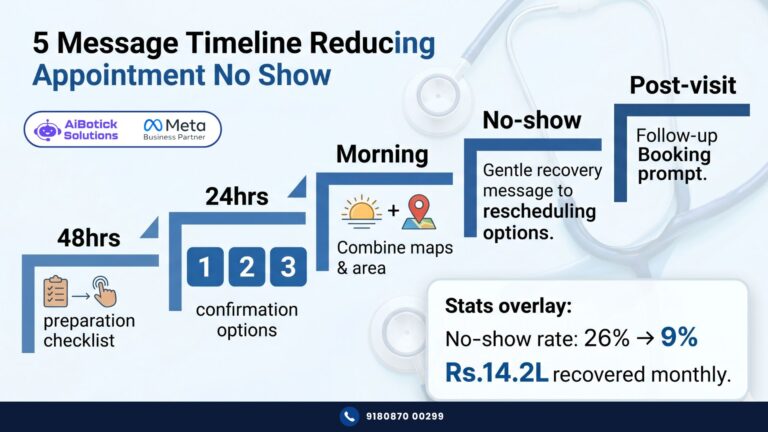
48-hour reminder:
“Namaste [Patient Name]! 🙏
Reminder: Your OPD appointment at [Hospital Name] 👨⚕️ Dr. [Name] — [Department] 📅 [Day, Date] at [Time] 📍 [Building/Block/Floor] — [Hospital Address] 🗺️ [Google Maps link]
Please bring: ✅ Hospital patient ID (if returning patient) ✅ Previous reports, prescriptions, or imaging ✅ Insurance card and documents (if applicable) ✅ Referral letter (if referred by another doctor)
Arrive 15 minutes early for registration. 🙏 — [Hospital Name]”
Morning of appointment:
“Good morning [Patient Name]! Your appointment is today.
⏰ [Time] — Dr. [Name], [Department] 📍 [Building/Block/OPD Counter Number]
[Real-time delay alert if applicable:] “Update: Dr. [Name]’s OPD is currently running [X] minutes behind schedule. Your revised expected time is [Time].”
Questions? Reply here.“*
The real-time delay alert — this is where WhatsApp for hospitals creates its most visible immediate impact. When OPD is running late, one WhatsApp blast to all patients scheduled in the next 60 minutes — sent the moment the admin team identifies the delay — saves hundreds of minutes of combined patient waiting time and dozens of frustrated inquiries.
OPD Day-Of Queue Management
For hospitals with digital queue management — AiBotick can receive queue position updates and send patients their current estimated wait time.
“[Patient Name], you’re currently #8 in the queue for Dr. [Name]’s OPD. Estimated wait time: 25 minutes. Please be at OPD Counter [X] in 20 minutes. 😊”
Patient doesn’t need to physically sit in the waiting area. They can wait in the cafeteria, in the car, wherever. And arrive just before their turn.
This transforms the patient waiting experience — from anxious physical waiting to comfortable informed waiting.
Post-Consultation
“[Patient Name], thank you for visiting [Hospital Name] today. 😊
A summary of today’s consultation: 👨⚕️ Seen by: Dr. [Name] 📋 Prescriptions issued: [Number] medications — please see attached prescription PDF 🔬 Tests ordered: [List — if applicable] 📅 Follow-up recommended: [Timeframe]
Important instructions from Dr. [Name]: [Key post-consultation instructions — entered by doctor or staff]
To book your follow-up — reply ‘FOLLOWUP’ or [Link]. Questions about your prescription? Reply here. — [Hospital Name]”
The prescription PDF attachment — this is valuable beyond just WhatsApp for hospitals. Patient has their prescription on their phone. Goes directly to pharmacy. No “forgot the paper at home.” No “can’t read doctor’s handwriting” — digital prescription is legible. Pharmacy interaction is smoother.
WhatsApp for Hospitals — IPD Communication System
This is where WhatsApp for hospitals creates the most emotional impact. And where it addresses the most difficult communication challenge.
Admission Notification to Family
Patient admitted (emergency or planned admission):
“Namaste [Family Contact Name]. 🙏
This is to inform you that [Patient Name] has been admitted to [Hospital Name]:
🏥 Ward: [Ward Name/Number] 🛏️ Bed: [Bed Number] 👨⚕️ Attending Doctor: Dr. [Name] 📅 Admission: [Date, Time] 📋 Reason: [Brief — “for cardiac monitoring” / “post-surgery recovery” etc.]
Visiting hours: [Hours] For urgent queries: [Nursing station number]
We will send updates on this WhatsApp as [Patient Name]’s care progresses. 🙏 — [Hospital Name]”
This one message — family feels informed. Informed family members are calmer, more cooperative, and make fewer anxious calls to the nursing station.
Surgical Procedure Updates
This is the WhatsApp for hospitals application that generates the most emotional gratitude from families. Because the anxiety of waiting during surgery is among the most intense human experiences.
Pre-surgery (when patient enters OT):
“[Family Name], [Patient Name] has entered the Operation Theatre at [Time]. Procedure: [Name of procedure]. Lead Surgeon: Dr. [Name]. We’ll update you at key milestones. 🙏”
Surgery complete:
“[Family Name], great news — [Patient Name]’s procedure is complete. ✅ [Patient Name] is now in the Recovery Room. They will be moved to the ward in approximately [X hours] once stable. We’ll update you when they’re in the ward. 🙏”
Moved to recovery ward:
“[Family Name], [Patient Name] has been moved to Ward [X], Bed [Y]. They are comfortable and resting. Dr. [Name] will review them at approximately [Time]. Visiting hours: [Hours] today. 🙏”
Three messages. Family has complete visibility without calling once. The anxiety of unknowing — which is often worse than bad news — is addressed.
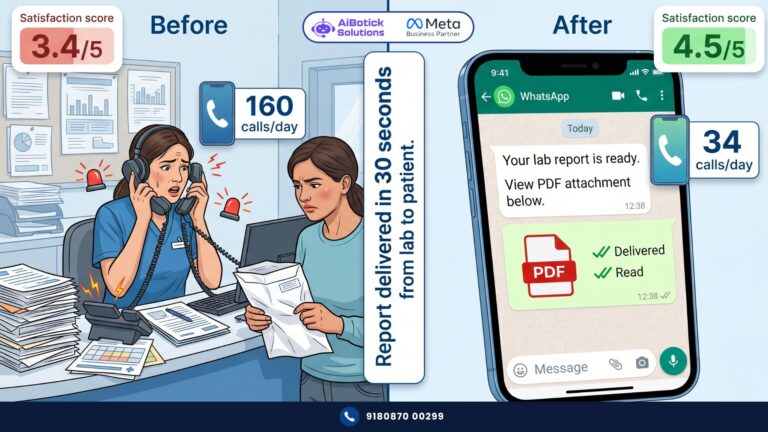
Actually — let me share something from a hospital I worked with in this space. Their nursing station was receiving 180-200 calls per day from waiting families of surgery patients. After implementing WhatsApp surgical updates — calls dropped to 23 per day. The same families. Just now informed.
The nurses told us this: “We used to dread answering the phone during surgery hours. We had no updates to give and families were understandably desperate. Now when a family does call — it’s usually something specific. The conversations are shorter and more productive.”
That’s not just operational improvement. That’s team wellbeing improvement.
Daily IPD Updates
For extended admissions — patients hospitalised for 3+ days — daily WhatsApp update to family:
“Daily Update — [Patient Name] — [Date]
General condition: [Stable / Improving / Under monitoring] Today’s key activities: [Brief — e.g., ‘Physiotherapy session completed, X-ray done, doctor review at 4pm’] Medication: [Continuing as prescribed / adjusted as per doctor’s review] Visiting hours today: [Hours]
Next expected update: Tomorrow [Time]. For urgent queries: [Number]. — [Treating Team, Hospital Name]”
This daily update — families don’t need to be physically present in the hospital to feel connected to their patient’s care. For families managing work and home alongside a hospitalised family member — this is genuinely life-simplifying.
WhatsApp for Hospitals — Post-Discharge Follow-Up Programme
This is the most clinically important part of WhatsApp for hospitals. And the most financially impactful — because preventing readmission is both better for patients and reduces the operational burden on the hospital.
Discharge Day
“[Patient Name], you’re going home today! 🎉
Discharge summary and discharge instructions: [PDF Attached]
Your medication list: 💊 [Med 1] — [Dosage, timing] 💊 [Med 2] — [Dosage, timing] 💊 [Med 3] — [Dosage, timing]
Important: Do not stop any medication without consulting Dr. [Name].
Follow-up appointment: [Date, Time] with Dr. [Name]
Warning signs — call us immediately if you experience: 🚨 [Symptom 1 relevant to condition] 🚨 [Symptom 2 relevant to condition] 🚨 [Symptom 3 relevant to condition]
Emergency: [Number] Questions: Reply here anytime. Get well soon! 🙏 — [Hospital Name]”
The warning signs section — customised to the patient’s specific condition — this is where WhatsApp for hospitals saves lives. Not dramatically. But quietly. A post-surgical patient who sees “excessive swelling at incision site” on their warning signs list and notices it — they call. Without this message — they might dismiss it as normal.
Post-Discharge Medication Reminders (First Week)
For complex medication regimes — morning and evening reminders:
“Good morning [Patient Name]! 🌅 Time for your morning medications: 💊 [Med 1] — [Dosage] 💊 [Med 2] — [Dosage]
Remember: Take with food if Dr. [Name] recommended. — [Hospital Name]”
Medication compliance drops dramatically after discharge. Patients feel better. They skip doses. Conditions relapse.
Daily medication reminders — simple, personal, specific — are the single highest-impact post-discharge intervention for preventing readmission. And the easiest to automate.
7-Day and 30-Day Check-ins
“Hi [Patient Name]! It’s been 7 days since your discharge from [Hospital Name]. 😊
How are you feeling? Quick check: 1️⃣ Feeling much better — recovery going well 2️⃣ Okay, but have some questions 3️⃣ Not feeling well — need to speak to someone
If 3️⃣ — we’ll connect you to our doctor on call immediately.“*
Patients who select 3️⃣ — immediate escalation to duty doctor. This catches deteriorating patients before they become emergency readmissions.
Real Numbers — Hyderabad Tertiary Hospital (650-Bed)
Specific. Documented. Real.
Large tertiary hospital. Hyderabad. 650 beds. 800-900 OPD consultations daily. 120-150 IPD admissions monthly. Average 45-50 surgeries per week.
Before WhatsApp for hospitals:
- OPD delay-related complaints: 180-220 per month
- Nursing station calls from IPD families during surgery hours: 190-210 per day
- Post-discharge medication compliance rate (self-reported at follow-up): 61%
- 30-day readmission rate: 9.2%
- Patient satisfaction score (quarterly survey): 3.3/5
- Monthly Google reviews: 14-17
After 90 days with WhatsApp for hospitals:
- OPD delay-related complaints: 31 per month (83% reduction)
- Nursing station calls during surgery hours: 22 per day (89% reduction)
- Post-discharge medication compliance rate: 84% (37% improvement)
- 30-day readmission rate: 5.8% (37% reduction)
- Patient satisfaction score: 4.4/5
- Monthly Google reviews: 67 (nearly 4x increase)
Financial impact:
Readmission reduction: from 9.2% to 5.8% on 135 monthly admissions = approximately 4.6 fewer readmissions per month.
Average readmission cost to hospital (staff time, bed, resources, with insurance complications): Rs.45,000-65,000 per avoidable readmission.
Conservative: 4.6 × Rs.50,000 = Rs.2,30,000/month saved from readmission reduction alone.
Nursing staff hours reclaimed from family inquiry calls: from 190 calls/day × 3 minutes average = 570 minutes = 9.5 staff-hours daily. At Rs.150/hour × 26 days = Rs.37,050/month in recovered clinical staff time.
Patient satisfaction improvement (3.3 → 4.4) — improved referral rates and repeat visits. Conservative estimate: 25-30 additional patients monthly from word-of-mouth and Google review improvement. At Rs.2,000 average revenue per OPD patient = Rs.50,000-60,000/month.
Total monthly impact: Rs.3,17,000-3,27,000/month.
Platform cost for the full hospital: Rs.60,000/year = Rs.5,000/month (Enterprise plan — hospital scale).
64x monthly ROI. On a conservative calculation.
What Hospitals Get Wrong About WhatsApp for Hospitals
One assumption. And it’s a serious one in healthcare specifically.
“Our patients are too old or not tech-savvy for WhatsApp.”
Yaar, I’ve heard this at hospitals across India. And it’s empirically wrong.
India has 500 million+ WhatsApp users. The majority of Indian hospital patients — including elderly patients — have WhatsApp. Not necessarily used for complex tasks. But for receiving messages? Absolutely.
No no, scratch that — let me be more precise. Even if the patient is elderly and not comfortable with WhatsApp themselves — they have a family member who is. The family contact WhatsApp number — used throughout the IPD communication system — is typically a younger family member. They receive the updates. They relay to the patient and the rest of the family.
The question isn’t “will patients engage with WhatsApp?” The question is “are you building the flows for the right audience?” For elderly patients — the family contact is the primary WhatsApp communication target. The patient themselves is the primary care target.
That distinction — family contact vs patient — is what most WhatsApp for hospitals implementations miss.
For how WhatsApp automation ROI compounds across the complete patient lifetime in healthcare — our WhatsApp automation ROI guide has the specific healthcare LTV calculation methodology.
Setting Up WhatsApp for Hospitals — Priority Order
Don’t try to implement all three systems (OPD, IPD, post-discharge) simultaneously. Choose priority based on your biggest current pain point.
If your biggest problem is patient satisfaction and OPD wait complaints: Start with OPD delay notifications and appointment reminders. Fast to set up (1-2 weeks). Immediate visible impact.
If your biggest problem is nursing staff overwhelm from family calls: Start with IPD surgical updates and daily family communication. Sets up in 1-2 weeks. Staff relief is immediate.
If your biggest problem is readmissions and post-discharge outcomes: Start with discharge communication and medication reminders. More complex to set up (3-4 weeks including medication-specific customisation). But highest clinical impact.
Ideal sequence for a full implementation: Week 1-2: OPD reminders and delay notifications. Week 3-4: IPD family communication. Month 2: Post-discharge programme. Month 3: Integration with HMS for automated data flow.
For how the appointment booking system integrates with the broader hospital communication — our WhatsApp appointment booking guide covers the OPD scheduling foundation that this system builds on.
Toh hospital administrators se seedha baat:
Aapke hospital mein last month kitni complaints aayi OPD delays ke baare mein?
Kitne calls aaye nursing station pe surgery ke dauraan?
Kitne patients 30-day mein readmit hue?
Calculate those numbers. Then calculate what improving each by even 30% would mean financially and operationally.
That’s WhatsApp for hospitals. Not a technology project. A communication problem — with a very practical, very measurable solution.
Tap below. 👇 Tell us your hospital size, daily OPD volume, and current biggest communication challenge — we’ll design your complete WhatsApp for hospitals implementation plan and show you what 90-day impact looks like for your specific situation.
— Mohit Shah | 15+ years in IT industry | 4+ years in WhatsApp automation | Worked with various MNC brands | Now helping businesses figure out what actually works
Q1: How does WhatsApp for hospitals improve OPD patient experience in India?
A1: WhatsApp for hospitals improves OPD experience primarily through real-time delay notifications — when a doctor’s OPD runs late, an automated WhatsApp reaches all patients scheduled in the next 60 minutes with the revised expected time. Patients plan accordingly instead of waiting anxiously. This single change reduces OPD delay-related complaints by 70-85% at most hospitals. Combined with 48-hour appointment reminders, morning-of reminders, and queue position updates, it transforms the OPD waiting experience from stressful and uninformed to comfortable and managed.
Q2: How does WhatsApp for hospitals handle IPD family communication during surgery?
A2: WhatsApp for hospitals sends automated surgical milestone updates to the designated family contact — when patient enters the OT, when surgery is complete, and when the patient moves to recovery. Families receive complete visibility without calling the nursing station. A 650-bed Hyderabad hospital reduced nursing station calls from IPD families during surgery hours from 190-210 per day to 22 per day (89% reduction) using this system. The same families, now informed through WhatsApp, had no reason to call because they received updates at every meaningful milestone.
Q3: How does the WhatsApp post-discharge programme prevent hospital readmissions?
A3: The post-discharge WhatsApp programme prevents readmissions through three mechanisms — discharge-day summary with condition-specific warning signs (patients know when to call emergency), daily medication reminders for the first week (compliance improved from 61% to 84% in one hospital), and 7-day and 30-day check-in messages with immediate escalation for patients reporting deteriorating symptoms. The 650-bed Hyderabad hospital reduced 30-day readmission rates from 9.2% to 5.8% — representing approximately 4.6 fewer readmissions monthly and Rs.2.3L in saved readmission costs each month.