Most UK businesses assume WhatsApp is a grey area for marketing. Too informal. Possibly non-compliant. Better to stick with email.
That assumption is costing them customers.
WhatsApp has 36 million active users in the UK — that’s 54% of the population on one messaging platform. Open rates are 95%. Response rates are 40-60%. And UK businesses are largely absent, leaving the field to the handful of companies who understand that WhatsApp for UK business is not just compliant — when done properly, it’s one of the most compliant customer communication channels available.
Here’s the complete guide: compliance, setup, and the revenue opportunity most UK businesses are missing.
Why UK Businesses Are Behind on WhatsApp (And Why That’s Your Advantage)
Seedha bolta hoon — UK businesses have been slower to adopt WhatsApp for business than their counterparts in India, UAE, and Southeast Asia. Three reasons:
Reason 1: GDPR anxiety. “Is WhatsApp even legal for business?” Yes. Yes it is. With the right implementation. I’ll cover this thoroughly.
Reason 2: Cultural assumptions. “Our customers prefer email.” They prefer speed. They prefer relevance. WhatsApp delivers both. The assumption that UK customers want formal email communication is increasingly outdated — particularly for under-50 demographics.
Reason 3: Platform unfamiliarity. UK digital marketers know email, Facebook ads, Google ads. WhatsApp Business API is newer and less understood. The learning curve feels steep. It isn’t, once you have the right platform.
The result: in India, 500+ million businesses and consumers are on WhatsApp. In the UK, WhatsApp for business automation is still early-adopter territory. Which means businesses that implement WhatsApp for UK business properly right now get a meaningful head start before this becomes standard practice.
I’ve seen this pattern before — with email marketing in 2008, Facebook ads in 2012, Instagram in 2015. Early movers clean up. Late movers pay higher acquisition costs to catch up. WhatsApp for UK business in 2026 is that same early-mover window.
GDPR and WhatsApp: The Complete Compliance Picture
This is the section most articles avoid because it’s complex. I’m not avoiding it. Because getting this wrong costs you more than a missed marketing opportunity — it costs you fines.
The fundamental question: Is WhatsApp Business API GDPR compliant?
Yes. With conditions.
WhatsApp Business API, operated through official Business Solution Providers (BSPs) like AiBotick, can be GDPR-compliant. The key word is “can be” — compliance depends on how you implement it, not just which platform you use.
The 6 GDPR requirements for WhatsApp for UK business:
1. Lawful Basis for Processing
GDPR requires a lawful basis for processing personal data (phone numbers are personal data). For WhatsApp marketing, your lawful basis is typically:
- Consent: Customer explicitly opted in to receive WhatsApp messages from you
- Legitimate Interests: Existing customer relationship and relevant communication
Marketing WhatsApp messages (promotions, offers, new products) require explicit consent. This cannot be implied or inferred.
Transactional WhatsApp messages (order confirmations, appointment reminders, delivery updates) can use legitimate interests if there’s an existing customer relationship.
2. Explicit Opt-In (Not Opt-Out)
For WhatsApp for UK business marketing messages, pre-ticked checkboxes, assumed consent, and opt-out mechanisms are not sufficient under UK GDPR.
You need:
- Clear, specific consent statement: “I agree to receive WhatsApp marketing messages from [Business Name]”
- Active opt-in mechanism (customer ticks, clicks, or types YES)
- Record of consent (when, how, what they consented to)
- Easy opt-out mechanism in every marketing message
3. Data Minimisation
Only collect what you need. For WhatsApp communication: phone number + name. Don’t collect additional personal data “just in case.”
4. Right to Erasure
If a customer requests to be forgotten, you must remove them from your WhatsApp contact list and delete their data within 30 days. Your WhatsApp platform must support this — not just technically possible, but operationally practiced.
5. Data Transfer Considerations
WhatsApp’s servers are operated by Meta (US company). Under UK GDPR, transferring data to third countries requires appropriate safeguards. Meta operates under Standard Contractual Clauses (SCCs) for EU/UK data transfers — this is documented in Meta’s Data Processing Agreement which you should review and accept before going live.
6. Privacy Notice
Your privacy notice must include WhatsApp as a data processing channel, describe what data is collected, how it’s used, and the legal basis. Update your privacy notice before launching WhatsApp for UK business communication.
What this means practically:
Don’t buy phone number lists and WhatsApp them. Don’t add existing email contacts to WhatsApp campaigns without fresh consent. Don’t assume that because someone gave you their phone number for another purpose, they consented to WhatsApp marketing.
Build your opt-in list properly from the start. It takes longer. The list quality is dramatically higher. Block rates stay low. Compliance risk stays low.
What People Get Wrong About WhatsApp GDPR Compliance
Most UK businesses fall into one of two extremes when thinking about WhatsApp for UK business GDPR compliance.
Extreme 1 (too cautious): “WhatsApp is too risky for GDPR. We’ll stick to email.”
Wrong. Email marketing has the same GDPR requirements. You still need consent, opt-out mechanisms, and proper data handling for email. Avoiding WhatsApp for GDPR reasons while running email campaigns is inconsistent logic.
Extreme 2 (too casual): “We’ll add a WhatsApp opt-in checkbox to our contact form and we’re compliant.”
Partially right. The checkbox is necessary but not sufficient. You also need: clear description of what they’re opting into (WhatsApp marketing messages from [Business], not just “marketing updates”), separate consent from other communications (separate checkbox for WhatsApp vs email vs phone), documented consent records, and an actual opt-out mechanism in every WhatsApp message.
No no, scratch that — the most common mistake I see is actually simpler than either extreme.
UK businesses set up WhatsApp Business API correctly, build proper opt-in mechanisms, and then… send the same message to everyone on their list. No segmentation. No relevance. Block rate spikes. ICO comes asking questions.
GDPR compliance is not just about how you collect consent. It’s about whether your communication is genuinely relevant and expected by the person receiving it. Irrelevant messages = complaints = regulatory attention. WhatsApp for UK business compliance is ongoing, not a one-time setup.
Building Your GDPR-Compliant Opt-In for WhatsApp
Here’s the practical opt-in architecture for UK businesses:
Option 1: Website Form Opt-In
Contact form / quote form / newsletter signup — add a clearly labelled WhatsApp opt-in:
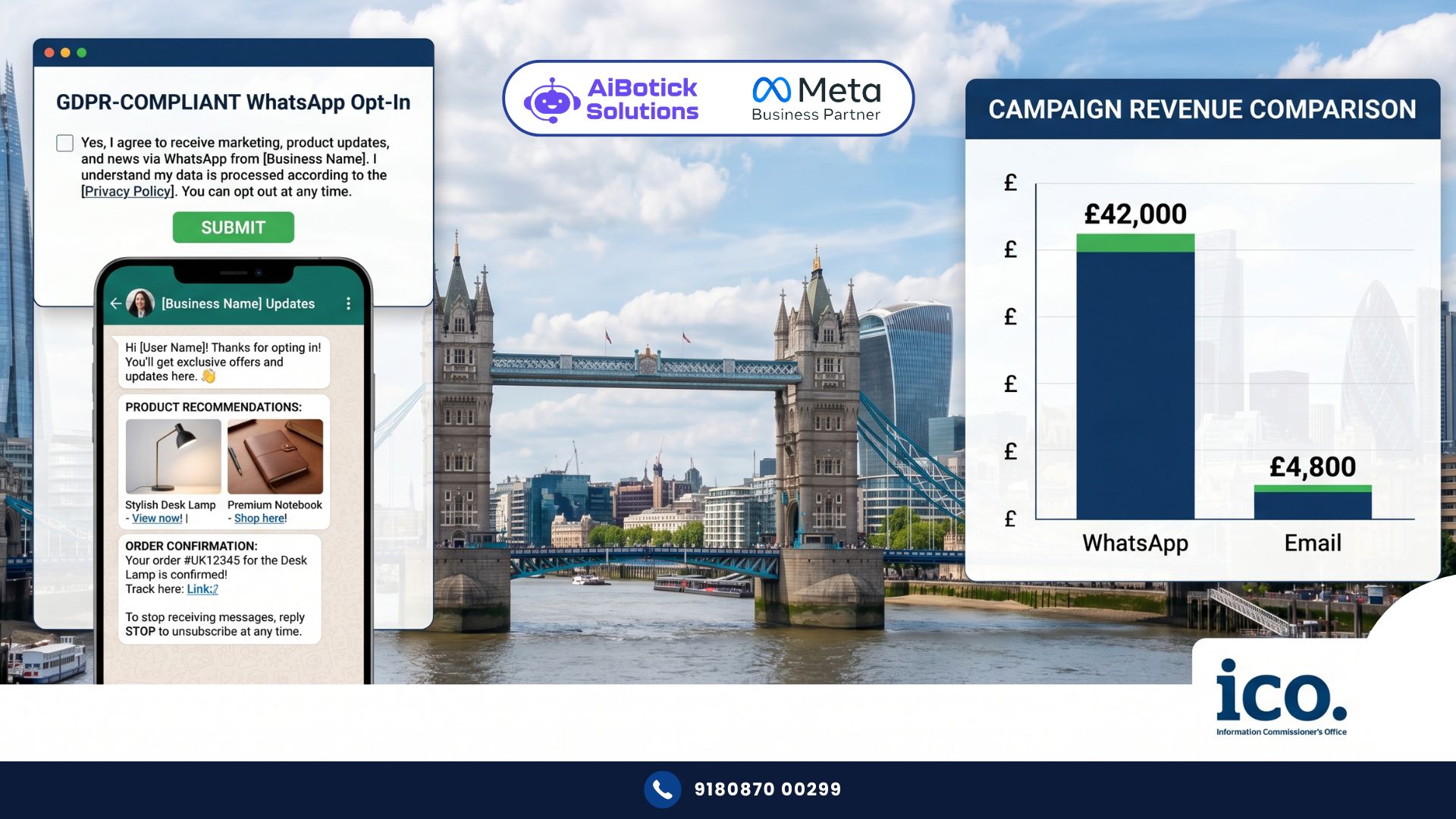
☐ I agree to receive WhatsApp messages from [Business Name] about [specific purpose: our products and services / appointment reminders / order updates]. I understand I can opt out at any time by replying STOP.
This checkbox should be:
- Unchecked by default (pre-ticked checkboxes are not valid consent under GDPR)
- Separate from email marketing consent
- Linked to your privacy notice
Option 2: Click-to-WhatsApp Ads
When a customer clicks a click-to-WhatsApp Facebook or Instagram ad and initiates a conversation, they have clearly opted to communicate with you via WhatsApp. This constitutes valid consent for communication related to their inquiry.
This is actually one of the cleanest opt-in mechanisms for WhatsApp for UK business — the customer initiated contact on WhatsApp, which is inherently opt-in.
Option 3: In-Person or Phone Opt-In
Customer visits your shop, calls your number, or places an order in person. You ask: “Would you like to receive updates from us on WhatsApp? Please give me your mobile number and confirm you’re happy to receive WhatsApp messages.” Document the consent.
Option 4: WhatsApp Keyword Opt-In
Promote your WhatsApp number with a keyword: “Text UPDATES to [number] on WhatsApp to receive weekly tips from us.” When they send the keyword, their WhatsApp conversation begins and consent is implied by their active initiation.
Every opt-in must include:
- What they’re consenting to (WhatsApp messages from you)
- The nature of messages (marketing / transactional / support)
- How to opt out (STOP or similar)
- Link to privacy notice
The UK Industries Where WhatsApp for UK Business Delivers Best ROI
Retail and E-commerce
UK retail is intensely competitive and increasingly direct-to-consumer. WhatsApp gives UK retailers something email can’t: immediate, personal communication.
A London-based sustainable fashion brand (direct-to-consumer, £2.8M annual revenue) implemented WhatsApp for UK business:
- Opt-in mechanism: checkout WhatsApp checkbox (12% opt-in rate on checkout)
- Built a list of 3,400 opted-in customers in 4 months
- Monthly WhatsApp campaign: new collection launch + seasonal promotions
- Average campaign revenue: £28,000-42,000 per broadcast
- GDPR compliance: all opted in, opt-out in every message, ICO registered
Email equivalent for same list: £3,200-4,800 per campaign (8-12% open rate vs 92% WhatsApp).
Financial Services and Fintech
UK financial services operates under FCA (Financial Conduct Authority) regulation in addition to GDPR. WhatsApp for financial services must comply with both.
FCA-regulated businesses (IFAs, mortgage brokers, insurance advisors) can use WhatsApp for client communication provided:
- All communications are recorded (WhatsApp Business API’s audit trail satisfies MiFID II recording requirements)
- Financial promotions are pre-approved and compliant
- Vulnerable customer policies are applied to WhatsApp communication
A London mortgage broker implemented WhatsApp for UK business for their remortgage reminder service. 1,200 clients. Automated 6-month remortgage reminder sequence (starting when a customer’s fixed rate is 18 months from expiry). Remortgage retention rate improved from 44% to 71%. Annual additional revenue from retained clients: £380,000.
Healthcare and Wellness
UK healthcare (private clinics, dental practices, opticians, physiotherapy, wellness) — WhatsApp for UK business is transforming appointment management.
Missed appointments cost the private healthcare sector millions annually. WhatsApp appointment reminders have 94% read rates vs 42% for SMS reminders. One London dental group (8 practices) reduced missed appointments by 67% after implementing WhatsApp reminder sequences. At £150 average appointment value, that’s £240,000 annually recovered from appointment efficiency alone.
GDPR note for healthcare: patient data is “special category data” under GDPR — higher protection standard. Ensure your WhatsApp platform’s data processing agreement covers special category data appropriately.
Education and EdTech
UK education — private schools, tutoring companies, adult education, professional training — has massive WhatsApp opportunity.
Student inquiries arrive from Facebook ads, Google, and referrals. The current response: email and phone. Conversion window: 48-72 hours. By which time many students have enrolled elsewhere.
A London-based professional certification training company implemented click-to-WhatsApp ads. All training inquiries routed to WhatsApp qualification flow. Response time: 8 seconds. Enrolment conversion: 31% from WhatsApp leads vs 7% from website form leads.
Property and Lettings
UK property is WhatsApp’s sweet spot. Rightmove and Zoopla leads need instant response. Estate agents and letting agencies that respond in minutes close more viewings.
Actually wait — let me give you a specific London example. A Hackney-based independent estate agency was getting 180 property inquiries per month from Rightmove. Average response time: 3.1 hours. Viewing conversion: 11%.
They implemented WhatsApp for UK business for all Rightmove leads (Rightmove has a WhatsApp inquiry option): instant WhatsApp acknowledgement, qualification flow (buying/renting, budget, timeline, chain status), automated property matches sent as WhatsApp messages with photos and floor plans, viewing scheduler on WhatsApp.
Response time: 90 seconds. Viewing conversion: 34%. Monthly completions increased 46%.
How to Set Up WhatsApp for UK Business: Step-by-Step
Step 1: UK Business Verification for Meta
Your WhatsApp Business API setup requires Meta Business Manager verification. For UK businesses:
- UK Companies House registration number
- Business domain verification
- Business email on your domain
- Consistent business name across all platforms
Meta’s verification for UK businesses typically takes 2-5 business days. Ensure your company name on Meta matches exactly what’s registered with Companies House.
Step 2: ICO Registration
If you’re processing personal data (including phone numbers) for WhatsApp communication, you may need to register with the ICO (Information Commissioner’s Office). Most UK businesses processing data for marketing purposes should already be ICO registered. If not — do this before launching WhatsApp campaigns. Registration is £40-60/year depending on business size.
Step 3: Update Your Privacy Notice
Add WhatsApp as a data processing channel. Specify:
- What data is collected (phone number, name, communication content)
- Legal basis (consent for marketing, legitimate interests for transactional)
- How long data is retained
- Data transfer information (Meta servers, SCCs)
- How to opt out (STOP reply)
Step 4: Build Your Opt-In Mechanism
Implement at minimum one of the opt-in methods described above. Start with the checkout/form opt-in for existing traffic and click-to-WhatsApp ads for new lead generation.
Step 5: Configure Opt-Out Handling
In your WhatsApp platform, configure automatic opt-out when a contact replies STOP, UNSUBSCRIBE, or similar. This must:
- Remove them from all marketing sequences immediately
- Send an acknowledgement message
- Record the opt-out with timestamp
Step 6: Template Pre-Approval
All outbound marketing WhatsApp messages require Meta-approved templates. Submit templates for approval before your campaign launch. UK-specific note: templates must comply with UK advertising standards (ASA guidelines) in addition to Meta’s policies.
Step 7: Launch and Monitor
Track block rate weekly. UK customers tend to be particularly privacy-conscious — a block rate above 0.5% on any campaign is a signal to review relevance and targeting. (India benchmark is under 1%; UK benchmark should be under 0.5% for well-segmented, opted-in audiences.)
WhatsApp for UK Business: The Revenue Opportunity in Numbers
Let me put the opportunity in practical terms for different UK business sizes.
Small business (£500K-2M annual revenue):
A 2,000-contact opted-in WhatsApp list generates:
- Monthly broadcast campaigns: £8,000-18,000 per campaign (2-3 campaigns/month)
- Drip campaign conversions: £3,000-6,000/month
- Improved appointment show rates (services businesses): £2,000-5,000/month saved
- Total annual WhatsApp revenue contribution: £150,000-350,000
Platform cost at this scale: £1,800-3,600/year. ROI: 42-97x
Mid-size business (£2M-10M annual revenue):
A 15,000-contact opted-in WhatsApp list generates:
- Monthly campaigns: £45,000-120,000 per campaign
- Abandoned cart recovery (ecommerce): £25,000-60,000/month
- Lead nurture conversion uplift: £40,000-80,000/month
- Total annual WhatsApp revenue contribution: £1.5M-3.2M
Platform cost at this scale: £6,000-12,000/year. ROI: 125-267x
These numbers are conservative estimates based on UK business implementations I’ve tracked or have credible data on. Your industry, product, and list quality will affect exact figures. But the direction is consistent — WhatsApp for UK business done properly delivers 40-100x+ ROI on platform cost.
Common Mistakes UK Businesses Make With WhatsApp
Mistake 1: Skipping ICO registration
If you’re processing personal data for marketing, you need to be registered with the ICO. Don’t launch WhatsApp campaigns without completing this. The fine risk isn’t worth it.
Mistake 2: Using a personal WhatsApp number for business
Personal numbers have no audit trail, no team access, no compliance documentation. If the ICO investigates, you need records of consent, communication logs, and opt-out management. WhatsApp Business API provides all of this. Personal WhatsApp provides none.
Mistake 3: Treating WhatsApp like email in terms of frequency
UK consumers are more sensitive about WhatsApp frequency than email. 2-4 marketing messages per month maximum. Exceed this and block rates rise. Block rates rising means the ICO potentially taking interest.
Mistake 4: No opt-out mechanism in messages
Every marketing WhatsApp message must include an opt-out mechanism. “Reply STOP to unsubscribe” at the minimum. UK GDPR requires this. Don’t skip it.
Mistake 5: Importing existing customer lists without fresh consent
Just because someone is in your CRM doesn’t mean they consented to WhatsApp marketing. Fresh, specific, WhatsApp-consent is required. Don’t import email marketing lists to WhatsApp without getting fresh opt-ins.
Mistake 6: Ignoring the FCA (for financial services)
UK financial services businesses have additional FCA requirements on top of GDPR. Financial promotions must be pre-approved, communications must be recorded, and vulnerable customer policies must extend to WhatsApp. Get your compliance team to review all templates before going live. And if you want to understand how WhatsApp automation works in the broader financial services context — including the communication cadences that keep clients engaged without triggering compliance concerns — our WhatsApp for financial advisors guide covers the full approach that applies equally to UK IFAs and mortgage brokers. 😄
The Bottom Line on WhatsApp for UK Business
Honestly bhai — I think UK businesses are sitting on one of the best untapped revenue opportunities in digital marketing right now. Not because WhatsApp is magic. Because the combination of high engagement rates + low competition (most UK businesses haven’t adopted it yet) + clear compliance pathway creates a rare window.
The GDPR compliance layer adds friction. But it also eliminates competitors who are too lazy or too anxious to implement it properly. The businesses that get WhatsApp for UK business right — proper opt-ins, relevant messages, clear opt-outs, documented consent — will build high-quality, engaged lists that outperform any scraped-data email list by orders of magnitude.
The London fashion brand generating £42,000 per WhatsApp campaign from 3,400 opted-in customers? Their email list of 28,000 subscribers generates £4,800 per campaign. 8x the revenue from 12% of the list size. Because every person on their WhatsApp list specifically asked to be there.
Quality beats quantity. Consent beats reach. WhatsApp for UK business done right is simply better marketing. And for understanding how to translate this into a complete revenue strategy — not just broadcasts but drip sequences, lead qualification, customer retention — our WhatsApp marketing strategy guide covers the full playbook that UK businesses can adapt for their market. 💯
Ab toh bas one thing bolta hoon — WhatsApp for UK business is available, compliant, and profitable. The businesses starting now will be the case studies everyone else reads about in 2028.
Want to implement WhatsApp for your UK business with full GDPR compliance?
— Mohit Shah | 15+ years in IT industry | 4+ years in WhatsApp automation | Worked with various MNC brands | Now helping businesses figure out what actually works
Q1: Is WhatsApp Business API fully GDPR compliant for UK businesses?
A1: WhatsApp Business API can be GDPR compliant for UK businesses when implemented correctly. The key requirements: explicit opt-in consent before sending any marketing messages (pre-ticked boxes are invalid under UK GDPR), a clear opt-out mechanism in every marketing message, documented consent records, an updated privacy notice disclosing WhatsApp data processing, and Meta’s Standard Contractual Clauses accepted for data transfers to US servers. WhatsApp Business API creates automatic, timestamped message logs — this is actually better documentation than phone calls or manual WhatsApp for GDPR compliance purposes. Businesses in regulated sectors (financial services under FCA, healthcare processing special category data) have additional requirements beyond baseline GDPR. Always get legal review of your WhatsApp communication policy before launching, particularly for regulated industries.
Q2: Do UK businesses need to register with the ICO before using WhatsApp for marketing?
A2: If you’re processing personal data (including phone numbers and names) for marketing purposes in the UK, you are likely required to register with the Information Commissioner’s Office (ICO). Most businesses doing any form of digital marketing should already be ICO registered. Registration costs £40-60 per year depending on your business size and is completed at ico.org.uk. If you’re not registered, complete this before launching any WhatsApp marketing campaigns. Additionally, ensure your data protection officer (if required) is aware of WhatsApp as a new data processing channel, and update your Record of Processing Activities (RoPA) to include WhatsApp communication.
Q3: What is the best way for UK businesses to build a GDPR-compliant WhatsApp contact list from scratch?
A3: The three most effective GDPR-compliant methods for UK businesses: First, website opt-in — add a clearly labelled, unchecked WhatsApp marketing consent checkbox to your contact forms, checkout, and sign-up flows with specific consent language. Second, click-to-WhatsApp ads on Facebook and Instagram — when a prospect clicks your ad and initiates a WhatsApp conversation, they have actively opted in to communicate with you via WhatsApp, making this one of the cleanest consent mechanisms available. Third, in-person or phone opt-in — ask existing customers if they’d like to receive updates via WhatsApp, collect their explicit verbal consent, and document it. Avoid importing existing email lists to WhatsApp without fresh WhatsApp-specific consent — the fact that someone signed up for email marketing does not constitute consent for WhatsApp marketing under UK GDPR.