There’s a specific kind of Indian entrepreneur I’ve met dozens of times.
Built something real back home. Relocated to Dubai, Abu Dhabi, or Sharjah — or opened a Gulf branch while keeping India operations running. Hustled hard. Got the trade licence. Set up the office. Hired the team.
And then discovered that everything they knew about running a business in India — every shortcut, every relationship hack, every way of staying in front of customers — needed to be rebuilt from scratch in a market that looks familiar but operates completely differently.
The ones who figured out WhatsApp Gulf business communication early? They’re doing well. Genuinely well.
The ones still running Gulf operations like they run their India business — same tools, same cadence, same assumptions? Yaar, I see them frustrated at conferences, wondering why their India playbook isn’t translating.
This article is for the second group. Before it’s too late.
The Indian Business Footprint in the Gulf — Bigger Than Most People Realise
Let’s establish context before tactics. Because the scale of Indian business presence in the Gulf is genuinely staggering.
3.5 million Indians live in UAE alone. Add Saudi Arabia, Qatar, Kuwait, Bahrain, Oman — the GCC Indian diaspora crosses 8 million people. And within that community, Indian-owned businesses span every sector imaginable:
Trading and distribution. Retail. Food and beverage. IT services. Logistics. Healthcare. Education. Real estate. Jewellery. Textiles. Construction. Finance and accounting. Digital marketing agencies.
Many of these businesses serve three distinct customer groups simultaneously:
Group 1 — Indian expat community in the Gulf. People who understand Hindi, share cultural context, trust Indian business owners implicitly, and prefer communicating in a familiar way.
Group 2 — Local Emirati and Arab clientele. Require Arabic communication, different relationship-building protocols, formal initial engagement.
Group 3 — The mixed expat market. British, American, Filipino, Pakistani, Bangladeshi — the incredible demographic diversity that defines Gulf cities.
A WhatsApp Gulf business strategy has to navigate all three. Most Indian businesses try to serve all three with a single undifferentiated WhatsApp approach — and end up serving none of them particularly well.
Let’s fix that.
Why Indian Businesses Specifically Have a WhatsApp Advantage in the Gulf
Here’s something I genuinely believe — and I’ll own this as my honest opinion:
Indian entrepreneurs operating in the Gulf have a structural WhatsApp advantage that most of them are completely failing to leverage.
Why? Because WhatsApp is native to the Indian business experience in a way it isn’t for European, American, or even local Emirati business owners.
Indian entrepreneurs grew up negotiating on WhatsApp. Sending voice notes to suppliers. Managing customer groups. Broadcasting festival offers. Running entire supply chains through WhatsApp threads. This muscle memory — this intuitive comfort with WhatsApp as a business tool — is genuinely rare in a global context.
The Gulf market is WhatsApp-first but WhatsApp-unsophisticated in terms of automation. Most local and Western businesses are still treating WhatsApp like email — reactive, unstructured, person-dependent.
An Indian business owner who takes their natural WhatsApp fluency and adds proper API automation infrastructure on top? That combination is formidable. Seriously formidable.
Ab toh the question is just — are you actually doing it?
The 4 Operating Realities Indian Gulf Businesses Must Understand
Before I get into the actual strategy — four realities that change everything about how you build your WhatsApp Gulf business approach.
Reality 1 — You’re Running Two Time Zones, Not One
Gulf Standard Time is UTC+4. India is UTC+5:30. That’s only 1.5 hours difference — feels manageable. But in practice, for Indian businesses running operations across both geographies:
Your India-based team follows up during India business hours. Your Gulf customers are expecting responses during Gulf business hours. Your India office is having lunch when your Dubai customer needs an urgent answer. Your Gulf branch closes at 6pm GST — which is 7:30pm IST — when your India backend team is still fully operational.
Without WhatsApp automation handling the gaps, customers fall into a 1.5-hour black hole multiple times a day. Every day. That’s a lot of dropped conversations for a business supposedly operating in two markets.
Automation doesn’t sleep. It doesn’t take a lunch break. It doesn’t go home at 6pm. For Indian Gulf businesses specifically, this is one of the clearest ROI arguments for WhatsApp automation that exists.
Reality 2 — Your Indian Customers in the Gulf Are Your Warmest Leads
Indian expats in the Gulf actively seek out Indian businesses. Familiarity. Trust. Cultural comfort. Shared reference points. The ability to negotiate in Hindi. The assumption that you’ll understand their specific needs without extensive explanation.
This community — 3.5 million people in UAE alone — represents a ready, warm, high-trust customer base that is dramatically easier to serve well if you communicate with them in the right way.
WhatsApp in Hindi or Hinglish to Indian Gulf expats is not just a communication choice. It’s a relationship signal. It says: we see you, we know you, we’re one of you.
That signal converts.
Reality 3 — The Gulf Market Expects Premium Communication Standards
Indian business communication in India often runs on the assumption of tolerance — customers will follow up if they don’t hear back, respond will come eventually, informal is fine.
Gulf market — including the Indian expat community that has adapted to Gulf standards — operates differently. Response speed expectations are higher. Communication quality expectations are higher. Ghosting a lead is not just a lost sale — it’s a reputation event in a community where everyone knows everyone.
Indian businesses that carry India-standard communication cadence to the Gulf consistently underperform. WhatsApp automation solves this by ensuring the standard is consistent regardless of who’s in the office, what time it is, or how busy the team is.
Reality 4 — Cross-Border Operations Create Documentation and Follow-Up Nightmares
For Indian businesses with operations in both India and Gulf — the complexity of managing client communication across two jurisdictions, two teams, and two time zones without a centralised system is significant.
Customer conversations happening on personal WhatsApp numbers of individual team members. Follow-ups depending on someone’s memory. Deals falling through because a team member in Mumbai didn’t pass context to the Dubai branch properly.
A centralised WhatsApp Business API setup with a shared team inbox solves this structurally. Every customer conversation in one place. Accessible by both teams. Context transferred. Nothing lost.
The WhatsApp Gulf Business Playbook — What Actually Works
Enough context. Here’s what to build.
Chapter 1 — The Tri-Language Opt-In Architecture
Every Indian Gulf business should capture language preference at the very first interaction.
“Welcome to [Business Name]. We’re here to help. Please select your preferred language: 1️⃣ English 2️⃣ عربي (Arabic) 3️⃣ हिंदी / اردو (Hindi/Urdu)”
From this point forward — every automated message, every broadcast, every follow-up sequence — delivered in the chosen language.
This is table stakes. Not advanced strategy. Table stakes. If you’re not doing this, you’re already behind every competitor that is.
The Hindi/Urdu option specifically — I cannot overstate how much this matters for the Indian expat segment. I’ve seen businesses add this single choice to their opt-in and watch Hindi-speaking customer response rates jump 40-60% within weeks.
Actually wait — better example to make this concrete:
A Mumbai-based IT services company opened a Dubai branch in 2023. Targeting Indian businesses in UAE for their services. Running WhatsApp outreach entirely in English. Getting 12% response rates from Indian expat business owners.
Added Hindi as an option. Switched their Indian-expat-targeted messages to Hinglish. Response rate: 51% within 30 days.
Same service. Same pricing. Same team. Just language.
Dekho — this is not complicated. It’s attention.
Chapter 2 — The India-to-Gulf Lead Handoff Flow
This one is specific to businesses that generate leads in India and convert them in Gulf, or vice versa.
Common scenario: An Indian family planning to relocate to Dubai enquires through your India website. Lead captured in India. Needs Gulf follow-up. Currently — this lead gets emailed to someone in Dubai, who picks it up the next morning, by which time the family has already spoken to three other services.
WhatsApp automation handles this in real time:
Lead comes in through India channel → instant WhatsApp response acknowledges → qualification questions run automatically → hot lead gets assigned to Gulf team with full conversation transcript → Gulf team member picks up a pre-qualified, already-engaged prospect rather than a cold lead
The handoff is invisible to the customer. They experience one seamless conversation. Internally, two teams are coordinating through automation.
For immigration consultants, education advisors, relocation services, financial advisors — any Indian business that serves customers moving between India and Gulf — this flow is worth building before almost anything else.
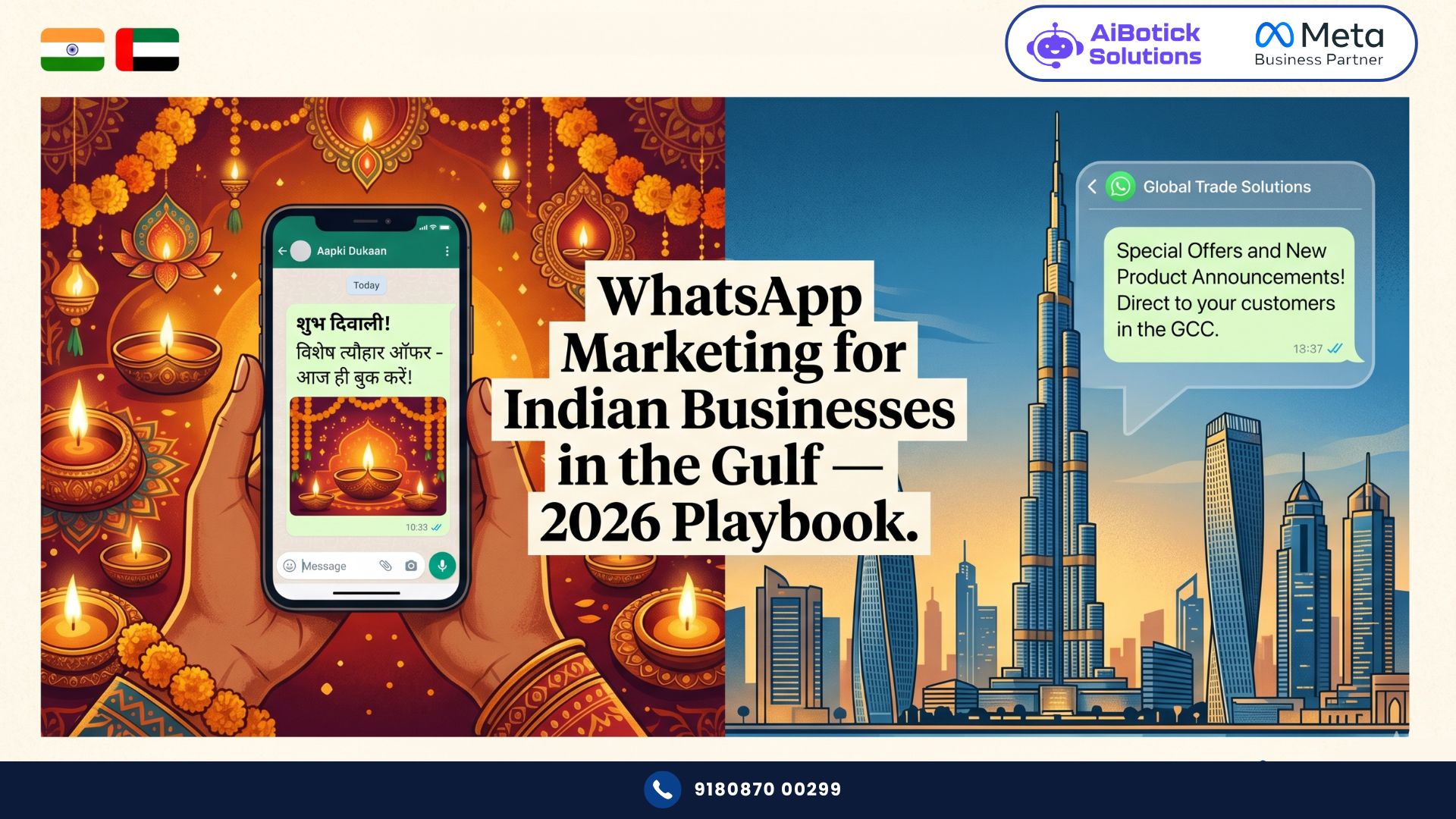
Chapter 3 — The Festival Calendar Strategy (This One Is Pure Gold)
Yaar, Indian businesses in the Gulf have access to not one but two rich festival calendars — and almost none of them use this properly.
Indian festivals: Diwali, Holi, Eid (celebrated by Indian Muslims), Dussehra, Navratri, Onam, Pongal, Christmas (celebrated by Indian Christians), New Year.
Gulf/Islamic festivals: Eid Al Fitr, Eid Al Adha, UAE National Day, Ramadan (entire month), New Year.
That’s 15-20 distinct occasions across a year where personalised, culturally relevant WhatsApp communication lands extraordinarily well.
An Indian jewellery retailer in Sharjah Gold Souk — doing AED 2M+ monthly — runs this festival calendar on WhatsApp with full automation:
- 3 days before Diwali: Festive collection preview to all Indian customers in Hindi
- Diwali day: Personalised greeting with exclusive offer — “Aapko aur aapke parivaar ko Diwali ki dher saari shubhkaamnayein 🪔”
- 10 days before Eid: Arabic broadcast to Muslim customers with Eid collection preview
- Eid day: Eid Mubarak in Arabic with exclusive discount for existing customers
- UAE National Day (December 2): Bilingual message celebrating with their UAE home
Each message is segmented by language preference and purchase history. Each feels personal because it is personal — specific to that customer’s cultural context.
Last Diwali campaign: 847 messages sent to Indian customers in Hindi. 71% open rate. 34% clicked the collection preview. 89 purchases in 72 hours averaging AED 2,400. One campaign.
Could be wrong, but I’ve never seen a generic “festive offer” email approach these numbers. The cultural specificity is what makes it work.
Chapter 4 — The Referral Activation Flow (The Indian Business Superpower)
Indian business communities in the Gulf operate on referral networks more heavily than almost any other demographic. A recommendation from a trusted Indian contact carries enormous weight.
WhatsApp is the natural infrastructure for this. But most Indian businesses activate referrals informally — “bhai tell your friends” — rather than systematically.
A structured WhatsApp referral flow:
Post-purchase or post-service delivery → automatic WhatsApp message → “We’re so glad we could help. If you know any other Indian business owners in Dubai who might benefit from [service] — we’d love to meet them. Share this link with them and they’ll get [specific benefit]. You’ll get [specific benefit] as our thank you.”
The link opens a WhatsApp conversation with your business — pre-populated with a message that identifies the referral source.
Referred lead receives: immediate WhatsApp response that acknowledges the referral (“Rajesh bhai ne aapka naam liya — unke friend hain toh hamare bhi friend hain”) and starts a warm, personalised conversation.
An Indian accounting firm in DIFC — 3 partners, serving Indian businesses in UAE — added this flow after client delivery. 60 days later, 34% of new client enquiries were coming from WhatsApp referrals. Their previous referral rate was 11% — informal, untracked, inconsistent.
Same referral culture. Just systematised.
Chapter 5 — The Cross-Border Trust Building Sequence
This is specifically for Indian businesses in Gulf trying to win clients who are evaluating them against local Gulf competitors or established international firms.
The trust deficit is real. “You’re an Indian company — are you really established here?” It’s unspoken sometimes. But it’s there.
WhatsApp is actually uniquely positioned to address this — because it’s the most personal business communication channel that exists. A sequence that builds trust over 30-45 days:
Day 1: Welcome + your Gulf credentials (trade licence number, years in UAE, key clients or projects) Day 7: A genuinely useful piece of content relevant to their industry in UAE — no pitch Day 14: A client story (anonymised) from a similar Indian business you helped in Gulf — specific outcomes Day 21: An invitation — “We host a monthly informal session for Indian business owners in Dubai. Want to join the next one?” (even if this session is a WhatsApp group — the community signal is powerful) Day 28: A personalised check-in from a real human. Not automated. The sequence gets them warm enough that this check-in lands in friendly territory rather than cold outreach.
By day 30, this prospect has received five touchpoints. Each valuable. None pushy. And they know significantly more about your Gulf credibility than they did on day one.
The Operational Setup — What Indian Gulf Businesses Actually Need
Let me be specific about infrastructure because this is where Indian businesses in Gulf often underinvest.
Central WhatsApp Business API number — mandatory. Not personal numbers. Not the WhatsApp Business app. The API. This is the foundation. Without it, nothing else scales. If your Gulf operations are running on someone’s personal number — that’s an emergency, not a todo item.
Shared team inbox with India + Gulf access. Both teams — India backend and Gulf client-facing — need visibility into customer conversations. Shared inbox with proper assignment and tagging. No conversation siloed on one person’s device.
Language-tagged contact database. Every contact tagged with: language preference, geography (UAE / Saudi / Qatar / India), customer type (Indian expat / local / other expat), purchase history, lifecycle stage. This tagging is what makes every future broadcast and sequence feel personalised rather than generic.
Broadcast calendar — planned quarterly. Indian Gulf businesses have the richest festival broadcast calendar of any business type in any market. Plan it quarterly. Build templates in advance. Get Meta approvals done before the festival — not the day before. Nothing worse than a Diwali template sitting in approval queue on Diwali morning.
Human handoff protocol — clearly defined. Which conversations go to Gulf team? Which to India team? What’s the response SLA for each? Who covers Gulf hours when Gulf team is off? These questions answered in advance — not discovered during a crisis.
For a detailed look at how to measure the return on this infrastructure investment, our WhatsApp automation ROI guide gives you the exact framework to calculate what this is worth for your specific business model and deal values.
What People Get Wrong About WhatsApp Gulf Business Marketing
Wrong belief 1: “One WhatsApp number for India operations and one for Gulf is fine.”
It’s not fine — it’s a structural problem. Customers who interact with both your India and Gulf operations have two separate conversation threads, no context sharing, and experience you as two different companies. A single business WhatsApp presence — with proper routing to the right team — creates a coherent brand experience regardless of geography.
Wrong belief 2: “Our Indian customers in Gulf don’t need automation — we know them personally.”
You know 50 of them personally. What happens when you have 500? Or 2,000? The personal relationship doesn’t scale. The documented, systematic WhatsApp follow-up does. And it actually preserves the personal feel better than inconsistent manual outreach from a growing team.
Wrong belief 3: “Arabic is not our market — we focus on Indian expats only.”
This is leaving money on the table. Indian businesses in sectors like trading, food, retail, and services have enormous untapped opportunity in local Emirati and Arab expat markets. Not investing in Arabic WhatsApp communication means self-limiting to one demographic in a genuinely diverse market.
Wrong belief 4: “We’ll build this when we’re bigger.”
The businesses that built WhatsApp Gulf business infrastructure when they were small now have clean contact databases, optimised flows, and systematic referral engines. The businesses that waited are now trying to retrofit automation onto chaotic contact lists and inconsistent communication histories. Starting small and starting correctly is dramatically easier than fixing a mess at scale.
For understanding what a proper WhatsApp Business API setup looks like versus the regular app — and why the distinction matters enormously for Gulf operations — our WhatsApp Business API explainer covers exactly what you need to know before making any infrastructure decision.
The Honest Assessment — Where Most Indian Gulf Businesses Currently Stand
Look, here’s the thing — and I’m going to be direct because I think it’s more useful than diplomatic.
Most Indian businesses in the Gulf are running WhatsApp the same way they ran it in India five years ago. Personal numbers. Informal groups. Manual follow-up. Broadcast lists on the regular app. No automation. No segmentation. No measurement.
This worked when the market was less competitive and customer expectations were lower. Neither of those conditions applies anymore.
The Gulf market is maturing fast. Local competitors are professionalising. International players are entering. And the Indian expat customer — who grew up watching WhatsApp communication get better and better — now compares your follow-up quality against every other business they interact with.
The gap between what most Indian Gulf businesses are doing on WhatsApp and what’s possible is genuinely large. Which means the opportunity is also genuinely large for the businesses that move now.
Seedha bolta hoon — this is a 2026 window. By 2027, the businesses that built this correctly will have 12-18 months of optimised flows, clean databases, and systematic referral engines running. The ones who wait will be playing catch-up against competitors who already have all of that.
Let’s Build Your Gulf WhatsApp Infrastructure
At AiBotick, we work with Indian businesses operating in India and the Gulf — we understand the cross-border complexity, the multi-language requirements, the cultural nuances, and the compliance landscape across both markets.
Every client gets personalised onboarding — not a generic setup guide. Live training with your actual team, not a pre-recorded video. A dedicated WhatsApp support group that stays active through your entire journey — from first flow to full operation. And this isn’t an enterprise-only offering. Every plan. Every client. Because we’ve seen what businesses lose when support disappears after go-live. 💯
We don’t just sell you software. We partner with you until it works. That’s not a tagline — it’s literally how we operate.
Chat with us on WhatsApp — tell us about your Gulf business setup, which markets you’re serving, and what’s currently broken in your WhatsApp communication. We’ll give you an honest assessment of what to build first and what realistic results look like in your first 60 days.
— Mohit Shah | 15+ years in IT industry | 4+ years in WhatsApp automation | Worked with various MNC brands | Now helping businesses figure out what actually works
Q1: Why should Indian businesses in the Gulf use Hindi on WhatsApp if English works fine?
English works — but Hindi converts significantly better with Indian expat audiences in the Gulf. Indian professionals and business owners in UAE respond to Hindi WhatsApp communication at dramatically higher rates than equivalent English messages because it creates an immediate trust and familiarity signal in a market where most businesses communicate only in English or Arabic. Businesses that add Hindi as an opt-in language option consistently report 40-60% higher response rates from Indian expat segments within 30 days of implementing it.
Q2: How should Indian businesses in UAE handle WhatsApp communication across India and Gulf teams?
The most effective setup is a single WhatsApp Business API number with a shared team inbox that both India-based and Gulf-based team members can access simultaneously. Conversations are assigned based on geography, language, or specialisation — with full context visible to both teams. This eliminates the problem of customer conversations being siloed on individual team members’ personal devices, ensures continuity when staff changes, and creates a coherent customer experience regardless of which team member is handling the conversation.
Q3: What WhatsApp broadcast campaigns work best for Indian businesses targeting Gulf customers during Indian festivals?
Festival campaigns segmented by language and cultural background consistently outperform generic promotions. For Indian customers in Gulf, Diwali, Holi, and New Year campaigns in Hindi with culturally specific messaging generate open rates of 60-75% and conversion rates 3-4x higher than equivalent English broadcasts. Key factors: send in Hindi or Hinglish rather than English, reference the festival specifically rather than a generic “festive offer,” include an exclusive element that makes the recipient feel like an insider, and time the campaign 2-3 days before the festival rather than on the day itself when inboxes are crowded.