Here’s a situation I’ve watched play out more times than I’d like.
A business owner in Dubai spends three weeks evaluating WhatsApp API providers. Reads the feature pages. Watches the demo videos. Picks the one with the slickest interface. Signs up. Pays.
Six weeks later — templates getting rejected, Arabic flows breaking, support tickets going unanswered for 48 hours, and the sales guy who promised everything has stopped picking up calls.
Yaar, choosing a WhatsApp API UAE provider is not a feature comparison exercise. It’s a trust decision. And most businesses only figure that out after they’ve made the wrong one.
Let me save you that six weeks.
Why UAE Is a Different Beast When It Comes to API Providers
Before we get into what to look for — understand why this market is genuinely different from India or Europe.
UAE businesses deal with a set of realities that most WhatsApp API providers aren’t actually built for:
- Multi-language operations — English, Arabic, Hindi, Urdu, Tagalog all in the same customer base
- Higher regulatory sensitivity — UAE Personal Data Protection Law means consent management isn’t optional
- Premium customer expectations — A broken bot in Dubai gets screenshotted and shared. Fast.
- Cross-timezone operations — Many Gulf businesses have India-based backend teams. Support needs to span both.
- Diverse industry mix — Real estate, luxury retail, hospitality, FMCG distribution, logistics — each with completely different automation requirements
A provider that works beautifully for a Pune-based ecommerce brand might completely fall apart for a Dubai real estate agency handling Arabic-speaking clients with complex multi-step flows.
So when I say “what to look for” — I mean specifically for UAE. Not generic SaaS evaluation criteria. Actual Gulf-market requirements.
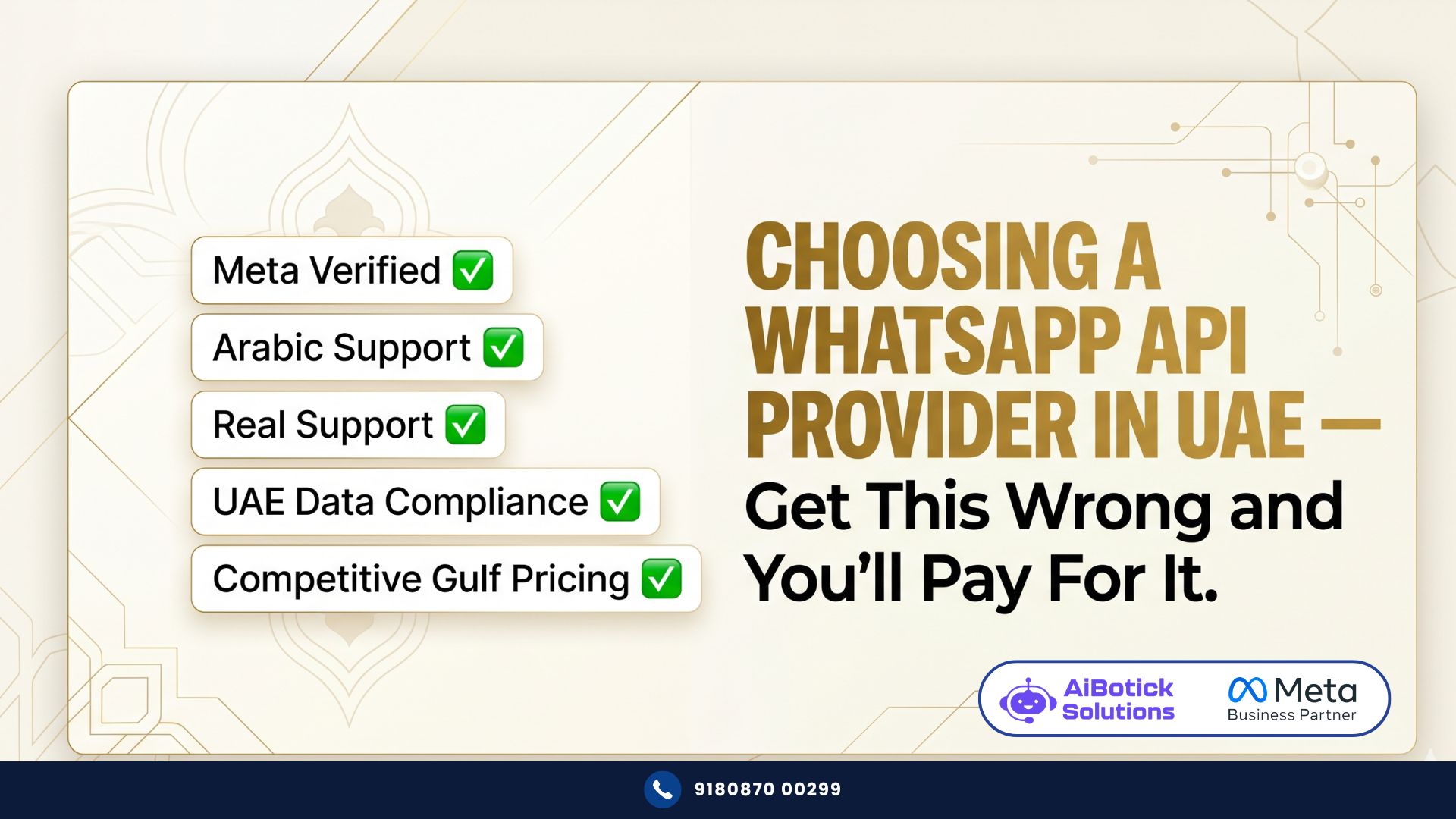
The 8 Things That Actually Matter When Choosing a WhatsApp API UAE Provider
1. Official Meta Partnership — Non-Negotiable, Verify It
Seedha bolta hoon — there are providers in the market operating through grey channels. Unofficial resellers who don’t have a direct relationship with Meta. They work. Until they don’t. Until Meta does a policy sweep and your number gets flagged.
Every legitimate WhatsApp Business API provider must be a Meta Business Partner or work through an official BSP (Business Solution Provider).
How to verify: Ask them directly. A legitimate provider will show you their Meta BSP status without hesitation. If they deflect, get vague, or say “we work through a partner network” — that’s your answer. Walk away.
AiBotick is officially Meta-verified. We say this not to brag — but because in an environment where grey operators exist, it matters that you know the difference.
2. Arabic Language Support — The Real Test, Not the Demo
Every provider will say “yes we support Arabic” in a sales call.
Here’s what to actually test before signing anything:
- Can you build flows where Arabic is the primary language — not a translation layer on top of English?
- Does the platform handle right-to-left text rendering correctly in the dashboard itself?
- Can Arabic templates be submitted and managed from within the platform without workarounds?
- Has the provider actually set up Arabic flows for real clients before — or is yours going to be the pilot?
Ask for a live demo of an Arabic flow. Not a screenshot. Not a slide. A live demo with an actual Arabic message being sent and received. If they can’t do that in 10 minutes — WhatsApp API UAE Arabic support is theoretical for them, not operational.
Actually wait — here’s the real tell. Ask them: “What are the most common Arabic template rejection reasons you’ve seen and how do you handle them?”
A provider who’s actually done this will answer immediately. A provider who hasn’t will get very quiet.
3. Template Approval Track Record — This Is Where Projects Die
WhatsApp message templates require Meta approval before you can send them. Rejection is common. Re-submission takes time. Poor template writing causes delays of days or weeks.
For UAE businesses, this is especially critical because:
- Arabic templates have different approval sensitivity than English
- Templates mentioning financial products, real estate, healthcare face more scrutiny
- Some categories require additional business verification
What to ask your provider:
- What’s your average template approval time for UAE clients?
- What’s your template rejection rate and what are the most common reasons?
- Do you review templates before submission or just pass through what we write?
- Do you have experience with [your specific industry] template approvals in UAE?
A good provider actively helps you write templates that pass. They know the patterns that get rejected. They guide you. A bad provider just submits what you give them and blames Meta when it fails.
4. Genuine Support — The Difference Between Vendor and Partner
This one is personal for me. And it’s the thing I’ve seen matter most after the initial setup honeymoon period ends.
Most WhatsApp API UAE providers — especially the bigger international ones — give you:
- A ticketing system
- A knowledge base
- A 24-48 hour response SLA
- An account manager you speak to once a quarter
That’s fine when nothing is breaking. It’s catastrophic when your main customer communication channel goes down on a Thursday and you have a property launch event Friday morning.
What you actually need:
- Direct access to someone who knows your setup
- Response measured in minutes for critical issues — not hours
- Onboarding that actually trains your team, not just sends a PDF
- Someone who proactively flags issues before you discover them
At AiBotick, every client gets a dedicated WhatsApp support group — not a ticket number. When something breaks, you message the group. Real humans respond. This isn’t an enterprise-only feature. It’s how we operate for everyone, every plan. Because we’ve seen what happens when support fails at the wrong moment — and we refuse to be that provider. 💯
5. Multi-User Team Inbox — Essential for UAE Business Scale
UAE businesses typically have larger teams managing customer communication compared to equivalent Indian SMEs. A real estate agency with 15 agents. A hotel with 6 front desk staff. A retail chain with 4 stores each needing access.
Your WhatsApp API UAE provider must have a robust shared team inbox where:
- Multiple agents handle conversations from a single WhatsApp number
- Conversations can be assigned, transferred, and tagged
- Supervisors can monitor without interfering
- Each agent’s performance can be tracked
- Conversations don’t fall through cracks when staff rotates (which in UAE, happens constantly)
Staff turnover in UAE is significantly higher than India. If your customer relationships live on individual agents’ logins — and those agents leave every 18 months — you have a structural problem. The right platform solves this at the foundation level.
6. Broadcast and Segmentation Capability — Not All Platforms Are Equal
Sending a WhatsApp broadcast to 5,000 contacts is table stakes. Any platform can do that.
What separates good platforms for UAE:
- Segmentation depth — Can you broadcast to “Arabic-speaking customers who bought in the last 60 days and are in the AED 500K+ property segment”? Or just “all contacts”?
- Broadcast scheduling — Can you schedule for UAE timezone specifically?
- Opt-out management — UAE data regulations require clean opt-out handling. Is it automatic?
- Delivery analytics — Delivered, read, clicked — broken down by segment?
- A/B testing — Can you test two message variants before the full send?
For a Dubai retail brand or real estate agency running regular broadcast campaigns, these aren’t luxury features. They’re what determines whether your campaigns make money or just create noise.
7. Integration Capability — Your CRM, Your Property Software, Your POS
UAE businesses run on specific software:
- Real estate: Salesforce, Zoho CRM, property management systems
- Retail: Shopify, WooCommerce, POS systems
- Hospitality: Opera PMS, Cloudbeds, custom booking engines
- Logistics: Custom ERPs, tracking platforms
Your WhatsApp API UAE provider needs to either have pre-built integrations or offer clean API/webhook connectivity for custom integrations. Ask specifically:
- Do you have an integration with [your current CRM]?
- If not, do you provide webhook access for custom development?
- What does the typical integration timeline look like?
- Do you support Zapier/Make for no-code integrations?
A provider who can only connect to a fixed list of 5 tools will limit you within 6 months as your operations grow.
8. Pricing Transparency — Including Meta’s Conversation Charges
This is where I see businesses get surprised the most.
WhatsApp Business API pricing has two components:
- The platform fee (what you pay the provider)
- Meta’s conversation charges (what Meta charges per conversation)
Some providers bundle these opaquely. Some show a low platform fee but have high conversation markups. Some charge per message instead of per conversation — which sounds similar but can be dramatically more expensive at scale.
For UAE operations specifically:
Meta charges for international authentication conversations at Rs.2.4971 per conversation (roughly AED 0.11). Marketing conversations run at Rs.0.8631 (roughly AED 0.038). These are Meta’s India-tier rates — if you’re operating through an India-based provider for UAE, confirm which rate tier applies to your number.
Ask any provider you evaluate:
- What is your platform fee structure?
- What are the exact Meta conversation charges I’ll pay?
- Are these bundled or billed separately?
- What’s the total estimated monthly cost for my projected volume?
Get this in writing. Not in a verbal conversation on a demo call.
The Questions Most Businesses Forget to Ask
No no, scratch that — these aren’t forgotten questions. These are the ones businesses are too polite or too rushed to ask. Don’t be.
“Can I speak to a current UAE client of yours?” A provider confident in their UAE delivery will connect you without hesitation. Reluctance is a red flag.
“What happens to my data if I cancel?” Data portability matters. Customer conversation history, contact lists, flow data — who owns it, how do you export it, and does it disappear if you leave?
“What’s your uptime SLA and what’s your compensation if you miss it?” 99.9% uptime means about 8.7 hours of downtime per year. For a business running customer communication on WhatsApp, even 2 hours at the wrong time is painful. Know what you’re covered for.
“Have you handled a WhatsApp number ban situation before?” Numbers get flagged. Sometimes wrongly. Sometimes due to customer spam reports. A provider who’s navigated this before knows the process. A provider who hasn’t — you don’t want to be their first lesson.
What People Get Completely Wrong About WhatsApp API Providers in UAE
Wrong belief: “Bigger international provider = better for UAE.”
Some of the largest global WhatsApp API providers have minimal actual UAE market experience. Their support is US or Europe timezone. Their documentation assumes English-only flows. Their account managers have never visited the Gulf.
A focused provider with genuine UAE client experience will outperform a large generic provider almost every time. Dekho — in B2B software, market focus beats market size. Every time.
Wrong belief: “Cheapest platform fee = lowest total cost.”
If a provider charges you AED 200/month less on platform fees but their conversation charges are 20% higher than a competitor — and you’re sending 10,000 conversations per month — you’re paying significantly more overall. Do the full math. Not just the headline number.
Wrong belief: “I can switch providers easily if it doesn’t work out.”
Switching providers means: migrating your WhatsApp number (possible but has a process), rebuilding your flows from scratch (most platforms don’t export flows in a transferable format), retraining your team, and potentially facing a gap in service during migration.
Switching is possible. It’s just expensive in time and disruption. Choose correctly the first time.
How to Actually Evaluate Providers — A 2-Week Process
Bhai, if you’re serious about this decision, here’s the process I’d recommend. Not a 45-minute demo and a signature.
Week 1 — Shortlist and surface questions:
- Identify 3-4 providers who are officially Meta-verified
- Request demos specifically focused on UAE use cases — not generic demos
- Ask all 8 questions from the section above
- Request to speak with at least one UAE client each
Week 2 — Hands-on testing:
- Get trial access to the dashboard (not just a guided demo)
- Build a simple 3-step flow yourself and see how intuitive it is
- Submit a test Arabic template and measure response time and guidance quality
- Simulate a support request and see how fast and how helpfully they respond
Then decide. Not before.
For context on what the full ROI picture looks like once you’re set up — our WhatsApp automation ROI guide walks through the calculation framework so you know what to expect after go-live.
And if you’re still building clarity on how WhatsApp Business API fundamentally differs from the regular WhatsApp Business App — worth reading our plain-English breakdown of WhatsApp Business API before you start provider conversations.
Why AiBotick for UAE Businesses
Look, here’s the thing — I’m going to be straight with you rather than give you a glossy pitch.
AiBotick is built for businesses that want automation that actually works — not just automation that demos well. We’re Meta-verified. We support multi-language flows including Arabic. We’ve worked with Gulf-based clients across real estate, retail, and hospitality.
But the thing that genuinely separates us? We don’t disappear after onboarding. Every client — whether they’re on our Growth plan or our Enterprise plan — gets personalised onboarding, live training sessions, and a dedicated WhatsApp support group that stays active. Not for 30 days. Not until you “graduate.” Ongoing.
We don’t just sell you software. We partner with you until it works. 😄
If you’re evaluating WhatsApp API UAE providers right now — talk to us before you decide. Not because we’re definitely the right fit for every business. But because the conversation will give you sharper questions to ask everyone else too.
Chat with us on WhatsApp — tell us about your UAE business setup and what you’re trying to automate. We’ll give you an honest assessment within the conversation.
— Mohit Shah | 15+ years in IT industry | 4+ years in WhatsApp automation | Worked with various MNC brands | Now helping businesses figure out what actually works
Q1: How do I verify if a WhatsApp API provider in UAE is officially Meta-verified?
A1: Ask the provider directly to show their Meta Business Solution Provider (BSP) status or official Meta partnership documentation. Legitimate providers share this without hesitation. You can also cross-check on Meta’s official BSP directory. Avoid providers who are vague about their Meta relationship or describe themselves as working “through a partner network” without clarification.
Q2: Does a WhatsApp API provider need to be based in UAE to serve UAE businesses?
A2: No — your provider does not need to be UAE-based. What matters is that they have genuine experience with UAE-specific requirements: Arabic language flow support, familiarity with UAE data protection regulations, experience with Gulf industry workflows like real estate and hospitality, and support coverage that spans UAE business hours. Many India-based providers with Gulf market experience serve UAE businesses effectively.
Q3: What is the difference between platform fees and Meta conversation charges for WhatsApp API in UAE?
A3: Platform fees are what you pay your WhatsApp API provider for access to their software and services. Meta conversation charges are separate fees charged by Meta directly for each conversation initiated — these vary by conversation type (marketing, utility, service, authentication) and by the country tier of your WhatsApp number. Always ask providers to break down both components clearly before signing, as total cost can vary significantly between providers depending on how conversation charges are structured.