Dubai Mall gets 105 million visitors a year.
Let that sink in. 105 million. That’s more footfall than the entire population of Germany walking through one mall complex annually.
And yet — I’ve watched Dubai retail brands with prime locations, gorgeous stores, and serious marketing budgets lose repeat customers simply because their post-visit follow-up was a generic email that nobody opened.
Yaar, you fought for that customer’s attention. They walked into your store. They maybe even bought something. And then you sent them a 22% open rate email three days later and called it retention marketing.
WhatsApp Dubai retail is fixing this. Quietly. Effectively. And the brands that figured it out 18 months ago are now running laps around competitors who are still A/B testing subject lines.
The Dubai Retail Reality in 2026 — Context First
Before tactics, understand the market you’re operating in. Because Dubai retail is genuinely unlike anywhere else.
The customer base is unlike any city on earth.
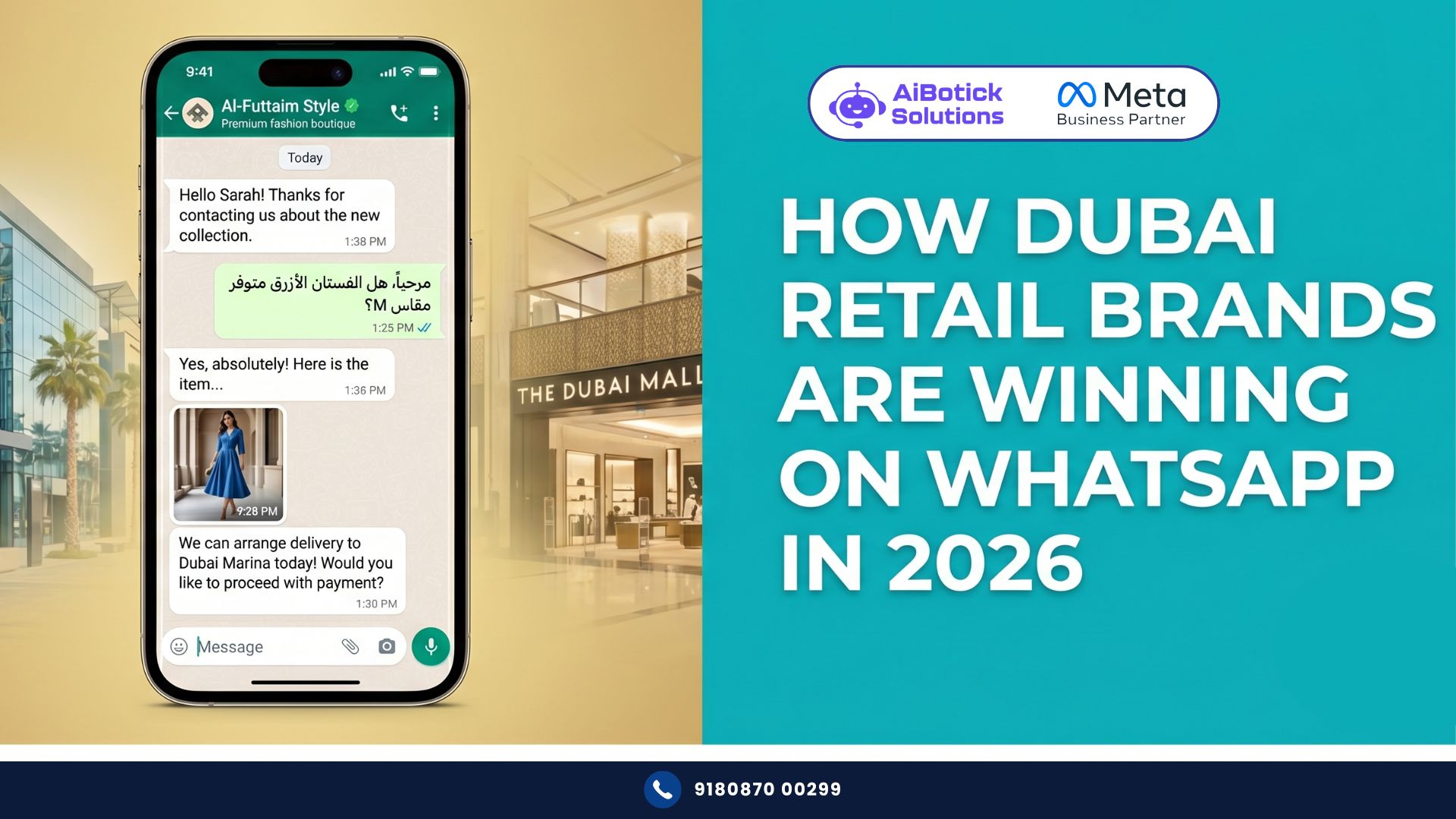
Walk into any mid-to-premium retail store in Dubai — JBR, Dubai Mall, Mall of the Emirates, City Walk — and your customers in a single hour might include a British expat, an Indian professional, an Emirati family, a Russian tourist, a Filipino domestic worker buying a gift, and a Saudi visitor on a weekend trip.
Different languages. Different price sensitivities. Different communication preferences. Different purchase triggers.
The competition is brutal and rent is savage.
Dubai Mall retail space costs upwards of AED 3,000 per square foot annually in premium zones. Every square foot has to earn its keep. Customer acquisition cost is high. Which makes customer retention not just important — it’s existential.
WhatsApp penetration is effectively total.
90%+ of UAE smartphone users are on WhatsApp daily. This isn’t a channel you’re introducing to customers. It’s where they already live. You’re just showing up there properly.
This is the environment where WhatsApp Dubai retail automation isn’t a nice experiment. It’s a revenue lever.
What Dubai Retail Brands Are Actually Doing on WhatsApp — Specific Flows, Real Results
Let me get into what’s actually working. Not theory. Not “best practices.” What I’ve seen deployed and what the numbers looked like.
The VIP Early Access Flow — For Fashion and Lifestyle Brands
Here’s a flow that a women’s fashion boutique in City Walk implemented. Two outlets. Mixed international clientele. Average transaction value AED 380.
The setup: Every customer who made a purchase was added to a WhatsApp list — with their language preference tagged (English, Arabic, or Hindi/Urdu). When a new collection dropped, VIP customers got a WhatsApp message 48 hours before the general public. The message included:
- A short video of 3-5 hero pieces from the new collection
- “Reply with the number of the piece you want held for you”
- A 48-hour hold window before pieces went to general floor stock
The result in 60 days:
- 34% of VIP list responded to early access messages
- Average response-to-purchase conversion: 61%
- New collection sell-through in first 72 hours jumped from 18% to 43%
- Zero additional ad spend on these sales
Actually wait — the number that floored me was the average transaction value on WhatsApp early access purchases. AED 520. Compared to AED 380 in-store average. The exclusivity framing made people buy more. Every time.
This is WhatsApp Dubai retail done with actual intelligence.
The Post-Purchase Sequence — For Electronics and Appliances
A mid-size electronics retailer with 3 outlets — Dubai Silicon Oasis, Deira, and Al Barsha — was haemorrhaging repeat customers. People bought a laptop or phone, had questions about setup in the first week, couldn’t reach anyone, felt abandoned, and never came back.
The automation they built:
Day 0 (purchase): “Your [product name] is ready. Here are 3 things to set up in the first 10 minutes — [link to setup guide]”
Day 3: “How’s your [product name] working? Any questions? Reply here — our team responds within 2 hours.”
Day 14: “Quick tip for your [product name] — [specific useful tip relevant to product category]”
Day 30: “Your 1-month check-in. Accessories that work great with your [product name] — [catalog link]”
Day 60: “Extended warranty reminder — protect your investment. Reply YES to get details.”
Results over 90 days:
- Customer support query resolution rate: up from 34% (call centre) to 78% (WhatsApp)
- Accessories upsell conversion from Day 30 message: 19%
- Repeat purchase rate within 6 months: up from 11% to 29%
- Net Promoter Score: jumped from 31 to 58
Bhai, they didn’t change their products. They didn’t change their pricing. They changed how they communicated after the sale. That’s it.
The Abandoned Browse Recovery — For Online-to-Offline Retail
This one is underused and under-discussed for Dubai retail specifically.
Many Dubai retail brands now have WhatsApp opt-ins on their website — customers who browse online but buy in-store. If someone spends 4 minutes on the product page for a specific sofa and then disappears — that’s a signal.
A furniture and home décor brand in Business Bay set up a WhatsApp trigger: if a customer who’d previously opted in browsed a specific product category for 3+ minutes without adding to cart, they received a WhatsApp message within 2 hours.
Not a pushy sales message. Something like: “We noticed you were looking at our Scandinavian living room collection — our interior consultant is available for a quick 10-minute WhatsApp call if you’d like help shortlisting pieces for your space.”
Results:
- 41% of triggered messages received a response
- 23% of those led to a scheduled consultation
- 68% of consultations converted to purchase
- Average purchase value from WhatsApp-assisted sales: AED 4,200 vs AED 2,800 in-store browse average
The consultation framing changed the entire dynamic. Not “buy this.” But “let us help you decide.” WhatsApp Dubai retail done with genuine customer focus.
Broadcast Campaigns — The Right Way and The Wrong Way
Seedha bolta hoon — most Dubai retail brands doing WhatsApp broadcasts are doing it wrong. And it’s hurting them more than they realise.
The wrong way (very common):
- Blast the entire contact list with every promotion
- Same message in English to everyone regardless of language preference
- No segmentation — AED 500 handbag promotion sent to customers who only buy AED 50 accessories
- Frequency: every week or more
- Result: High opt-out rate, number getting flagged for spam, WhatsApp quality rating dropping
The right way (what actually works):
A luxury watch retailer in Dubai Mall — 2 outlets, average transaction AED 8,000+ — runs WhatsApp broadcasts with these rules:
- Maximum 2 broadcasts per month per customer
- Segmented by purchase history: entry-level buyers get different messages than premium buyers
- Language-matched: Arabic customers get Arabic messages, English customers get English
- Occasion-aware: Eid, Diwali, Christmas, New Year get specific campaigns for relevant customer segments
- Exclusivity framing always: “This is for our existing clients only — not a public promotion”
Their last Eid broadcast to 1,200 Arabic-speaking clients: 67% open rate, 31% click-through, 14 purchases averaging AED 12,400 each. One broadcast. AED 1,73,600 in revenue. From 1,200 messages.
Could be wrong, but I’ve never seen email deliver numbers anywhere close to that. 😅
The Multi-Language Reality — This Is Where Most Get It Wrong
No no, scratch that — this isn’t “getting it wrong.” This is where most Dubai retail brands don’t even try.
Your customers speak different languages. Your WhatsApp automation needs to reflect that. Not optionally. Not eventually. From day one.
Here’s a practical framework:
At opt-in — capture language preference. “Please select your preferred language for WhatsApp updates: 1 – English | 2 – Arabic | 3 – Hindi/Urdu”
This single step changes everything that follows. Every broadcast, every sequence, every template — now delivered in the language they actually read and respond to.
Arabic is not just translated English. Arabic customers in UAE respond to different emotional triggers, different formality levels, different visual cues. A direct translation of your English WhatsApp message into Arabic is better than nothing — but it’s not good. Get proper Arabic copywriting done. It’s not expensive. And the uplift in response rate is substantial.
Hindi/Urdu is a competitive advantage most brands ignore. 2.8 million Indians in UAE. A significant portion of them are retail customers. A WhatsApp message in Hindi from a Dubai retail brand feels genuinely personal — because nobody else is doing it. It stands out. It converts.
I’ve seen a single Hindi-language Diwali broadcast from a Dubai electronics retailer generate 3x the response rate of their equivalent English broadcast to Indian customers.
Ab toh it’s not complicated. It’s just attention to detail.
What People Get Wrong About WhatsApp Dubai Retail
Wrong belief 1: “WhatsApp is for customer service — not sales.”
This was possibly true in 2020. In 2026, some of the highest-converting sales touchpoints for Dubai retail brands are WhatsApp messages. The channel has purchase intent. Customers who opt into WhatsApp from a retail brand are already warm. Stop treating the channel like a complaint inbox.
Wrong belief 2: “We need a huge contact list before it’s worth it.”
A Dubai boutique with 400 WhatsApp contacts running well-segmented, well-timed campaigns will outperform a competitor with 4,000 contacts running sloppy broadcasts. List quality and message relevance matter infinitely more than list size.
Wrong belief 3: “WhatsApp automation kills the personal touch.”
Only if you build it badly. The best WhatsApp Dubai retail implementations feel MORE personal than what they replaced — which was usually a forgotten email or no follow-up at all. Automation that delivers relevant, timely, language-appropriate messages at scale is more personal than generic mass communication. Full stop.
Wrong belief 4: “Our customers are too premium for WhatsApp.”
Bhai. The Burj Al Arab uses WhatsApp for guest communication. Luxury real estate brokers in Palm Jumeirah close deals on WhatsApp. Premium customers in UAE aren’t too premium for WhatsApp — they’re on it more than anyone else. They just have higher standards for how you show up on it.
For a full breakdown of how broadcast campaigns work and what separates effective ones from spam, our WhatsApp broadcasting guide covers the mechanics in detail.
The Compliance Layer — Don’t Skip This
UAE’s Personal Data Protection Law isn’t something to figure out later.
For WhatsApp Dubai retail specifically:
- Explicit opt-in is mandatory. Customers must actively choose to receive WhatsApp communications. Adding people without consent isn’t just bad practice — it’s legally problematic.
- Opt-out must be instant and honoured. If a customer replies STOP — they’re off the list immediately. No exceptions. No “we’ll process in 3-5 business days.”
- Data storage location matters. UAE regulations have specific provisions around where customer data is stored. Verify with your provider.
- Marketing vs utility distinction matters. WhatsApp’s own policies (and Meta’s billing) distinguish between marketing messages and transactional ones. Misclassifying them creates both compliance and cost problems.
This isn’t meant to scare you. It’s meant to make sure you build correctly from the start. The brands getting this right have a structural advantage — because when regulators get stricter (and they will), they’re already compliant.
Building Your WhatsApp Dubai Retail Stack — Where to Start
Dekho, I’ll give you the honest sequence. Not the ideal scenario. The realistic starting point for a Dubai retail brand doing this for the first time.
Month 1 — Foundation:
- Get WhatsApp Business API properly set up (not the app — the API)
- Build your opt-in flow at every customer touchpoint: billing counter, website, Instagram bio, receipts
- Collect language preference at opt-in
- Set up one post-purchase sequence for your highest-selling category
Month 2 — Expand:
- Add your first broadcast campaign — segmented, language-matched, low frequency
- Build a simple restock alert flow for your top 10 SKUs
- Set up human handoff for complex queries your bot can’t handle
Month 3 — Optimise:
- Review open rates, response rates, opt-out rates by segment
- Kill what’s not working. Double down on what is.
- Add Arabic-specific flows if not already live
- Start tracking WhatsApp-assisted revenue as a separate metric
Month 4 onwards — Scale:
- VIP tier segmentation and exclusive access flows
- Cross-sell sequences based on purchase history
- Integration with your POS or CRM for richer personalisation
Most brands that follow this sequence see meaningful WhatsApp-attributed revenue by month 2. Not month 6. Month 2.
If you want to understand how to measure returns properly at each stage, our WhatsApp automation ROI guide gives you the exact metrics framework to track.
The Brands That Win — What They Have in Common
I’ve worked across enough retail implementations to see the pattern clearly.
The Dubai retail brands that extract serious revenue from WhatsApp share three things:
One — They treat WhatsApp like a VIP channel, not a broadcast pipe. Every message has to earn the right to be in someone’s WhatsApp. They’re careful about frequency. They’re obsessive about relevance. They’d rather send 2 highly relevant messages a month than 8 generic ones.
Two — They close the loop between in-store and digital. WhatsApp doesn’t live in isolation. The best implementations connect purchase data, browsing behaviour, in-store interactions, and WhatsApp conversations into one coherent customer picture. It’s not harder to do this. It just requires intentional setup.
Three — They have human backup that actually works. Automation handles the 80% that’s repetitive. Humans handle the 20% that matters most — the high-value queries, the complaints, the complex requests. And the handoff between bot and human is seamless enough that the customer barely notices the transition.
That’s the model. Not complicated. Just consistent.
Let’s Talk About Your Retail Setup
WhatsApp Dubai retail done right is one of the highest-ROI decisions a brand can make in this market in 2026. The channel is there. The customers are there. The technology exists. The question is just whether you build it properly or improvise and wonder why it didn’t work.
At AiBotick, we’ve helped retail brands across India and the Gulf set up WhatsApp automation that actually drives revenue — not just automation that looks good in a demo. You get personalised onboarding, live training with your actual team, and a dedicated support group that stays with you beyond go-live. Every plan. No exceptions. Because we’ve seen what half-supported implementations look like and we refuse to deliver that. 💯
Chat with us on WhatsApp — describe your retail setup and what you’re trying to solve. We’ll tell you exactly what’s possible and what the realistic timeline looks like.
— Mohit Shah | 15+ years in IT industry | 4+ years in WhatsApp automation | Worked with various MNC brands | Now helping businesses figure out what actually works
Q1: How are Dubai retail brands using WhatsApp to increase repeat purchases?
A1: Dubai retail brands are using WhatsApp for post-purchase sequences, VIP early access campaigns, restock alerts, and personalised broadcast campaigns segmented by language and purchase history. The most effective implementations combine automated follow-up sequences with human agents for high-value queries — creating a customer experience that feels personal at scale. Brands doing this consistently report repeat purchase rate increases of 50-150% within 90 days.
Q2: Is WhatsApp marketing legal for retail brands in UAE?
A2: Yes — with proper opt-in and compliance. UAE’s Personal Data Protection Law requires explicit customer consent before sending WhatsApp marketing messages. Customers must be able to opt out instantly and permanently. Marketing messages sent through the WhatsApp Business API must use pre-approved templates. Retail brands that build their WhatsApp lists with proper opt-in flows and respect opt-out requests are fully compliant and protected.
Q3: How should Dubai retail brands handle multi-language WhatsApp communication?
A3: Capture language preference at the point of opt-in — asking customers to select English, Arabic, or Hindi/Urdu before they enter any automated flow. All subsequent broadcasts and sequences are then delivered in the customer’s chosen language. Arabic messages require proper right-to-left copywriting by a native speaker, not just translated English. Hindi and Urdu messaging is a significant competitive advantage for brands serving the large Indian expat community in UAE, as very few retailers currently offer it.